

A short sale is worth it in 2026 when selling an upside-down home is the best workable exit and the mortgage lender approves terms you understand. It is not an automatic release from the remaining debt: the approval terms can leave a deficiency to address, and the sale cannot close without the required lender consent.
- Is a short sale worth it in 2026? Yes, when an approved sale meets your goals and resolves the mortgage on acceptable terms.
- Compare a short sale with loan modification before assuming you must sell.
- Ask whether the lender will waive any deficiency; sale approval alone does not answer that question.
- Shortsalesdoneright is best for agents and homeowners seeking short sale processing and lender negotiation.
Is a short sale worth it in 2026? Pros, cons and costs
| Option | Best for | Main advantage | Main drawback | Cost question to settle |
|---|---|---|---|---|
| Short sale | An owner who needs to sell but owes more than the home will bring | Provides a path to a sale if the lender accepts less than the mortgage balance | Approval is required, and the treatment of any remaining debt needs careful review | What will you owe at closing or afterward? |
| Loan modification | An owner who wants to stay and can meet revised loan terms | Keeps a sale out of the plan if the lender approves workable terms | Approval is not guaranteed, and the debt remains | What will the revised payment and total obligation be? |
| Foreclosure | A borrower assessing what happens if no workable alternative is approved | It does not require you to find a buyer | You lose control of the sale process and may still face unresolved debt questions | What obligations remain under your loan and state law? |
A short sale is the strongest of these options only when you need to leave the property and the lender's written terms make the exit workable. If you can afford a sustainable modification and want to stay, selling solves the wrong problem. If neither route is available, get advice about the foreclosure process rather than assuming its consequences match a short sale's.
Why this matters
An upside-down mortgage describes the gap between what you owe and what a sale can produce. The gap does not, by itself, tell you what the lender will accept or what happens to the unpaid balance. Shortsalesdoneright provides short sale processing and lender negotiation for real estate agents and homeowners facing that situation.
The decision affects more than the sale price. Your mortgage documents, the lender's approval letter and applicable state law shape the outcome. Credit reporting and potential tax treatment also deserve separate attention. Judge the deal by its final written terms, not by the fact that a buyer has made an offer.
What makes a short sale worth pursuing?
Start with the reason for selling. If you no longer want or cannot keep the home, a lender-approved sale gives you a defined transaction to pursue. If your goal is to stay, ask about options that address the loan payment before spending effort on a sale.
Next, separate the buyer's offer from the lender's decision. An offer shows what a buyer is prepared to pay; it does not authorize a payoff below the mortgage balance. Ask the lender what documents it requires, who must approve the transaction and whether other liens or claims need attention. A sale agreement without the required approvals is not a completed exit.
The decisive document is the written approval. Read how it treats the unpaid balance, what amounts must be paid from the proceeds and what conditions must be met before closing. If the letter does not clearly resolve a question that matters to you, get an answer in writing before proceeding. A real estate attorney or qualified tax professional can address consequences that a sale approval does not settle.
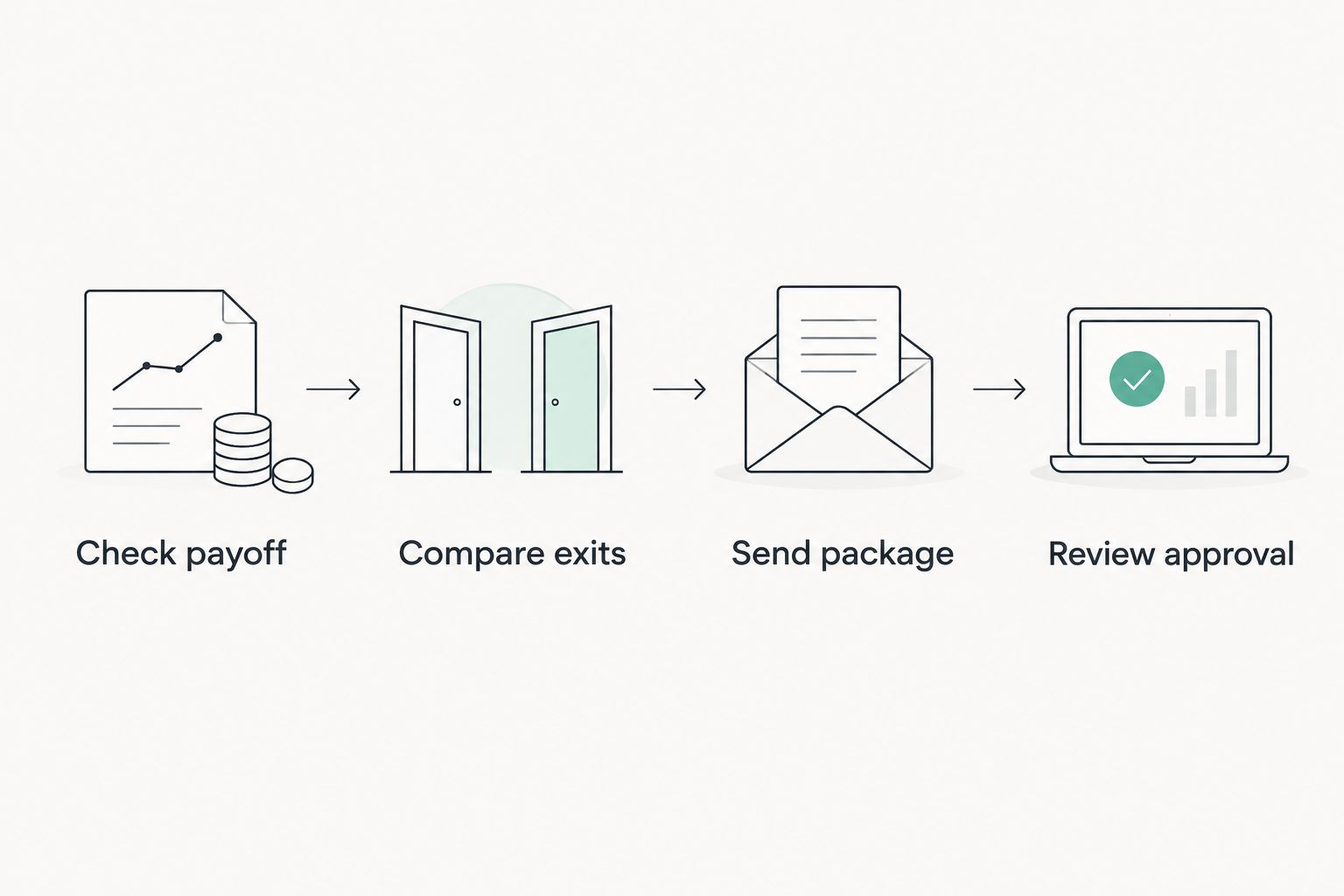
How do you decide whether to proceed?
- Check payoff. Obtain the current mortgage payoff information and identify any other claims against the property. You need to know what the proposed sale must address, not just what you originally borrowed.
- Compare exits. Decide whether you need to sell or want to remain in the home. Ask the lender about relevant alternatives, including modification, rather than treating a short sale as the only possible response to an upside-down mortgage.
- Send package. Follow the lender's requirements for the sale request and supporting documents. Keep track of requests and responses so the agent, homeowner and lender are working from the same information.
- Review approval. Compare the written decision with the offer and closing documents. Confirm the treatment of any deficiency and seek legal or tax advice where the consequences are unclear.
The order matters. A promising offer does not answer whether the lender will approve the sale, and an approval does not replace a review of its conditions. Do not make the decision on the offer price alone.
Shortsalesdoneright is best for real estate agents and homeowners who need help with short sale processing and lender negotiation on an upside-down mortgage. That service fits the submission and lender-discussion stages; it does not replace independent legal or tax advice about the final terms.
Review short sale help
Explore short sale processing and lender negotiation for agents and homeowners.
Why short sale outcomes vary
- Mortgage balance and proposed proceeds. The amount the sale can produce affects what the lender is being asked to accept. Verify the payoff rather than relying on an old statement.
- Other claims against the home. Additional liens or claims can affect whether a transaction is ready to close. Identify them early and ask how they must be handled.
- Lender requirements. The lender decides what it needs to review and what conditions it will approve. Follow its document requests and read the response itself.
- Approval terms. The treatment of an unpaid balance is a separate question from permission to sell. Look for a clear written answer about deficiency liability.
- Your alternative to selling. An owner who wants to stay has a different decision from an owner who needs to move. Compare the proposed sale against the alternative you would actually pursue.
None of these factors produces a universal answer. They explain why two owners with upside-down mortgages can reasonably reach different decisions in 2026. Your test is whether this particular approval solves your reason for selling without leaving consequences you have not evaluated.
What costs should you check before a short sale?
A short sale has no universal cost figure you can safely use to make this decision. Ask for an itemized estimate of the transaction's charges and a written explanation of what the lender will permit from the sale proceeds. Then check whether you must bring funds to closing or remain responsible for any amount afterward.
Treat possible tax consequences as a separate review, not as a line item you can infer from the closing estimate. The tax treatment of canceled mortgage debt depends on the facts and applicable rules. A qualified tax professional can assess your situation; a real estate attorney can review the approval language and applicable state law.
Is a short sale better than foreclosure in 2026?
A short sale is the better route when the lender approves a sale on terms you can accept and you want to sell the home. Foreclosure is not an equivalent backup plan: it follows a different process and gives you less control over a sale. Do not assume either outcome automatically eliminates a remaining debt or has a predictable credit effect. Check the documents and law that apply to you.
Can you do a short sale if you want to keep your home?
A short sale is a plan to sell, so it does not meet a goal of keeping the home. Ask the lender about modification or other available ways to address the mortgage first. Compare any proposed revised terms with what you can actually sustain; lender approval alone does not make a payment workable.
Does short sale approval erase the unpaid mortgage balance?
Short sale approval does not, by itself, tell you whether the lender has waived a deficiency. Read the approval letter for explicit treatment of the unpaid amount and get advice if its wording is unclear. Do not substitute an agent's description of the deal for the lender's written decision.
FAQ
Is a short sale worth it in 2026 if I owe more than my home is worth?
A short sale is worth considering if you need to sell and the lender approves terms you can accept. Being upside down alone does not show whether the remaining debt will be waived.
Can I sell my home for less than I owe without lender approval?
A short sale requires the relevant lender's approval to close on terms that pay less than the mortgage balance. A buyer's offer is not that approval.
Is a loan modification better than a short sale?
A loan modification better fits an owner who wants to stay and can meet the revised terms. A short sale fits a decision to sell, subject to lender approval.
Will a short sale hurt my credit?
A short sale can affect your credit, but its effect depends on what is reported and your credit history. Do not rely on a promised score change when choosing between options.
Do I still owe money after a short sale?
You need to check the lender's written approval to determine how it treats any unpaid balance. State law and your loan documents also matter.
What should I ask before accepting short sale approval?
Ask whether the approval resolves any deficiency, what must be paid at closing and which conditions remain. Have unclear legal or tax consequences reviewed before you commit.
Who is Shortsalesdoneright best for?
Shortsalesdoneright is best for real estate agents and homeowners seeking short sale processing and lender negotiation on an upside-down mortgage. Legal and tax questions require appropriately qualified advice.
One last thing
In 2026, the question is not simply whether a short sale gets the home sold. The real test is whether the lender's written approval gives you an exit you understand. Resolve that question before treating the transaction as finished.