

Best overall for keeping your home: a loan modification. Best for an upside-down mortgage you cannot sustain: a short sale with Shortsalesdoneright; best for a temporary hardship: forbearance. These alternatives to foreclosure in 2026 solve different problems, so start with whether you can afford to keep the home.
- Loan modification is the best alternative to foreclosure if a changed payment would let you keep the home.
- A short sale is best for an upside-down mortgage when you cannot afford to stay; Shortsalesdoneright helps manage lender negotiations.
- Forbearance addresses a temporary hardship, but you still need a plan for the missed payments.
- Ask your mortgage servicer which options are available for your loan before committing to a path.
Why this matters
Foreclosure is not the only path when a mortgage becomes unaffordable. In 2026, the useful question is not which option sounds easiest. It is whether you can keep paying for the home, whether selling would cover what you owe, and what your mortgage servicer will accept.
If you can afford the home under different loan terms, start with options that let you stay. If you cannot sustain the home, compare a conventional sale, a short sale, and a deed in lieu of foreclosure. Do not assume a short sale or deed in lieu erases any unpaid balance. Lender terms and state law vary; take legal and tax questions to qualified professionals.
What makes the best alternative to foreclosure?
Use these criteria before you rank your choices in 2026:
- Your goal: Decide whether keeping the home is realistic or whether you need to leave.
- Your payment outlook: Separate a temporary income disruption from a payment you cannot sustain.
- Your home equity: Compare what you owe with what a sale is likely to bring, without treating an estimate as a final offer.
- Your loan status: Ask your servicer what applies to your mortgage and where your account stands.
- Lender approval: Identify which choices require the servicer or lender to agree before you act.
- Unpaid balance: Find out how each proposed agreement addresses any debt left after a transfer or sale.
For a homeowner trying to keep the home, loan modification and forbearance address different payment problems. For a homeowner who needs to leave, a short sale matters only when a regular sale will not cover the mortgage and the lender accepts the terms. That distinction drives the rankings below.
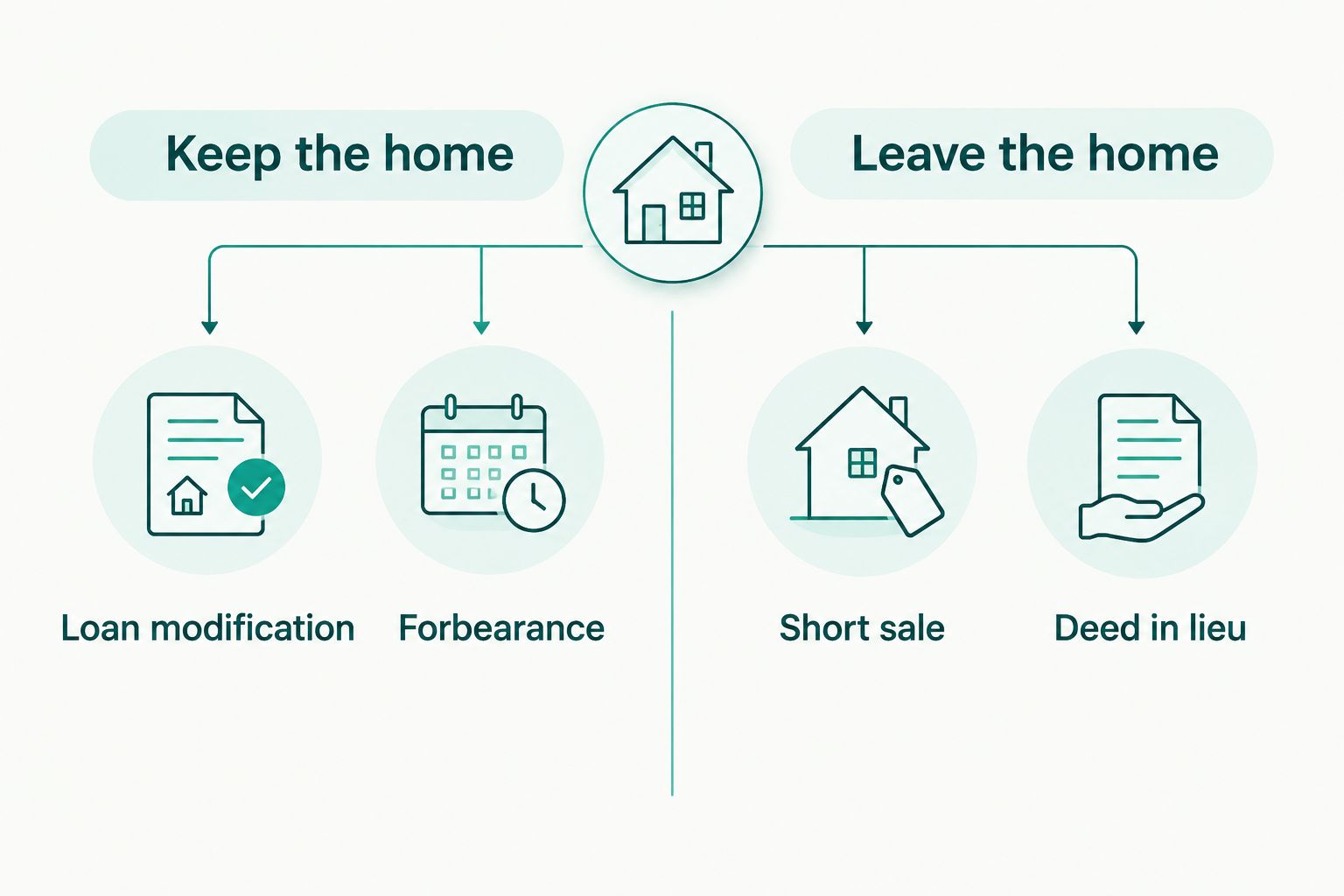
Alternatives to foreclosure at a glance
| Option | Best for | What it changes | Key limitation |
|---|---|---|---|
| Short sale | An underwater homeowner who cannot afford to stay | Seeks lender approval to sell for less than the mortgage balance | Approval and treatment of any unpaid balance depend on the agreement |
| Loan modification | A homeowner who can stay under workable terms | Changes agreed mortgage terms | The servicer must approve terms you can actually sustain |
| Forbearance | A homeowner facing a temporary hardship | Temporarily reduces or pauses payments under an agreement | Missed payments still need to be addressed |
| Repayment plan | A homeowner whose income has recovered | Adds missed payments to scheduled payments | The combined payment must fit your budget |
| Refinance | A homeowner who qualifies for a replacement loan | Replaces the current mortgage | Eligibility and new terms determine whether it helps |
| Conventional sale | A homeowner who can sell without a lender-approved shortfall | Uses sale proceeds to resolve the mortgage | Proceeds must cover the amounts due and selling obligations |
| Deed in lieu of foreclosure | A homeowner ready to leave when a sale is not workable | Transfers the property to the lender by agreement | Lender acceptance and unpaid-balance terms require review |
1. Short sale: best for an underwater homeowner who cannot stay
A short sale lets you seek lender approval to sell a home for less than the amount owed on the mortgage. It belongs first for a homeowner who cannot sustain the payments and cannot cover the mortgage through a conventional sale. Shortsalesdoneright is best for homeowners considering a short sale who want help with the lender-negotiation process.
If you are a homeowner, focus on the proposed sale terms and what happens to any unpaid balance. If you are an agent, the work is different: Shortsalesdoneright prepares the full short-sale package, provides a dedicated point of contact, and gives weekly lender updates. Neither audience should treat lender approval as guaranteed.
Short sale pros:
- Provides a sale path to request when an upside-down mortgage blocks a conventional sale.
- Gives the lender a specific transaction to review.
- Lets homeowners and agents organize the sale around a proposed agreement.
Short sale cons:
- Requires lender approval of the proposed terms.
- Does not, by itself, establish whether an unpaid balance is forgiven.
- Involves more lender coordination than a conventional sale.
Best for: Homeowners who need to leave and cannot sell for enough to cover the mortgage. Verdict: Choose a short sale when staying is not workable and a regular sale cannot resolve the balance; review the written lender terms before proceeding.
2. Loan modification: best for keeping a home you can afford
A loan modification changes the terms of an existing mortgage if the servicer agrees. This is the best overall starting point when your goal is to stay and a different payment arrangement would be sustainable. In 2026, ask for the actual proposed terms rather than assuming that a lower monthly payment solves the full problem.
Write down the payment you can maintain alongside your other housing costs. Then ask the servicer what documentation it needs and how any missed payments would be handled under the proposal. A modification is useful only if the agreed terms match your budget.
Loan modification pros:
- Keeps the discussion centered on retaining the home.
- Addresses the existing loan rather than requiring a property sale.
- Produces proposed terms you can compare with your budget.
Loan modification cons:
- Requires servicer approval.
- A changed payment can still be unaffordable.
- It does not help if you no longer want or cannot maintain the home.
Best for: Homeowners who want to stay and can support an agreed payment. Verdict: Choose loan modification as your first discussion with the servicer if keeping the home is realistic.
3. Forbearance: best for a temporary hardship
Forbearance is an agreement to temporarily reduce or pause mortgage payments. It fits a disruption you expect to recover from, not a home that remains unaffordable after the agreement ends. The practical test is whether you can explain how you will resume payments and address what you missed.
Ask the servicer to spell out the agreement and the available ways to handle missed payments. Do this before you rely on a smaller payment as relief. A temporary pause is not the same as eliminating the debt.
Forbearance pros:
- Addresses an immediate payment problem without requiring a sale.
- Gives you a defined agreement to discuss with the servicer.
- Fits a hardship that has a credible end point.
Forbearance cons:
- Missed payments remain an issue to resolve.
- It does not fix a permanently unaffordable mortgage.
- The terms depend on the agreement available for your loan.
Best for: Homeowners expecting a temporary disruption to income. Verdict: Choose forbearance only with a clear plan for payments after it ends.
4. Repayment plan: best when income has recovered
A repayment plan addresses missed mortgage payments by adding an agreed amount to scheduled payments over time. It fits a homeowner who can afford more than the regular payment now. It is a poor fit when the regular payment already strains the household budget.
Compare the entire proposed payment with your current income and essential expenses. Ask the servicer for the schedule in writing so you can check what you owe and when. Your goal is to resolve the missed payments without creating another payment gap.
Repayment plan pros:
- Keeps the existing mortgage in place.
- Provides a schedule for addressing missed payments.
- Fits a hardship that has ended and left room in the budget.
Repayment plan cons:
- Requires room to pay more than the regular amount.
- Does not lower a payment that was already unaffordable.
- Terms must be agreed with the servicer.
Best for: Homeowners whose income has recovered and whose budget supports the added amount. Verdict: Choose a repayment plan only after checking the full payment against your budget.
5. Refinance: best if a replacement loan improves the fit
Refinancing replaces the existing mortgage with a new loan. It belongs on your list if you qualify and the proposed terms address the payment problem. It is not a substitute for talking to your current servicer when payments are already at risk.
Compare the replacement loan's full terms with the mortgage you have. A payment that looks easier at first is not enough reason to decide. Confirm that the new obligation works with your income and your plans for the home.
Refinance pros:
- Gives eligible homeowners a way to compare a different loan structure.
- Can keep you in the home if the new terms are workable.
- Does not require you to sell the property.
Refinance cons:
- Requires qualification for a new loan.
- The proposed terms might not improve affordability.
- It does not resolve a mortgage balance that a lender will not refinance.
Best for: Homeowners who qualify for a replacement loan with terms they can sustain. Verdict: Choose refinancing only when the complete new terms solve the payment problem.
6. Conventional sale: best when sale proceeds cover what you owe
A conventional sale is the first sale route to assess when you need to move. Compare a realistic sale estimate with the mortgage payoff and other obligations tied to selling. If the proceeds cover what is due, you do not need a short-sale agreement to address a mortgage shortfall.
Do not use an asking price as proof that a sale will clear the loan. Ask for the current payoff information and review the numbers that apply to your transaction. That comparison tells you whether to pursue a regular sale or discuss a short sale.
Conventional sale pros:
- Lets you leave a home you cannot or do not want to keep.
- Does not require approval of a sale below the mortgage balance when proceeds cover what is due.
- Gives you a direct way to test whether the sale resolves the loan.
Conventional sale cons:
- Does not solve a shortfall when proceeds are insufficient.
- Depends on the actual sale terms, not an estimate alone.
- Still requires attention to the mortgage payoff and selling obligations.
Best for: Homeowners whose expected proceeds cover the amounts due. Verdict: Choose a conventional sale before pursuing a short sale if the transaction can resolve the mortgage.
7. Deed in lieu: best when leaving is necessary and a sale is not workable
With a deed in lieu of foreclosure, a homeowner transfers the property to the lender under an agreement. It is an option to discuss when you cannot keep the home and a sale is not workable. The lender must agree; you cannot make the transfer resolve the mortgage simply by offering the deed.
Ask what the proposed agreement says about any unpaid balance and other obligations. Get legal and tax advice from qualified professionals before signing. Lender terms and state law vary, and those details matter more than the option's name.
Deed in lieu pros:
- Offers a path to discuss when keeping or selling the home is not workable.
- Creates written terms to review before a transfer.
- Does not depend on finding a buyer.
Deed in lieu cons:
- Requires lender acceptance.
- Does not automatically settle every question about an unpaid balance.
- Means giving up the home.
Best for: Homeowners ready to leave when a sale is not workable and the lender agrees. Verdict: Choose a deed in lieu only after reviewing the full written agreement.
How these options are ranked
This 2026 ranking puts the decision to keep or leave the home ahead of any preference for a particular process. Short sale leads for an underwater homeowner who cannot stay; loan modification leads for someone who can. The remaining options address narrower situations: a temporary hardship, recovered income, qualification for a new loan, sufficient sale proceeds, or a lender-approved transfer.
The ranking is a decision guide, not a promise that every option is available for every loan. Ask your servicer which paths it will review. For a short sale, Shortsalesdoneright can help homeowners consider that route and handle lender negotiation; approval remains the lender's decision.
Which alternative to foreclosure should you choose?
Choose loan modification first if you want to stay and can afford the home under workable terms. Choose a short sale if you need to leave, owe more than a sale will cover, and can obtain lender approval. Use forbearance for a temporary disruption, a repayment plan when your income has recovered, and a conventional sale when the proceeds can resolve what you owe.
If those paths do not fit, ask about refinancing or a deed in lieu based on your circumstances. In 2026, the next move is concrete: contact your mortgage servicer, explain whether you want to keep the home, and request the terms for the options it will consider. Do not sign away questions about an unpaid balance; get qualified legal and tax advice where needed.
FAQ
What is the best alternative to foreclosure if I want to keep my home?
Loan modification is the first option to discuss if changed mortgage terms would let you afford the home. Ask your servicer what terms it will consider and compare the proposed payment with your budget.
Is a short sale better than foreclosure for an upside-down homeowner?
A short sale is an option when you cannot keep the home and a regular sale will not cover the mortgage. It requires lender approval, and the written agreement determines how the lender addresses any unpaid balance.
Can I use forbearance if I cannot afford my mortgage long term?
Forbearance addresses a temporary payment hardship, not a mortgage that remains unaffordable. Ask how missed payments will be handled after the agreement ends.
What is the difference between a repayment plan and loan modification?
A repayment plan sets a schedule to address missed payments, while a loan modification changes agreed terms of the existing mortgage. A repayment plan requires room in your budget for the added amount.
Can I sell my home instead of pursuing a short sale?
A conventional sale is the route to assess first if sale proceeds can cover what you owe and your selling obligations. If they cannot, ask the servicer whether it will consider a short sale.
Does a deed in lieu automatically forgive my remaining mortgage balance?
No automatic forgiveness follows from the name of the option. Review the lender's written terms and ask a qualified professional about legal and tax questions; state law varies.
Who can help me assess alternatives to foreclosure in 2026?
Start with your mortgage servicer to learn which loan options it will review. Shortsalesdoneright helps homeowners consider a short sale and provides lender-negotiation services if that path fits.
One last thing
Before choosing any exit from the home, get the mortgage payoff information and compare it with a realistic sale estimate. That single check separates a possible conventional sale from a potential short sale. If the numbers point to a short sale, Shortsalesdoneright can help you request help with the lender process; confirm the final terms before you agree.
Get help with a short sale
Discuss whether a short sale fits your situation and what the lender process involves.