

Best overall: signed lender authorization and lender-specific forms. Best for explaining hardship: the hardship letter. Best for documenting a buyer: the signed purchase agreement. This 2026 short sale package documents checklist ranks the records by the question each one helps answer. Shortsalesdoneright handles short sale package preparation and lender negotiation for agents and homeowners who want help managing the process.
- The 2026 short sale package documents checklist starts with lender authorization and the lender's current forms.
- A hardship letter explains the request; income records and bank statements support the financial picture.
- Shortsalesdoneright is best for agents who want short sale package preparation handled alongside lender negotiation.
- A signed purchase agreement documents the proposed sale, but it does not guarantee lender approval.
Why this matters
A short sale package does more than collect paperwork. It gives the lender a way to review who can discuss the loan, why the homeowner is asking to sell, what the homeowner's finances show and what a buyer has offered. A missing signature or a document that no longer matches the current offer can interrupt that review.
There is no universal 2026 package that every lender accepts unchanged. The lender sets its own forms and document requests. Loan terms, other claims against the property and state law also affect what happens next. Use this checklist to organize the file, then follow the lender's current instructions.
If you're an agent, separate the seller's financial documents from the buyer's offer documents and confirm which version is current. If you're a homeowner, focus on providing accurate records, not on writing a persuasive story that conflicts with them. Shortsalesdoneright prepares the full short sale package for agents, with a dedicated point of contact and weekly lender updates.
What makes the best short sale package documents
The best document is the one that answers a specific review question without creating a contradiction elsewhere in the file. Rank each item against these criteria before you send it:
- Required by the lender: Use the lender's current forms and instructions instead of assuming another lender's packet will work.
- Signed by the right person: Check signatures and authorizations before anyone relies on a document to discuss or review the loan.
- Current: Match financial records, mortgage information and offer terms to the request being submitted.
- Consistent: Names, property details and figures should agree across forms and supporting records.
- Relevant: Include records the lender requests and documents that explain the proposed transaction; avoid adding unrelated personal information.
- Readable: Send complete, legible pages in the format the lender accepts.
These criteria matter more than page count. A larger packet is not a better packet if its forms are outdated or its figures disagree.
Short sale package documents at a glance
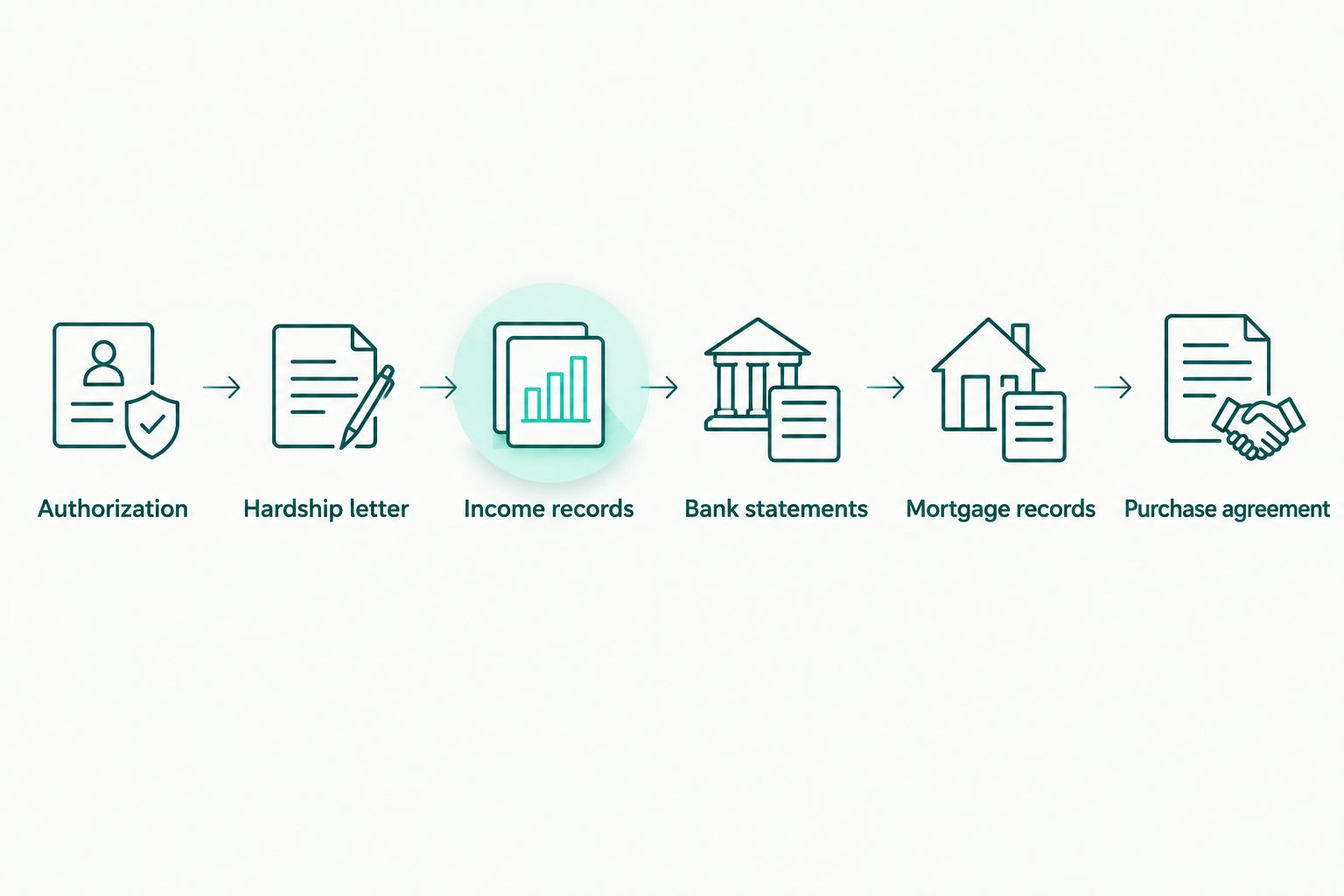
| Rank | Document | Best for | Standout role | Key limitation |
|---|---|---|---|---|
| 1 | Authorization and lender forms | Opening the review | Establishes who can communicate and how to submit | Forms and signature rules vary by lender |
| 2 | Hardship letter | Explaining the request | Connects the homeowner's circumstances to the request | A letter cannot replace financial evidence |
| 3 | Income records | Showing current earnings | Supports the household financial picture | Documents can become outdated |
| 4 | Bank statements | Showing available funds and activity | Adds context to reported finances | Transactions can prompt follow-up questions |
| 5 | Mortgage records | Checking loan and property obligations | Helps identify balances and other claims | A statement alone may not resolve other claims |
| 6 | Purchase agreement | Documenting the proposed sale | Shows the buyer's agreed terms | An offer does not guarantee approval |
This is a preparation order, not a claim that every lender reviews files in this order. Ask for the lender's current checklist first. Then assemble a file whose forms, financial records and offer describe the same transaction.
1. Authorization and lender forms: best for opening the review
A signed authorization identifies who can communicate with the lender about the loan. Lender-specific forms tell you what the lender wants submitted and how it wants the request presented. Start here in 2026: a neatly assembled hardship file still needs the forms and permissions the lender requires.
For agents, this is the practical handoff point. Confirm the homeowner has authorized the right party to speak with the lender before expecting status updates or discussing the file. For homeowners, read each form before signing and ask what access it gives to the people helping with the sale.
Authorization and lender forms pros:
- Establish a clear contact path for the request.
- Surface lender-specific requirements before the rest of the packet is assembled.
- Give the agent or processor a starting point for tracking the file.
Authorization and lender forms cons:
- An authorization does not prove hardship or support the offer.
- A form accepted for one loan is not automatically right for another.
Best for: Agents setting up lender communication and homeowners starting a request. Verdict: Use first. Confirm the lender's current version and signature instructions rather than reusing an old packet.
2. Hardship letter: best for explaining the request
The hardship letter states why the homeowner is requesting a short sale. It should explain the circumstances plainly and align with the financial records supplied. A clear account beats an elaborate one: the letter gives context, while the supporting documents let the lender assess it.
Homeowners should describe their actual circumstances without claiming that a short sale will be approved or that an unpaid balance will be forgiven. Agents should check that the letter, forms and records do not tell conflicting stories. If the lender provides a hardship form, use its instructions.
Hardship letter pros:
- Gives the lender context that account statements cannot supply alone.
- Lets the homeowner explain a change in circumstances in their own words.
- Helps the rest of the package read as one consistent request.
Hardship letter cons:
- It cannot replace requested income or bank records.
- Vague or inconsistent statements invite questions instead of resolving them.
Best for: Homeowners explaining why they are asking for a short sale. Verdict: Include when requested. Keep it factual and check it against the supporting documents before submission.
3. Income records: best for showing current earnings
Income records support the homeowner's reported financial position. The lender's checklist determines which records to provide and how current they must be. A household with employment income will have different records from one with self-employment income; submit what accurately reflects the household and meets the request.
Agents should not guess at a homeowner's income or fill gaps with assumptions. Ask for the records the lender specifies, check that every page is legible and flag any mismatch with the financial form for correction. Homeowners should keep copies of what they submit.
Income records pros:
- Support reported earnings with source documents.
- Help explain the household's ability to meet its obligations.
- Give the lender a way to compare the financial form with underlying records.
Income records cons:
- Older records may not show the homeowner's current position.
- Income records alone do not show spending, account balances or all obligations.
Best for: Supporting the income stated in the homeowner's financial paperwork. Verdict: Include the records requested. If the financial situation changed, make sure the explanation and documents reflect that change.
4. Bank statements: best for showing account activity
Bank statements show balances and transactions over the period the lender asks to review. They give context to the figures in a financial form, but they also raise questions when a transaction has no obvious explanation. In a 2026 package, supply the requested statements rather than choosing pages that look most favorable.
For agents, completeness matters: a partial statement can be hard to reconcile with the financial form. For homeowners, accuracy matters more than trying to predict which transaction the lender will notice. Explain a relevant discrepancy truthfully if the lender requests clarification.
Bank statements pros:
- Show account activity behind reported finances.
- Help the lender assess the financial form against records.
- Make a documented change in available funds easier to discuss.
Bank statements cons:
- Transactions can require follow-up explanation.
- Statements do not, by themselves, establish the full household budget.
Best for: Supporting the homeowner's reported cash position and account activity. Verdict: Include complete requested statements. Check page continuity and legibility before the package goes out.
5. Mortgage records: best for checking property obligations
The mortgage statement helps identify the loan being reviewed and the amount the servicer reports as due. Records of other loans or claims against the property matter because a proposed sale has to be considered against the obligations tied to that property. Do not treat one mortgage statement as a complete picture of every claim.
An agent should identify the loans and claims the homeowner reports, then follow the lender's directions for documenting them. A homeowner should not assume that approval from one lender settles another lender's position. Lender terms and state law vary; take questions about legal rights or an unpaid balance to a qualified professional.
Mortgage records pros:
- Help connect the request to the correct loan and property.
- Show information relevant to the proposed transaction.
- Prompt early questions about other reported claims.
Mortgage records cons:
- A statement can change before the sale closes.
- It does not establish that every party with a claim will accept the proposal.
Best for: Checking the loan and reported obligations behind the short sale request. Verdict: Include current requested records. Identify other reported claims early rather than discovering them after an offer is assembled.
6. Purchase agreement: best for documenting the proposed sale
A signed purchase agreement records the buyer's and seller's proposed terms. It gives the lender a transaction to review, alongside the seller's financial information and the property obligations. An accepted offer is not lender approval. Keep that distinction clear with the buyer, seller and everyone handling deadlines.
For agents, check that the submitted agreement and any changes match the version the parties are working from. If an offer changes during review, ask the lender what updated documents it needs. For homeowners, read the agreement and ask your agent to explain what depends on lender approval.
Purchase agreement pros:
- Shows the terms of a specific proposed sale.
- Lets the lender review an actual offer rather than a hypothetical one.
- Gives the agent a document to reconcile with later changes.
Purchase agreement cons:
- The lender can request more information or decline the proposal.
- Changed terms can make a previously submitted version inaccurate.
Best for: Agents and homeowners with a signed offer ready for lender review. Verdict: Include the current agreement when requested. Track changes closely so the offer in the file remains the offer under discussion.
How these documents were ranked
The ranking follows the work each document does in a short sale request: establish communication, explain the request, support the financial picture, identify obligations and document the proposed transaction. It does not rank documents by a claimed chance of approval. No document can promise that outcome, and a lender's own checklist takes precedence over this order.
Shortsalesdoneright short sale package preparation fits agents who want the paperwork and lender communication handled through a dedicated point of contact. Its weekly lender updates give agents a regular status check. Homeowners can use the same document categories to understand what the lender is asking for while comparing a short sale with other options.
Get help with your package
Ask about short sale processing and lender negotiation for your situation.
Which short sale package documents should you prepare first?
Start with the lender's current forms and a signed authorization. Next, prepare the hardship explanation and requested financial records. Add mortgage information and the current purchase agreement as the lender's instructions and the transaction require. This 2026 short sale package documents checklist is a way to organize the work, not a substitute for the lender's requirements.
If you're an agent, make one person responsible for checking that the file stays current when the lender asks for revisions or the offer changes. If you're a homeowner, provide accurate documents and ask direct questions about anything you do not understand before signing. Shortsalesdoneright helps agents prepare the full package and helps homeowners compare a short sale with other options; it does not control the lender's decision.
FAQ
What documents are needed for a short sale package in 2026?
A short sale package commonly brings together lender forms and authorization, a hardship explanation, financial records, mortgage information and documents for a proposed sale. The lender's current checklist decides which items and versions it requires.
What is the most important document in a short sale package?
The lender's required forms and signed authorization are the best starting point because they establish how the request can be handled. The lender still needs supporting records and any transaction documents it requests.
Does a hardship letter replace bank statements?
No. A hardship letter explains the request, while bank statements document account activity. Send both when the lender asks for them, and make sure they tell a consistent story.
Do I need an offer before preparing short sale documents?
You can gather the homeowner's forms and financial records before an offer exists. Ask the lender and your agent when a signed purchase agreement is needed for review.
Does submitting a complete package guarantee short sale approval?
No. A complete package gives the lender the requested information to review, but it does not guarantee approval or forgiveness of an unpaid balance. Lender terms and state law vary.
What should an agent do when the offer changes?
An agent should check which agreement version the lender has and ask what updated documents it requires. Keep the seller and buyer informed about which terms are under review.
Can Shortsalesdoneright prepare a short sale package for my agent?
Yes. Shortsalesdoneright offers short sale package preparation and lender negotiation services for agents, with a dedicated point of contact and weekly lender updates. Lender approval remains the lender's decision.
One last thing
The best 2026 checklist is the one you update when the transaction changes. A complete packet can become inconsistent if a new agreement, financial record or lender form replaces something already submitted. Before each submission, check that the lender has the current version and that the homeowner understands what is being sent. Direct legal and tax questions to qualified professionals.