

Yes, you can short sale a house that's in a trust if the trustee has authority to sell and the required lenders agree to the transaction. For a 2026 sale, confirm who can sign before listing; trust ownership does not itself erase the mortgage or guarantee forgiveness of an unpaid balance.
- Can I short sale a house that's in a trust? Yes, subject to trustee authority and lender approval.
- The trustee, borrower, and beneficiary can be different people with different responsibilities.
- Confirm selling authority before signing a listing agreement or accepting an offer.
- Shortsalesdoneright provides short sale processing and lender negotiation support; legal and tax questions require qualified professionals.
Why this matters
Permission to sell the house and permission to settle the mortgage are separate issues. A trustee can have authority to transfer the property without having a lender's agreement to accept the proposed short-sale proceeds. A lender's approval does not fix missing trustee authority either.
Start by separating those questions. For processing support, Shortsalesdoneright helps homeowners compare a short sale with other options and handles lender negotiation. A qualified attorney should interpret the trust and applicable state law.
For a 2026 transaction, review the current deed, trust authority, and mortgage records together. Do not rely on who lives in the house or who usually pays the bill.
Can I short sale a house that's in a trust?
Yes. The practical question is whether the person signing has authority over the property and whether the mortgage holders will accept the proposed transaction.
Separate these 3 roles before you prepare an offer:
| Role | What the role means | What to verify |
|---|---|---|
| Trustee | Administers trust property under the trust's terms | Authority to sell and sign for the trust |
| Borrower | Has obligations under the mortgage loan documents | Who must provide financial information and address remaining debt |
| Beneficiary | Receives benefits under the trust | Whether the trust or state law requires consent or notice |
The same person can fill several roles. But being a beneficiary does not, by itself, establish authority to sign a deed or negotiate on the borrower's behalf.
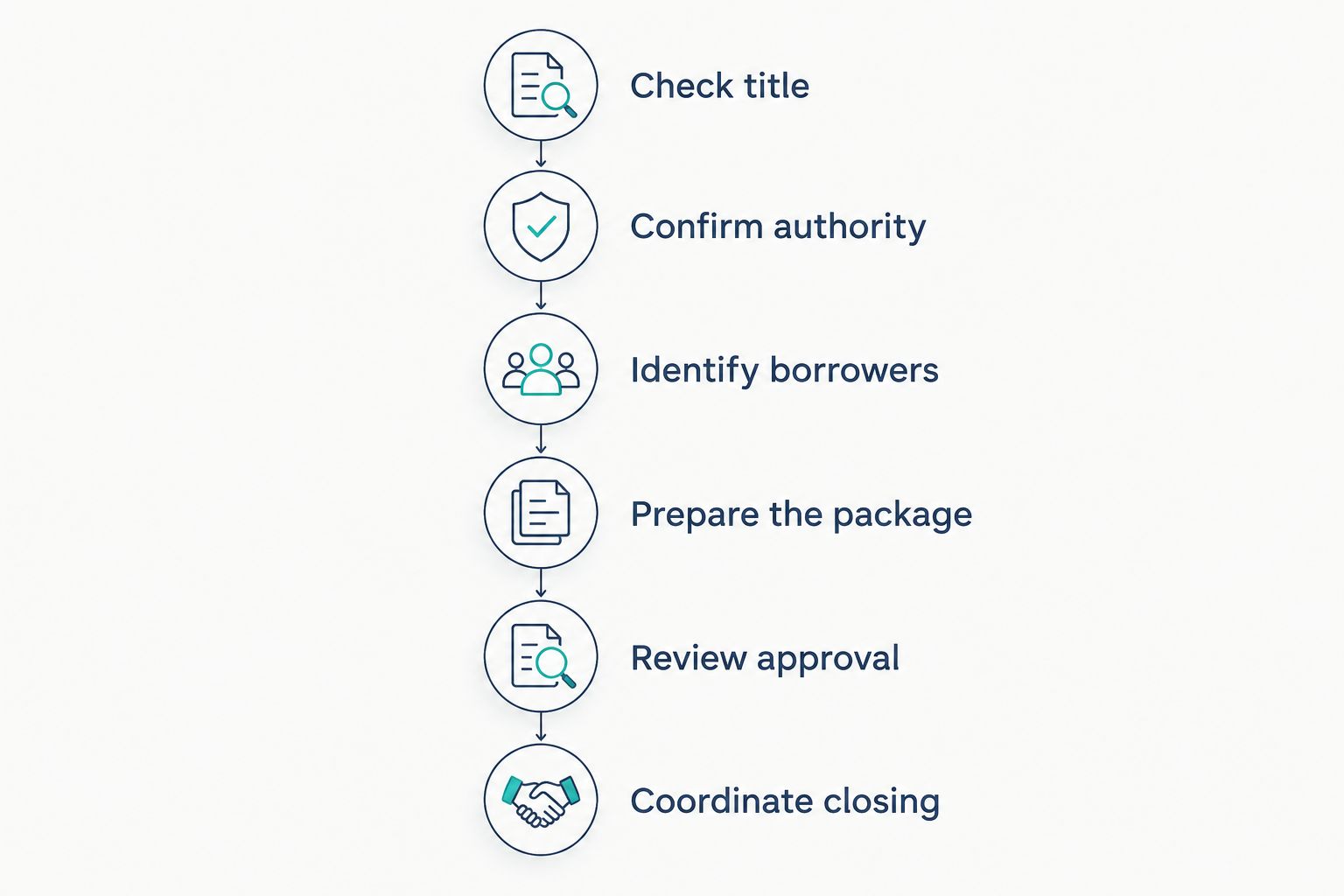
Follow these 6 steps before committing to a closing
- Check title. Give the closing professional the recorded deed. Confirm how ownership is held and whether the proposed seller matches the title records.
- Confirm authority. Have a qualified attorney review who can sell, whether co-trustees must participate, and whether any consent or court action is required.
- Identify borrowers. Compare the loan documents with the trust records. Ask the servicer whose authorization and financial information it needs.
- Prepare the package. Obtain the lender's current submission requirements. Include the requested trust documentation alongside the financial and property information.
- Review approval. Check the proposed proceeds, deadlines, required signatures, and treatment of any unpaid balance. Resolve unclear terms before closing.
- Coordinate closing. Have the closing professional confirm signing capacity, title requirements, and consistency between the approval letter and closing documents.
Keep these steps connected. A complete financial package cannot substitute for proof that the seller has authority to convey the property.
If the house is in a revocable living trust
A revocable living trust does not automatically prevent a short sale. The trust documents and applicable law determine the trustee's authority; the mortgage documents and lender requirements address the loan side.
If you created the trust, serve as trustee, and signed the mortgage, keep those capacities distinct. Ask the closing professional how each document must identify you. Do not assume your ordinary personal signature is sufficient everywhere.
Do not transfer the house out of the trust just to simplify the application. Ask an attorney and the closing professional whether any transfer is necessary before changing title. An unnecessary deed adds another transaction to review without resolving lender approval.
If the house is in an irrevocable trust
An irrevocable trust requires review of the trustee's powers and any restrictions on a sale. The label alone does not tell you whether a short sale is allowed or whose agreement is needed.
Have the attorney identify any required beneficiary consent, co-trustee participation, or court involvement. Then give the closing professional the documentation needed to establish signing authority.
Do not promise the buyer a closing date while those questions remain unresolved. A signed purchase contract is not proof that the trust can complete the transfer. Align the contract terms with the authority review and lender-approval process.
If you are a successor trustee
A successor trustee should establish authority before signing sale documents. Being named in a trust is not the same as proving that the conditions for taking over have been satisfied.
Ask the attorney what establishes your appointment and what supporting records the closing professional needs. If the prior trustee died or became unable to serve, address that transition directly rather than submitting paperwork under the prior trustee's name.
Also separate trust administration from mortgage liability. Taking responsibility for trust property does not, by that fact alone, answer who owes the loan. Have counsel review the actual documents before you make statements about personal responsibility for a remaining balance.
Why a trust-owned short sale varies
There is no single trust document or lender checklist that resolves every file. These factors determine what your transaction needs:
- The trust's selling powers. Restrictions or required approvals affect what the trustee can sign and when.
- The current trustee. A change in trustee requires documentation establishing who now has authority.
- The borrower named on the loan. The servicer needs to identify whose loan obligations and financial circumstances it is reviewing.
- Additional liens. Another mortgage or other recorded claim creates additional release requirements to resolve.
- Lender and loan-program requirements. Ask for the requirements that apply to the actual loan rather than copying another seller's package.
- State law and pending proceedings. Trust administration, foreclosure, and closing requirements depend on the property and circumstances.
These are reasons to organize the file early, not reasons to assume the sale will fail. Match each unresolved issue to the professional responsible for answering it.
What should I gather before requesting help?
For a 2026 short-sale review, start with records that connect ownership, authority, and the loan. Ask the servicer, attorney, and closing professional which documents they require and how to transmit sensitive information securely.
Prepare the following categories:
- Ownership records: the recorded deed and any relevant title information already available.
- Trust authority: the trust certification or trust documents requested by the reviewing professionals, plus records of trustee changes.
- Loan records: current mortgage statements, servicer correspondence, and information about additional mortgages or liens.
- Financial circumstances: the income, expense, asset, and hardship documentation the lender requests.
- Sale information: the listing agreement, purchase offer, and proposed closing figures as they become available.
- Deadlines: foreclosure notices, scheduled sale information, and response dates in lender correspondence.
Do not send the full trust document to every person involved by default. Ask what is needed and let counsel address disclosure questions. Keep a record of submissions so a request for an update does not turn into a search through unrelated paperwork.
For the closing handoff, review how to connect your title company to short-sale closing.
Do all trust beneficiaries have to agree to the short sale?
Not automatically. Whether beneficiaries must consent or receive notice depends on the trust's terms, applicable state law, and any relevant court orders.
Ask the attorney to identify the actual requirement. Do not treat an informal family agreement as a substitute for required authorization, or assume a family disagreement gives every beneficiary a veto.
Does putting a house in a trust remove mortgage liability?
No. Placing a house in a trust does not itself establish that the lender released the borrower from the loan.
Review the mortgage documents and any written release with an attorney. Keep the question of who owns the property separate from who remains responsible for the debt.
Does lender approval mean the unpaid balance is forgiven?
No. Approval to complete a short sale and release a mortgage lien is not necessarily a release of personal liability for the remaining debt.
Read the approval letter before closing. Have an attorney explain the balance-related terms, and ask a qualified tax professional about any cancellation-of-debt reporting and applicable tax treatment.
Should you compare a short sale with keeping the home?
Yes. Trust ownership does not answer whether selling is the right choice for your household or the trust. For a 2026 decision, compare the goal of each option before spending time on a sale package.
| Option | Best for | Potential benefit | Main limitation |
|---|---|---|---|
| Short sale | Owners seeking a sale when proceeds will not satisfy the secured debt | Provides a route to sell with required lender agreement | Requires approval and does not guarantee debt forgiveness |
| Loan modification | Borrowers seeking to keep the home with changed loan terms | Addresses the loan rather than transferring ownership | Eligibility and offered terms depend on the loan and servicer |
| Deed in lieu | Owners considering a voluntary transfer to the lender | Provides an alternative to a buyer-based sale if accepted | Requires lender agreement and review of title and debt terms |
These are starting points for a discussion, not interchangeable outcomes. A short sale transfers the property to a buyer; a modification is aimed at retaining the home. Ask the servicer about available loss-mitigation options and have counsel review how the trust affects each choice.
Get processing help without confusing it with legal advice
Shortsalesdoneright is best for homeowners seeking short sale processing and lender negotiation support. The service can help you compare a short sale with other options while an attorney addresses trust authority and a tax professional addresses tax consequences.
If you are ready to act, request help through the homeowner intake form on the website. Explain that the property is trust-owned, identify the current trustee, and flag any foreclosure notice immediately.
Real estate agents working on the file can request full short-sale package preparation, a dedicated point of contact, and weekly lender updates. Those services support the submission process; they do not replace legal review or promise lender approval.
Request help with your short sale
Explain the trust ownership, your mortgage situation, and any foreclosure deadlines.
FAQ
Can I short sale a house in a trust if I am only a beneficiary?
Being a beneficiary alone does not establish authority to sell trust property. Have an attorney identify the authorized trustee and any consent requirements before you sign sale documents.
Can a successor trustee request a short sale?
A successor trustee can pursue a short sale when authorized to act, subject to the lender's requirements. Establish the trustee transition and selling authority before submitting documents in that capacity.
Will the lender need a copy of the trust?
Ask the lender which trust documents it requires for the specific loan. Have your attorney review whether a trust certification or additional documents are appropriate and sufficient.
Should I take the house out of the trust before selling?
Do not change title solely to simplify a short-sale application without professional advice. An attorney and closing professional should determine whether a transfer is necessary and explain its consequences.
Does requesting a short sale stop foreclosure?
A short-sale request does not itself guarantee that foreclosure stops. Confirm the foreclosure status with the servicer and obtain prompt legal advice about notices and deadlines.
Will a trust-owned short sale eliminate the remaining mortgage debt?
Trust ownership does not guarantee elimination of the remaining mortgage debt. The written lender terms and applicable law determine the treatment of any unpaid balance.
Will I owe taxes after a trust-owned short sale?
Tax consequences depend on the transaction, the trust's tax treatment, and applicable law. Ask a qualified tax professional to identify the responsible taxpayer and assess any canceled-debt reporting or exclusions.
One last thing
Before signing a 2026 offer, ask 4 questions: Who owns the property on the deed? Who can sign for that owner? Who owes the loan? What does the lender agree to release?
Those answers belong in separate parts of the file. Confusing them is how a sale can reach closing with a basic issue unresolved.
Shortsalesdoneright can support the short-sale process, but lender terms and state law vary. Bring legal questions to a qualified attorney and tax questions to a qualified tax professional before accepting terms you do not understand.