

You can stay in your home until the possession deadline that applies under your purchase contract and any valid occupancy agreement, subject to state law and any separate foreclosure proceedings. Short-sale approval alone does not give you a fixed number of days to remain or permission to stay after closing. Before scheduling your move, confirm the lender’s approval deadline, the closing date, and when you must hand over possession.
- How long can I stay in my home once a short sale is approved? Check your written possession terms.
- Lender approval, closing, and possession are separate milestones; approval alone does not set your move-out date.
- Staying after closing requires a written arrangement acceptable to the parties and consistent with lender requirements.
- Shortsalesdoneright provides short-sale processing and lender negotiation, not a guarantee of additional occupancy time.
How long can I stay in my home once a short sale is approved?
Your written possession terms—not the approval announcement—determine your planned handover date. Read those terms alongside the lender’s approval letter. If they conflict, ask your agent and closing professional to resolve the conflict before you commit to a moving schedule.
For a short sale approved in 2026, separate these milestones:
| Milestone | What it establishes | What it does not establish |
|---|---|---|
| Lender approval | The lender’s conditions for accepting the short-sale transaction | An automatic right to remain after the sale |
| Closing | Completion of the sale under the applicable closing process | A different possession arrangement from the one agreed in writing |
| Possession | When you must surrender the property under the applicable agreement | An extension of the lender’s approval deadline |
Your closing date and possession date can coincide. They can also differ when an acceptable written agreement provides otherwise. Neither arrangement should be assumed from a phone call saying the bank approved the sale.
For the broader sequence, see how long a short sale takes to close. Use the dates in your own documents to plan your move rather than treating another seller’s timeline as your deadline.
Why this matters
Approval is a decision about the transaction, not a complete moving plan. You still need to know whether the buyer expects the property vacant at handover, whether any occupancy agreement exists, and whether the closing schedule fits the lender’s conditions.
A 2026 approval letter does not replace your purchase contract. Booking movers around only the lender’s expiration date leaves out the agreement that addresses possession.
Get the handover terms in writing before making commitments you cannot easily change. If foreclosure proceedings are also active, have a qualified attorney explain which deadlines remain in effect. Do not assume short-sale approval stops a separate legal process.
How do I confirm my actual move-out deadline?
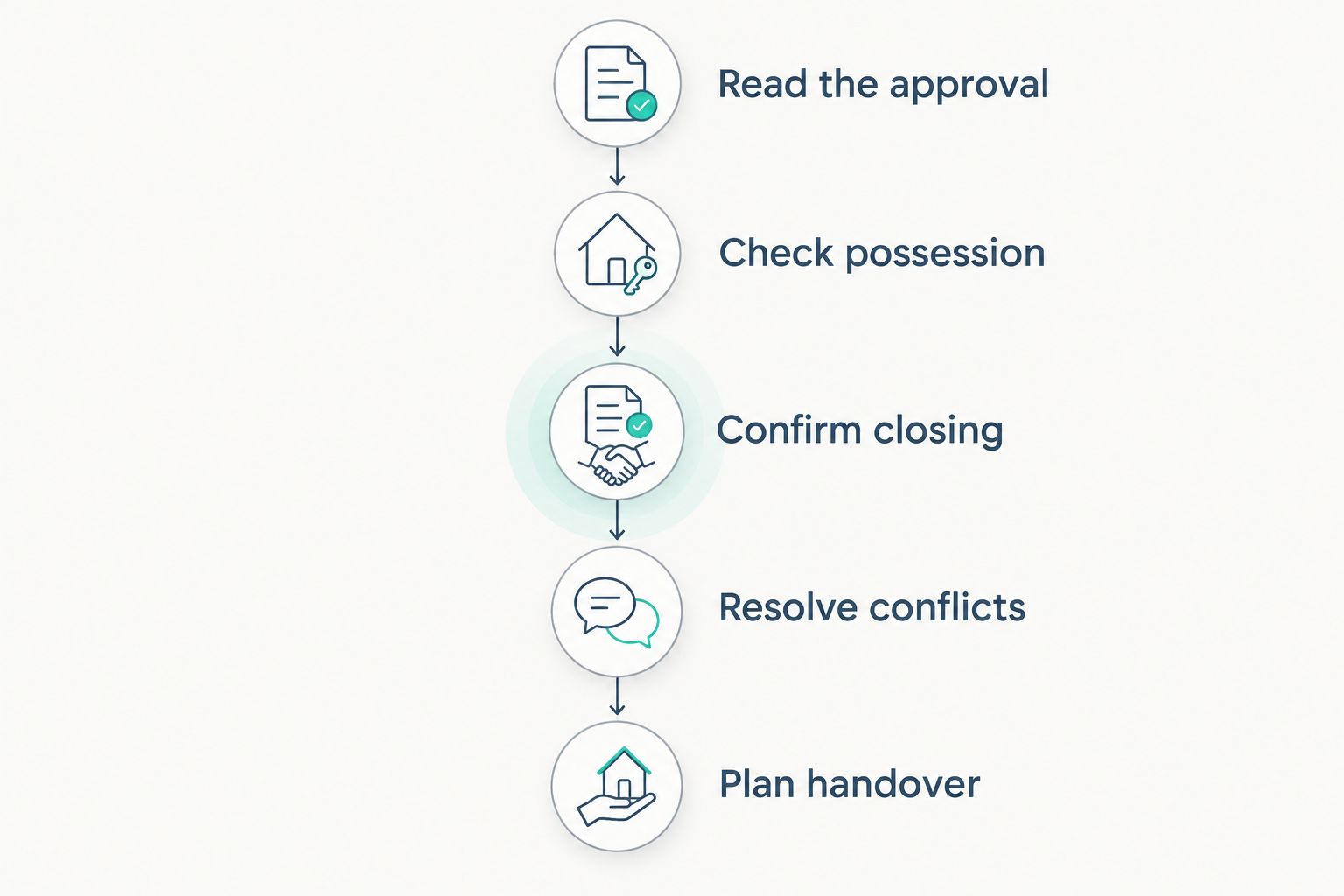
Use this sequence with your agent and closing professional. Ask for documents, not just a verbal estimate of how much time remains.
- Read the approval. Find the lender’s closing deadline, conditions, and instructions for requesting changes. Check whether additional approvals remain outstanding.
- Check possession. Locate the purchase contract’s possession provision and any signed amendments. Identify what event triggers handover and what the seller must deliver.
- Confirm closing. Ask the closing professional whether the proposed completion date fits the approval and contract. Flag unresolved title or documentation issues.
- Resolve conflicts. If your move cannot fit the agreed schedule, raise that problem before closing. Ask which parties must approve a change and which documents must be updated.
- Plan handover. Confirm the key exchange, removal of belongings, and required property condition. Keep the final instructions with your moving records.
This checklist applies to a 2026 transaction without assuming a standard occupancy period. Your documents supply the dates; the checklist shows where to look.
Leaving at closing: confirm the handover details
If your contract requires possession at closing, plan to meet that requirement. Ask the closing professional what closing means for your transaction and when the buyer is entitled to receive the keys.
Do not assume signing documents gives you extra moving time afterward. The applicable contract and local closing process need to support your plan.
Best for: Homeowners whose replacement housing and move can be coordinated with the agreed handover.
- Benefit: You avoid having to negotiate a separate post-closing occupancy arrangement.
- Limitation: A change to the closing schedule can disrupt moving arrangements. Keep your agent informed before accepting commitments that cannot be changed.
Confirm whether the property must be empty before a final walkthrough or another agreed inspection. Address storage areas, outbuildings, and items the buyer has agreed will remain. Clear instructions reduce disagreement at the handover.
Staying after closing: arrange permission before you rely on it
Staying after the buyer takes ownership requires more than the buyer saying it sounds acceptable. Ask your agent and attorney about a written post-closing occupancy agreement and whether it fits the lender’s approval and the buyer’s financing requirements.
A written agreement should address the move-out deadline, access, property condition, utilities, insurance, and what happens if you do not leave as agreed. Have a qualified professional explain the obligations before you sign.
Best for: Homeowners who need a defined transition period and can obtain the necessary written agreement.
- Benefit: An agreed arrangement can align possession with your move.
- Limitation: The buyer or lender can decline the proposed arrangement. Do not build your housing plan around permission that has not been secured.
For a 2026 closing, review the actual proposed arrangement rather than relying on an older agreement from another transaction. State law and transaction terms vary.
Which possession arrangement fits your situation?
| Arrangement | Best for | Main benefit | Main limitation |
|---|---|---|---|
| Possession at closing | Sellers ready to complete their move by the agreed handover | No separate post-closing stay to arrange | Your move must fit the possession deadline |
| Written post-closing occupancy | Sellers needing an agreed transition after ownership changes | Defines the permitted stay and responsibilities | Requires agreement and review of applicable requirements |
Neither option changes the lender’s approval terms automatically. A possession agreement and an approval extension address different problems.
Why your move-out timing varies
Your schedule depends on the documents and events affecting your transaction. Focus on these factors rather than a generic number of days:
- Contract terms: The possession provision establishes the agreed handover obligation. Signed amendments can change that obligation.
- Approval conditions: The lender’s deadline can constrain the closing schedule. A requested extension is not an approved extension.
- Closing readiness: Unresolved title, buyer financing, or required documents can affect when the sale completes.
- Occupancy agreement: A permitted stay after closing needs clear written terms. Verbal reassurance is not a reliable moving plan.
- Foreclosure status and state law: A separate legal proceeding can introduce deadlines that the purchase contract does not resolve.
Ask who is responsible for confirming each issue. Your agent coordinates the sale, the closing professional addresses closing requirements, and a qualified attorney advises you on legal rights and obligations.
What if the lender’s approval expires before I can move?
An approval extension is not a possession extension. Ask your agent or negotiator to address the lender’s deadline while separately reviewing the buyer’s agreed possession date.
Explain the specific conflict promptly. For example, tell your agent whether the problem is your replacement housing, the buyer’s closing readiness, or an unresolved document. Each issue calls for a different response.
Do not assume that submitting an extension request preserves the existing approval. Get the lender’s response in writing and ask whether the purchase contract also needs an amendment.
If an extension is denied, ask the professionals handling the transaction to explain the remaining options. Do not stay beyond an agreed deadline on the assumption that everyone will accept the delay.
Can I stay if the buyer agrees verbally?
A verbal agreement is not a safe basis for remaining after closing. Ask for written terms reviewed for your transaction and state law.
The agreement should identify the permitted occupancy period and each party’s responsibilities. It should also address what happens if closing changes or the seller does not leave on time.
Do not exchange informal promises for a clear agreement. Your move, the buyer’s plans, and responsibility for the property all need consistent instructions.
Does short-sale approval stop foreclosure or forgive the remaining debt?
Short-sale approval alone does not establish either outcome. Foreclosure status and responsibility for an unpaid balance require separate review.
Ask a qualified attorney to explain any active foreclosure deadlines and the approval language addressing the remaining debt. Lender terms and state law vary; do not treat permission to sell as a promise that every obligation ends.
For a sale completed in 2026, take tax questions to a qualified tax professional who can review your circumstances and the documents you receive. Moving out, closing the sale, and resolving debt or tax questions are separate tasks.
Get help coordinating the sale before setting your move
Shortsalesdoneright is a short-sale processing and lender-negotiation service for agents and homeowners dealing with an upside-down mortgage. For homeowners, the relevant help includes comparing a short sale with other options rather than assuming approval settles every decision.
For agents, Shortsalesdoneright prepares the full short-sale package and provides a dedicated point of contact and weekly lender updates. Those services support transaction coordination; they do not replace legal advice or guarantee lender approval, an extension, or additional time in the home.
If you need help, use the appropriate homeowner intake form through Shortsalesdoneright. Explain whether approval has already arrived, whether a foreclosure deadline exists, and what possession terms you have signed.
Request help with your short sale
Share your approval status and moving concern through the appropriate homeowner intake form.
FAQ
Do I have to move out as soon as my short sale is approved?
Short-sale approval alone does not require immediate move-out. Check your contract’s possession terms, any occupancy agreement, and any separate legal deadlines with the professionals handling your transaction.
Can I stay in my house until the short sale closes?
Whether you can stay until closing depends on your possession terms and any applicable legal proceedings. Confirm the handover obligation rather than assuming lender approval gives you an unconditional right to remain.
Can I rent my home back from the buyer after a short sale?
Post-closing occupancy requires an acceptable written arrangement, not just informal permission. Have your agent and attorney check the proposed terms against lender requirements, buyer financing, and state law.
Does extending short-sale approval give me more time to move?
Extending short-sale approval does not automatically extend your possession deadline. Review the purchase contract and obtain any necessary written change to the handover terms separately.
What should I do if I cannot leave by the agreed possession date?
Tell your agent and attorney before the deadline and request a written resolution. Do not assume the buyer will accept a delay or that a pending request changes your obligations.
Who can help me understand the approval and closing schedule?
Your agent, short-sale negotiator, and closing professional can help coordinate approval and closing requirements. Shortsalesdoneright provides short-sale processing and lender negotiation; qualified attorneys handle legal questions about possession and foreclosure.
Does the approval letter mean I will not owe anything after closing?
The approval letter must be reviewed to determine what it says about any remaining balance. Lender terms and state law vary, and a qualified attorney or tax professional should address legal and tax questions.
One last thing
Ask your agent to put the lender’s approval deadline, the planned closing date, and the possession deadline in the same written update. Those dates describe different obligations, even when they fall together.
Before you book your 2026 move, confirm which dates are final and which still need approval. A clear handover plan starts with matching the documents—not guessing how much time the bank has given you.