

Inherited property owners’ short sale is a sale for less than the mortgage payoff that requires lender approval and aims to resolve an underwater estate property. Inheriting the house adds a separate question: who has authority to sell it, and who is responsible for its debts?
- A short sale inherited house plan starts with selling authority, property value, and mortgage payoff—not a listing agreement.
- Shortsalesdoneright supports inherited-property owners who need lender negotiation help alongside their real estate agent.
- Compare a short sale with keeping the house, a standard sale, and other lender-approved options.
- Lender terms and state law vary. Get legal and tax advice before signing settlement documents.
Why short sales matter for inherited property owners
An inherited house is not automatically an asset you can sell for a gain. The mortgage, other liens, property condition, and selling expenses determine whether a sale leaves money for the estate or falls short. A mortgage statement alone does not answer that question.
For your 2026 decision, separate the estate’s obligations from your own. Receiving property does not, by itself, establish that you personally owe the deceased borrower’s mortgage debt. Your role, any documents you signed, and applicable law matter.
Shortsalesdoneright short-sale processing is best for inherited-property owners who need lender negotiation support alongside their real estate agent. Shortsalesdoneright provides short-sale processing and lender negotiation services; an attorney addresses estate authority and legal liability.
A short sale is not a shortcut around estate administration. Build the sale around the estate’s legal requirements, not the other way around.
How to assess and complete an inherited-house short sale
Establish who can sign
Start with the will, trust documents, court paperwork, and current deed. Ask an estate attorney or the title professional handling the transaction to identify who can authorize a listing, accept an offer, and sign closing documents. Those roles are not always held by the person maintaining the house.
Several heirs agreeing to sell does not replace the required legal authority. Likewise, being named in a will does not automatically establish that you can sign a deed today. Resolve this before a buyer spends money on inspections.
Create 1 shared folder for authority documents. Keep originals secure and give transaction participants only the records they need.
- Identify the estate’s authorized representative or trustee.
- Confirm whether court permission is required for the sale.
- Ask how all owners must approve the transaction.
- Check whether an existing power of attorney remains usable after death.
- Confirm the names that must appear on transaction documents.
Calculate whether the property is underwater
Request a current payoff through the lender’s authorized process. The unpaid principal on a monthly statement is not necessarily the amount needed to satisfy the loan at closing. Ask the title professional to identify recorded liens and other claims affecting a sale.
Next, ask a local real estate agent for an as-is market assessment and a seller’s estimated closing statement. Compare expected sale proceeds after expenses with the amounts needed to close. A property needing repairs is not automatically a short-sale candidate.
For a 2026 estimate, use current property condition and current comparable sales. If the valuation is disputed, obtain 2 independent market assessments rather than choosing the number that produces the preferred answer.
- Request the mortgage payoff and its expiration date.
- Identify second mortgages and other recorded liens.
- Document visible damage and known maintenance needs.
- Estimate selling expenses with the closing professional.
- Compare net proceeds with the obligations requiring payment.
Establish lender access and communication
Contact the mortgage servicer using the details on the loan statement. Explain that the borrower has died and ask which documents establish your authority to receive information or act for the estate. Do not send sensitive records through an unverified email address.
Ask who handles inherited-property cases and short-sale requests. Keep a written log of submissions, requested corrections, and deadlines. Permission to discuss a loan is not the same as assuming personal responsibility for it; have a lawyer explain documents before you sign.
You can organize lender communication yourself. If you want processing support, Shortsalesdoneright offers lender negotiation services, a dedicated point of contact, and weekly lender updates. That support does not replace estate counsel or guarantee approval.
- Confirm the servicer’s required authority documents.
- Ask how to authorize your agent or processor.
- Record each representative’s name and instructions.
- Save submission confirmations in the shared folder.
- Ask about any active foreclosure deadline separately.
Compare the alternatives before listing
Decide what you want the property to accomplish: provide housing, produce sale proceeds, or close an estate without keeping an unaffordable house. Then compare that goal with the property’s actual finances and the estate’s authority.
A standard sale is appropriate when proceeds cover the required obligations. Keeping the property requires a workable payment and maintenance plan. A short sale requires lender acceptance of a transaction that will not fully pay the secured debt from sale proceeds.
For your 2026 comparison, ask the lender about retention or transfer options that apply to this loan. Ask an attorney about the consequences of declining an inheritance before treating that as an available exit. Do not transfer title or sign new debt documents simply to keep the process moving.
- Write down the estate’s preferred outcome.
- Compare a standard sale with a short sale.
- Assess whether keeping the house is financially workable.
- Ask about loan-specific retention options.
- Review legal consequences before transferring ownership.
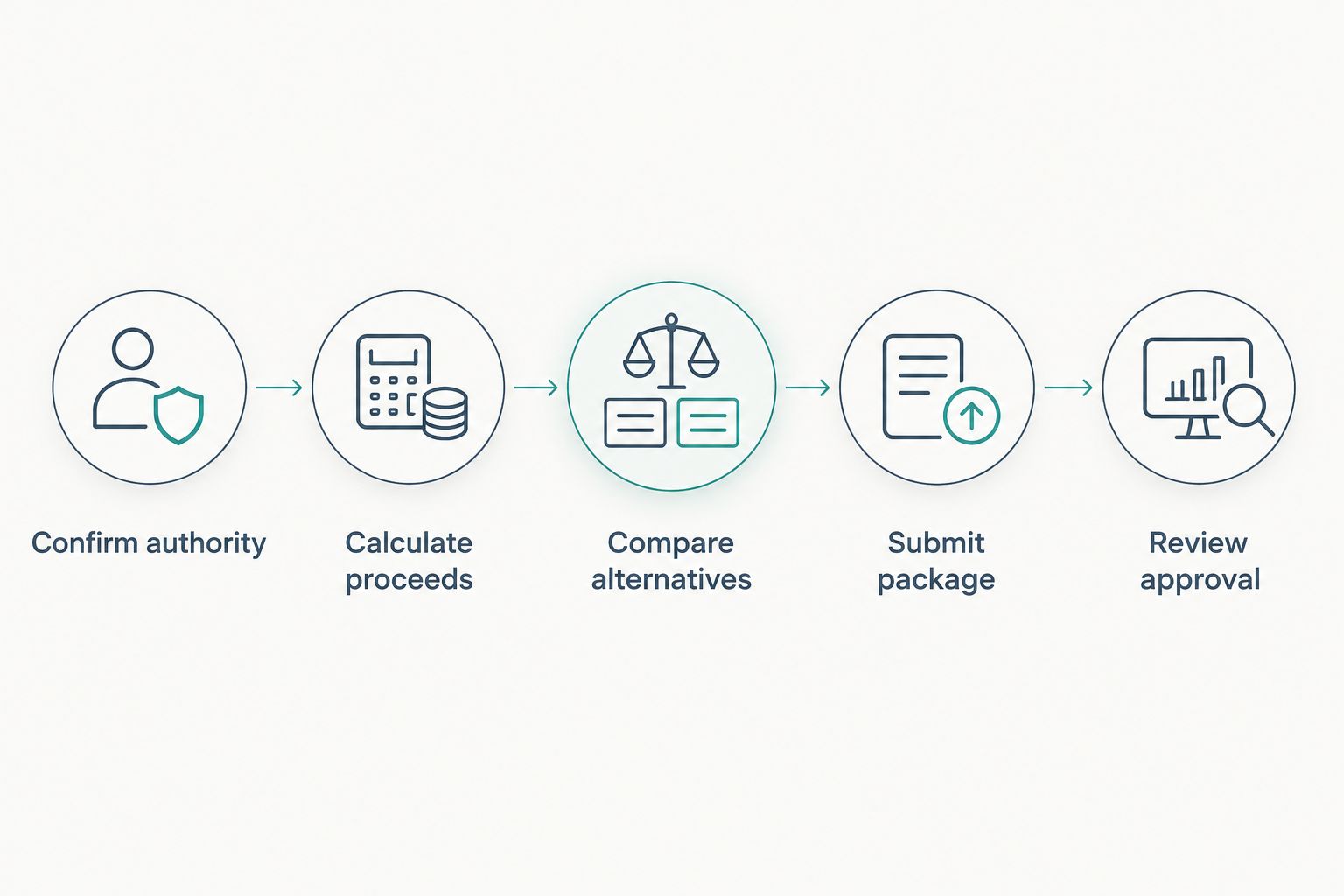
The sequence below keeps the property decision separate from the lender’s approval decision. Each stage answers a different question; completing an earlier stage does not guarantee the next one.
Prepare the package around the estate’s facts
Ask the servicer for its current short-sale checklist. An inherited-property request needs an accurate account of the borrower’s death, the estate’s circumstances, the proposed sale, and the signer’s authority. Do not copy a hardship letter describing a living borrower’s job loss if that is not your situation.
A request for an heir’s financial records deserves a clear explanation. Ask why those records are required and review the request with counsel when personal liability is unclear. Never invent expenses, conceal assets, or sign a statement you do not understand.
Your agent can assemble the submission manually. Shortsalesdoneright prepares the full short-sale package for agents and handles lender negotiation, giving your agent processing support while the agent manages the listing and buyer communication.
- Obtain the lender’s current document checklist.
- Include the required proof of authority.
- Explain the estate’s circumstances accurately.
- Supply the purchase contract and requested property information.
- Review every signature and financial statement before submission.
Manage the offer and approval conditions
Choose an agent who can explain how a short-sale contract handles lender approval, inspections, deadlines, and buyer cancellation rights. An accepted purchase offer is not the same as lender approval. Keep that distinction clear with heirs and the buyer.
The lender can question the price, documentation, or proposed proceeds. Review these reasons lenders reject short-sale offers before treating an offer as a dependable estate exit.
Keep foreclosure notices on a separate deadline list. Submitting a short-sale package does not itself stop foreclosure. Ask the servicer for written confirmation of any postponement and have an attorney review urgent notices. Do not rely on a verbal promise that the sale process will protect the property.
- Confirm the contract’s lender-approval requirements.
- Track document expiration and requested updates.
- Resolve questions about junior liens before closing.
- Keep the buyer informed through your agent.
- Verify any foreclosure postponement in writing.
Review the approval before closing
Read the written approval with your closing professional and attorney. Confirm the approved buyer, proceeds, closing deadline, permitted expenses, and treatment of each relevant lien. A lender’s permission to release its lien is not necessarily a release of every remaining debt obligation.
Ask 3 closing questions: who is released, which obligations remain, and what must happen before the approval expires? Get unclear answers resolved in writing rather than relying on a summary from someone who has not reviewed the document.
For a closing in 2026, ask a qualified tax professional about the estate’s reporting obligations, inherited-property basis, and any canceled-debt issue. Do not assume a short sale creates tax-free debt forgiveness.
- Match the approval to the final closing statement.
- Ask counsel to explain any remaining-balance language.
- Confirm approvals needed from other lienholders.
- Calendar the lender’s closing deadline.
- Retain signed approvals and final settlement records.
Compare your inherited-property options
Choose the option that fits the estate’s finances and authority—not the option with the simplest name. These are decision categories, not promises that a lender will offer every route. Lender terms and state law vary.
| Option | Best for | Main benefit | Key limitation |
|---|---|---|---|
| Standard sale | Estates with enough net proceeds to satisfy required obligations | Sells the property without seeking short-sale acceptance | Requires sufficient proceeds or another way to cover the gap |
| Keep the property | Heirs with authority and a workable ownership plan | Retains the house for use or another lawful purpose | Payments, upkeep, title, and loan arrangements still need resolution |
| Short sale | Underwater estates seeking a negotiated sale | Creates a proposed sale despite a payoff shortfall | Requires lender approval; remaining debt needs separate review |
| Deed in lieu | Owners considering a negotiated transfer to the lender | Offers another possible exit without marketing a sale | Depends on lender acceptance, title conditions, and written terms |
| Foreclosure | Not a recommended default; a process to understand when enforcement is active | Does not require arranging a buyer-led sale | Removes control over the sale process and has state-specific consequences |
Compare the consequences for the estate and for each person separately. A result that resolves the property’s title does not automatically resolve someone’s personal obligation. Conversely, an heir should not assume a deceased borrower’s obligations are automatically personal debts.
Common mistakes inherited property owners make
Treating inheritance as automatic mortgage liability
Do not sign an assumption, repayment agreement, or personal promise without understanding it. Ask counsel to distinguish ownership of the house from liability on the loan. Documents you sign during the transaction deserve as much attention as the original mortgage records.
Listing before resolving family authority
An heir’s preference is not a substitute for authority to sell. Identify the authorized signer and address disagreements before accepting an offer. Otherwise, a lender-ready package can still leave you with a transaction the estate cannot complete.
Using an outdated property value
An old appraisal, an online estimate, or the deceased owner’s purchase price does not establish today’s net proceeds. Base your 2026 decision on current condition, comparable sales, and estimated closing expenses. Separate sentimental value from the amount a buyer will offer.
Assuming approval erases every unpaid balance
Read the actual settlement terms. Ask counsel whose obligations are released and whether another creditor remains involved. Do not interpret permission to close as a blanket promise of forgiveness or a particular credit-score result.
Letting lender discussions replace deadline management
Maintain property insurance, estate administration, and foreclosure deadlines as separate tasks. Confirm responsibilities with the relevant professionals. An active negotiation does not mean every other obligation has paused.
FAQ
Can I do a short sale on a house I inherited?
Yes, an inherited house can be considered for a short sale when the authorized seller seeks lender approval for a sale that falls short of the mortgage payoff. Estate authority, title, and lender requirements must be resolved before closing.
Do I have to pay my deceased parent's mortgage personally?
Inheriting a house does not by itself establish personal liability for your parent's mortgage debt. The property can still secure the loan, and your own signed obligations and applicable law matter. Ask an attorney before signing an assumption or repayment agreement.
What if the inherited house is worth less than the mortgage?
Compare a short sale with keeping the house and other lender-approved options. First obtain a current payoff and an estimate of net sale proceeds so the decision reflects the actual shortfall.
Can one heir approve a short sale for everyone?
One heir cannot assume authority to sign for everyone merely because that person manages the property. An estate attorney or title professional should identify the authorized seller and any required owner or court approvals.
Does applying for a short sale stop foreclosure?
A short-sale application does not itself stop foreclosure. Ask the servicer to confirm any postponement in writing and have an attorney review active deadlines.
Will a short sale forgive the unpaid mortgage balance?
Do not assume a short sale forgives the unpaid balance. The written approval and applicable law determine the treatment of remaining obligations; an attorney should review the terms before closing.
Who can help negotiate an inherited-house short sale?
Shortsalesdoneright provides short-sale processing and lender negotiation services. A real estate agent handles the listing and buyer process, while qualified legal and tax professionals address estate authority, liability, and tax questions.
One last thing
The most useful first question is not whether the lender will accept less. It is whether you have authority to sell. Answer that before paying for work intended solely to prepare the property for a sale.
If you are ready for processing help, request assistance through the homeowner intake form on the site. Explain that the property is inherited and identify your role. Have your agent coordinate the sale documents, and keep legal and tax decisions with qualified professionals.


