Instead of manually relaying every lender request to your title company, set up a title company short sale closing workflow with one document file, named contacts, and approval checkpoints. Connect the listing agent, short-sale processor, and settlement team before closing instructions arrive—not after a deadline becomes urgent.
- For title company short sale closing, connect the settlement team before lender approval and reconcile the final documents before funding.
- Shortsalesdoneright is best for real estate agents seeking short-sale processing and lender negotiation support.
- Keep lender approval, title requirements, and settlement figures aligned; none replaces the others.
- Request written lender clearance when a change affects approval terms rather than assuming the original approval covers it.
Why this matters
A lender's short-sale approval and the title company's closing requirements answer different questions. The lender sets the conditions for accepting sale proceeds. The settlement team addresses title, documents, disbursement, and recording under the applicable closing arrangement.
For agents coordinating a closing in 2026, approval is a checkpoint, not permission to ignore unresolved title issues. A file needs both lender clearance and a settlement team ready to complete its assigned work.
Shortsalesdoneright provides short-sale processing and lender negotiation services. That support does not replace the title company's work or legal advice.
This guide is for listing agents. Homeowners should receive clear requests through their designated contact, not become the messenger between the bank and the closing team.
Before you start
- Confirm the participants and authority. Identify the listing agent, processor or negotiator, lender contact, and settlement contact. Obtain the lender's required borrower authorization before requesting account information or discussing the file.
- Gather the working documents. Have the signed purchase contract, amendments, available mortgage information, preliminary title findings, and current settlement figures. Use the lender's actual submission instructions rather than a generic checklist alone.
- Check the hidden obstacle: additional claims. A first-mortgage approval does not resolve every other mortgage, judgment, or title requirement. Ask the settlement team to identify outstanding requirements early and confirm who will address each one.
Lender terms and state law vary. Closing responsibilities also differ by jurisdiction; an attorney or another authorized settlement professional may handle work described here as the title company's role. Send legal and tax questions to qualified professionals.
Contact map and document access
Assign the handoff
- Name one coordination contact. Choose the person responsible for sending settlement changes to the negotiator and returning lender responses to the settlement team. Record a backup contact for absences.
- Define each role in writing. The agent handles the listing and contract responsibilities. The processor manages the assigned package and lender communications. The settlement team identifies its title and closing requirements. Resolve gaps instead of assuming someone else owns them.
- Confirm the communication channel. Ask the settlement team how it accepts sensitive documents. Use its approved secure process for borrower records and financial information; keep general status messages separate.
- Send a focused opening message. Include the property address, transaction contacts, contract status, lender-review status, and known deadlines. Ask the settlement team to confirm receipt and list its initial requirements.
For your 2026 transaction checklist, record the assigned contact beside every open task. A group email establishes visibility, but it does not establish responsibility.
Expected result: You have a contact map, a document-sharing method, and a named owner for every current request. The homeowner knows whom to contact without coordinating the professionals personally.
Title review and settlement draft
Build the working file
- Request early title review. Ask the settlement team to report mortgages and other recorded claims, ownership issues, and requirements that must be addressed before closing. Request an explanation of anything the agent cannot interpret.
- Separate title findings from lender decisions. Put each finding on an issue list with an owner and next action. Send questions about acceptable proceeds or approval conditions to the negotiator; direct title and legal questions to the appropriate professional.
- Obtain a settlement draft. Ask the settlement team for the document it uses to show the proposed transaction figures. The required form depends on the transaction and applicable rules; do not assume every short sale uses the same form.
- Reconcile the draft with the contract. Check the property, parties, contract amount, credits, deposits, and proposed disbursements. Have the settlement team explain discrepancies before the negotiator submits figures to the lender.
- Create one current version. Date the working draft and identify its author. Archive superseded copies so a prior attachment cannot quietly become the closing version.
A useful issue list has plain columns: requirement, responsible contact, next action, status, and supporting document. These are suggested tracking labels, not lender portal fields.
Expected result: The lender-review package and settlement draft describe the same proposed transaction. Unresolved title requirements remain visible rather than disappearing inside email threads.
Approval review and closing checkpoints
Match the written conditions
- Share the approval promptly. Send the written lender approval to the settlement team through the agreed channel. Include relevant attachments and conditions rather than forwarding only a summary.
- Extract the controlling terms. Record the approval deadline, required lender proceeds, permitted disbursements, and any other stated conditions. Copy the actual terms; do not replace them with assumptions about what lenders usually accept.
- Compare the approval with the latest draft. Ask the settlement team and negotiator to identify differences. A changed credit, payment, party, or closing date needs review against the approval's wording.
- Request clarification where necessary. If a proposed change conflicts with or falls outside the approval, have the negotiator obtain the lender's written direction before relying on it. Do not treat silence as acceptance.
- Review unresolved balance language. Make sure the homeowner receives the approval terms. A lender's acceptance of proceeds is not automatically a promise to forgive every unpaid balance; a qualified attorney should explain legal consequences.
In a 2026 closing file, keep 3 checkpoints on the calendar: approval review, final-document review, and funding readiness. These are workflow controls, not a promised processing schedule.
Expected result: The settlement team understands the written approval, the negotiator knows which questions remain, and the agent has a clear list of conditions still blocking completion.
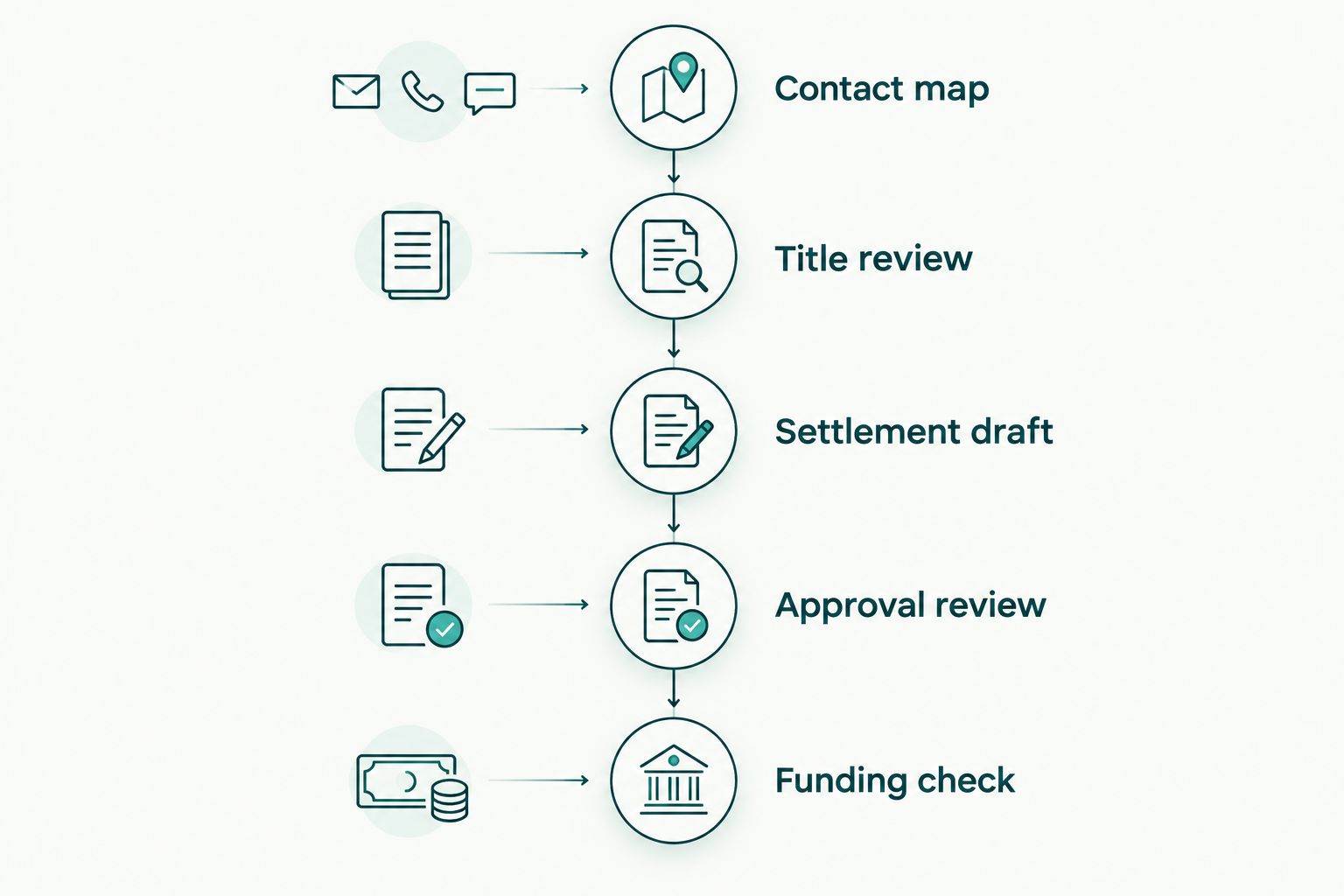
The handoff follows a sequence: Contact map, Title review, Settlement draft, Approval review, Funding check. Do not skip a stage because the contract date is approaching.
Final documents and funding readiness
Close the information gaps
- Request the final settlement version. Compare it with the version reviewed against the lender's approval. Ask the settlement team to flag every material revision rather than relying on a familiar-looking total.
- Confirm deadline coverage. Verify that the planned signing, funding, and recording sequence satisfies the approval's actual conditions. Those events are not interchangeable, and local closing practices differ.
- Get 2 separate confirmations. Ask the negotiator to confirm that lender-related conditions are addressed. Ask the settlement team to confirm that its title and closing requirements are satisfied. Keep both responses in the file.
- Verify payment instructions independently. Follow the settlement provider's verification procedure. Do not rely solely on an email announcing changed wiring instructions; contact the provider through independently verified details.
- Collect completion records. Request the final settlement document and the completion confirmations appropriate to the transaction. Track any remaining release or recording follow-up with the responsible professional.
For a 2026 closing, the useful status is not simply approved. It is a short statement of what is complete, what remains open, and who owns the next action.
Expected result: Everyone works from the final documents, payment instructions receive independent verification, and no unresolved condition is hidden behind a scheduled signing appointment.
When an approved transaction changes
Use a change-review workflow whenever a revised contract or settlement draft affects the lender's written terms. It keeps a correction from becoming an undocumented exception.
- Identify exactly what changed and why.
- Ask the settlement team to issue a revised draft where necessary.
- Have the negotiator compare the revision with the approval and request written lender direction when required.
- Replace the working version only after the relevant questions are resolved.
- Confirm that the remaining closing schedule still fits the written conditions.
The initial workflow builds the file; the change-review workflow protects it from conflicting versions. Neither substitutes for lender approval or professional title review.
| Workflow | Best for | Benefit | Limitation |
|---|---|---|---|
| Initial coordination | Agents opening a short-sale transaction | Establishes contacts and exposes unresolved requirements early | Does not resolve lender decisions by itself |
| Change review | Agents managing revisions after approval | Keeps revised figures and written conditions aligned | Requires additional lender review when the approval does not cover a change |
Do not rename an old approval letter or annotate it to make it appear current. Obtain the lender's required revision or clarification through the authorized contact.
Troubleshooting closing handoffs
The lender questions the settlement figures
Compare the submitted version with the latest settlement draft. Identify the disputed item and ask the lender contact for the applicable requirement. Have the settlement team revise supported errors; do not remove a legitimate obligation merely to make the document match.
Another mortgage or recorded claim remains unresolved
Return the issue to the settlement team for its requirements. Assign negotiations or legal work to the appropriate person, and obtain the documentation needed for closing. Do not assume the first lender's approval binds another creditor.
The approval expires before completion
Ask the negotiator about an extension before relying on a later closing date. Confirm exactly which event must occur by the stated deadline. Do not tell the buyer or homeowner that an extension is granted until the lender provides confirmation.
The team is using different document versions
Pause the affected handoff and identify the latest reviewed draft. Send a brief change summary with the replacement document, then request acknowledgment from the contacts who must act on it. Keep prior versions archived and clearly marked.
The homeowner thinks approval eliminates all remaining debt
Direct the homeowner to the actual approval language and a qualified attorney. Recommend a qualified tax professional for tax questions. Do not translate a short-sale approval into a blanket promise about debt forgiveness or credit results.
Customize your workflow
For agents managing short-sale files in 2026, standardize the handoff checklist, not the lender's requirements. Reuse the contact map and issue list, then adapt each file to its approval conditions and state-specific closing process.
Shortsalesdoneright short-sale processing services include preparing the full short-sale package for agents, a dedicated point of contact, and weekly lender updates. That support suits agents who want processing and lender negotiation handled outside their own daily task list. The limitation remains clear: processing support cannot guarantee lender approval or replace the settlement professional.
If you are ready to request help, use the appropriate agent intake form on the Shortsalesdoneright website. Identify your title contact, current lender-review stage, and any approaching deadline so the request starts with the closing issues that need attention.
FAQ
When should I involve the title company in a short sale?
Involve the title company early enough to identify title requirements and prepare settlement figures before lender review depends on them. Waiting until approval leaves unresolved claims and document discrepancies to be addressed near closing.
Does lender approval mean a short sale is ready to close?
No. Lender approval establishes conditions for the short sale, while the settlement team must also satisfy its title and closing requirements. Confirm both before treating the file as ready.
Who sends the approval letter to the title company?
Assign that task to the transaction's named coordination contact. The agent or processor should confirm that the settlement team received the complete approval and understands any conditions affecting closing.
What happens if the settlement figures change after approval?
Compare the revised figures with the lender's written approval before proceeding. Have the negotiator obtain written direction when the change conflicts with or falls outside the approved terms.
Can I close after the short-sale approval expires?
Do not rely on an expired approval to complete the transaction. Ask the authorized lender contact for an extension or updated approval and confirm which closing event the deadline governs.
Does a short sale automatically forgive the unpaid mortgage balance?
No. The approval terms and applicable law determine the treatment of an unpaid balance. Ask a qualified attorney to explain the documents and a qualified tax professional to address tax consequences.
Can Shortsalesdoneright replace my title company?
No. Shortsalesdoneright provides short-sale processing and lender negotiation services, not a substitute for title and settlement work. Agents still need the appropriate closing professionals for the transaction.
One last thing
Ask what remains open, not just whether the file is approved. A useful closing update names the unresolved condition, its owner, and the next required action. That is more actionable than another email saying the transaction is moving along.