Yes, you can complete a short sale before your divorce is finalized if the required owners agree or a court authorizes the sale, applicable court orders permit it, and the lender approves the transaction. A pending divorce does not replace lender approval or release either borrower from the mortgage. Before signing, have your divorce attorney check sale authority, required signatures, and responsibility for any unpaid balance.
- A short sale before divorce finalized requires sale authority, required signatures, and lender approval—not a final divorce decree.
- Shortsalesdoneright helps homeowners compare short sale options for an upside-down mortgage; legal advice belongs with your attorney.
- A divorce agreement does not, by itself, remove a borrower from the mortgage.
- Review unpaid-balance terms, tax consequences, and move-out arrangements before agreeing to close.
Can I short sale my house before my divorce is finalized?
Yes. The deciding issue is whether you have authority to sell and can satisfy the lender’s conditions—not whether the divorce decree is final. For a sale planned in 2026, your attorney should review the orders currently governing your property before you commit to a contract.
If your spouse objects, review whether a co-owner can block a short sale and take the disagreement to your attorney. A processor cannot resolve a dispute over ownership or permission to sell.
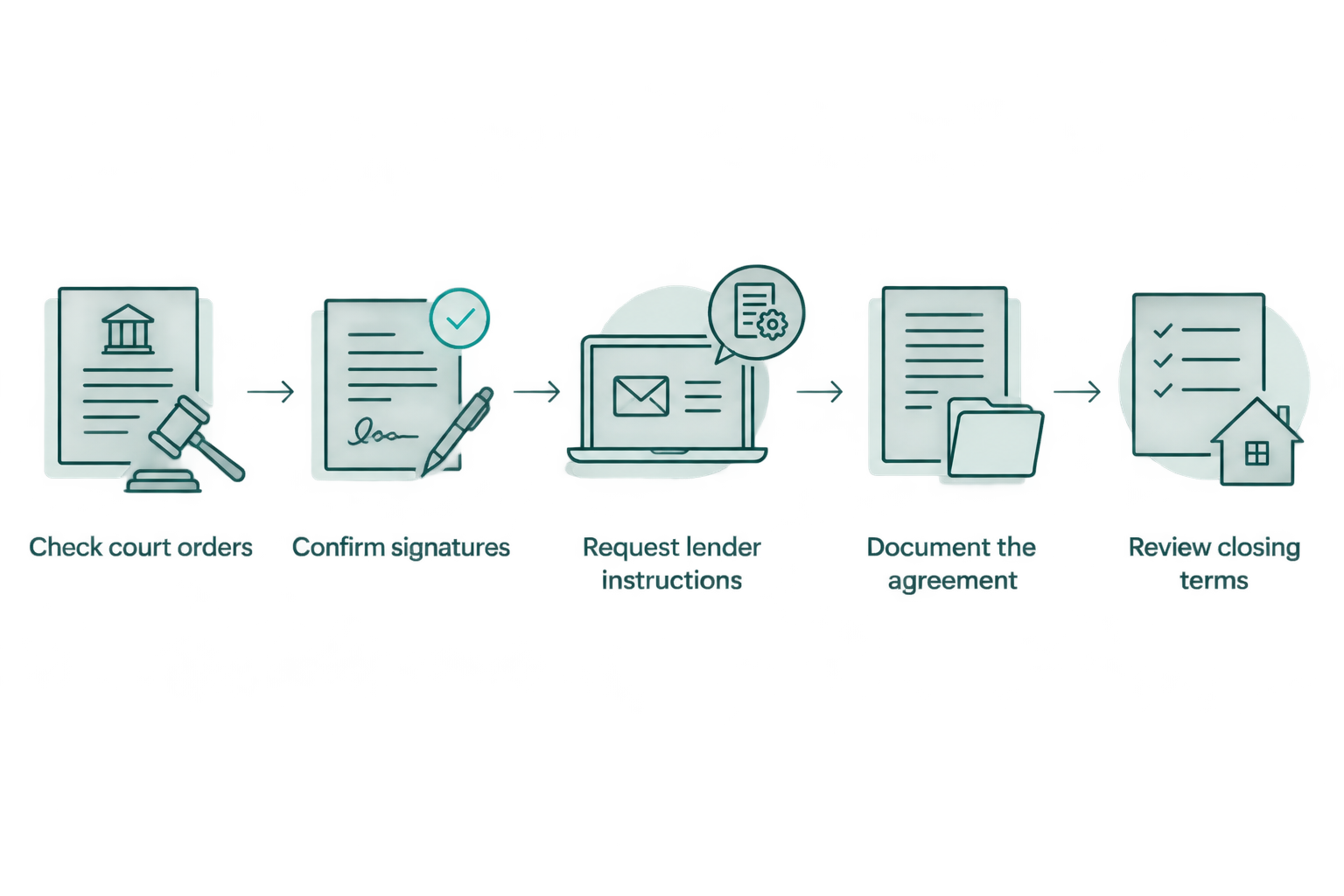
Use this sequence before making promises to a buyer:
- Check court orders. Ask whether temporary restrictions, required consent, or court approval affect listing or selling the home.
- Confirm signatures. Have the closing professional identify the owners and other people whose signatures are required under applicable law.
- Request lender instructions. Get the current short-sale submission requirements and explain that the borrowers are divorcing.
- Document the agreement. Have your attorneys address cooperation, property expenses, access, and the handling of lender demands.
- Review closing terms. Check written lender approval, title requirements, and any remaining debt before signing final documents.
Why this matters
Divorce and mortgage approval are separate processes. Your divorce court addresses rights and duties between spouses; your lender evaluates the proposed mortgage settlement. Resolving one does not automatically resolve the other.
A settlement assigning the mortgage to your spouse does not, by itself, release you from your loan obligation. Moving out also does not remove your name from the loan or transfer your ownership interest.
Plan the property sale and the divorce together, but verify each approval separately. That keeps a workable sale from depending on an assumption about what the divorce paperwork accomplishes.
Selling before divorce versus waiting: what changes?
Neither timing choice fixes an unaffordable mortgage on its own. Compare the practical benefit with the unresolved issue before choosing a path in 2026.
| Option | Best for | Main benefit | Main limitation |
|---|---|---|---|
| Short sale before divorce is final | Spouses seeking an agreed exit from an underwater home | Lets the property transaction proceed alongside the divorce | Requires coordinated signatures, legal authority, and lender approval |
| Wait until after divorce | Spouses who need ownership or sale authority resolved first | Lets the divorce address disputed responsibilities before closing | Waiting does not suspend mortgage obligations or foreclosure deadlines |
| Keep the home and explore mortgage assistance | A household seeking to retain the property | Allows review of a home-retention alternative | Assistance depends on eligibility and does not automatically release a departing borrower |
Selling before the divorce is final
An earlier sale lets you address the property without waiting for every divorce issue to be resolved. That is useful when both spouses agree to sell but still have other matters to settle.
The drawback is coordination. Financial documents, signatures, court permissions, lender review, and buyer deadlines must line up. Choose this route only after your attorney confirms the legal path and both sellers understand the proposed responsibilities.
Waiting until the divorce is final
Waiting gives the divorce process time to resolve a disagreement about whether to sell or who has authority to act. It also lets your attorneys address cooperation in the final agreement or order.
The drawback is that the mortgage remains separate from that timetable. Do not assume a divorce hearing or settlement discussion pauses collection activity. Ask the servicer about the account’s status and your attorney about any urgent deadlines.
Keeping the home instead
If you want to stay, ask the servicer about available mortgage-assistance options before committing to a sale. Review whether the household keeping the property can carry the ongoing obligations.
The limitation is borrower liability. Permission for one spouse to live in the home is not the same as a lender releasing the other spouse from the loan.
What needs to be settled between you and your spouse?
Start with the decisions that can interrupt a closing. You do not need to resolve every divorce issue before discussing a sale, but the transaction needs clear instructions from people authorized to give them.
Have your attorneys address:
- Cooperation: Who will provide documents, respond to requests, and sign when required?
- Property expenses: How will you handle mortgage payments, insurance, utilities, maintenance, and other obligations while the sale is pending?
- Access: Who will coordinate showings, inspections, valuation visits, and closing appointments?
- Lender conditions: How will you respond if approval requires terms either spouse disputes?
- Possession: When will occupants leave, and how will belongings and keys be handled?
Keep the agreement consistent with existing court orders. A private understanding between spouses is not a reason to disregard a court restriction.
Do not sign your spouse’s name or assume that marriage gives you authority to sign for them. If someone cannot attend closing, ask the closing professional and attorney what legally valid arrangements are acceptable.
What documents should you prepare?
Request the lender’s current checklist rather than treating a generic list as complete. For a 2026 submission, confirm which financial records must be current and how the lender wants separate households documented.
Common short-sale requests include a hardship explanation, income information, bank statements, tax documents, the purchase contract, and an estimated closing statement. Exact requirements depend on the loan and the reviewing parties.
Explain the financial effect of the separation plainly. Describe changes such as supporting separate households or losing access to income only when they are true. A divorce filing alone does not establish that the lender will approve a short sale.
Ask your attorney which divorce documents should be provided and how sensitive information should be handled. Send financial records through the recipient’s approved secure method, not a group message with everyone involved in the transaction.
Why the path to approval varies
A pending divorce adds coordination, but it does not create a single nationwide short-sale procedure. These factors determine what needs attention:
- Court restrictions and state law: Local rules and case-specific orders affect authority to transfer marital property.
- Ownership and borrower status: The deed and loan documents serve different purposes; required participation depends on both.
- Cooperation between spouses: Missing signatures or disputed instructions can leave the transaction unable to proceed.
- Loan and lien requirements: The mortgage and other liens must be addressed for the proposed closing.
- Financial documentation: The lender needs the records required to evaluate the request and proposed transaction.
- Existing deadlines: Contract dates, court dates, approval expirations, and foreclosure activity require separate tracking.
Ask what remains unresolved, who owns that task, and what written confirmation will resolve it. A general statement that the file is being reviewed does not answer those questions.
What if my spouse refuses to cooperate?
A spouse’s refusal can prevent a voluntary closing when that spouse’s consent or signature is required. Tell your divorce attorney exactly what is missing: permission to list, lender authorization, financial records, or closing signatures.
Your attorney can explain whether an agreement or court relief is available under state law. Do not promise the buyer that the lender, agent, or processor can override the refusal.
Keep communications factual. Record requests and responses without turning the transaction file into an argument about the marriage. The immediate goal is to identify the legal obstacle and the person authorized to address it.
Does lender approval erase the unpaid mortgage balance?
Lender approval does not automatically establish that every unpaid balance is forgiven. The written approval terms and applicable law determine the treatment of the remaining debt.
Ask your attorney to distinguish permission to release the mortgage lien from a release of personal liability. Those are different issues. If the approval language is unclear, get clarification before closing rather than relying on a verbal summary.
Your divorce agreement should also address responsibility between spouses for obligations that remain. That allocation does not automatically bind a lender that has not agreed to it.
Will I owe taxes if the sale closes during my divorce?
Canceled mortgage debt can have tax consequences, and exclusions depend on the facts and applicable law. Have a qualified tax professional review a proposed 2026 closing using your actual loan history and tax situation.
Do not assume that divorce, financial hardship, or lender approval makes cancellation of debt tax-free. Ask how filing status, ownership, use of the property, and any applicable exclusion affect your situation.
Keep the approval letters, closing statement, loan records, and relevant tax forms. Your tax professional needs the transaction documents, not just confirmation that the house sold.
Where short-sale processing help fits
Shortsalesdoneright is best for homeowners who want short-sale processing and lender negotiation support while comparing an exit from an upside-down mortgage. The service helps homeowners compare a short sale with other options; it does not replace independent legal or tax advice.
For agents, Shortsalesdoneright prepares the full short-sale package and provides a dedicated point of contact with weekly lender updates. That is a different role from deciding either spouse’s legal rights or representing a homeowner in divorce court.
If you are ready to discuss your situation, visit Shortsalesdoneright and use the appropriate intake form. Explain that a divorce is pending, whether both owners agree to sell, and whether any court or foreclosure deadline is already scheduled.
Request help with your short sale
Explain your pending divorce, mortgage situation, and any existing deadlines through the appropriate intake form.
FAQ
Can I start a short sale before filing for divorce?
Yes, you can explore a short sale before filing for divorce. Confirm ownership, required consent, lender requirements, and any legal restrictions before committing to a sale.
Do both spouses have to sign a short sale?
Required signatures depend on ownership, loan documents, state law, and court orders. Have your attorney and closing professional identify the required signers rather than assuming both spouses—or only the borrower—must sign everything.
Does a divorce decree take my name off the mortgage?
A divorce decree does not, by itself, remove your name from the mortgage loan. A division of responsibility between spouses is separate from a lender’s release of a borrower.
Does starting a short sale stop foreclosure during divorce?
Starting a short sale does not, by itself, guarantee that foreclosure stops. Ask the servicer for written confirmation of the account’s status and have an attorney review any scheduled sale or response deadline.
Can I move out before the short sale closes?
Moving out does not remove your ownership interest or mortgage obligations. Review court orders, insurance requirements, property care, and access arrangements before leaving.
Will a short sale protect my credit during divorce?
A short sale does not guarantee a particular credit result. Mortgage payment history and how the account is reported affect the outcome, so do not choose a sale based on a promised credit-score change.
Can the lender approve the sale before the judge approves it?
Lender review and court review are separate processes. Receiving lender approval does not authorize you to disregard a court restriction or close without required legal permission.
One last thing
An approval letter is not a substitute for checking who still owes what. Before a 2026 closing, ask your attorney to review the lender’s debt language alongside the divorce agreement—not as unrelated documents.
Your final check should answer three separate questions: Can the property legally transfer? What obligations remain with the lender? What responsibilities remain between spouses? Clear answers matter more than simply getting the house sold.
Lender terms and state law vary. Direct legal questions to your attorney and tax questions to a qualified tax professional.