

Best for an agreed exit from an underwater home: a professionally coordinated short sale. Best for keeping the home: a buyout with lender-approved financing. Best for a home with enough equity: a conventional sale. This 2026 guide compares short sale during divorce options by ownership, affordability, and lender requirements.
- Shortsalesdoneright provides short sale processing and lender negotiation for homeowners who need help managing an underwater-home sale.
- Compare short sale during divorce options against a conventional sale, buyout, loan modification, and deed in lieu.
- A divorce agreement does not itself remove a borrower from the mortgage loan.
- Get written lender terms and legal advice before accepting responsibility for any remaining mortgage balance.
Why this matters
Divorce creates two separate decisions: who receives the home, and who remains responsible for its mortgage. An agreement between spouses does not automatically change the lender’s rights under the loan.
If you owe more than the home can sell for, Shortsalesdoneright provides short sale processing and lender negotiation services. That support addresses the sale process; your divorce attorney addresses ownership, signing authority, and the settlement between spouses.
Shortsalesdoneright short sale processing is best for homeowners who need help coordinating an underwater-home sale and lender negotiations during divorce. It does not replace legal advice or guarantee approval.
For a 2026 decision, compare what each option actually resolves. Transferring ownership, ending occupancy, and ending loan liability are different outcomes. You need to understand each before signing.
What makes the best divorce-related home exit
Use these criteria before choosing an option:
- Equity: Does the expected sale amount cover the mortgage payoff and transaction expenses?
- Affordability: Can the spouse keeping the home support its ongoing obligations independently?
- Signing authority: Who must approve the listing, offer, lender documents, and ownership transfer?
- Loan responsibility: What written lender action releases either borrower from the debt?
- Timing: How do lender review, court requirements, and any foreclosure deadlines interact?
- Remaining obligations: What do the documents say about unpaid debt, contributions, and taxes?
A strong option fits your finances and can be carried out by everyone whose participation is required. Agreement between spouses helps, but it is not a substitute for lender consent when that consent is necessary.
Divorce housing options at a glance in 2026
These 6 options serve different situations. The order follows the decisions facing a divorcing homeowner, not a claim that one approach beats every alternative.
| Option | Best for | Main benefit | Key limitation |
|---|---|---|---|
| Professionally coordinated short sale | Both spouses want to sell an underwater home | Organizes the package and lender negotiation | Requires lender approval and seller cooperation |
| Attorney-coordinated short sale | Disputed ownership or signing authority | Aligns the sale with legal requirements | Legal coordination does not guarantee lender acceptance |
| Conventional sale | Proceeds can cover payoff and expenses | Avoids requesting a short payoff | Does not solve a proceeds shortfall |
| Buyout with financing or lender release | One spouse wants and can afford the home | Creates a path to separate ownership and debt | Requires financing or an acceptable lender arrangement |
| Loan modification | Keeping the home remains the shared goal | Seeks changes to the existing loan | Does not itself separate joint borrowers |
| Deed in lieu | A property transfer is preferable to finding a buyer | Avoids a buyer-dependent sale | Lender acceptance and debt-release terms still matter |
1. Professionally coordinated short sale: best for an agreed exit
A short sale asks the lender to accept less than the full mortgage payoff from the sale proceeds. It fits an underwater property when neither spouse intends to keep the home and both can participate in the transaction.
Shortsalesdoneright short sale services provide processing and lender negotiation. The service benefits include preparing the full short-sale package for agents, a dedicated point of contact, and weekly lender updates. You still need legal advice about your divorce settlement and the lender’s proposed terms.
Coordinated short sale pros:
- Gives the sale package and lender communication a defined process.
- Supports agents handling the transaction while homeowners address the divorce.
- Provides a dedicated point of contact and weekly lender updates.
Coordinated short sale cons:
- The lender can decline the proposed transaction.
- Missing documents or disputed signatures can prevent progress.
- Approval does not automatically mean every unpaid obligation is forgiven.
Best for: Cooperative spouses who want to sell an underwater home rather than retain it.
Before proceeding, agree on document access, communication, and who answers requests. Ask your attorney to review any proposed cash contribution or remaining-debt provision before either spouse accepts it.
Verdict: Choose a coordinated short sale when both spouses want an exit and the lender’s written terms are acceptable.
2. Attorney-coordinated short sale: best for disputed authority
An attorney-coordinated short sale follows the same lender approval process, but legal issues control how it moves forward. It fits situations where spouses disagree about selling, one person will not sign, or an existing court order affects the property.
Your attorney establishes what authority exists and what additional agreement or court action is needed. The agent and processor then work within that authority; they do not decide the spouses’ legal rights.
Attorney-coordinated short sale pros:
- Addresses signing and ownership disputes before closing documents arrive.
- Helps align the transaction with applicable court requirements.
- Separates lender negotiations from disputes between spouses.
Attorney-coordinated short sale cons:
- Resolving the legal dispute adds work beyond the sale itself.
- A court order affecting spouses does not automatically bind the lender.
- Unresolved participation issues can still stop the transaction.
Best for: Homeowners who need an underwater-home exit but lack clear agreement or signing authority.
Do not ask the buyer or agent to rely on a verbal promise that the other spouse will cooperate. Have your attorney explain the required authority and signing process before you commit to transaction deadlines.
Verdict: Hold transaction commitments until your attorney confirms how the sale can lawfully proceed.
3. Conventional sale: best for sufficient equity
A conventional sale is the better fit when the proceeds can cover the mortgage payoff and transaction expenses. You do not need to request a short payoff simply because the sale happens during divorce.
Start with an agent’s supported market assessment and current payoff information. Compare the expected net proceeds with the actual obligations, not an online estimate alone.
Conventional sale pros:
- Avoids a request for lender acceptance of a mortgage shortfall.
- Converts the property into proceeds that the settlement can address.
- Removes the need to decide which spouse keeps the property.
Conventional sale cons:
- Expected equity can disappear when the full transaction is accounted for.
- Ownership disputes and required signatures still need resolution.
- Spouses still need an agreement about distributing the proceeds.
Best for: Homeowners whose expected net sale proceeds are sufficient to complete the transaction.
Ask how proceeds will be held and distributed if the divorce settlement is unfinished. Your closing professional and attorney should explain the arrangement before closing, not after the funds arrive.
Verdict: Choose a conventional sale when the numbers support a full payoff.
4. Buyout with financing: best for one spouse keeping the home
A buyout addresses the departing spouse’s ownership interest. Refinancing or an approved lender release addresses mortgage responsibility. Those are separate tasks, even when the divorce agreement treats them as one plan.
Do not assume that transferring the deed removes a name from the loan. Confirm the financing or release requirements directly with the lender before committing to a settlement built around keeping the property.
Buyout with financing pros:
- Lets one spouse pursue continued ownership and occupancy.
- Can separate mortgage responsibility if the required financing or release succeeds.
- Avoids listing the home when retention is financially workable.
Buyout with financing cons:
- The retaining spouse must meet the relevant lender requirements.
- An underwater home complicates the equity and financing discussion.
- A deed transfer alone leaves loan responsibility unresolved.
Best for: A spouse who wants the home and can support an independently workable ownership plan.
For a 2026 settlement, ask the lender to evaluate the actual proposed arrangement. Include ongoing taxes, insurance, maintenance, and any applicable association obligations in your affordability review.
Verdict: Choose a buyout only after confirming affordability and a workable plan for the departing borrower’s loan responsibility.
5. Loan modification: best for retaining the home through hardship
A loan modification changes agreed terms of an existing mortgage when the lender approves it. It is an alternative to selling, not a method of dividing ownership between spouses.
This option belongs in the discussion when retaining the property remains the goal. If one spouse intends to leave the loan, ask separately how that release would occur.
Loan modification pros:
- Gives homeowners a route to request changes to the existing loan.
- Supports a retention plan rather than a sale.
- Lets you assess lender alternatives before committing to an exit.
Loan modification cons:
- Approval and available terms depend on the lender and loan.
- Revised payments do not automatically resolve joint liability.
- Keeping an unaffordable home remains a problem despite a modification request.
Best for: Homeowners pursuing retention who need to assess whether revised loan terms support that goal.
Avoid treating a pending request as an approved solution. Ask how review affects current payment requirements and any foreclosure activity, and obtain the answer in writing.
Verdict: Hold the retention decision until approved terms and the divorce arrangement work together.
6. Deed in lieu: best for an exit without a buyer-dependent sale
A deed in lieu involves voluntarily transferring the property to the lender under an agreed arrangement. It is an alternative to a short sale, which requires a buyer and an approved transaction.
The lender must agree to the transfer. Title issues, other liens, and the lender’s requirements can affect whether this route is available.
Deed in lieu pros:
- Removes the need to complete a sale to a third-party buyer.
- Provides another exit proposal to discuss with the lender.
- Allows you to evaluate transfer and remaining-debt terms together.
Deed in lieu cons:
- The lender is not required to accept the proposal.
- Other liens or title problems can complicate acceptance.
- Debt release must be established by the applicable terms and law.
Best for: Homeowners seeking an exit who want to assess a lender-accepted property transfer instead of a buyer-dependent sale.
Compare the written proposal with the short sale alternative. Ask your attorney what happens to any remaining balance and whether the documents release each borrower.
Verdict: Consider a deed in lieu only after reviewing acceptance requirements and written debt-release terms.
Put the decision in the right order
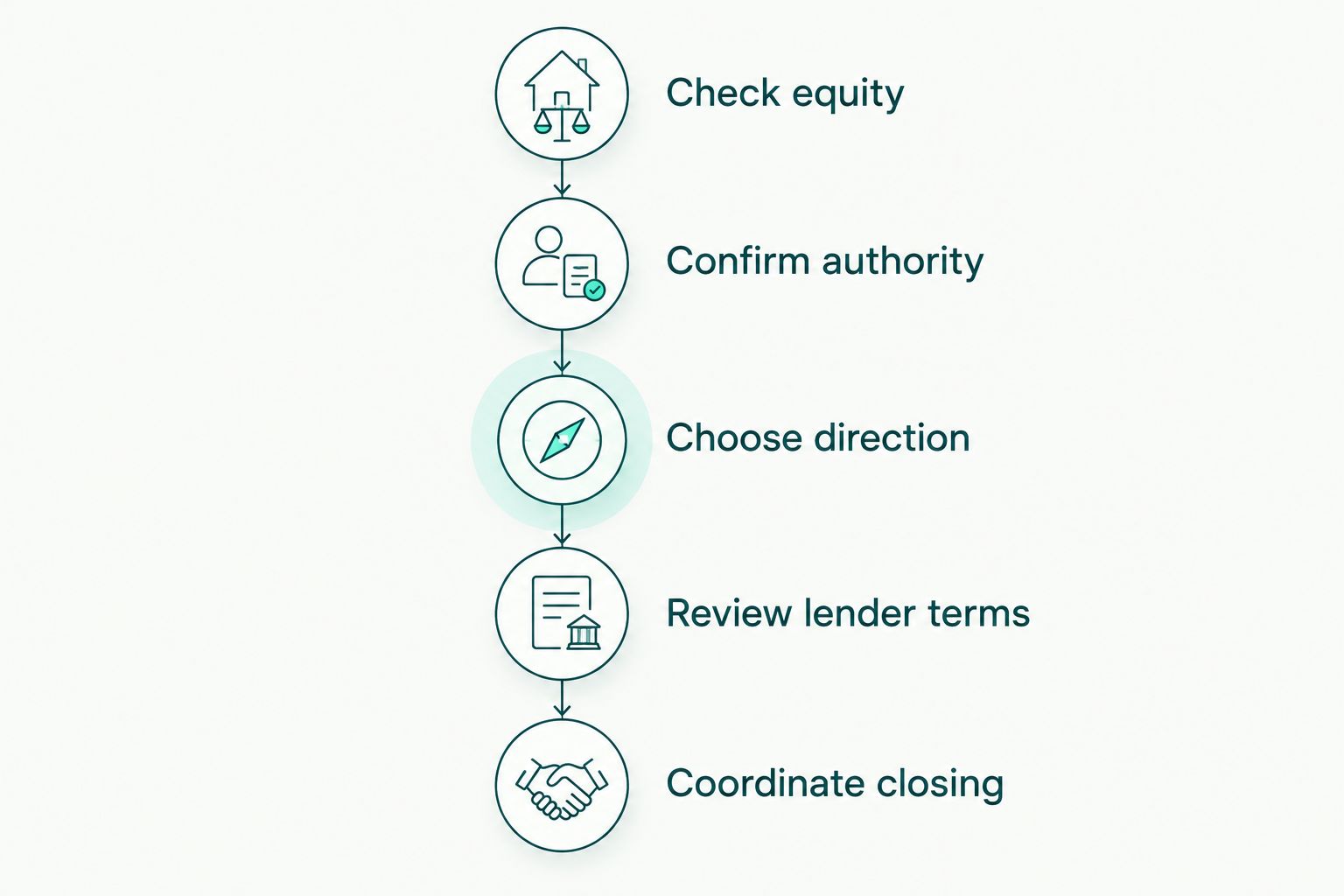
For a 2026 divorce-related housing decision, use this sequence before accepting an offer or finalizing a property settlement:
- Check equity. Obtain current payoff information and a supported estimate of net sale proceeds.
- Confirm authority. Ask your attorney who must sign and how court requirements affect the transaction.
- Choose direction. Decide whether you are pursuing retention or an exit.
- Review lender terms. Confirm approval requirements, borrower releases, and remaining obligations.
- Coordinate closing. Align the sale or transfer with the divorce agreement and required documents.
A lender review also needs a coherent submission. Use the guide to documents to include in a short sale package to organize the paperwork discussion with your agent and processor.
If you are ready to assess an underwater-home sale, request homeowner help through the appropriate intake form on the site. Keep legal and tax questions with qualified professionals.
Request help with your short sale
Discuss your underwater-home situation and the lender negotiation process.
How these options are ranked
This guide ranks options by the problem they address: an agreed exit, disputed authority, sufficient equity, individual retention, loan hardship, or a lender-directed transfer. It does not rank them by promised approval, credit outcomes, or debt forgiveness.
Lender terms and state law vary. The best choice is the one whose written requirements fit your finances and divorce arrangement.
Which option should you choose?
Start with a coordinated short sale if the home is underwater, neither spouse wants to keep it, and both can participate. Start with attorney coordination instead if authority or cooperation is unresolved.
If the home has sufficient equity, choose the conventional-sale path. If one spouse wants to stay, confirm financing and loan responsibility before treating a buyout as settled. Do not let attachment to the home substitute for an affordable plan.
FAQ
What are the best short sale during divorce options in 2026?
A coordinated short sale fits spouses who agree to sell an underwater home; an attorney-coordinated short sale fits unresolved authority or signing disputes. Compare both with a conventional sale, buyout, loan modification, and deed in lieu according to equity and affordability.
Can I sell our home in a short sale if my spouse refuses?
Your ability to proceed depends on ownership, required signatures, court orders, and state law. Ask your divorce attorney to establish the necessary authority before promising a buyer that the sale can close.
Does a divorce decree remove me from the mortgage?
A divorce decree does not itself remove you from the mortgage loan. Confirm with the lender what refinancing, approved release, or other action is required to end your responsibility.
Will a short sale forgive the remaining mortgage balance?
A short sale does not automatically guarantee forgiveness of the remaining balance. Have an attorney review the written lender terms and applicable state law, and direct tax questions to a qualified tax professional.
Is a short sale better than foreclosure during divorce?
There is no universal better option because lender terms, state law, timing, and borrower obligations differ. Compare the actual short sale proposal with your circumstances rather than assuming a particular credit result or debt outcome.
Should one spouse refinance instead of doing a short sale?
Refinancing is the retention route to assess when one spouse wants the home and can meet the lender’s requirements. A short sale addresses an underwater-home exit instead; neither route should be selected without reviewing affordability and borrower responsibility.
Who can help us coordinate a short sale during divorce?
Shortsalesdoneright provides short sale processing and lender negotiation services. Your real estate agent handles the property transaction, while your attorney addresses divorce-related authority, settlement terms, and legal questions.
One last thing
Before signing in 2026, compare 2 separate documents: the ownership-transfer document and the lender’s debt-release terms. One can change who owns the home without changing who owes the mortgage.
Ask 3 questions: Who owns the home afterward? Who owes the lender afterward? What obligation remains after closing? Get clear answers before treating the housing issue as resolved.