

Yes. A co-owner can generally block a voluntary short sale of the entire property by refusing to sign documents that require their consent. Lender approval does not override ownership rights or replace a required signature. Your next step is to have a title professional and a real estate attorney confirm who must sign, whether anyone has valid authority to act for that owner, and what state law allows.
- Can a co-owner block short sale completion? Yes, when that owner's consent is legally required.
- A deed establishes ownership; loan documents establish repayment obligations. Check both before deciding whose cooperation you need.
- Shortsalesdoneright handles short sale processing and lender negotiation, not court resolution of ownership disputes.
- Lender terms and state law vary. Get legal advice before relying on a power of attorney or court order.
Why this matters
An ownership disagreement and a lender negotiation are different problems. Sending more financial documents to the bank does not resolve an owner's refusal to sell. Waiting for lender approval before addressing that refusal leaves a closing requirement unresolved.
For your 2026 short sale, separate 2 approvals: the owners' authority to transfer the property and the lender's agreement to the short payoff. Neither replaces the other. Shortsalesdoneright provides short sale processing and lender negotiation services; a disputed ownership right requires legal advice.
Can a co-owner block a short sale if they disagree?
A co-owner whose consent is required can generally prevent a voluntary sale of the whole property from closing. The answer depends on the recorded ownership, applicable state law, and any valid authority permitting someone else to sign. Disagreeing with the sale is different from lacking legal power to prevent it.
| Situation | What it means for the sale | What you should verify |
|---|---|---|
| Co-owner is on the deed and refuses to sign | The refusal can prevent transfer of the entire property | Required signatures and available legal remedies |
| Co-borrower signed the loan but is not on the deed | Loan obligations and lender requirements still need review | Whether the lender requires participation or documents |
| Co-owner agrees but cannot attend closing | The problem concerns signing arrangements rather than consent | Closing instructions and accepted signing authority |
| Someone claims authority under a court order or power of attorney | The document needs review before anyone relies on it | Its scope, validity, and acceptance for the transaction |
Do not assume the person making mortgage payments is the only person whose approval matters. Likewise, moving out does not remove someone from title or release a borrower from the loan.
This page concerns a sale of the entire property. Selling only your ownership interest is a different transaction. It does not, by itself, resolve the mortgage or create a lender-approved short sale.
Why a co-owner's ability to block the sale varies
The word “co-owner” does not answer every signing question. These factors determine what needs review:
- Recorded ownership. The current deed identifies the ownership interests that the proposed sale must address.
- Loan obligations. The borrowers' repayment obligations are separate from the ownership shown on the deed.
- Marital rights. State law can create spousal signing requirements even when a spouse is not listed as an owner.
- Signing authority. A power of attorney, trust document, estate appointment, or court order needs transaction-specific review.
- Existing proceedings. Divorce, probate, bankruptcy, or another court proceeding can affect authority to sell.
- Lender requirements. The lender's approval conditions determine what it requires for the short payoff, not who owns the home.
Do not settle a signing dispute by counting names on a mortgage statement. Have the title professional identify the requirements, and refer disputed rights to an attorney licensed in the property's state.
What should you do when a co-owner refuses to sign?
Start with 3 records: the current deed, the signed loan documents, and any document claimed to authorize someone else to act. Give copies to the professionals reviewing the transaction. A verbal account of what an ex-spouse, relative, or lender said is not a substitute for reviewing the actual documents.
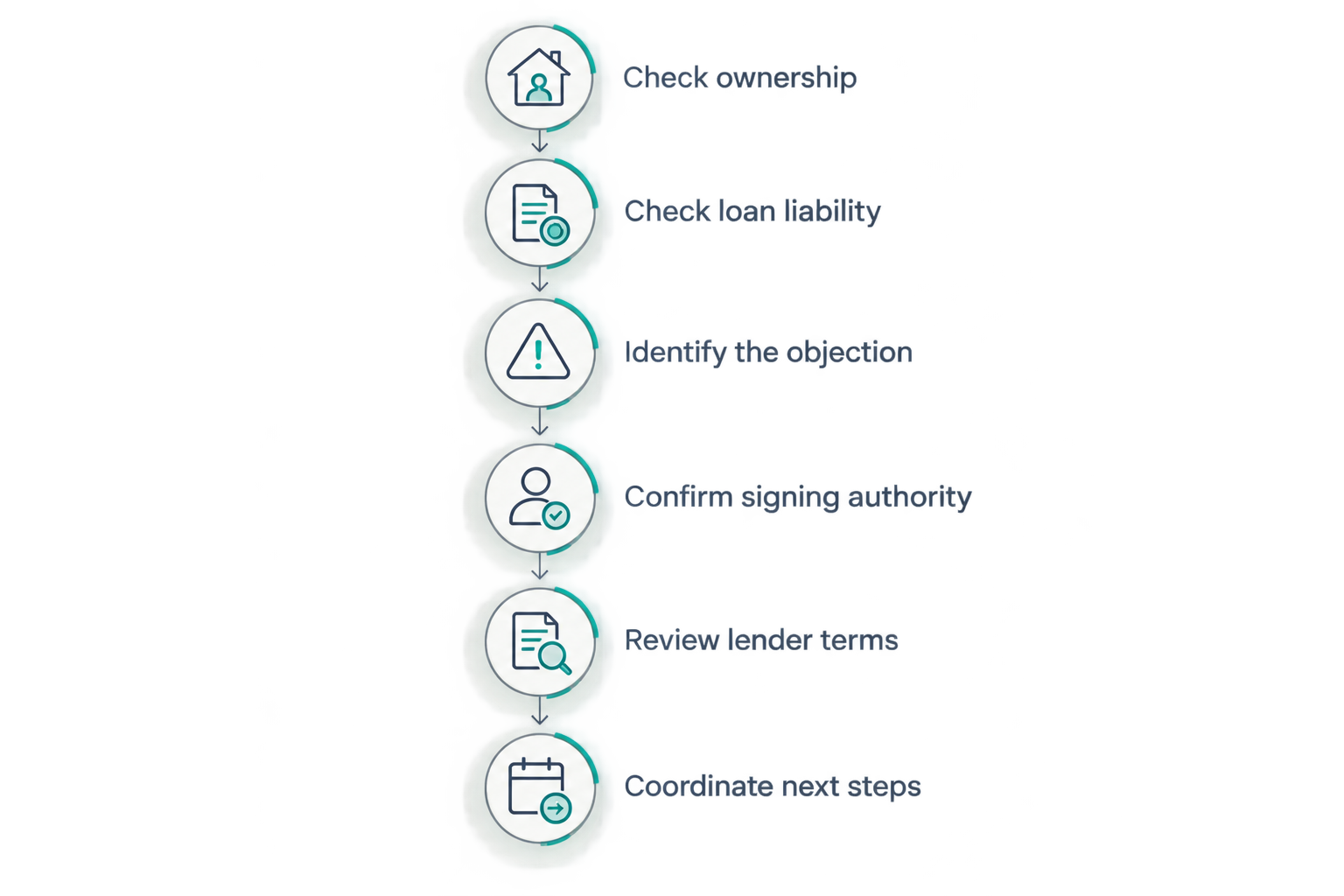
Use these 6 steps to organize your next move in 2026.
Check ownership
Ask the title company or closing attorney to confirm the current ownership and identify required signers. Flag any deceased owner, trust, business entity, or pending ownership dispute immediately.
Do not rely only on an old purchase contract or tax bill. You need the ownership requirements for this proposed closing.
Check loan liability
Identify who signed the repayment obligation and what the lender requires from each borrower. A co-owner and a co-borrower are not interchangeable roles.
Ask the lender or authorized processor which financial documents and authorizations it needs. Do not submit another person's signature or represent that the person has consented when they have not.
Identify the objection
Ask whether the disagreement concerns selling, moving, unpaid debt, tax consequences, or the proposed terms. Write down the actual objection rather than describing the person as simply uncooperative.
A homeowner worried about remaining debt needs the proposed lender terms explained. A homeowner disputing ownership needs legal advice. Those problems require different responses.
Confirm signing authority
If someone proposes signing for the refusing owner, have an attorney review the claimed authority. The title company and lender also need to confirm whether the documents satisfy their requirements.
Marriage, family relationship, or paying the mortgage does not by itself authorize you to sign another owner's name. Do not assume an existing power of attorney covers the transaction.
Review lender terms
Ask for the lender's written requirements and review any approval conditions before signing. Pay particular attention to language addressing the unpaid balance and any obligations the lender asks a borrower to accept.
Approval to release a lien is not automatically a release from personal liability for the remaining debt. Have an attorney explain the distinction and a qualified tax professional address potential tax consequences.
Coordinate next steps
Tell your agent, processor, and closing professional exactly what remains unresolved. Ask who owns each follow-up task and whether any contract, lender, or foreclosure deadline requires immediate attention.
Do not give the buyer an unconditional assurance that every seller will sign. Keep communications accurate while the ownership question is being resolved.
Which approach fits the disagreement?
Choose the response that addresses the objection, not the response that pressures the owner fastest. More bank follow-up will not settle a dispute over ownership. A lawsuit is not a substitute for understanding why someone objects.
| Approach | Best for | Benefit | Limitation |
|---|---|---|---|
| Documented discussion | Owners who need facts about the proposed sale | Identifies specific questions and requested terms | Does not compel consent |
| Mediation | Owners willing to seek an agreement with a neutral facilitator | Provides a structured setting for discussing the disagreement | Does not guarantee a settlement or lender acceptance |
| Attorney review | Disputed ownership, authority, or court-related issues | Identifies applicable rights and potential remedies | Does not guarantee a sale or short payoff approval |
If voluntary agreement fails, ask an attorney whether a partition action or another court remedy is available. A partition action concerns dividing jointly owned property or obtaining a court-directed sale, subject to applicable law.
Do not treat a possible court remedy as a guaranteed route to this buyer, this contract, or this lender's approval. The mortgage and any other liens still require attention.
Can my ex-spouse block the short sale after a divorce?
An ex-spouse can generally block a voluntary short sale if their required consent remains unresolved. A divorce agreement or decree needs review alongside the current title and loan documents. Do not assume that being assigned the house also removed the other person from ownership or released either borrower from the lender's claim.
Give your real estate attorney the complete order, not just the paragraph discussing the home. Ask what it requires, whether additional documents are necessary, and how any refusal should be addressed.
For a 2026 sale, make this review an early task. Your agent can coordinate the transaction, but the agent should not interpret a disputed divorce order or promise to enforce it.
Does lender approval let me sell without the other owner?
Lender approval does not, by itself, let you sell without a required owner's consent. The lender is deciding whether to accept the proposed short payoff under its conditions. It is not granting you authority to transfer someone else's ownership interest.
Read the approval letter with the closing professional and your attorney. Confirm the required signers, expiration conditions, and treatment of the unpaid balance before describing the transaction as ready to close.
Ownership disputes are one reason a transaction needs continued attention after approval. See whether a short sale can collapse after lender approval before treating the bank's decision as the final step.
Does a co-owner dispute stop foreclosure?
A co-owner dispute does not automatically stop foreclosure. Neither the disagreement nor a pending short sale request establishes that a scheduled foreclosure has been postponed. Confirm the actual status rather than relying on an assumption.
If you have received foreclosure papers or notice of a sale date, contact a qualified attorney promptly. Ask the servicer for the current status, but obtain legal advice about deadlines and available protections.
Do not withhold mortgage payments to force another owner to agree. Get advice about your obligations and alternatives based on the loan, your finances, and your state's law.
Where short sale processing helps—and where it stops
Shortsalesdoneright is best for homeowners and agents who need short sale processing and lender negotiation support. For agents, the service includes preparing the full short sale package, a dedicated point of contact, and weekly lender updates. For homeowners, support includes comparing a short sale with other options.
That support addresses the lender-facing work. It does not replace legal advice about an unwilling owner, authorize someone to sign without valid authority, or guarantee lender approval. Keeping those boundaries clear helps you assign the right issue to the right professional.
If you are ready to act, request help through the appropriate homeowner or agent intake form on the website. Explain the co-owner disagreement at the outset, including any known court proceeding or foreclosure notice.
Get help with your next step
Explain the ownership disagreement and request homeowner or agent short sale support.
What should you confirm before moving ahead in 2026?
Before you commit to the next transaction milestone, get clear answers to these questions:
- Who owns the property, and whose signature does the closing professional require?
- Who owes the mortgage debt, and what does the lender require from each borrower?
- What exactly does the refusing owner object to?
- Has an attorney reviewed any disputed authority, court order, or ownership claim?
- What does the proposed approval say about the remaining debt?
- Who is tracking contract deadlines, approval conditions, and foreclosure notices?
Ask for explanations you understand. “The bank approved it” is not an answer to “Who has authority to sign?” Keep those questions separate in every conversation.
FAQ
Can a co-owner block a short sale just by refusing to sign?
Yes, a co-owner can generally block a voluntary sale of the entire property when their signature is required. Have a title professional confirm the signing requirements and an attorney assess any disputed rights or authority.
Can I sign for my co-owner if I pay the mortgage?
Paying the mortgage does not by itself authorize you to sign for a co-owner. Any claimed authority, such as a power of attorney, needs review for the transaction.
Does being on the mortgage mean I own the house?
Being obligated on the mortgage loan does not by itself establish ownership. Review the current deed for ownership and the signed loan documents for repayment obligations.
Can a judge make a co-owner cooperate with a short sale?
Whether a court can order cooperation or authorize a sale depends on state law and the case. A real estate attorney must assess the available remedies; court involvement does not guarantee lender approval.
Will a short sale erase what both owners owe?
A short sale does not automatically erase the unpaid balance for either borrower. Lender terms and state law determine the consequences, so have an attorney review any proposed release and consult a qualified tax professional.
Can an owner who moved out still block the sale?
Moving out does not by itself end an ownership interest or eliminate a required signature. Confirm the current title and any relevant agreements or court orders.
Can Shortsalesdoneright resolve an ownership dispute in 2026?
Shortsalesdoneright provides short sale processing and lender negotiation services, not court resolution of ownership disputes. Homeowners with disputed signing rights should consult a qualified attorney while coordinating the lender-facing work.
One last thing
An owner's signature and a borrower's debt release solve different problems. Getting everyone to sign does not prove that everyone is released from the remaining debt. Getting a lender's approval does not prove that everyone required to transfer ownership has agreed.
Before your 2026 closing, ask the closing professional to confirm the required signatures and ask your attorney to explain the written debt terms. Resolve both questions before assuming the disagreement is behind you. Lender terms and state law vary; direct legal and tax questions to qualified professionals.


