

You do not automatically owe taxes after a short sale: canceled mortgage debt can create taxable income, but an exclusion or exception can remove some or all of it. A lender's permission to sell does not establish whether the remaining debt is forgiven, and debt forgiveness does not establish your tax bill. For a 2026 transaction, have a qualified tax professional review the lender's written terms, your finances, and the rules that apply when the debt is canceled.
- Will I owe taxes after a short sale? Not automatically; canceled mortgage debt and available exclusions determine the answer.
- IRS Form 1099-C reports canceled debt, not your final tax bill.
- Shortsalesdoneright handles short-sale processing and lender negotiation; qualified professionals handle your legal and tax questions.
- For 2026 debt cancellation, do not assume the qualified principal residence exclusion still applies.
Why this matters
A short sale addresses a sale that cannot cover the mortgage payoff. Your tax return addresses a different question: what happened to the unpaid debt? Treating those as the same decision leaves an important part of your financial outcome unchecked.
Shortsalesdoneright provides short-sale processing and lender negotiation services and helps homeowners compare a short sale with other options. Keep that transaction help separate from tax advice. You need both the lender's written decision and a professional review of its consequences.
Will I owe taxes after a short sale?
You owe federal income tax on canceled mortgage debt only to the extent it is taxable after applicable exceptions and exclusions. The amount forgiven is not the amount of tax due. Any taxable portion becomes part of the income calculation on your return.
The IRS discusses these rules in Publication 4681, Canceled Debts, Foreclosures, Repossessions, and Abandonments. Its federal guidance distinguishes debt cancellation from the sale or disposition of property. State income-tax treatment requires a separate review.
| What happens to the unpaid balance? | Federal tax issue | What you need to establish |
|---|---|---|
| The lender cancels debt for which you are personally liable | Canceled debt generally enters the income calculation unless an exception or exclusion applies | The canceled amount and your eligibility for relief |
| The lender leaves a balance collectible | The sale does not, by itself, prove debt cancellation | Whether you still owe money under the agreement and state law |
| The debt is nonrecourse, meaning you are not personally liable | The disposition generally follows different rules and does not create cancellation-of-debt income | The loan's legal status and the sale calculation |
| Canceled debt qualifies for an exclusion | Some or all of the canceled amount can be excluded | The required facts, records, and reporting |
This distinction matters before you sign. Ask separately whether the lender releases its claim against the property and whether it releases you from personal repayment. Those are not interchangeable promises.
Insolvency: an exclusion tied to your financial position
For federal tax purposes, insolvency means your total liabilities exceed the fair market value of your total assets immediately before the debt cancellation. Being behind on your mortgage does not establish insolvency. Neither does owing more on the house than it is worth.
The insolvency exclusion is limited to the amount of insolvency. Your tax professional must examine your whole financial position, not just the property being sold. IRS Publication 4681 provides an insolvency worksheet and explains which assets and liabilities belong in that calculation.
Best for: homeowners whose total debts exceed their total asset values immediately before cancellation. The benefit is an exclusion tied to that shortfall; the limitation is that it does not automatically cover all canceled debt.
Gather account balances, loan statements, and support for asset values around the cancellation date. Records from when you first listed the house are not a substitute for records showing your finances immediately before cancellation.
Bankruptcy: different rules with broader consequences
Debt canceled in a qualifying Title 11 bankruptcy case is generally excluded from federal gross income. That does not mean filing bankruptcy is the right response to a potential short-sale tax issue. Bankruptcy has legal consequences that require advice from a qualified attorney.
Best for: professional review when bankruptcy is already part of your debt situation. The exclusion can address qualifying canceled debt, but it does not turn bankruptcy into a simple tax-planning shortcut.
Tell your tax preparer about any bankruptcy proceeding before the return is prepared. Exclusions can also require reductions to tax attributes, such as certain losses or property basis. Excluding income is not always the end of the tax analysis.
Principal residence debt: check the 2026 cutoff
The qualified principal residence indebtedness exclusion has a specific timing limit. It generally covers qualifying debt discharged before January 1, 2026, or qualifying debt discharged under an arrangement entered into and evidenced in writing before January 1, 2026.
A short sale completed in 2026 does not automatically qualify for this exclusion. For a 2026 cancellation, ask your tax professional whether a qualifying written arrangement meets the cutoff and whether the debt meets the other requirements.
The use of the borrowed money also matters. Debt used to buy, build, or substantially improve the main home receives different consideration from borrowing used for unrelated spending. Refinancing does not erase the need to trace how the borrowed funds were used.
Best for: homeowners whose debt and written cancellation arrangement satisfy the applicable requirements. The benefit is targeted relief for qualifying home debt; the limitation is that neither living in the home nor completing a short sale establishes eligibility.
Why short-sale tax outcomes vary
Your result depends on the debt, the cancellation terms, and your circumstances—not simply the label “short sale.” These factors deserve a direct answer before you rely on any tax estimate:
- Personal liability: Whether you are personally responsible for repayment affects the federal treatment of the unpaid debt.
- Written lender terms: Approval to sell and an agreement to forgive debt answer different questions.
- Cancellation date: Timing affects the applicable tax year, exclusion rules, and financial records needed.
- Assets and liabilities: Insolvency depends on your total financial position immediately before cancellation.
- Loan proceeds: How you used the borrowed funds matters when evaluating qualifying home debt.
- State treatment: State tax rules and laws governing unpaid balances vary.
Do not assume foreclosure avoids these questions. A foreclosure can also involve a property disposition and canceled-debt analysis. The short sale, foreclosure, and deed-in-lieu comparison explains the transaction choices; a qualified professional must evaluate your specific legal and tax outcome.
What should I do before accepting short-sale terms?
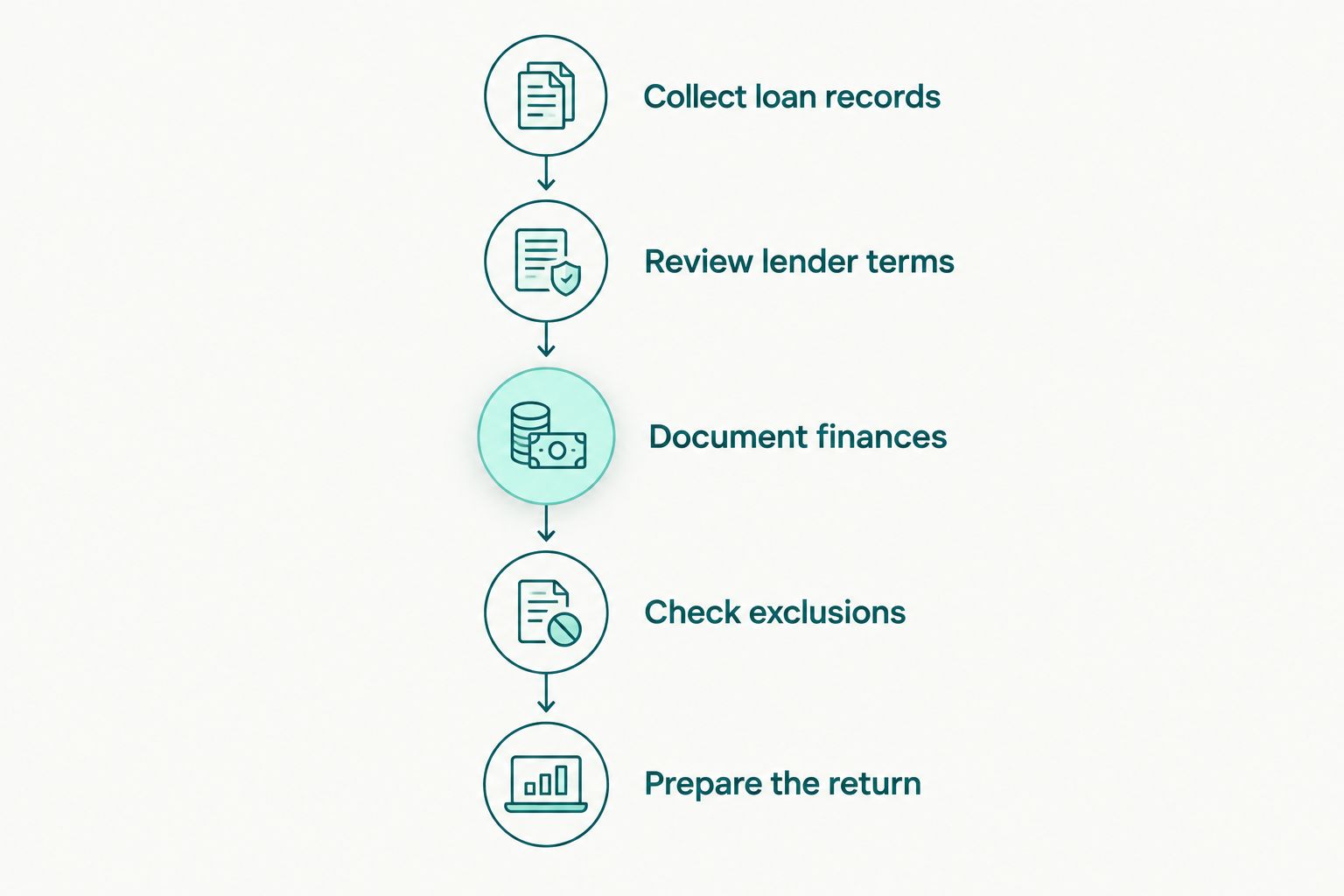
Review the debt outcome before treating the proposed sale as a complete financial resolution. Use this sequence to keep lender negotiations and tax preparation connected without confusing their roles.
- Collect loan records. Gather mortgage statements, refinancing records, and documents showing how borrowed funds were used. Include each loan secured by the property.
- Review lender terms. Ask what happens to the unpaid balance and whether the written agreement releases personal liability. Have an attorney explain unclear language.
- Document finances. Preserve asset values and liability balances immediately before cancellation if insolvency needs evaluation. Ask your preparer which supporting records to retain.
- Check exclusions. Have a qualified tax professional evaluate the available exclusions and their reporting requirements. For 2026 cancellation, address the principal residence cutoff explicitly.
- Prepare the return. Reconcile lender forms with the closing documents and report the sale and debt cancellation as required. Do not discard a form because you believe no tax is due.
Shortsalesdoneright is best for homeowners seeking short-sale processing and lender negotiation, not a tax determination. Its service helps address the lender process; it does not guarantee approval, forgiveness of an unpaid balance, or a particular tax result.
If you are ready to discuss a short sale, request help through the homeowner intake form on the site. Bring legal questions to an attorney and tax questions to a qualified tax professional.
Request help with your short sale
Discuss lender negotiation and compare a short sale with other options for your home.
Does Form 1099-C mean I owe tax?
Form 1099-C does not establish your final tax bill. It reports cancellation-of-debt information that your preparer must reconcile with the applicable rules and your records.
An applicable lender generally files Form 1099-C when reportable canceled debt is $600 or more. That $600 reporting threshold is not a tax-free allowance. A smaller canceled amount still requires review, even if no form arrives.
Check the reported amount, cancellation date, and personal-liability information. If something appears wrong, contact the lender and give your preparer the supporting documents. Do not simply substitute a preferred amount on your return without addressing the discrepancy.
Can I owe tax on the sale as well as canceled debt?
A short sale can require both a property-sale calculation and a separate canceled-debt calculation. Owing more than the home sells for does not prove you have a tax loss. Mortgage balance and adjusted tax basis measure different things.
For a qualifying main-home sale, the federal gain exclusion can reach $250,000 for an eligible individual or $500,000 for eligible married taxpayers filing jointly. Eligibility generally includes ownership and use requirements involving 2 years during the 5-year period before the sale, along with other conditions and exceptions. IRS Publication 523 explains the home-sale rules.
Those gain exclusions do not automatically exclude canceled mortgage debt. Give your preparer the purchase records, eligible improvement records, closing statement, and any lender tax forms so both calculations receive attention.
Can the lender collect the balance after closing?
A short sale does not automatically eliminate the remaining balance. The lender's written terms and applicable state law determine whether personal repayment remains an issue.
Ask an attorney to distinguish a release of the property lien from a release of your repayment obligation. If there is another mortgage, review that lender's terms separately. Do not assume one lender's agreement settles every loan.
FAQ
Will I owe taxes after a short sale in 2026?
You do not automatically owe taxes after a short sale in 2026. Canceled debt can be taxable, but exceptions and exclusions affect the result; state taxes require a separate review.
Does a 1099-C mean I must pay the amount shown?
No. Form 1099-C reports canceled-debt information, not a bill for that amount. Your tax professional must determine how much, if any, belongs in taxable income.
Is canceled mortgage debt below $600 tax-free?
No. The $600 threshold generally concerns an applicable lender's reporting requirement, not a tax-free allowance. Review canceled debt even when no Form 1099-C arrives.
How do I know whether I qualify for insolvency?
You are insolvent for this federal tax purpose when your total liabilities exceed the fair market value of your total assets immediately before cancellation. The exclusion is limited to that excess.
Does the mortgage debt exclusion apply to every 2026 short sale?
No. For qualifying debt discharged in 2026, the principal residence exclusion requires review of the written-arrangement cutoff and all other eligibility conditions. Living in the property alone is not enough.
Can I ignore the tax forms if my lender forgave everything?
No. Forgiveness can create the canceled-debt issue that the tax forms report. Give your preparer the forgiveness agreement, closing records, and all related tax forms.
Will a short-sale processor handle my legal and tax advice?
Short-sale processing and lender negotiation do not replace qualified legal and tax advice. Use a tax professional for reporting and an attorney for questions about repayment obligations and state law.
One last thing
Keep the final written debt-release terms with your closing records. A completed sale proves the property changed hands; it does not, by itself, prove what happened to every unpaid obligation.
Ask Shortsalesdoneright about the processing and lender-negotiation steps. Ask your tax professional to explain the tax outcome using the actual agreement—not an assumption that every short sale receives the same treatment.


