A lender decides the minimum short sale price by reviewing the property's current market value, the proceeds it would receive after permitted selling expenses, and the loan owner's approval requirements. A buyer's offer must satisfy more than a price target: the lender also reviews the proposed transaction, and accepting a sale does not automatically forgive the remaining mortgage balance.
- How lender decides minimum short sale price: property value, net proceeds, and loan-owner requirements drive the review.
- A listing price is not lender approval, and an accepted purchase contract does not bind the mortgage lender.
- Challenge an unsupported valuation with comparable sales, condition evidence, and the lender's requested review process.
- Shortsalesdoneright handles short sale processing and lender negotiation; approval remains with the lender.
How does a lender decide the minimum short sale price?
The lender evaluates what the property should sell for and what the proposed sale would actually return. Those are different questions. A strong offer on paper can still leave the lender with unacceptable proceeds after requested deductions.
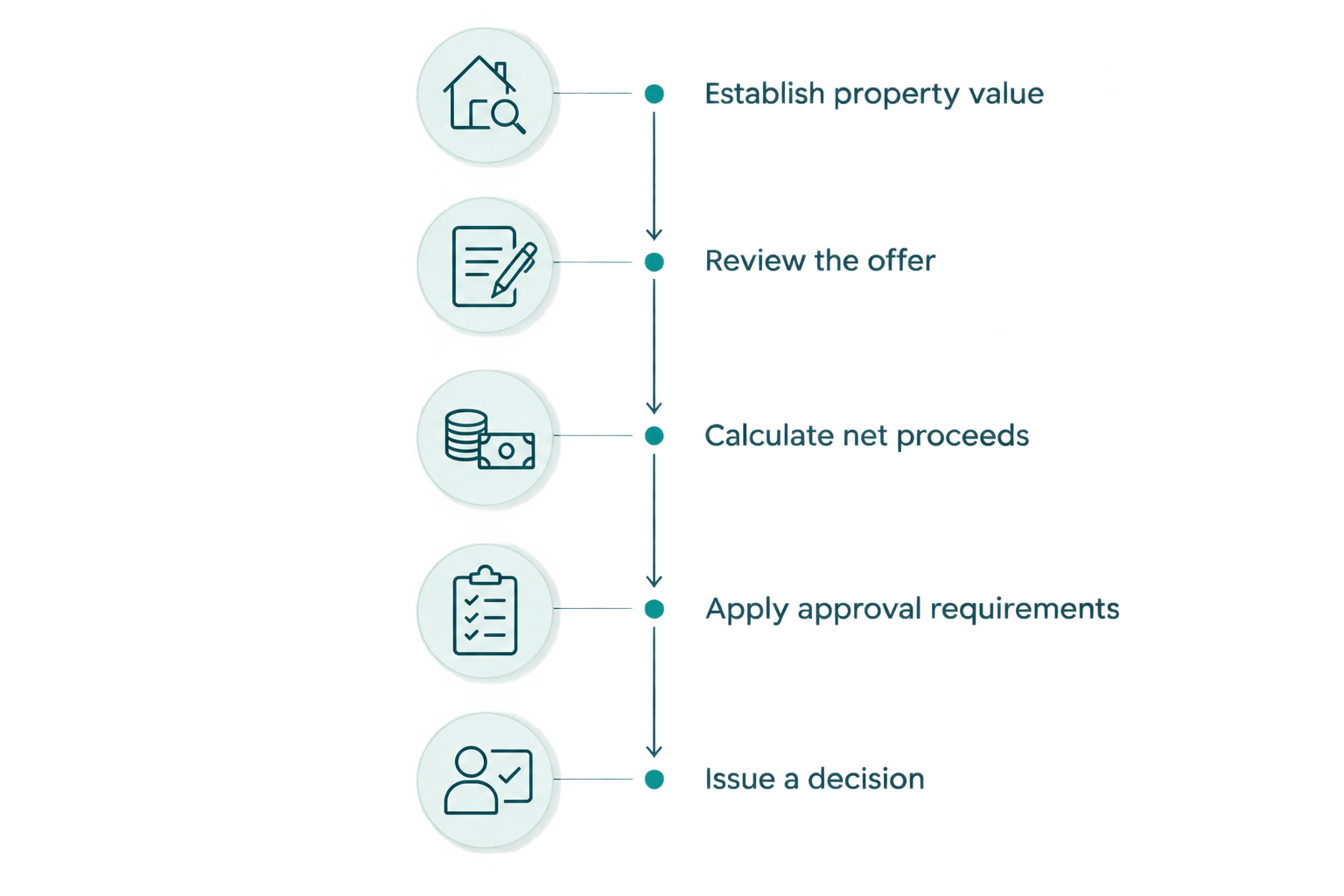
For agents handling a 2026 listing, the practical sequence is:
- Establish property value. The servicer obtains or reviews a property valuation, such as a broker price opinion or appraisal, under the applicable requirements.
- Review the offer. The servicer examines the purchase contract, proposed concessions, financing, and transaction terms.
- Calculate net proceeds. The proposed settlement statement shows the expected proceeds after requested selling expenses and other disbursements.
- Apply approval requirements. The mortgage owner, insurer, or guarantor's rules determine what the servicer can approve and what needs further review.
- Issue a decision. The lender approves, counters, requests more information, or declines the proposal.
Shortsalesdoneright provides short sale processing and lender negotiation services. That support organizes the submission and communication; it does not replace the lender's decision.
Why this matters
An asking price attracts buyers. It does not establish what the mortgage lender will accept. A seller's agreement to an offer also does not authorize the lender to release its mortgage for less than the amount owed.
For homeowners, that distinction prevents a painful misunderstanding: signing a contract is not the same as receiving short sale approval. For agents, it identifies the next move. Find out whether the obstacle is valuation, proposed deductions, missing documents, or an approval requirement before recommending a response.
Property value: what supports the lender's starting point?
The lender needs evidence of current market value. The mortgage balance establishes what is owed, but it does not establish what a buyer will pay for the home in its present condition.
Two valuation methods you will encounter are a broker price opinion, often called a BPO, and an appraisal. Neither is simply the listing agent's preferred asking price.
| Valuation method | Best suited to | What it contributes | Limitation |
|---|---|---|---|
| Broker price opinion | A lender-requested broker assessment | A real estate broker's opinion using market and property information | Its usefulness depends on the property information, access, and comparable sales considered |
| Appraisal | A lender-requested appraisal assignment | An appraiser's value opinion under the assignment's scope | It is a value opinion, not a guarantee of an offer or short sale approval |
Document the property's actual condition before arguing about value. If an interior defect is not visible from outside, make sure the valuation contact receives accurate information through the permitted channel. Do not assume the person reviewing the file already knows about it.
For a 2026 submission, distinguish recent market evidence from older information that no longer reflects the property's condition or competing homes. Explain why a comparable sale is relevant rather than sending an unexplained stack of listings.
Net proceeds: why the offer alone is not enough
The contract price is the amount the buyer agrees to pay. Net proceeds are what remains for the lender after the deductions it permits. The lender reviews both.
Requested buyer credits, commissions, taxes, title charges, and payments needed to address other claims against the property affect the proposed distribution. Whether a particular deduction is permitted depends on the transaction and applicable approval requirements.
That is why raising an offer while adding a matching concession does not necessarily improve the lender's position. The headline changes. The proposed proceeds might not.
Ask for the settlement estimate supporting the submission. Check that it matches the contract, includes known claims, and reflects the requested concessions accurately. An incomplete estimate can produce a price discussion based on the wrong proceeds.
For homeowners, this does not mean every expense becomes your responsibility. It means the proposed allocation needs review and approval rather than assumption.
Loan requirements: who controls the decision?
The company receiving the mortgage payment is the servicer. The servicer does not necessarily own the loan or have unrestricted authority to approve a short sale.
Investor requirements and any applicable mortgage insurance or government program requirements shape the decision. A negotiator might need another party's approval before accepting terms outside delegated authority.
Ask whose approval is still outstanding. A statement that the file is under review tells you little about whether valuation is complete, the proposed proceeds are acceptable, or another decision-maker must consent.
For a 2026 transaction, request the requirements applicable to that particular loan. Do not apply another homeowner's approval terms or an old program summary to the current file.
Why the minimum short sale price varies
There is no single discount from the mortgage balance that establishes an acceptable short sale offer. These factors explain why different properties and loans produce different responses:
- Current market evidence. Relevant closed sales and competing inventory inform the property's market position.
- Property condition. Documented damage and repair needs affect the evidence supporting value.
- Expected net proceeds. Requested deductions change what the lender receives from the transaction.
- Loan-owner requirements. The servicer's approval authority depends on the applicable investor and program rules.
- Other property claims. Additional mortgages, liens, and unpaid charges can complicate the proposed distribution and required releases.
- Transaction changes. A revised contract, new concession, or changed closing terms can require another review.
Treat these as separate issues. A repair report addresses condition; it does not resolve a disagreement over a proposed payment to another lienholder. Matching the response to the objection keeps the submission focused.
What should an agent do when the lender's value seems too high?
Submit a documented valuation dispute through the lender's stated process. A buyer's refusal to increase an offer is useful transaction information, but it is not, by itself, proof that the valuation is wrong.
Build the response around 3 evidence categories:
- Comparable sales. Explain differences in location, condition, size, and other material features.
- Condition evidence. Supply dated photographs, relevant inspection findings, and repair estimates when available.
- Market response. Document listing exposure, price changes, showing feedback, and offers accurately.
Ask what evidence the lender accepts and whether a revised valuation or reconsideration is available. Do not assume every servicer uses the same dispute procedure or will provide its complete valuation report.
For a 2026 file, label when photographs, inspections, and market information were collected. If the lender identifies a specific factual error, address that error directly. Keep the explanation short enough that a reviewer can connect each document to the requested change.
A supported dispute still does not guarantee a lower required price. The lender retains its decision-making authority.
How should homeowners respond to a higher counteroffer?
A lender counteroffer is a proposed set of terms, not an instruction that you must accept. Ask your agent or authorized negotiator to explain what changed and what evidence supports a response.
Separate the discussion into these questions:
- Is the lender disputing property value or expected proceeds?
- Is the buyer willing and financially able to revise the offer?
- Does the proposal request anything from you beyond selling the home?
Do not agree to a contribution or remaining-balance obligation without understanding it. Lender terms and state law vary. A qualified attorney should review legal obligations, and a qualified tax professional should address potential tax consequences.
A short sale request does not itself stop foreclosure. If a sale date or court deadline exists, ask the servicer about its status and obtain legal advice promptly rather than relying on a pending negotiation.
Where does short sale processing help?
Shortsalesdoneright is best for real estate agents seeking outsourced short sale processing and lender negotiation. Its agent services include preparing the full short sale package, providing a dedicated point of contact, and delivering weekly lender updates.
The practical benefit is an organized submission and a clear communication path. The limit is equally important: a processor cannot promise lender approval, forgiveness of an unpaid balance, or a particular credit-score result.
For homeowners, Shortsalesdoneright helps compare a short sale with other options. That is a different task from an agent outsourcing file preparation. Start with your goal, whether that is evaluating an exit from an upside-down mortgage or getting an existing transaction organized.
If you are ready to act, request help through the appropriate agent or homeowner intake form. Keep legal and tax decisions with qualified professionals.
Is the listing price the lender's minimum price?
The listing price is not the lender's minimum price unless the lender has specifically approved applicable terms. An agent uses market evidence to recommend an asking price; the lender separately evaluates whether it will accept the proposed transaction.
Ask whether any stated lender price is current, conditional, and tied to a particular offer. A prior conversation is not a substitute for written approval.
Does a higher offer guarantee short sale approval?
A higher offer does not guarantee short sale approval. The lender still reviews net proceeds, the complete submission, applicable loan requirements, and the proposed transaction terms.
A price increase does not cure every problem. Missing authorization, unresolved property claims, or an incomplete financial submission requires its own response.
Does approval mean the remaining mortgage debt is forgiven?
Short sale approval does not automatically mean the remaining mortgage debt is forgiven. Review the written terms to determine what they say about the unpaid balance and any requested borrower obligation.
Releasing the mortgage from the property and releasing the borrower from further payment are different issues. Ask a qualified attorney to explain the approval language and applicable state law before closing.
FAQ
How does a lender decide the minimum short sale price?
A lender reviews current property value, expected net proceeds, and applicable loan-owner requirements. The proposed contract and complete submission must also satisfy the lender's review.
Does the mortgage balance determine the lowest offer the bank will accept?
The mortgage balance does not establish the property's market value or an automatic acceptable offer. The lender evaluates the proposed recovery under the requirements applicable to the loan.
Can my agent challenge a short sale valuation?
Your agent can ask the lender about its valuation dispute process and submit the evidence that process requires. Relevant comparable sales, documented condition issues, and accurate market history support the request but do not guarantee a change.
Why would a lender reject an offer at the asking price?
The asking price does not bind the lender. The offer can still fail the lender's valuation, net-proceeds, documentation, or other approval requirements.
Can the lender change its required terms after a counteroffer?
A counteroffer is not final written approval. Changed transaction details or further review can lead to revised requirements, so confirm the current terms in writing.
Will submitting a short sale offer stop foreclosure?
Submitting a short sale offer does not itself stop foreclosure. Confirm the status with the servicer and seek legal advice immediately if a foreclosure deadline or sale date exists.
Will I owe the unpaid mortgage balance after the short sale?
Your responsibility for an unpaid balance depends on the written agreement and applicable law. Have a qualified attorney review the terms, and ask a qualified tax professional about potential tax consequences.
One last thing
Before asking whether the lender will accept less, ask what specifically makes the current proposal unacceptable. A valuation dispute, a proceeds shortfall, and an incomplete package need different responses.
For your 2026 file, request a written explanation of the outstanding issue and the next required action. That gives your agent or negotiator something concrete to address instead of another round of guesswork.