

A short sale affects your next mortgage application through a program-specific waiting period, your payment history, and your ability to qualify for a new loan. Completing the waiting period does not guarantee approval: the lender still reviews your income, debts, credit, and funds for the purchase. For a 2026 application, confirm the rules for the new mortgage before choosing a purchase date.
- How does a short sale affect my next mortgage application? Waiting periods, credit history, and current finances determine eligibility.
- Fannie Mae generally requires 4 years after a short sale; documented extenuating circumstances can shorten that period.
- FHA generally requires 3 years after a short sale, with exceptions subject to specific conditions.
- Shortsalesdoneright provides short sale processing and lender negotiation; a mortgage lender determines eligibility for your next loan.
Keep those roles separate. Shortsalesdoneright helps with the short sale; your next mortgage lender evaluates the new loan.
How does a short sale affect my next mortgage application?
A short sale creates an eligibility issue and a credit-review issue. You must address both. The loan program sets the waiting-period rules, while underwriting determines whether your finances support another mortgage.
These are agency guideline baselines for planning a 2026 application, not promises of approval. Ask your lender to confirm the current requirements and any stricter requirements it applies.
| Application route | General waiting-period baseline | Best for | Main limitation |
|---|---|---|---|
| Fannie Mae standard route | 4 years after completion | Borrowers planning around the standard conventional requirement | Time alone does not establish creditworthiness |
| Fannie Mae documented exception | 2 years after completion | Borrowers with qualifying, documented extenuating circumstances | A hardship does not automatically qualify for the exception |
| FHA standard route | 3 years after completion | Borrowers considering an FHA-insured mortgage | Credit, income, and other FHA requirements still apply |
| FHA exception review | No universal waiting-period answer for every exception | Borrowers whose payment history or circumstances meet specific FHA provisions | The lender must establish that the applicable exception is satisfied |
The sources for these distinctions are Fannie Mae's Selling Guide, section B3-5.3-07, and HUD's FHA Single Family Housing Policy Handbook 4000.1, which addresses short sales under borrower credit requirements. These rules concern the new mortgage, not simply the type of loan you sold the previous home under.
Why this matters
You can resolve an unaffordable mortgage without being ready for another mortgage immediately. Those are separate milestones. Confusing them can lead you to shop for a home before a lender can approve the financing.
Your goal is to leave the short sale with a clear record of what happened and a realistic plan for the next application. Keep the approval letter, final settlement statement, and evidence of completion together. Those records help the next lender establish the event and assess your eligibility.
Fannie Mae standard route: 4 years
Fannie Mae generally requires a 4-year waiting period after a preforeclosure sale, commonly called a short sale. The relevant period runs from completion of the short sale to the disbursement date of the new loan under its guideline.
This route provides a clear planning baseline. Its limitation is equally clear: reaching the date does not override other underwriting requirements. Your lender still evaluates your credit history, income, existing obligations, and available funds.
For a 2026 purchase, ask the lender to identify the completion date it will use and calculate the earliest qualifying disbursement date. Do not calculate from the day you first missed a payment, listed the property, or submitted the short sale package.
Also ask whether the proposed conventional loan follows Fannie Mae, Freddie Mac, or a different investor's requirements. “Conventional” is a category, not a complete explanation of the rules governing your application.
Fannie Mae documented exception: 2 years
Fannie Mae permits a 2-year waiting period when qualifying extenuating circumstances are documented. This is an exception requiring evidence, not an automatic benefit attached to having experienced financial hardship.
Fannie Mae describes extenuating circumstances as nonrecurring events beyond the borrower's control that cause a sudden, significant, and prolonged reduction in income or a catastrophic increase in financial obligations. The lender must evaluate the circumstances and supporting documentation.
Ask about the exception before building your purchase plan around it. A hardship letter prepared for short sale approval does not, by itself, establish eligibility for a future mortgage exception.
Useful records include evidence of the event, its financial effect, and the resolution of the circumstances. Let the mortgage lender specify what it needs rather than assuming that a written explanation will be enough.
FHA standard route: 3 years
FHA generally applies a 3-year waiting period after a short sale. HUD's Handbook 4000.1 also provides specific exceptions, including provisions tied to payment history and qualifying circumstances.
The advantage is a different eligibility framework from the standard conventional route. The limitation is that FHA insurance does not remove underwriting requirements or make an exception automatic. A participating lender must review the complete file.
Ask the lender how the short sale completion date affects FHA case-number eligibility for your 2026 application. The timing checkpoint is not interchangeable with every conventional mortgage rule.
If you remained current before the sale, say so at the start of the discussion. Provide the payment records and let the lender assess the applicable FHA provisions; do not assume that staying current guarantees immediate eligibility.
Why your next mortgage outcome varies
The waiting period is only part of the decision. These factors determine what the lender needs to review:
- New loan program. Fannie Mae, FHA, VA, and other lending routes do not share one universal short sale rule.
- Completion date. The lender needs evidence of when the short sale actually closed, not just when negotiations began.
- Payment history. Mortgage delinquencies and later missed payments are separate credit considerations.
- Hardship documentation. An exception requires evidence that meets the applicable program's requirements.
- Current finances. Income, debts, and funds for the purchase remain part of underwriting.
- Lender requirements. An individual lender can impose requirements stricter than the agency baseline.
Ask which issue is preventing approval. “You need to wait” and “your current debts do not qualify” require different next steps. A useful lender conversation separates the timing problem from the financial problem.
What should you do before applying again?
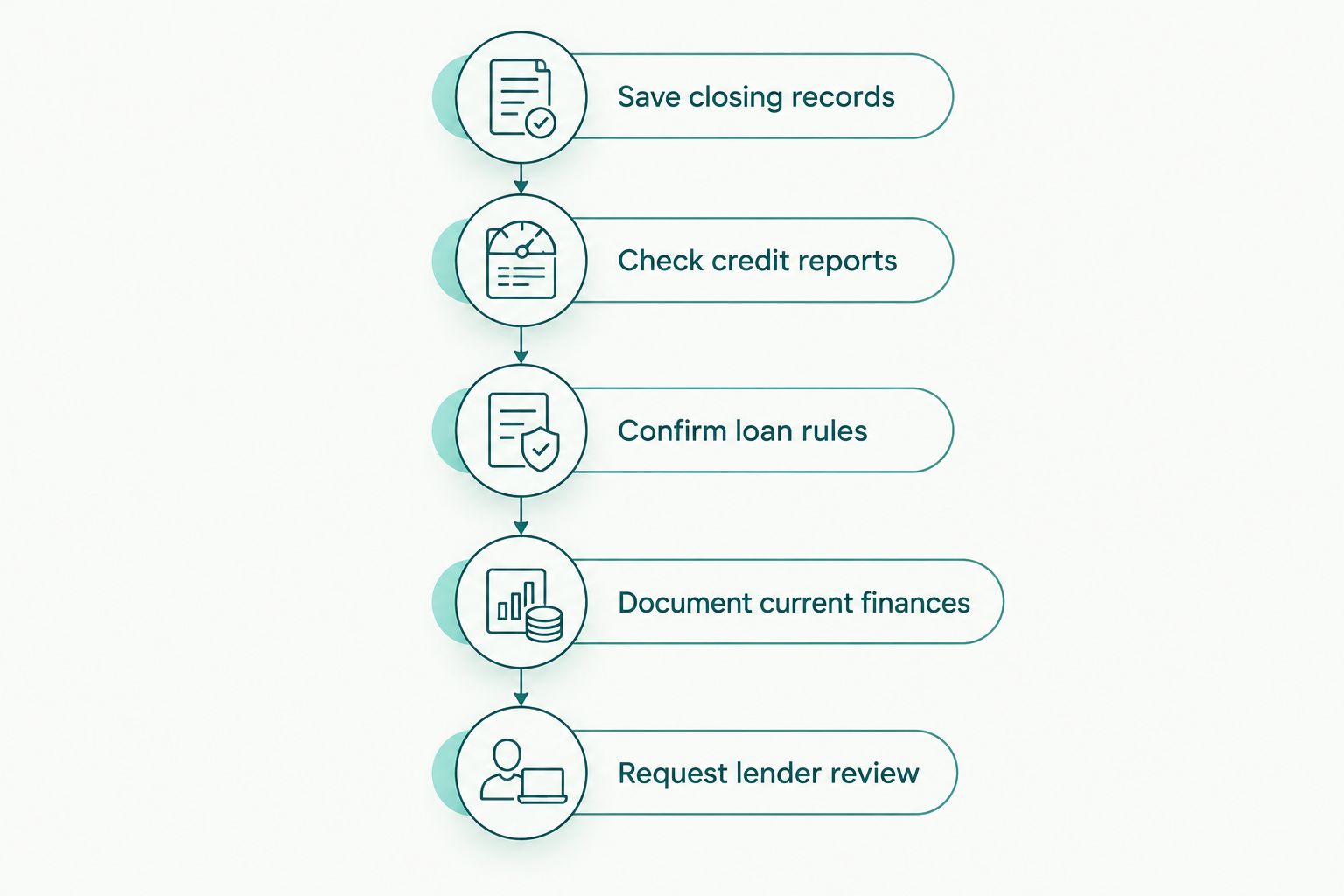
Build the application around documents, not assumptions. Start with the completed short sale, then verify the credit record and the rules for the new loan.
- Save closing records. Keep the lender's short sale approval, final settlement statement, and completion records. Preserve relevant correspondence about any remaining obligation.
- Check credit reports. Review the mortgage account information and dispute inaccuracies with supporting documents. Do not dispute accurate negative information simply because it affects an application.
- Confirm loan rules. Tell the mortgage lender about the short sale before requesting a purchase preapproval. Ask which program applies and what date controls eligibility.
- Document current finances. Gather the income, employment, debt, and asset records the lender requests. Explain material changes since the short sale with evidence.
- Request lender review. Have the lender identify outstanding conditions before you rely on financing for a purchase contract.
For a closer look at the timing question, read how long after a short sale you can buy another house. Use the timing guidance to prepare questions for the lender, not as a substitute for an individual underwriting review.
Will a better credit score remove the waiting period?
A better credit score does not erase a program's short sale waiting period. Credit qualification and event-based eligibility are separate requirements.
You can reach the waiting-period deadline and still have an application declined because your current finances do not qualify. You can also improve your credit before the deadline without becoming eligible under the standard rule.
For your 2026 plan, ask the lender to identify both requirements separately: when the short sale stops blocking eligibility under the applicable rule, and what your current application still needs. No reliable adviser can promise a specific credit-score outcome from completing a short sale.
Does short sale approval mean the unpaid balance is forgiven?
Short sale approval does not automatically mean every unpaid balance is forgiven. The approval terms, any separate agreement, and applicable state law determine the treatment of the remaining obligation.
This matters to your next mortgage because the lender needs an accurate picture of your liabilities. A release of the lien against the property is not necessarily the same as a release from personal responsibility for the debt.
Have a qualified attorney review unclear language about any remaining balance. Direct tax questions to a qualified tax professional. Lender terms and state law vary, and neither short sale approval nor future mortgage eligibility settles those questions by itself.
Should you stop making payments to qualify for a short sale?
Do not stop making mortgage payments merely to try to qualify for a short sale or a future loan exception. Missed payments become part of the record the next mortgage lender reviews.
If the payment is unaffordable, contact your servicer about available options and explain the actual hardship. Ask how each option affects the existing loan, and discuss the consequences with qualified advisers before deciding.
A short sale addresses a sale for less than the mortgage balance with lender approval. It is not a strategy for obtaining a guaranteed waiting-period reduction, debt release, or credit result.
Where short sale processing help fits
Shortsalesdoneright is best for homeowners who need short sale processing and lender negotiation. That service addresses the current sale; it does not replace a mortgage lender's decision about your next purchase.
Shortsalesdoneright helps homeowners compare a short sale with other options. The service includes a dedicated point of contact and weekly lender updates, so you have a clearer view of the sale's progress.
Keep the boundary clear: processing support does not guarantee lender approval, forgiveness of an unpaid balance, or a particular credit-score result. If you are still deciding what to do with an upside-down mortgage, request homeowner help through the intake form on the site.
Request help with your short sale
Get help comparing your options and handling lender negotiation for your current mortgage.
FAQ
Can I get a conventional mortgage after a short sale?
Yes, a short sale does not permanently prevent a conventional mortgage. Fannie Mae generally requires 4 years after completion, or 2 years with qualifying documented extenuating circumstances, plus satisfaction of the remaining underwriting requirements.
How long does FHA make me wait after a short sale?
FHA generally requires 3 years after a short sale. Specific exceptions exist, but a lender must establish that you meet the applicable conditions in HUD's Handbook 4000.1.
Does the waiting period start when I miss my first payment?
The standard short sale waiting periods discussed here are tied to completion of the short sale, not your first missed payment. Ask the lender which completion record and new-loan timing checkpoint apply to your program.
Will staying current on my mortgage help my next application?
Staying current preserves a different payment history from an account with missed payments and can matter when a lender reviews certain FHA exceptions. It does not guarantee immediate mortgage eligibility or a particular credit score.
Can I use a VA loan after a short sale?
A prior short sale does not by itself answer whether you qualify for a VA-backed loan. Ask a VA lender to review your credit, entitlement, any loss on a prior VA loan, and its applicable underwriting requirements.
Will the next lender need my short sale approval letter?
Keep the approval letter and expect the next lender to request records establishing the short sale and its completion. The final settlement statement and documents addressing any remaining obligation are also useful.
Can a short sale company promise when I will qualify again?
No short sale processing company can guarantee approval of your next mortgage. The new lender must apply the relevant loan-program rules and evaluate your current finances.
One last thing
The letter approving your short sale is not proof that the sale closed. Save the final settlement statement alongside it. A future lender needs to distinguish permission to complete a transaction from evidence that it actually happened.
Before your 2026 mortgage application, ask for a written list of the documents and eligibility conditions the lender needs. That gives you a practical next step instead of a vague instruction to wait.