

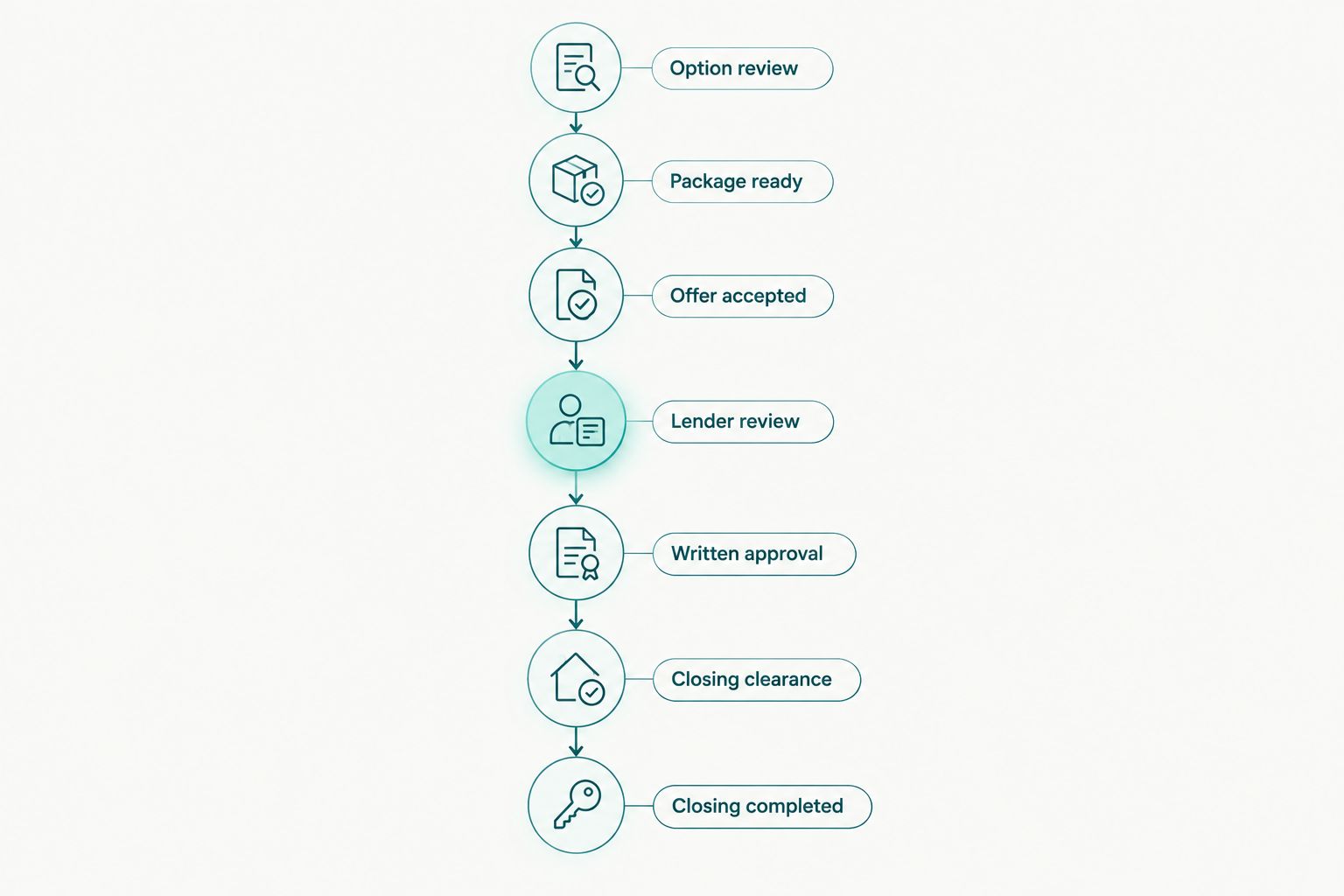
The short sale timeline follows milestones, not a guaranteed closing date: review your options, prepare the package, secure an offer, complete lender review, obtain written approval, and close. Written lender approval is the key checkpoint, but you still need to satisfy its conditions before the sale can finish.
- Short sale timeline what to expect: document preparation, an accepted offer, lender review, written approval, and closing.
- Written lender approval is the strongest checkpoint; a seller-accepted offer alone does not authorize a short sale.
- Shortsalesdoneright provides short sale processing and lender negotiation services for agents and homeowners.
- Lender terms and state law vary. Get legal and tax advice before accepting terms involving an unpaid balance.
For agents managing a listing in 2026, Shortsalesdoneright prepares the full short-sale package and provides a dedicated point of contact and weekly lender updates. For homeowners, the service also helps compare a short sale with other options.
Why this matters
A short sale means selling a home for less than the mortgage balance with the lender's approval. Accepting a buyer's offer does not settle what the lender will accept or what happens to the remaining debt.
Your timeline therefore has separate tracks: the seller-buyer contract, the lender's review, and the work needed to close. Progress on one track does not automatically finish the others.
Shortsalesdoneright's short sale processing service is best for real estate agents who want package preparation and lender negotiation outsourced. Homeowners need a different starting point: whether selling is the right choice at all.
What makes a useful short sale timeline
Use these criteria to judge progress in 2026, rather than treating an estimated closing date as a promise:
- Document readiness: The required financial and property information is complete and current.
- Clear responsibility: Someone owns each request, response, and follow-up.
- Lender acknowledgment: You know whether the package was received and what remains outstanding.
- Written terms: Approval conditions are documented, not inferred from a conversation.
- Closing readiness: Financing, title work, signatures, and lender conditions align.
- Deadline visibility: Contract dates, approval expiration, and any foreclosure deadlines remain visible.
Use 1 status update per week as your communication checkpoint. The update should explain the current stage, outstanding requests, and next action—not simply report that everyone is waiting.
Short sale milestones at a glance
These milestones appear in working order. Some tasks overlap, and a lender request can send the file back to an earlier stage.
| Milestone | Best for | What it establishes | Key limitation |
|---|---|---|---|
| Option review | Homeowners deciding whether to sell | Whether a short sale fits the homeowner's goal | It does not establish lender approval |
| Package ready | Agents preparing a reviewable file | Required information is assembled; use the short sale package document guide | Documents can need updating |
| Offer accepted | Sellers selecting a buyer | Buyer and seller have agreed to contract terms | The lender has not necessarily accepted the proposed proceeds |
| Lender review | Agents tracking requests and negotiation | The lender evaluates the proposed transaction | Review can require additional information or changed terms |
| Written approval | Sellers checking whether terms are acceptable | The lender's approval conditions are documented | Approval does not mean every closing condition is satisfied |
| Closing clearance | Buyers and agents coordinating completion | Remaining transaction requirements are addressed | Unresolved financing or title issues can still prevent closing |
| Closing completed | Homeowners confirming the transaction finished | Closing documents and completion records are available | Remaining debt treatment still depends on applicable terms and law |
1. Option review: best for deciding whether to sell
Start the short sale timeline by deciding what you want to accomplish. Selling the property and keeping the property require different plans. A short sale addresses a proposed sale; it is not a way to retain ownership.
If keeping the home is your priority, ask your mortgage servicer about available options before committing to a listing. If selling is the priority, assess whether the mortgage balance exceeds the proceeds the proposed sale would produce.
Option review pros:
- Clarifies whether selling matches your goal.
- Gives you a chance to compare alternatives.
- Identifies legal and tax questions before you sign.
Option review cons:
- Does not reserve a lender decision.
- Does not suspend a foreclosure deadline by itself.
Best for: Homeowners choosing between selling and pursuing a home-retention option.
Verdict: Hold the sale commitment until you understand the alternatives and any urgent deadlines. If foreclosure proceedings have started, seek qualified legal help rather than relying on a sale application to stop them.
2. Package ready: best for preventing avoidable rework
The lender needs information supporting the requested short sale. Requirements differ, but the package commonly includes financial information, an explanation of the homeowner's circumstances, authorization documents, and transaction information when an offer is available.
Ask for the lender's current requirements in 2026. Do not assume a package used on another listing will meet this lender's requirements.
For agents, assign responsibility for collecting documents and tracking missing items. For homeowners, respond to requests and keep copies of what you provide.
Package ready pros:
- Makes outstanding items easier to identify.
- Gives the lender information needed for review.
- Creates a shared reference for the agent and homeowner.
Package ready cons:
- Financial documents can become outdated during review.
- A complete submission does not guarantee approval.
Best for: Agents who need a file that is ready for lender review.
Shortsalesdoneright's short sale processing includes preparing the full package for agents. The dedicated point of contact helps organize communication; weekly lender updates keep the agent informed.
Verdict: Hold submission until you have checked the required items, unless the lender directs a different submission process.
3. Offer accepted: best for establishing the proposed deal
An accepted offer gives the lender a proposed transaction to evaluate. It identifies the buyer's terms and the proceeds the sale is expected to produce. It is a contract milestone, not a substitute for lender consent.
Before accepting, make sure the contract addresses the need for short sale approval using appropriate documents for the transaction. Have your agent and, where needed, a qualified attorney explain the deadlines and contingencies.
Offer accepted pros:
- Establishes the proposed buyer and transaction terms.
- Gives the lender a specific offer to review.
- Gives the parties a basis for planning inspections and financing.
Offer accepted cons:
- The lender can reject or request changes to the proposal.
- The buyer's contractual deadlines still need attention.
Best for: Sellers ready to move from listing activity to a specific transaction.
Verdict: Wait for lender approval before treating the accepted offer as an approved short sale. Keep the buyer informed about the stage of review without promising a decision date.
4. Lender review: best for tracking the next required action
During lender review, the lender evaluates the package and proposed sale. Review can include property valuation, financial information, and the proposed proceeds. Additional approval requirements depend on the loan and the parties involved.
This is where an elapsed-day count tells you least. A file awaiting a missing document needs a different response from a file awaiting a valuation or a decision.
Lender review pros:
- Identifies lender requests and unresolved terms.
- Creates an opportunity to respond to objections.
- Establishes what must happen before a decision.
Lender review cons:
- Requests can require updated documents or revised terms.
- Communication does not guarantee an approval date.
Best for: Agents coordinating lender requests and keeping the buyer and seller informed.
At each update, ask 3 questions: What is outstanding? Who owns the next action? What deadline applies? Record the answers and act on requests you control.
Verdict: Wait on decisions, not on unanswered document requests. Return requested information promptly and keep contract deadlines separate from the lender's review schedule.
See the process before planning a move
The short sale sequence connects preparation, negotiation, and completion. Written approval sits between lender review and closing clearance because those are different checkpoints. Moving plans in 2026 should reflect that distinction.
5. Written approval: best for checking the actual terms
Written approval is the strongest checkpoint in the short sale timeline. Read the document itself. Confirm the approved transaction, conditions, required signatures, and expiration date.
Do not interpret permission to sell as automatic forgiveness of the unpaid balance. Lender terms and state law vary. Ask a qualified attorney to explain the debt language and a qualified tax professional to explain any tax consequences.
Written approval pros:
- Documents the lender's conditions for the proposed sale.
- Gives the closing team terms to work from.
- Lets the homeowner evaluate the agreement before completion.
Written approval cons:
- Conditions or expiration dates can affect closing.
- Approval language can leave important debt questions unresolved without professional review.
Best for: Homeowners deciding whether the approved terms are acceptable.
Verdict: Hold your final commitment until you understand the written conditions. If the contract changes, ask whether the lender requires renewed or revised approval.
6. Closing clearance: best for coordinating the finish
Written approval starts the final coordination work; it does not eliminate it. The buyer's financing, title review, closing documents, and lender requirements still need to line up.
Use 2 separate checkpoints: approval received and closing requirements satisfied. That separation prevents an approval announcement from becoming a premature promise that the sale is finished.
Closing clearance pros:
- Brings financing and title issues into focus.
- Checks the transaction against approval conditions.
- Helps identify a need for an extension before expiration.
Closing clearance cons:
- Buyer financing can remain unresolved.
- Title issues or changed terms can require further work.
Best for: Agents coordinating the lender, buyer, seller, and closing professionals.
Verdict: Wait to call the sale complete until the closing professionals confirm completion. Signing an individual document is not the same as satisfying every requirement.
7. Closing completed: best for preserving the final record
After the closing professionals confirm completion, keep the approval letter, signed documents, and final settlement records together. These records document what the parties agreed to and what occurred at closing.
For a homeowner, the important final question is not just whether the property sold. It is whether you understand any remaining obligation and have retained the documents needed to address later questions.
Closing completed pros:
- Provides a record of the completed transaction.
- Preserves documents for legal and tax review.
- Ends the transaction's active closing work.
Closing completed cons:
- A completed sale alone does not establish debt forgiveness.
- Tax or remaining-balance questions can require separate advice.
Best for: Homeowners organizing their records after the sale.
Verdict: Skip assumptions about the unpaid balance; use the written terms and qualified advice.
How these milestones are ordered
These are process checkpoints, not rankings of competing services. Their order reflects the work needed to evaluate an option, prepare a transaction, obtain approval, and complete closing.
The strongest milestone is written approval because it documents lender conditions. The best early milestone is package readiness because it identifies work the homeowner and agent can control.
Which checkpoint should you focus on now?
Focus on the earliest unresolved requirement, not the hoped-for closing date. If documents are missing, complete them. If review is underway, identify the next lender action. If approval has arrived, review its conditions and coordinate closing.
For a 2026 transaction, request help from Shortsalesdoneright through the appropriate intake form for your role. Agents need processing support; homeowners need help evaluating their options.
Request short sale help
Get help with agent processing or compare homeowner options before choosing your next step.
FAQ
How long does a short sale take in 2026?
A short sale has no universal completion timeline. Document readiness, lender review, approval conditions, buyer financing, and title work determine when the transaction can finish.
Does accepting an offer mean my short sale is approved?
No. Seller acceptance establishes the proposed contract, while lender approval addresses whether the lender accepts the short sale under stated conditions.
What is the most important short sale milestone?
Written lender approval is the key checkpoint because it documents the lender's conditions. Closing still depends on satisfying those conditions and the remaining transaction requirements.
Can the lender ask for documents again during review?
Yes. A lender can request additional or updated information during review. Keep copies of submissions and respond to the specific outstanding request.
Does a short sale application stop foreclosure?
Submitting a short sale application does not by itself guarantee that foreclosure stops. Ask your servicer about the account's status and get qualified legal advice about deadlines and protections that apply to your situation.
Will a short sale erase the unpaid mortgage balance?
A short sale does not automatically establish forgiveness of the unpaid balance. The written lender terms and applicable state law matter; have a qualified attorney explain any remaining obligation.
Who can help an agent manage the short sale process?
Shortsalesdoneright provides short sale processing and lender negotiation services, including full package preparation, a dedicated point of contact, and weekly lender updates. Lender approval remains the lender's decision.
One last thing
An approval expiration date and a contract closing date are not interchangeable. Put both on your calendar and identify who will request an extension if needed. That small distinction keeps a deadline from disappearing inside a general status update.