

There is no single nationwide notice period before a foreclosure auction; the required notice depends on your state, the foreclosure process, and the document you received. A default letter or court filing is not necessarily an auction notice, so verify the actual sale date and any earlier response deadline rather than counting from your last missed payment.
- How much notice does a lender give before a foreclosure auction? State law determines the auction-notice deadline.
- California generally requires at least 20 days’ mailed sale notice; Texas generally requires at least 21 days.
- A short-sale request does not automatically postpone a foreclosure auction.
- Shortsalesdoneright provides short-sale processing and lender negotiation, not a guarantee that foreclosure will stop.
How much notice does a lender give before a foreclosure auction?
Your state’s auction-notice rule is the starting point—not a national countdown. These examples show why you must identify the property’s state before calculating a deadline in 2026.
| State | General sale-notice requirement | What you must distinguish |
|---|---|---|
| California | Required mailed notice generally must be sent at least 20 days before the trustee’s sale | The sale notice is separate from the earlier notice of default |
| Texas | Required sale notice generally must be given at least 21 days before the sale | The sale notice is separate from any earlier default-and-cure notice |
Sources: California Civil Code §2924b(b)(2); Texas Property Code §51.002(b). These examples concern common nonjudicial mortgage foreclosures, not every property or proceeding.
For an underwater mortgage, Shortsalesdoneright helps homeowners compare a short sale with other options. A sale date requires a separate deadline check, even when you are already discussing a short sale.
Why this matters
You can have several deadlines at once: a court response, an application deadline, and an auction date. Meeting one does not necessarily satisfy another.
For your 2026 decision, separate two questions: how much notice the law requires and how much time remains in your actual case. A required mailing period does not necessarily give you that same amount of time after you open the envelope.
If an auction is scheduled, contact the mortgage servicer and a foreclosure attorney promptly. Ask who controls the sale, whether it remains scheduled, and what action is required before the next deadline.
Judicial foreclosure: check the court record
A judicial foreclosure proceeds through court. The complaint or summons starts a different stage from the later auction notice, and the deadline to respond to a lawsuit is not the auction-notice period.
Best for checking a judicial foreclosure deadline: the court docket and a foreclosure attorney. Look for the case number, filing dates, court orders, and any sale notice. Do not assume that a pending conversation with the servicer extends a court deadline.
The court record helps establish what has happened. It does not replace advice about how to respond, challenge a filing, or request relief under your state’s rules.
Nonjudicial foreclosure: check the trustee’s sale notice
A nonjudicial foreclosure generally proceeds under state law without a foreclosure lawsuit. Depending on the state, a trustee, attorney, or another authorized party handles the sale notices.
Best for checking a nonjudicial sale date: the party conducting the sale and the official sale records. Identify that party from the notice, then verify its contact information independently before sharing personal information or sending documents.
California’s 20-day mailing rule and Texas’s 21-day notice rule illustrate different requirements. Neither number is a nationwide minimum, and neither guarantees that a short sale can be completed before auction.
Does the federal 120-day rule give me auction notice?
The federal 120-day rule generally concerns starting foreclosure, not notice of the final auction. Under Regulation X, a covered mortgage servicer generally cannot make the first foreclosure notice or filing until a borrower is more than 120 days delinquent, subject to exceptions.
That distinction matters. You cannot take the date of a missed payment, add 120 days, and treat the result as your auction date or your final opportunity to act.
Source: Consumer Financial Protection Bureau, Regulation X, 12 CFR §1024.41(f). Coverage and exceptions matter; have a qualified professional apply the rule to your loan.
For a 2026 foreclosure review, keep the federal starting restriction separate from state sale-notice requirements. They govern different stages of the process.
Why foreclosure auction notice varies
The required notice depends on more than the lender’s internal schedule. These factors determine which rules you need to check:
- Property location. State law sets the applicable foreclosure procedures and notice requirements.
- Foreclosure process. A court-supervised case follows a different path from a trustee’s sale.
- Notice type. A default notice, lawsuit, and sale notice serve different purposes.
- Delivery requirements. Mailing, publication, posting, and service requirements depend on the governing law.
- Sale status. A postponed sale can have different notice requirements from the originally scheduled sale.
- Loan and borrower coverage. Federal servicing protections have coverage limits and exceptions.
Do not use a neighbor’s experience as your deadline. Even nearby properties can involve different loans, procedures, or stages of foreclosure.
What should I do after receiving an auction notice?
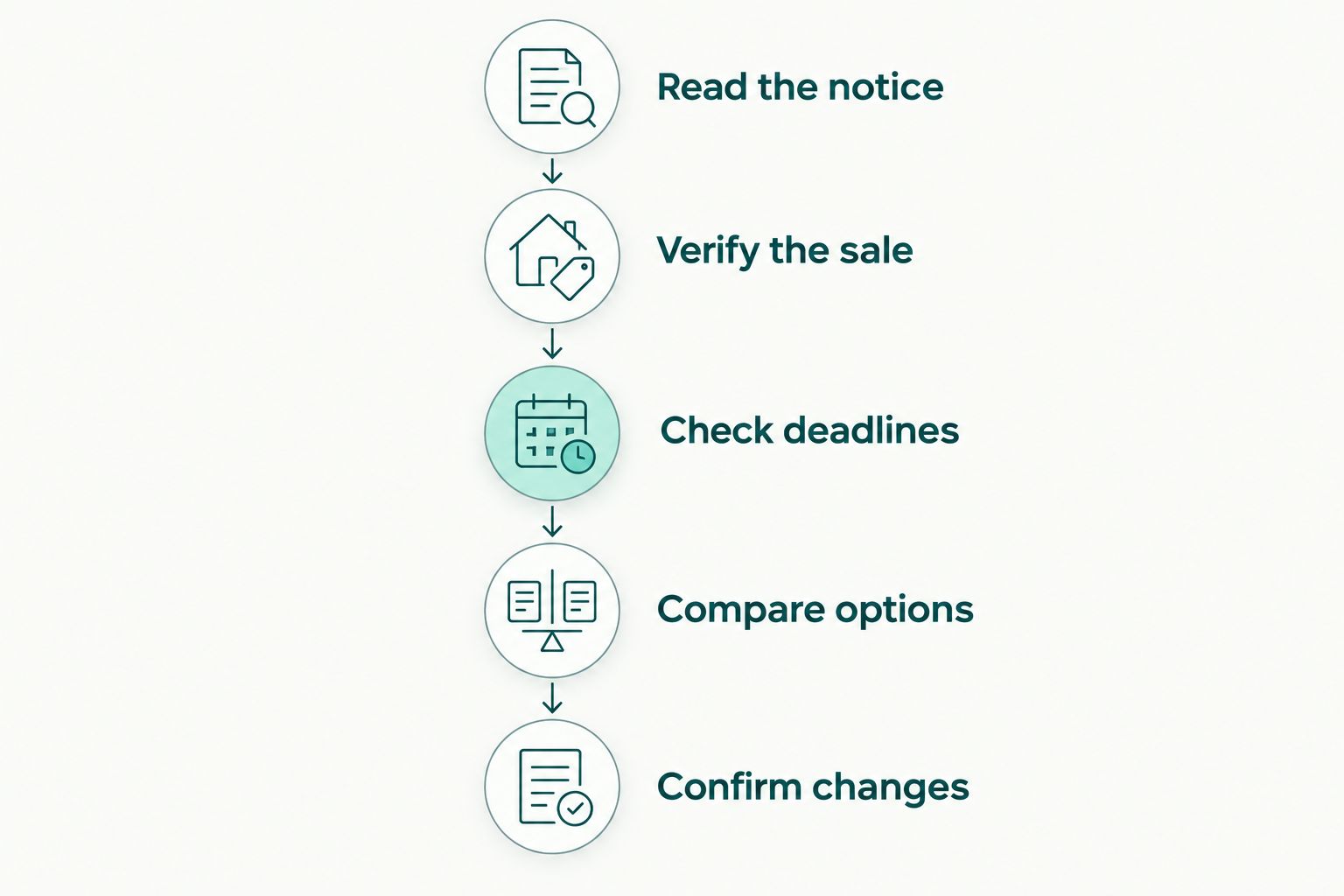
Use this sequence to establish the facts before choosing a response. Verify the deadline first; evaluate the solution second.
1. Read the notice
Find the property address, borrower name, sale date, sale location or bidding method, and the party conducting the auction. Keep the envelope and every page, including attachments.
Check whether the document actually schedules a sale. A warning that foreclosure is possible does not establish that an auction has been set.
2. Verify the sale
Contact the party conducting the auction using independently verified contact details. Ask whether the sale remains scheduled and how to check for later changes.
Also contact your mortgage servicer. If different parties give conflicting information, ask for written clarification and bring the conflict to your attorney immediately.
3. Check deadlines
Ask a foreclosure attorney to review the notice, court record if applicable, and any earlier documents. Identify the next action deadline—not just the auction date.
For a 2026 case file, keep a dated record of calls, names, reference numbers, and written responses. A clear record helps you explain what happened without relying on memory.
4. Compare options
Decide whether your goal is to keep the home or sell it. Ask about the requirements for each available path, including any documents that remain outstanding.
A request is not an approval. Continue tracking the auction while the servicer evaluates an application or proposed sale.
5. Confirm changes
If someone says the auction has been postponed or canceled, request written confirmation identifying the property and the affected sale date. Verify the status with the party conducting the sale.
Do not treat a scheduled callback, document upload, or buyer’s offer as proof of a postponement. Those events do not, by themselves, establish that the auction has stopped.
Can a short sale stop a scheduled foreclosure auction?
A short-sale request does not automatically stop an auction. A proposed sale needs lender review, and any postponement must be confirmed through the appropriate parties.
If your mortgage balance exceeds the home’s sale value, a short sale is one option to discuss. The key question is not simply whether a buyer exists; it is whether the required approvals and closing can occur before the applicable deadline.
Read more about starting a short sale after a foreclosure sale date is set. Keep your attorney involved when a sale date is close or disputed.
Shortsalesdoneright is best for homeowners seeking short-sale processing and lender negotiation support. It helps homeowners compare a short sale with other options; it does not replace legal advice or guarantee approval, postponement, or forgiveness of an unpaid balance.
Which option matches your goal?
These are discussion paths, not promises of eligibility. The right choice depends on your finances, loan requirements, and remaining time.
| Option | Best for | Main benefit | Main limitation |
|---|---|---|---|
| Loan modification | Homeowners seeking to keep the home | Changes approved loan terms | Requires servicer approval and an affordable outcome |
| Short sale | Homeowners seeking to sell an underwater property | Allows a sale for less than the mortgage balance with required approvals | Does not automatically pause foreclosure or erase remaining debt |
| Deed in lieu | Homeowners considering a negotiated transfer to the lender | Provides an alternative to completing a foreclosure sale when accepted | Requires lender acceptance and review of written terms |
Ask a qualified attorney about liability for any remaining balance. Ask a qualified tax professional about tax consequences before accepting an agreement.
Request help comparing your options
Discuss short-sale processing and lender negotiation without assuming the auction is on hold.
Use the homeowner intake form on the site to request help. Include the auction date shown on your notice so the deadline is part of the initial discussion.
Does a mortgage assistance application pause foreclosure?
Submitting an application alone is not a universal foreclosure pause. Federal protections depend on factors including coverage, whether the application is complete, and when the servicer receives it.
Under Regulation X, receipt of a complete loss-mitigation application more than 37 days before a scheduled sale generally triggers evaluation requirements and restrictions on conducting the sale, subject to the rule’s conditions and exceptions. That is not a guarantee of approval or a new auction-notice period.
Source: CFPB Regulation X, 12 CFR §1024.41(c) and (g). Ask the servicer to confirm completeness and receipt date in writing, and have an attorney assess the protections that apply.
What if I never received the auction notice?
Not receiving or opening a notice does not, by itself, establish that the sale is invalid. Legal notice requirements can turn on mailing, service, posting, or publication rather than the date you personally read the document.
Request copies of the relevant notices and records showing how notice was provided. Have a foreclosure attorney review compliance promptly instead of assuming the auction cannot proceed.
FAQ
How much notice does a lender give before a foreclosure auction in 2026?
There is no single nationwide auction-notice period in 2026. State law, the foreclosure process, and the notice involved determine the applicable requirement; verify the scheduled sale date separately.
Does the 120-day foreclosure rule mean I have 120 days before auction?
No. The federal 120-day rule generally restricts the first foreclosure notice or filing for covered loans, subject to exceptions; it does not establish the auction-notice period.
Can the bank auction my home while I am negotiating a short sale?
Short-sale negotiations do not automatically stop an auction. Confirm any postponement in writing and verify it with the party conducting the sale.
Will submitting mortgage assistance paperwork stop the sale?
Submitting paperwork does not automatically stop the sale. Protections depend on coverage, completeness, timing, and other requirements; ask for written confirmation of your application status.
What should I do if the auction date is very close?
Contact a foreclosure attorney and the party conducting the sale promptly. Verify the current sale status and ask what lawful action remains available before the deadline.
Does a short sale guarantee that I will not owe the unpaid balance?
No. Treatment of an unpaid balance depends on the agreement, applicable law, and other circumstances. Have a qualified attorney review liability and a tax professional review tax consequences.
Can Shortsalesdoneright help me understand my short-sale options?
Shortsalesdoneright provides short-sale processing and lender negotiation services and helps homeowners compare a short sale with other options. Request help through the homeowner intake form; lender approval and auction postponement are not guaranteed.
One last thing
A postponed auction and an approved short sale are different events. Neither proves the other has happened.
Before relying on either, obtain the relevant written confirmation and check its conditions. Lender terms and state law vary; legal and tax questions belong with qualified professionals.