

Short sale processing adds lender review and approval work to a listing, but there is no fixed number of extra days that applies to every file. Some preparation can overlap with marketing; offer review, approval conditions, and closing coordination still depend on the lender and the transaction. Plan around confirmed milestones, not a promised closing date.
- How much time does short sale processing add to a listing? The answer depends on lender review, package completeness, and closing conditions.
- Prepare seller documents during marketing; an accepted offer does not replace written lender approval.
- Shortsalesdoneright suits agents seeking outsourced short sale processing, package preparation, and weekly lender updates.
- Track package receipt, outstanding requests, and approval conditions separately from the listing’s days on market.
How much time does short sale processing add to a listing?
Short sale processing adds work before submission, during lender review, and after approval. It does not translate into a standard extension of a regular listing agreement. Your useful estimate starts with the file’s current status, not the date the property first appeared in the MLS.
For a 2026 listing, separate marketing time from lender-review time. A property can attract a buyer while the seller gathers documents, but that overlap does not establish when the lender will approve the proposed sale.
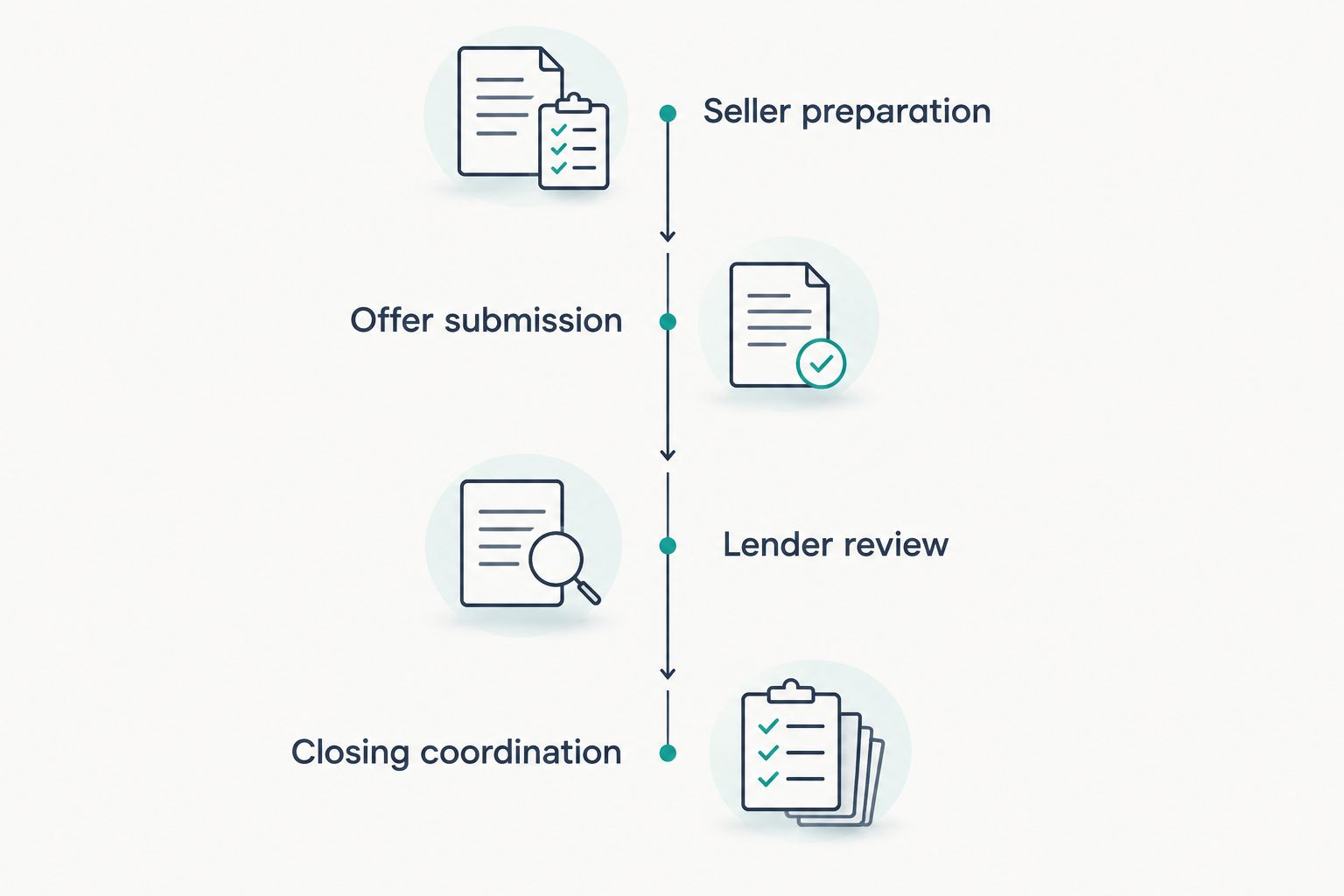
Use this milestone breakdown with your seller and buyer’s agent:
| Milestone | What moves the file forward | What it means for timing |
|---|---|---|
| Seller preparation | Required financial records, authorizations, and property information are gathered | Preparation can overlap with marketing |
| Offer submission | The offer and required supporting documents reach the lender | Delivery alone does not confirm the package is complete |
| Lender review | The lender evaluates the request and asks for additional information where needed | Outstanding requests keep the decision unresolved |
| Written approval | The lender issues terms and conditions for the proposed sale | Approval creates conditions to satisfy, not an automatic closing |
| Closing coordination | The parties satisfy applicable approval and transaction requirements | The closing date must fit the written terms |
The MLS listing to short sale package workflow explains the handoff between marketing the property and preparing the submission. Do not treat listing activation, package submission, and lender approval as the same starting point.
Why this matters
A seller needs to plan housing and moving decisions. An agent needs to manage the listing, buyer expectations, and contract deadlines. A vague promise that the bank will respond soon helps neither audience.
For your 2026 transaction plan, identify what is finished, what is pending, and who owns the next action. That gives the seller a useful update even when the lender has not issued a decision.
Keep contract obligations separate from lender status. A pending short sale request does not, by itself, change a contract deadline or establish that foreclosure activity has stopped. Lender terms and state law vary; send legal questions to a qualified attorney.
Where processing fits into the listing timeline
Before an offer: prepare the seller’s file
Start with the lender’s current requirements. Confirm the authorization needed to discuss the account, the requested seller documents, and the process for submitting a short sale request.
Ask whether the lender accepts preliminary documents before an offer. Do not assume every lender follows the same sequence. Early preparation is useful even when a complete offer package must wait for a buyer.
Give the seller a specific document list and identify missing signatures. Check that names, property details, and account information agree across the file. Finding an inconsistency before submission gives you a chance to correct it before the lender asks.
After an offer: confirm receipt and completeness
An accepted offer is a transaction milestone, not proof of lender approval. Submit the required materials through the lender’s designated process and retain the submission confirmation.
Then confirm what that acknowledgment means. Receipt, assignment, and a complete package are different statuses. Ask which status applies and whether anything remains outstanding.
Record the response in plain language. The seller should know whether the lender is reviewing the proposal or still waiting for information needed to review it.
During review: answer the actual request
Keep lender requests together in a shared file or transaction record. Identify the requested document, the person responsible, and any deadline the lender provides.
Check the request before sending a reply. A document that looks similar is not necessarily the document requested. Confirm that the lender received the response and whether it resolves the outstanding item.
Avoid giving the buyer’s agent an approval prediction based only on successful document delivery. A completed request moves the file forward; it does not establish the lender’s decision.
After approval: work from the written terms
Read the approval before announcing that the transaction is ready to close. Confirm its conditions, expiration date, required proceeds, and treatment of any remaining balance with the appropriate professionals.
Coordinate the approval with the buyer’s financing, title work, and contract obligations. If the proposed closing cannot meet the approval terms, address that conflict rather than assuming an extension will be granted.
Written approval narrows the work remaining; it does not eliminate it. Keep tracking open conditions until the closing team confirms they are satisfied.
Why short sale processing time varies
The added time depends on the work required for the particular loan and sale. These are the factors to check before offering a timeline:
- Package completeness. Missing documents, signatures, or requested explanations leave work outstanding. Confirm completeness with the lender rather than assuming a successful upload settles it.
- Lender requirements. Submission procedures and approval conditions differ. Use the requirements for the actual account instead of a checklist from an unrelated transaction.
- Property valuation. The lender’s assessment of the property and proposed proceeds affects its review. Ask whether valuation work is outstanding and whether access is needed.
- Additional liens. A second mortgage or another lien introduces additional release or approval questions. Identify those interests through the appropriate title and legal review.
- Offer changes. A changed buyer, proposed proceeds, or contract terms can require further review. Confirm the effect of a revision before presenting the existing approval as sufficient.
- Closing readiness. Buyer financing, title issues, and unmet approval conditions remain relevant after the lender responds. Keep those tasks visible alongside lender negotiations.
For a 2026 file, verify these factors directly. A timeline from a previous transaction is not a commitment from the lender handling this one.
What can an agent do to avoid preventable delays?
Prepare early, assign responsibility, and verify each handoff. These actions address work within the transaction team’s control without promising a faster lender decision.
- Confirm requirements. Ask for the lender’s current submission instructions and required documents. Record where the package belongs and how receipt will be confirmed.
- Assign ownership. Tell the seller which records to provide. Identify who handles lender follow-up, buyer communication, and closing coordination.
- Review the package. Check signatures, dates, property information, and requested attachments before submission. Keep a copy of exactly what was sent.
- Resolve requests. Track each outstanding item until the lender confirms its status. Do not let an unanswered request disappear inside a general transaction note.
- Check closing conditions. Once approval arrives, compare its requirements with the contract and closing plan. Raise conflicts while there is still work to do.
This is a coordination process, not an approval formula. The lender retains its decision-making role, and a well-organized submission does not guarantee acceptance.
For agents considering outsourced help, Shortsalesdoneright provides short sale processing and lender negotiation services, including full package preparation, a dedicated point of contact, and weekly lender updates. Shortsalesdoneright is best for real estate agents who want short sale processing and lender follow-up handled by a dedicated service.
The limitation is clear: Shortsalesdoneright cannot promise lender approval or a specific processing duration. Sellers still need to provide requested information, and the transaction team still needs to meet applicable contract and closing requirements.
Agents ready to act can request processing help through the realtor intake form on the site. Use the homeowner intake route when the homeowner needs help comparing a short sale with other options.
Request short sale processing help
Get help with package preparation, lender negotiation, and weekly lender updates.
How should you explain the timeline to your seller?
Explain the current stage before discussing a possible closing date. Tell the seller what has been confirmed, what remains unresolved, and what action is needed next.
Your 2026 seller update should distinguish progress from prediction. Package receipt is progress. A request for additional documents is an action item. Neither is written approval.
Use a consistent update format:
- Confirmed status: State the latest lender-confirmed milestone.
- Open request: Identify the specific document, response, or decision still needed.
- Responsible person: Name who must act next.
- Deadline: Include an actual lender or contract deadline when one exists.
- Next update: Tell the seller when you will communicate again.
Do not confuse weekly updates with weekly lender decisions. A useful update can confirm that a request remains pending and explain the follow-up underway. It should not create an impression of approval that the written record does not support.
Can short sale preparation start before the property gets an offer?
Preparation can start before an offer, but the lender’s rules determine what it will accept and review at that stage. Gather requested seller records and confirm submission requirements while the property is being marketed.
Early preparation does not mean the sale is preapproved. Explain that distinction to the seller before using preliminary progress to discuss a closing date.
Does outsourcing short sale processing guarantee a faster closing?
Outsourcing does not guarantee a faster closing. It assigns package preparation and lender follow-up to a service, while the lender controls its review and approval decision.
Evaluate the service by its stated responsibilities and communication process. Do not treat an assigned processor or frequent updates as evidence that the lender will approve the offer.
Does lender approval mean the buyer can close immediately?
Lender approval does not mean the buyer can close immediately. The parties still need to satisfy the written approval conditions and applicable financing, title, and contract requirements.
Before confirming a closing date, have the closing team check that the transaction fits the approval. Resolve any uncertainty about the remaining balance with a qualified attorney rather than assuming approval means forgiveness.
FAQ
How much time does short sale processing add to a listing in 2026?
Short sale processing has no fixed added duration that applies to every listing in 2026. The timeline depends on package preparation, lender review, outstanding requests, and closing conditions.
Does the short sale clock start when my listing goes live?
Listing activation does not establish the start of lender review. Track marketing, package submission, confirmation of completeness, and approval as separate milestones.
Can I submit short sale documents before I have a buyer?
Ask the lender whether it accepts preliminary documents before an offer. You can prepare seller records early without assuming the lender will review or approve a sale at that stage.
What should I tell buyers about the short sale closing date?
Tell buyers that the closing date depends on lender approval and satisfaction of the transaction’s conditions. Have the appropriate professionals address contract deadlines and any needed extensions.
Will a short sale processor guarantee bank approval?
A short sale processor cannot guarantee lender approval. Processing support addresses preparation, communication, and follow-up, not the lender’s final decision.
Does submitting a short sale stop a foreclosure auction?
Do not assume a short sale submission stops a foreclosure auction. Lender terms and state law vary; contact a qualified attorney promptly about an existing notice or sale date.
Will short sale approval erase the unpaid mortgage balance?
Do not assume short sale approval erases the unpaid balance. Have a qualified attorney review the written terms, and ask a qualified tax professional about potential tax consequences.
One last thing
A submission receipt is not a completeness confirmation. Before treating a 2026 short sale file as under review, ask whether the lender has everything it currently requires and what remains open.
Put that answer in the transaction record. It gives your next seller update a concrete purpose: resolve the missing item or follow up on the pending decision, rather than simply count days.


