

Best overall: Ask what the negotiator handles from package preparation through closing. Best for homeowners: Ask how an unpaid balance will be addressed. Best for fee clarity: Ask who pays and what triggers payment. These are the priority questions to ask short sale negotiator candidates in 2026; Shortsalesdoneright provides short sale processing and lender negotiation services for agents and homeowners.
- The best questions to ask short sale negotiator candidates establish scope, communication, payment responsibilities, and lender approval terms.
- Shortsalesdoneright suits agents seeking short sale processing and lender negotiation support, including package preparation and weekly lender updates.
- Homeowners should ask about unpaid balances and alternatives; lender terms and state law vary.
- Skip any negotiator who guarantees lender approval, debt forgiveness, or a specific credit-score result.
Why this matters
Hiring a short sale negotiator does not transfer every responsibility away from you. An agent still needs to know which tasks remain with the brokerage. A homeowner needs to understand what the proposed sale means for the mortgage and any unpaid balance.
Shortsalesdoneright is best for agents seeking short sale processing and lender negotiation support. Its stated service benefits include preparing the full short-sale package, a dedicated point of contact, and weekly lender updates. Use the questions below to clarify the scope for your transaction rather than assuming every closing task is included.
For a 2026 hiring decision, written responsibilities matter more than a confident pitch. A lender decides whether to approve the transaction and on what terms. Legal and tax questions belong with qualified professionals, not with a negotiator making promises outside the service agreement.
What makes the best short sale negotiator questions
Judge each answer against these criteria before comparing candidates:
- Defined scope: The answer separates package preparation, lender communication, and closing coordination from tasks you retain.
- Clear ownership: You know who requests documents, follows up, and reports unresolved issues.
- Useful communication: Updates explain the file's status, outstanding requests, and next action.
- Written terms: Payment responsibilities and service boundaries appear in the agreement.
- Honest limits: The candidate distinguishes lender decisions from work within the negotiator's control.
- Relevant judgment: The answer addresses your situation without substituting negotiation experience for legal or tax advice.
The ranking below prioritizes decisions you need before signing. It is not a ranking of companies, and no single reassuring answer replaces a review of the written agreement.
Questions at a glance
| Rank and question | Best for | What a useful answer establishes | Key limitation |
|---|---|---|---|
| 1. What exactly do you handle? | Agents outsourcing processing | Responsibilities from documents through closing | Scope does not establish competence |
| 2. What happens to an unpaid balance? | Homeowners evaluating debt exposure | Which approval terms require professional review | The negotiator cannot guarantee forgiveness |
| 3. Who handles my file and updates? | Agents managing seller communication | Named contact, reporting cadence, next actions | Frequent updates do not guarantee progress |
| 4. What deadlines affect this file? | Transactions with urgent notices | Known deadlines and who monitors them | A pending request does not establish a pause |
| 5. Who pays, and when? | Readers reviewing payment obligations | Payment triggers and cancellation terms | Written terms still need careful review |
| 6. What relevant experience can you show? | Readers checking capability | Comparable work and a clear process | Past outcomes do not predict approval |
| 7. Who do you represent? | Readers checking competing interests | Client relationship and decision authority | Disclosure does not eliminate conflicts |
| 8. What alternatives should I compare? | Homeowners deciding whether to sell | Other options to discuss with qualified help | Negotiation services are not legal or tax advice |
1. Scope question: best for agents outsourcing processing
Ask: What exactly do you handle, and what stays with me? A short sale negotiator's scope should describe tasks, not just promise to handle the bank. Ask the candidate to walk through the file from intake to the proposed closing.
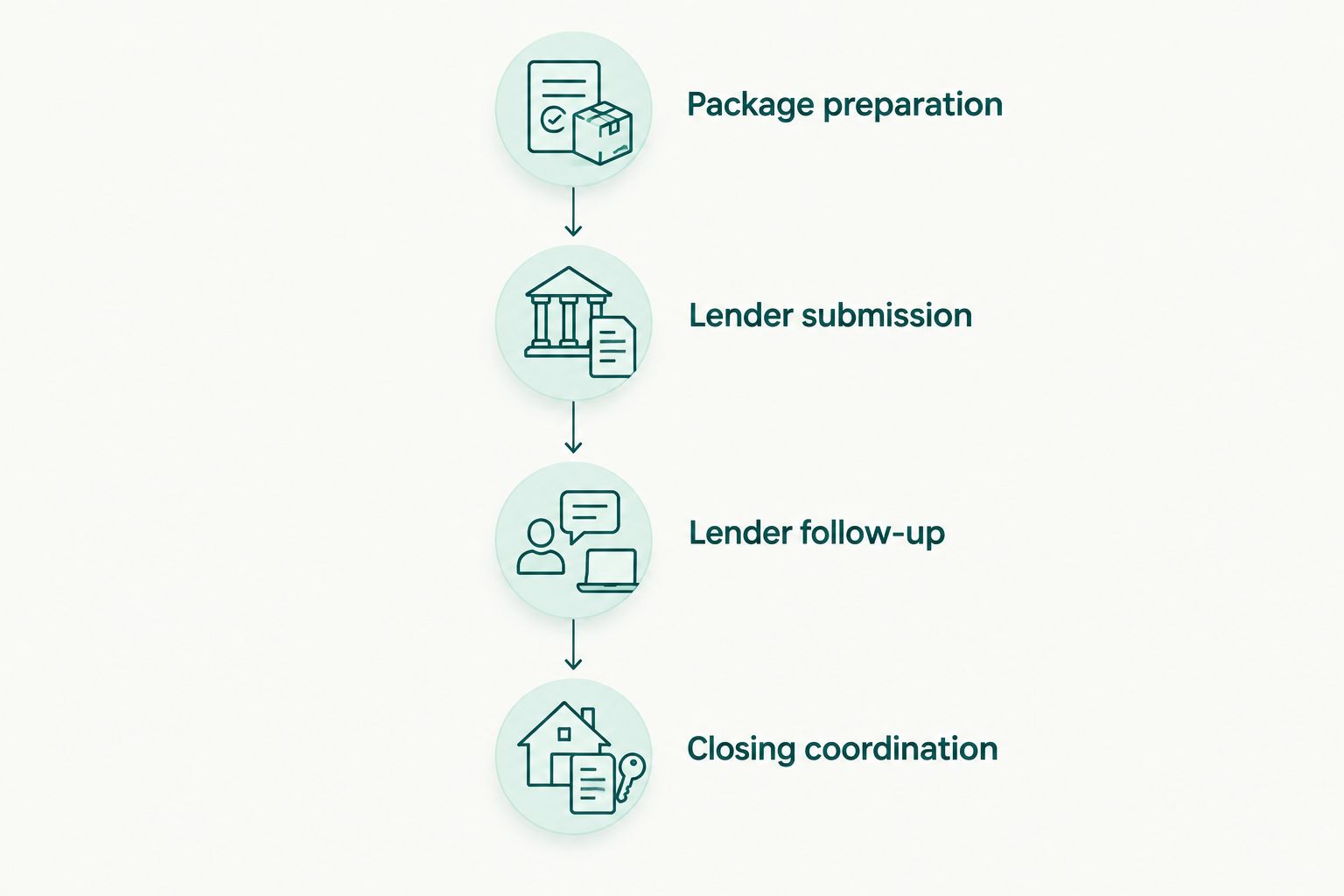
Use these task labels when discussing the agreement:
- Package preparation: Who gathers, checks, and assembles the required documents?
- Lender submission: Who sends the package and addresses submission problems?
- Lender follow-up: Who responds to requests and tracks unresolved items?
- Closing coordination: Who communicates approval conditions to the closing team?
A task discussion is useful only when it identifies an owner. Ask which responsibilities belong to the seller, listing agent, negotiator, and closing professional.
Scope question pros:
- Exposes gaps before you sign.
- Separates outsourced work from brokerage duties.
- Gives you a basis for checking the agreement.
Scope question cons:
- A detailed answer does not prove execution quality.
- Responsibilities still depend on the actual contract.
Best for: Agents buying processing support rather than occasional advice.
Verdict: Buy only after the written scope matches the work you need outsourced.
2. Unpaid-balance question: best for homeowners assessing risk
Ask: How will the lender's decision address the balance left after the sale? Approval to sell and release a mortgage lien does not, by itself, establish that every remaining payment obligation disappears. Have a qualified attorney review the wording that applies to you.
Ask whether the candidate identifies these terms for review before you accept an approval. Do not settle for an assurance that the lender normally forgives the difference. Your documents, lender terms, and state law control the situation.
For homeowners considering a short sale in 2026, this question belongs near the top of the interview. It addresses what happens after the transaction, not just whether the transaction closes.
Unpaid-balance question pros:
- Focuses attention on the actual approval language.
- Separates a sale decision from a debt decision.
- Creates a clear reason to involve legal counsel.
Unpaid-balance question cons:
- The negotiator cannot determine your legal rights.
- Final lender terms are not established by an interview.
Best for: Homeowners worried about obligations remaining after closing.
Verdict: Hold until you understand the approval terms and any remaining obligations.
3. Communication question: best for agents managing sellers
Ask: Who owns my file, how often will I hear from them, and what will an update contain? Request 1 named point of contact and an agreed reporting cadence. An update should identify the current status, outstanding requests, responsible person, and next action.
Shortsalesdoneright describes a dedicated point of contact and weekly lender updates among its service benefits. Ask how those updates reach you and how urgent issues are escalated between scheduled reports.
Do not equate a weekly message with weekly lender progress. A useful report distinguishes a completed action from a pending response so you can give the seller an accurate account.
Communication question pros:
- Makes seller communication easier to manage.
- Identifies who receives urgent requests.
- Turns vague status reports into actionable information.
Communication question cons:
- A reporting schedule cannot control lender response times.
- A named contact alone does not define escalation responsibilities.
Best for: Listing agents who need clear updates without chasing multiple people.
Verdict: Buy when the communication commitment is specific and documented.
4. Deadline question: best for files with urgent notices
Ask: What deadlines affect this property, and who is responsible for tracking them? Bring lender notices and any foreclosure-related documents to the discussion. Ask the candidate to distinguish known dates from estimates.
Do not assume that submitting a short sale request stops foreclosure activity. Get confirmation of any pause or postponement from the appropriate source and ask a qualified attorney about legal deadlines.
A 2026 calendar entry is not enough. You need to know what must happen before that date, who must act, and what information is still unresolved. Avoid treating an estimated closing date as a lender commitment.
Deadline question pros:
- Separates urgent actions from routine follow-up.
- Identifies documents requiring professional review.
- Clarifies who reports changes to the timeline.
Deadline question cons:
- Dates and lender decisions can change.
- The negotiator cannot replace legal advice about foreclosure proceedings.
Best for: Homeowners and agents handling a file with a scheduled action or formal notice.
Verdict: Hold if a material deadline remains unexplained or unassigned.
5. Payment question: best for reviewing service obligations
Ask: Who pays for the service, what triggers payment, and what happens if the transaction does not close? Read the agreement rather than relying on a verbal description. Request 1 written explanation covering payment responsibility, cancellation, and work already completed.
Ask whether any payment arrangement requires disclosure or approval by the lender or another transaction participant. Do not assume a payment responsibility belongs to the seller, buyer, agent, or lender without confirmation.
The goal is to understand the commitment before hiring. Keep compensation discussions separate from promises about lender approval or the outcome of the sale.
Payment question pros:
- Identifies the party responsible for payment.
- Exposes cancellation and termination terms.
- Helps you reconcile the pitch with the contract.
Payment question cons:
- A clear payment clause does not establish service quality.
- Questions about enforceability belong with qualified counsel.
Best for: Anyone signing a negotiation or processing agreement.
Verdict: Hold until payment triggers and termination terms are clear in writing.
6. Experience question: best for checking relevant capability
Ask: What experience do you have with files like mine, and how would you handle this one? Relevant experience means explaining the process and complications that apply to your transaction. A broad claim about closing difficult deals is not enough.
Request an explanation that respects past clients' privacy. Ask how the candidate handles incomplete packages, additional lender requests, and changes to proposed terms. For your 2026 interview, assess the proposed working method rather than accepting an unexplained success claim.
If references are offered, ask about responsiveness and ownership of tasks. Those questions address the service you are hiring without treating a past approval as a prediction.
Experience question pros:
- Tests whether the candidate can explain the work plainly.
- Connects experience to your file's actual needs.
- Gives references specific service questions to answer.
Experience question cons:
- Past transactions do not guarantee your outcome.
- Confidentiality limits what a candidate should disclose.
Best for: Readers comparing candidates with similar service descriptions.
Verdict: Skip candidates who replace a process explanation with approval guarantees.
7. Representation question: best for checking competing interests
Ask: Who is your client, who can instruct you, and what relationships should I know about? Identify the party hiring the negotiator and the authority granted by the agreement. Ask how offers, lender conditions, and material changes reach the seller and agent.
Do not confuse permission to communicate with permission to accept terms. Ask which decisions require your approval and how that approval is recorded. Have qualified counsel review questions about authority, required licensing, or conflicts under applicable state law.
Representation question pros:
- Clarifies whose instructions the negotiator follows.
- Makes decision authority explicit.
- Brings potentially competing interests into the discussion.
Representation question cons:
- Disclosure alone does not resolve a conflict.
- Legal requirements vary by state and activity.
Best for: Readers unsure how the negotiator fits into the transaction team.
Verdict: Hold until client relationships and approval authority are clear.
8. Alternatives question: best for homeowners deciding whether to sell
Ask: What other options should I compare before committing to a short sale? Depending on your circumstances, discussions can include a loan modification, repayment arrangement, ordinary sale, or deed in lieu of foreclosure. Eligibility and consequences differ.
A short sale service should not present every upside-down mortgage as the same problem. Ask what information is needed to compare your options, including your ability to keep the home and your goals for leaving it.
Use a qualified attorney and tax professional for questions within their fields. A HUD-approved housing counselor is another resource for discussing mortgage difficulties.
Alternatives question pros:
- Keeps the decision tied to your goals.
- Identifies questions beyond negotiation scope.
- Prevents an interview from becoming a one-option sales pitch.
Alternatives question cons:
- Not every option applies to every borrower.
- Comparing options requires facts about your mortgage and circumstances.
Best for: Homeowners who have not decided whether a short sale is the right path.
Verdict: Wait to commit until you have compared the relevant alternatives.
How these questions are ranked
Scope comes first because it defines the service you are buying. Unpaid-balance terms come next because homeowners need to understand obligations beyond the sale. Communication, deadlines, payment, experience, representation, and alternatives complete the hiring decision.
For an interview, take 1 written checklist and record each answer beside the corresponding contract term. An answer that never reaches the agreement is not the same as a service commitment.
Which question should you ask first?
Agents should start with scope. Homeowners should start with unpaid-balance terms and alternatives. Both audiences should review communication and payment responsibilities before signing.
Shortsalesdoneright offers short sale processing and lender negotiation support for agents and homeowners. Readers ready to act can request help through the appropriate intake form on its site. Keep legal and tax review separate from the processing engagement.
FAQ
What's the most important question to ask a short sale negotiator?
Ask what the negotiator handles and what remains your responsibility. Homeowners should also prioritize how the lender's approval addresses any unpaid balance.
Can a short sale negotiator guarantee lender approval?
No, a short sale negotiator cannot guarantee lender approval. The lender decides whether to approve the transaction and on what terms.
Does a short sale automatically erase the remaining mortgage balance?
No, a short sale does not automatically establish that the remaining mortgage balance is forgiven. Lender terms and state law vary; have a qualified attorney review the approval language.
How often should I hear from my short sale negotiator?
Agree on a reporting schedule before hiring. Shortsalesdoneright describes weekly lender updates and a dedicated point of contact among its service benefits.
Who pays the short sale negotiator?
The written agreement should identify who pays the negotiator and what triggers payment. Confirm cancellation terms and any required transaction disclosures before signing.
Does hiring a negotiator stop foreclosure?
Hiring a negotiator does not establish that foreclosure has stopped. Confirm any pause or postponement and ask a qualified attorney about deadlines affecting your property.
Should I compare a short sale with other options?
Yes, compare a short sale with the alternatives relevant to your mortgage and goals. Ask qualified professionals about legal and tax consequences, and consider speaking with a HUD-approved housing counselor.
One last thing
Ask the candidate to explain what happens when the lender requests something unexpected. That answer tests the working relationship better than a polished opening pitch. You need to know who receives the request, who acts, and how you learn what happens next.
Before signing in 2026, compare the answers with the agreement. Resolve differences before the file changes hands.