

Best overall: start when financial hardship makes your mortgage unsustainable and selling will not cover the debt. Best after missed payments: begin before a foreclosure filing. Best after a formal notice: get legal advice alongside short-sale help immediately. For homeowners deciding when to start a short sale before foreclosure in 2026, Shortsalesdoneright provides short-sale processing and lender negotiation services.
- Start short-sale planning when hardship and an upside-down mortgage make keeping the home unrealistic; do not wait for foreclosure.
- Shortsalesdoneright provides short-sale processing and lender negotiation services for homeowners considering a sale.
- A listing or buyer offer alone does not stop foreclosure. Confirm application status and legal deadlines separately.
- Compare a short sale with mortgage assistance before committing. Lender terms and state law vary.
Why starting early matters
A short sale requires your mortgage lender to accept sale proceeds that do not fully repay the mortgage. You need more than a willing buyer. The lender must review the transaction and agree to its terms.
Starting early gives you time to understand your options, assemble documents, and address lender requests before foreclosure deadlines become the main problem. It does not guarantee approval. Shortsalesdoneright is best for homeowners who need short-sale processing and lender negotiation help while evaluating an upside-down mortgage.
For a homeowner making this decision in 2026, the right trigger is a financial problem you cannot resolve—not a particular number of missed payments. If keeping the home remains realistic, ask about mortgage assistance before choosing a sale.
What makes the best short-sale starting point
Judge your timing against these criteria before choosing a path:
- Financial reality: Your payment is no longer sustainable, and you have assessed whether the problem is temporary or lasting.
- Sale proceeds: A realistic sale estimate, after transaction expenses, will not cover the mortgage debt.
- Foreclosure status: You know whether the lender has started foreclosure and whether a sale date exists.
- Document readiness: You can provide the information your mortgage servicer requires for its review.
- Homeownership goal: You have decided whether you want to keep the property or leave it.
- Decision authority: You understand that lender approval, unpaid debt, and legal deadlines require separate answers.
The best starting point in 2026 satisfies the financial criteria while leaving time to address the lender's requirements. Waiting for a foreclosure notice does not improve the underlying short-sale case.
Short-sale starting points at a glance
| Rank and starting point | Best for | Main advantage | Key limitation |
|---|---|---|---|
| 1. Financial hardship | Homeowners recognizing an unsustainable mortgage early | Time to compare keeping the home with selling | Hardship alone does not establish short-sale eligibility |
| 2. Missed payments | Homeowners already behind but without a foreclosure filing | Opportunity to act before the legal process advances | Foreclosure timing must be verified with the servicer |
| 3. Formal notice | Homeowners facing an active foreclosure process | A clear reason to coordinate sale planning and legal advice | A short-sale request does not automatically pause foreclosure |
| 4. Scheduled sale | Homeowners facing an immediate foreclosure deadline | Focuses attention on urgent legal and lender decisions | Approval and closing cannot be assumed before the sale |
These are ranked starting points, not interchangeable options. Use the section that matches your current situation, even if you have already passed the earliest stage.
1. Financial hardship: best for early short-sale planning
Start evaluating a short sale when your payment becomes unsustainable and the property cannot sell for enough to repay the mortgage. You do not need to create a missed payment just to begin asking questions. The lender determines whether your circumstances meet its requirements.
At this stage, separate two decisions: whether keeping the home is realistic, and whether selling requires lender approval. A payment problem does not automatically mean a short sale is the right answer. A property with sufficient equity might support a conventional sale instead.
Financial hardship pros:
- You can compare mortgage assistance with selling before a foreclosure deadline dominates.
- You can gather documents and correct gaps before submitting a package.
- You can discuss realistic sale expectations with a real estate agent.
Financial hardship cons:
- Your preferred outcome still depends on lender requirements.
- Starting early does not make an unsuitable short sale eligible.
Best for: Homeowners who recognize a lasting affordability problem and owe more than a realistic sale would repay.
Verdict: Start now. Begin the assessment before deciding to stop payments or commit to a sale. Ask the servicer what assistance is available while you evaluate the short-sale route.
2. Missed payments: best for acting before foreclosure filing
If you are already behind, start the short-sale conversation now rather than waiting for a legal notice. Ask your mortgage servicer for your delinquency status, its application requirements, and any known foreclosure deadlines. Keep the answers in writing where possible.
Under federal Regulation X, mortgage servicers generally cannot make the first foreclosure notice or filing until a covered mortgage loan is more than 120 days delinquent, subject to exceptions. This is not a universal short-sale deadline. State procedures and the loan's circumstances still matter.
Missed payments pros:
- You can identify the servicer's requirements before a filing advances the process.
- You can address incomplete documents while pursuing a defined sale strategy.
- You can compare selling with available options for keeping the home.
Missed payments cons:
- Delinquency has already begun, and early planning cannot undo it.
- The general federal filing restriction does not guarantee short-sale approval or completion.
Best for: Homeowners with missed payments who have not yet received a foreclosure filing or confirmed that one exists.
Verdict: Start now; skip waiting for another missed payment. For planning in 2026, treat the federal filing rule as a legal protection to understand, not a countdown to use up.
3. Formal notice: best for coordinated legal and sale planning
Once you receive a foreclosure notice or court papers, short-sale planning must run alongside legal deadline management. Read the notice, record any response or sale dates, and contact a qualified attorney about your obligations. Do not assume lender discussions replace a required legal response.
A formal notice does not establish that a short sale is impossible. It establishes that you need precise information about the foreclosure process and the lender's review status. Ask whether the lender will consider a short sale at this stage and what it requires.
Formal notice pros:
- You can build your plan around documented deadlines rather than assumptions.
- Legal advice can clarify the consequences of the notice in your state.
- A coordinated approach separates lender negotiations from court or notice requirements.
Formal notice cons:
- Starting a short sale does not automatically stop the foreclosure process.
- Lender review and legal deadlines can proceed on different schedules.
Best for: Homeowners who have received formal foreclosure documents but still want to explore a sale.
Verdict: Start immediately, with legal advice in parallel. Give your agent and short-sale processor copies of relevant notices. Keep responsibility for legal responses clearly assigned to a qualified professional.
4. Scheduled sale: best for urgent deadline assessment
If a foreclosure sale is scheduled, start with the sale date—not the listing plan. Contact a qualified attorney and your mortgage servicer immediately. Ask what options remain and what confirmation would establish that the sale has been postponed or canceled.
Federal Regulation X includes protections tied to a complete loss-mitigation application received more than 37 days before a foreclosure sale, subject to the rule's coverage and conditions. A last-minute listing or offer is not the same as a complete application. Do not assume that submitting either stops the sale.
Scheduled sale pros:
- You can identify the exact deadline that controls your next decision.
- Legal advice can distinguish available protections from assumptions.
- Direct servicer contact can clarify whether a short-sale review remains an option.
Scheduled sale cons:
- There is no guarantee the lender will review, approve, and close a short sale before the sale date.
- A pending request does not establish that foreclosure has been paused.
Best for: Homeowners who already have a scheduled foreclosure sale and need an immediate assessment.
Verdict: Skip a short-sale-only plan. Pursue urgent legal and lender guidance together. Treat the scheduled sale as active unless you receive reliable confirmation that its status has changed.
How these starting points rank
Financial hardship ranks first because it allows you to compare options before a legal deadline drives the decision. Missed payments rank next because you still need to act before the process advances. Formal notices and scheduled sales require increasingly urgent deadline management.
The ranking uses the criteria above: financial fit, foreclosure status, document readiness, and your goal for the property. It does not rank the likelihood of lender approval or predict your credit outcome.
What to do when you decide to start
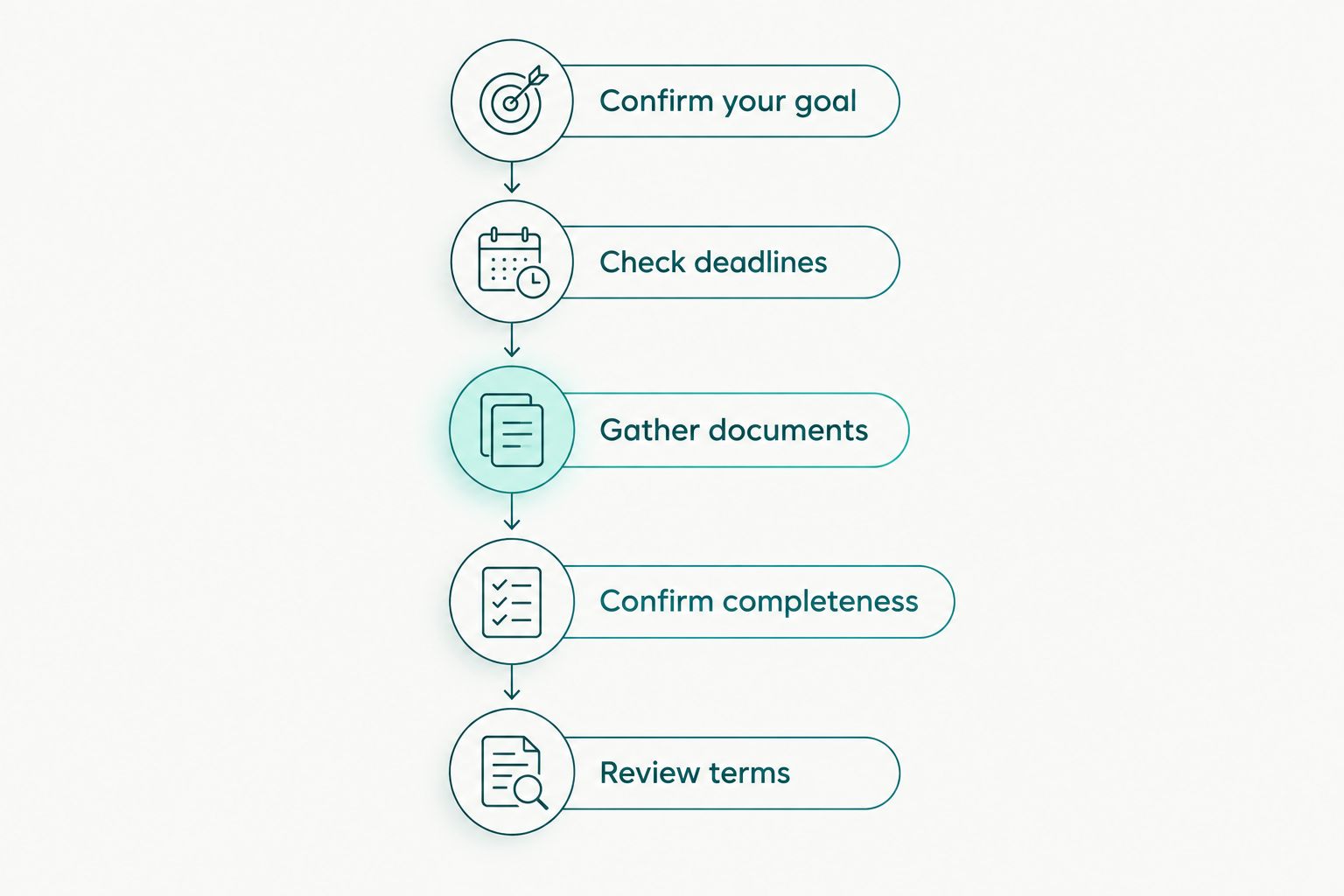
Confirm your goal
Decide whether you want to keep the home or leave it. If keeping it remains your goal, ask the mortgage servicer about available assistance before treating a short sale as the default.
Shortsalesdoneright helps homeowners compare a short sale with other options. Its short-sale processing service does not replace legal or tax advice about the consequences of leaving the property.
Check deadlines
Ask whether foreclosure has started and whether a sale date exists. Compare the servicer's answers with any notices you have received. Have a qualified attorney review legal documents and response requirements.
Gather documents
Get the servicer's current checklist rather than relying on a generic packet. Financial information, hardship details, mortgage statements, and transaction documents can be part of the review; the exact requirements vary.
Use the guide to documents to include in a short-sale package to organize your preparation. Your servicer's requirements control what you submit.
Confirm completeness
Ask the servicer to identify outstanding items and confirm when the loss-mitigation application is complete. Keep copies of submissions and correspondence. A document being sent is not the same as the servicer confirming that its requirements are satisfied.
Review terms
Before committing to lender approval terms, understand what happens to any unpaid mortgage balance. Approval to sell and release a mortgage lien is not necessarily forgiveness of that balance. Have qualified legal and tax professionals review the consequences.
In 2026, keep a written record of the lender's answers, outstanding documents, and next actions. An approval discussion without clear status leaves you unable to judge what remains before closing.
Federal timelines are not closing promises
The Consumer Financial Protection Bureau's Regulation X, 12 CFR § 1024.41, sets federal mortgage-servicing requirements. Its protections depend on coverage, application timing, and other conditions. They do not create a universal short-sale completion schedule.
For a qualifying complete loss-mitigation application received more than 37 days before a foreclosure sale, the rule generally requires evaluation within 30 days. That evaluation requirement is not a promise that a short sale will close within 30 days. Buyer financing, transaction requirements, and the lender's decision remain separate matters.
For your 2026 decision, ask a qualified attorney how the federal requirements and your state's foreclosure law apply. Ask the servicer which requirements remain outstanding. Do not substitute a general timeline for confirmation about your own loan.
Which starting point should you choose?
Choose the earliest stage that matches your circumstances. If the mortgage is unsustainable and a sale will not repay it, begin the assessment now. If you have a notice or scheduled sale, add immediate legal advice rather than waiting for short-sale negotiations to solve the deadline.
Homeowners ready to act can request help through the homeowner intake form on Shortsalesdoneright's site. Provide the foreclosure status and any scheduled sale date so the discussion starts with the right priorities.
FAQ
When should I start a short sale before foreclosure?
Start evaluating a short sale when your mortgage becomes unsustainable and a realistic sale will not repay the debt. Do not wait for foreclosure paperwork to begin comparing options and gathering lender requirements.
Do I have to miss payments before asking about a short sale?
You do not have to miss a payment to ask your servicer about a short sale. The lender determines eligibility, and you should not deliberately stop paying without understanding the consequences.
Does listing my home for a short sale stop foreclosure?
Listing your home for a short sale does not automatically stop foreclosure. Confirm the foreclosure status with the servicer and seek legal advice about any notices or response deadlines.
Can I start a short sale after foreclosure has been filed?
You can ask the lender to consider a short sale after foreclosure has been filed, but acceptance and completion are not guaranteed. Continue addressing legal deadlines while the lender reviews your request.
Is 120 days the deadline to begin a short sale?
No. The general federal restriction on a first foreclosure notice or filing before a covered loan is more than 120 days delinquent is not a short-sale deadline. Exceptions and state procedures matter.
Will a complete application submitted before a sale stop foreclosure?
A complete loss-mitigation application can trigger federal protections when the timing and other requirements are satisfied. Do not assume your sale is paused; ask a qualified attorney how the rule applies and confirm the sale's status.
Does short-sale approval forgive the remaining mortgage balance?
Short-sale approval does not automatically establish that the remaining mortgage balance is forgiven. Lender terms and state law vary, so have a qualified attorney review the written terms and consult a tax professional.
What short-sale help does Shortsalesdoneright provide?
Shortsalesdoneright provides short-sale processing and lender negotiation services and helps homeowners compare a short sale with other options. Lender approval, legal advice, and tax advice remain separate responsibilities.
One last thing
Track two statuses: the short-sale application and the foreclosure process. Progress on one does not prove the other has stopped. Before making your next move, get a clear answer about both—and keep the written confirmation.