

It is generally too late to prevent a foreclosure sale once the sale is legally complete, but the cutoff depends on state law and the type of relief you seek. Before that point, payment, an approved lender agreement, or timely legal action can stop or postpone a sale; simply submitting a short-sale request does not. If an auction is scheduled, confirm its status with the servicer and get state-specific legal advice immediately.
- When is it too late to stop foreclosure? State law and sale status determine the cutoff, not missed payments alone.
- A short-sale application does not automatically postpone a foreclosure auction. Get written confirmation of any postponement.
- Shortsalesdoneright provides short-sale processing and lender negotiation, not guaranteed foreclosure relief.
- Contact a foreclosure attorney immediately if an auction is scheduled or has already occurred.
When is it too late to stop foreclosure?
The decisive question is whether the foreclosure sale is legally complete and whether a valid way to stop it remains. A notice, lawsuit, scheduled auction, completed auction, and transfer of ownership are different stages. Your state's rules determine which deadlines apply.
Start with these steps:
- Confirm sale status. Ask your mortgage servicer for the scheduled sale date and whether a postponement has been authorized. Check the court or foreclosure trustee's records where applicable.
- Identify the deadline. Ask a foreclosure attorney which deadlines apply to payment, court action, and any rights after the sale.
- Request available relief. Tell the servicer whether you want to keep the home or pursue a sale. Ask what documents and decisions remain outstanding.
- Verify any pause. Get written confirmation of the sale's current status. Do not treat an application receipt as confirmation that an auction has stopped.
If you want to sell, read about starting a short sale after a foreclosure sale date is set. Starting the process and stopping the auction are separate tasks.
Why this matters
Foreclosure and mortgage-assistance review can move on separate tracks. You need to know both what the servicer is reviewing and what is happening with the sale.
For a homeowner facing foreclosure in 2026, the useful question is not just whether someone received the paperwork. Ask whether the application is complete, which protections apply, and whether the sale remains scheduled. Keep court deadlines separate from lender follow-up dates.
Before an auction is scheduled: preserve your options
Best for: homeowners who still have time to seek a documented solution. Contact the servicer's mortgage-assistance department as soon as you know the payment problem is not temporary. Explain your current income, hardship, and goal.
For many covered residential mortgages, federal servicing rules generally prohibit the first foreclosure notice or filing until the loan is more than 120 days delinquent, subject to exceptions. This is a restriction on starting foreclosure, not a guaranteed period after receiving a notice.
The Consumer Financial Protection Bureau's Regulation X, section 1024.41(f), provides that rule. For decisions in 2026, confirm that the rule covers your loan and servicer rather than applying it to every mortgage.
Early contact gives you time to gather documents and compare proposals. It does not guarantee approval, and a pending phone conversation does not extend a court response deadline.
After an auction is scheduled: act on the actual deadline
Best for: homeowners who need an urgent review of remaining options. A scheduled auction does not always mean every option has expired. It does mean you should stop relying on informal assurances.
Ask the servicer these questions:
- Is the foreclosure sale still scheduled?
- Is my mortgage-assistance application complete?
- Which documents are missing, and where must I send them?
- Does a review protection or approved agreement prevent the sale from proceeding?
- Who can provide written confirmation of the current sale status?
Call a foreclosure attorney with the notice in hand. The attorney needs the property state, sale date, loan documents, and any court papers to assess the situation.
Do not assume that listing the property, finding a buyer, or submitting an offer stops foreclosure. Those actions can support a proposed sale, but they are not a confirmed postponement.
After an auction occurs: get a state-specific legal review
Best for: homeowners checking whether any post-sale rights remain. Once an auction has occurred, ordinary lender negotiations are not a substitute for legal review. An attorney must determine whether the sale is final and whether state law provides any remaining remedy.
Some states provide redemption rights after certain foreclosure sales. Others have different finality rules or limited grounds for challenging a sale. Do not assume that a right available in another state applies to your home.
The deadline to prevent a sale is also different from the deadline to leave the property. Ask counsel about ownership, possession, notices, and any court proceedings separately. Do not ignore papers because the auction has already happened.
Which federal review deadlines matter in 2026?
Federal mortgage-servicing protections depend on timing, coverage, and application completeness. A document upload is not the same as a complete application. Ask the servicer to identify missing items in writing.
Under CFPB Regulation X, section 1024.41(g), a complete loss-mitigation application received more than 37 days before a foreclosure sale can restrict the servicer from conducting the sale while specified review and response protections apply. Coverage, exceptions, prior applications, and the review outcome matter. This is not an unconditional promise to cancel an auction.
A separate acknowledgment rule applies when a covered servicer receives a loss-mitigation application 45 days or more before a foreclosure sale. Section 1024.41(b)(2) generally requires acknowledgment within 5 days, excluding Saturdays, Sundays, and legal public holidays, stating whether the application is complete or incomplete.
These are federal servicing rules, not a national foreclosure calendar. In 2026, have a qualified professional check the current rule and its application to your loan, especially when the auction is close.
Why the foreclosure cutoff varies
The same number of missed payments does not create the same deadline for every homeowner. These factors change the analysis:
- State law. Court procedures, sale finality, reinstatement, and redemption rights differ.
- Foreclosure procedure. A court-supervised foreclosure follows different steps from a foreclosure conducted outside court.
- Loan coverage. Federal servicing protections have scope limits and exceptions.
- Application timing. A complete package received before a regulatory cutoff differs from an incomplete package submitted near the sale.
- Approved agreements. The terms of a repayment arrangement, modification, or postponement determine what you must do next.
- Sale status. A scheduled auction, completed auction, and legally final sale require different responses.
A neighbor's experience is not a deadline you can use. Work from your own notices and the law governing your property.
Which option fits your goal?
Choose first between keeping the home and leaving through a planned sale or transfer. That choice helps you ask for the right review. It does not remove the need to address an approaching auction.
| Option | Best for | Main benefit | Main limitation |
|---|---|---|---|
| Reinstatement | Homeowners able to cure the default under applicable terms | Can bring the loan current | Requires the necessary funds and compliance with the deadline |
| Loan modification | Homeowners seeking to keep the home with changed loan terms | Can change the payment arrangement | Requires approval; proposed terms must be affordable |
| Short sale | Homeowners who need to sell for less than the mortgage payoff | Provides a lender-reviewed sale path | Requires approval and does not automatically pause foreclosure |
| Deed in lieu | Homeowners considering a voluntary transfer to the lender | Can provide an alternative to completing foreclosure | Requires lender agreement; other liens can complicate it |
| Bankruptcy review | Homeowners needing legal advice about debt and foreclosure | A qualifying filing can trigger an automatic stay | Exceptions and serious legal consequences require attorney review |
Do not select bankruptcy solely from an online comparison. A bankruptcy attorney must assess whether a filing is appropriate and whether a stay would apply.
Likewise, do not accept a short sale or deed in lieu on the assumption that the unpaid balance disappears. Lender terms and state law vary. Have qualified legal and tax professionals review those consequences.
What should you do today if a sale date is set?
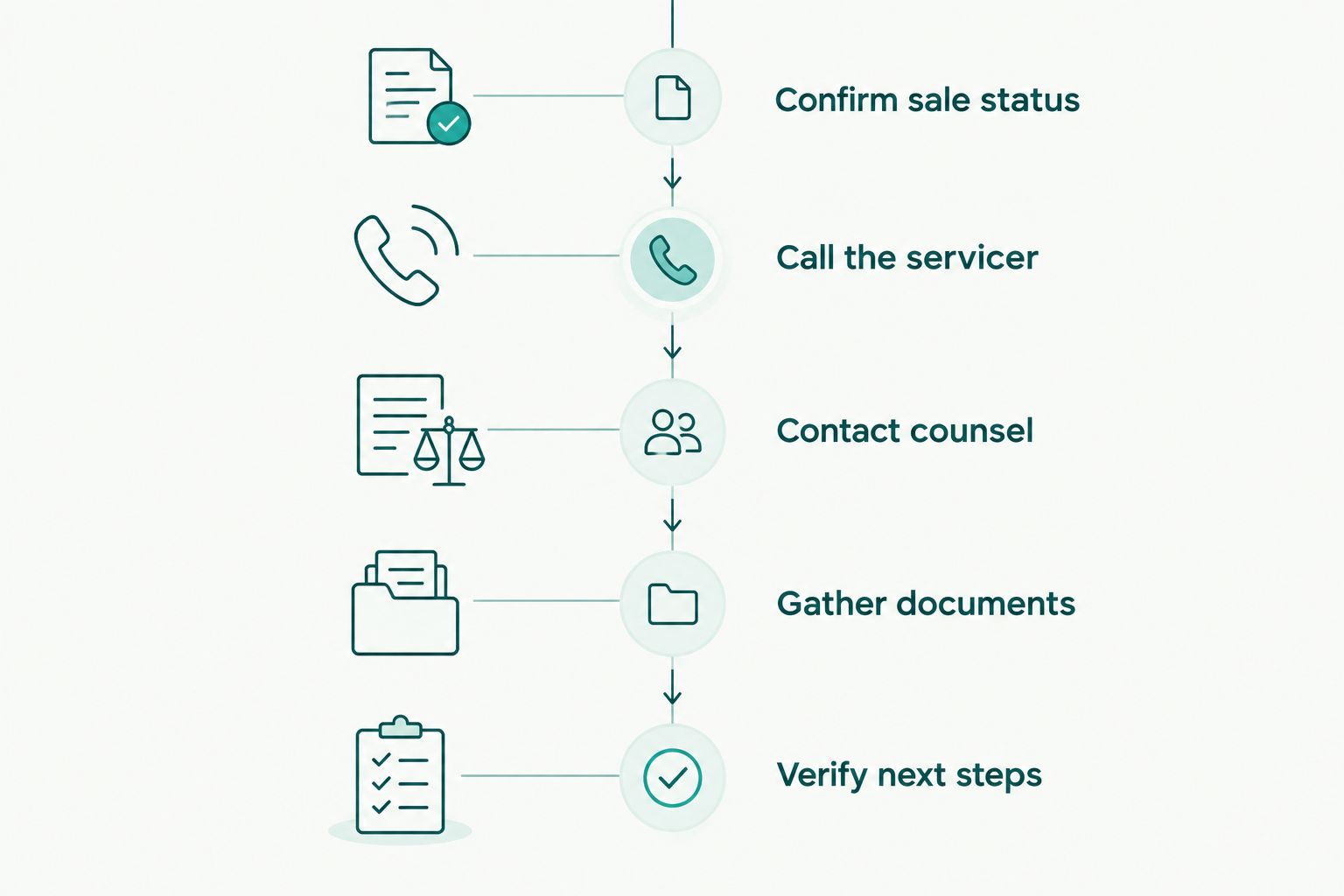
Use a short sequence. Keep one record of calls, documents, and responses so you can show exactly what happened.
Confirm sale status
Locate the latest foreclosure notice and verify the sale date through the appropriate official source. Ask the servicer whether the sale is active, postponed, or canceled, and request written confirmation.
Call the servicer
Ask for the department handling mortgage assistance and foreclosure coordination. State the sale date at the start of the conversation, then ask what action remains possible before that date.
Contact counsel
Send a foreclosure attorney the notices and any court papers. Ask about urgent deadlines, available relief, and what evidence the attorney needs. A HUD-approved housing counselor can also help you understand mortgage-assistance options, but does not replace legal representation.
Gather documents
Collect the servicer's requested financial records, hardship explanation, loan statements, and prior correspondence. If you are pursuing a short sale, coordinate the requested sale documents with your real estate agent.
Verify next steps
Record who owns each task and when it must happen. Check the sale status again rather than assuming that a submitted package or scheduled callback has changed it.
Can a short sale still help before foreclosure?
A short sale remains a possible path only if the necessary approvals and closing can fit the remaining timeline, or the sale is postponed. An offer is not lender approval, and lender review is not a foreclosure pause.
Shortsalesdoneright is best for homeowners seeking short-sale processing and lender negotiation for an upside-down mortgage. Shortsalesdoneright helps homeowners compare a short sale with other options; it does not promise lender approval, debt forgiveness, or a particular credit-score result.
If you are ready to explore that path, visit Shortsalesdoneright and request help through the homeowner intake form. Provide the foreclosure notice and sale date at the start. If the auction is imminent, contact a foreclosure attorney in parallel rather than waiting for processing to begin.
Does applying for a loan modification stop an auction?
A loan-modification application does not automatically stop an auction merely because you submitted it. Applicable federal protections, completeness, timing, and any approved agreement determine what restrictions apply.
Ask for written confirmation of application status and the sale's status separately. Do not interpret a request for more documents as a promise that foreclosure has paused.
Can I stop foreclosure by paying the overdue amount?
Paying the required reinstatement amount can stop foreclosure when reinstatement is permitted and you meet the applicable deadline. Ask for a current written figure and payment instructions; the amount needed is not necessarily just the missed monthly payments.
Have the servicer or your attorney confirm the deadline, accepted payment method, and effect on the scheduled sale. Keep proof of payment and confirmation of the updated status.
FAQ
When is it too late to stop foreclosure in 2026?
It is generally too late to prevent a sale once it is legally complete, but state law determines finality and any remaining remedies. Ask a foreclosure attorney to review your sale status and deadlines immediately.
Can I stop foreclosure the day before the auction?
Relief immediately before an auction depends on state law, the available remedy, and whether it can take effect in time. Contact the servicer and a foreclosure attorney immediately; do not rely on a pending application alone.
Does submitting a short-sale offer stop foreclosure?
Submitting a short-sale offer does not automatically stop foreclosure. Confirm any postponement in writing and verify that the auction's status has changed.
How many missed payments start foreclosure?
For many covered mortgages, federal rules generally prohibit the first foreclosure notice or filing until the loan is more than 120 days delinquent, subject to exceptions. That rule does not establish a universal auction date.
Does a complete assistance application protect me before the sale?
A complete application received more than 37 days before a foreclosure sale can trigger federal review protections for covered loans and servicers. Exceptions and other requirements apply, so have the timing and coverage checked.
Can I get my house back after a foreclosure auction?
Getting a home back after an auction depends on state law and the facts of the sale. Some states provide redemption rights in certain cases; an attorney must assess whether any remedy remains.
Will a short sale erase everything I owe?
A short sale does not automatically erase every unpaid obligation. Lender terms and state law vary; have an attorney review unpaid-balance provisions and a qualified tax professional review tax consequences.
One last thing
Ask two separate questions: Is my assistance file complete, and is my foreclosure sale still scheduled? The answers are not interchangeable. In 2026, keep both answers in writing and share them with the professional advising you before making your next decision.


