

Best overall if you want to stay: a loan modification. Best for a temporary income gap: forbearance. Best for leaving without a short sale: a regular sale that pays all required balances. These are leading alternatives to a short sale when you don't qualify in 2026; the right choice depends on affordability, equity and whether you need to move.
- Among alternatives to a short sale when you don't qualify, loan modification fits homeowners seeking sustainable payments.
- Forbearance addresses temporary hardship; repayment plans require enough income to catch up.
- A regular sale requires enough proceeds or other funds to cover all required balances and closing expenses.
- Shortsalesdoneright helps homeowners compare a short sale with other options; lender approval is never guaranteed.
Why this matters
A rejected short sale does not tell you which option comes next. An incomplete application, an unacceptable offer and a borrower eligibility decision are different problems. Get the specific reason before changing direction.
Shortsalesdoneright is a fit for homeowners who need help comparing short-sale services with other options. You can request homeowner help from Shortsalesdoneright while gathering the lender's decision and your current mortgage statements.
For a 2026 decision, separate two questions: can you afford to keep the home, and do you want to? Lender terms and state law vary. Take legal questions to a qualified attorney and tax questions to a qualified tax professional.
What makes the best short-sale alternative?
Use these criteria before choosing an option:
- Sustainable payment: The arrangement must fit your current income after essential expenses.
- Hardship duration: A temporary interruption needs a different response from a lasting income reduction.
- Keep-or-leave goal: Payment relief does not solve a need to relocate.
- Equity and title: Property value, mortgage balances and other liens affect your exit choices.
- Written terms: Confirm repayment obligations, remaining debt and deadlines before signing.
Do not choose solely by the smallest immediate payment. An arrangement that postpones an unaffordable obligation is not a lasting solution.
Short-sale alternatives at a glance
| Option | Best for | Standout feature | Key limitation |
|---|---|---|---|
| Loan modification | Staying after a lasting income change | Changes existing loan terms if approved | Approval and affordable terms are not guaranteed |
| Forbearance | A temporary hardship with a recovery path | Temporarily pauses or reduces required payments under an agreement | Missed amounts still need resolution |
| Repayment plan | Catching up after income recovers | Spreads overdue amounts across scheduled payments | Requires room above the regular payment |
| Regular sale | Leaving when the full payoff is covered | Sells without asking lenders to accept a short payoff | Proceeds or other funds must cover required obligations |
| Deed in lieu | Leaving when selling is not workable | Transfers ownership by agreement with the lender | Lender acceptance and remaining-debt terms matter |
| Bankruptcy consultation | Mortgage trouble combined with broader debt | Reviews legal options across debts | Filing has legal consequences and does not guarantee keeping the home |
1. Loan modification: best for staying after an income change
A loan modification changes the terms of your existing mortgage if the lender or servicer approves it. Depending on the program, changes can involve the interest rate, repayment period or treatment of overdue amounts. A modification is not a new home purchase loan.
Best for: You want to keep the home and have income that supports a revised payment.
Loan modification pros:
- Focuses on keeping your home.
- Addresses longer-term payment trouble.
- Can address overdue amounts within approved terms.
Loan modification cons:
- Requires review and approval.
- A lower payment does not necessarily mean less total interest.
- Revised terms still need to fit your budget.
For your 2026 review, compare the proposed payment with your full housing expense, including taxes, insurance and association obligations. Ask how unpaid amounts are treated and whether trial payments are required before the modification becomes permanent.
Verdict: Choose a loan modification first when staying is your goal and a revised payment is sustainable. Skip it as a solution to a necessary move.
2. Forbearance: best for a temporary income gap
Forbearance is an agreement to pause or reduce mortgage payments temporarily. It provides breathing room during a hardship, but it does not automatically erase the payments you miss.
Best for: Your income disruption has a realistic recovery path, and you need temporary relief rather than a permanent exit.
Forbearance pros:
- Addresses an immediate payment interruption.
- Keeps a home-retention path open.
- Provides agreed terms for temporary relief.
Forbearance cons:
- Does not automatically forgive missed payments.
- Requires a plan for what happens afterward.
- Does not fix a permanently unaffordable mortgage.
Before accepting, ask how the servicer will handle the unpaid amounts when relief ends. Do not assume the balance will move to the end of the loan or become due all at once; get the actual terms in writing.
Verdict: Choose forbearance for a temporary hardship. Skip it as a standalone answer when the regular payment will remain unaffordable.
3. Repayment plan: best for catching up after income recovers
A repayment plan lets you address overdue amounts through scheduled payments under an agreement with your servicer. It generally adds a catch-up amount to the regular payment for an agreed period.
Best for: Your income has recovered, and your budget can support both your mortgage and additional catch-up payments.
Repayment plan pros:
- Establishes a defined catch-up schedule.
- Addresses arrears without selling the home.
- Gives you specific payment obligations to budget around.
Repayment plan cons:
- Increases the amount due during the catch-up period.
- Offers little help if income remains reduced.
- Becomes difficult to maintain without a budget cushion.
Use actual take-home income, not hoped-for overtime or an uncertain bonus. Ask what happens if you miss a scheduled payment and whether another relief option remains available if your circumstances change.
Verdict: Choose a repayment plan only when the extra payment fits comfortably. Skip it when paying the regular mortgage already stretches your budget.
4. Regular sale: best for leaving when the payoff is covered
A regular sale works when sale proceeds, together with any funds you contribute, cover the required mortgage payoffs, other obligations and closing expenses. Unlike a short sale, it does not ask a lender to accept less than the required payoff.
Best for: You need to move and can complete the sale without a shortfall.
Regular sale pros:
- Provides a direct route out of ownership.
- Does not require short-payoff approval when all obligations are satisfied.
- Lets you compare an expected sale result with staying.
Regular sale cons:
- Requires enough proceeds or other funds.
- A buyer and completed closing are still necessary.
- Other liens can change the amount needed to close.
In 2026, use a current payoff statement rather than the principal balance shown on an old statement. Ask your real estate agent for estimated net proceeds and have the title or closing professional identify recorded liens and closing requirements.
Verdict: Choose a regular sale when the full closing calculation works. Skip assumptions based only on an online value estimate.
5. Deed in lieu: best for an agreed exit without a buyer
A deed in lieu of foreclosure transfers ownership to the lender through an agreement. The lender must accept the arrangement; you cannot create one simply by leaving the property or mailing back keys.
Best for: You need to leave, a sale is not workable, and the lender will consider a negotiated transfer.
Deed in lieu pros:
- Does not require finding a buyer for the transfer itself.
- Creates written terms for surrendering ownership.
- Provides another exit option to discuss with the servicer.
Deed in lieu cons:
- Requires lender acceptance.
- Other liens can complicate the transfer.
- Remaining-debt and tax consequences need separate review.
Ask an attorney to review whether the agreement releases you from personal responsibility for any unpaid balance. Do not treat a transfer of ownership as proof that every debt connected to the property disappears.
Verdict: Consider a deed in lieu when keeping or selling the home is not workable. Wait to sign until the debt and move-out terms are clear.
6. Bankruptcy consultation: best for mortgage trouble plus other debt
A bankruptcy consultation is a legal review, not a recommendation to file. A qualified bankruptcy attorney can explain how available chapters apply to your mortgage, income, assets and other debts.
Best for: Mortgage arrears are part of a broader debt problem, or foreclosure creates an urgent need for legal advice.
Bankruptcy consultation pros:
- Examines the wider debt picture.
- Clarifies legal options before irreversible decisions.
- Helps assess how a filing would affect your situation.
Bankruptcy consultation cons:
- Does not guarantee a suitable filing strategy.
- Filing carries legal and financial consequences.
- Keeping the home depends on more than seeking bankruptcy protection.
Do not assume filing permanently stops foreclosure or removes a mortgage lien. Ask the attorney about your specific deadlines, prior filings and ability to meet any required payments.
Verdict: Choose a legal consultation when debts overlap or foreclosure is urgent. Skip do-it-yourself filing decisions based on a general comparison article.
Check the rejection before abandoning a short sale
A rejected offer and a finding that you do not qualify are not interchangeable. Review the reasons lenders reject short-sale offers against the actual response you received.
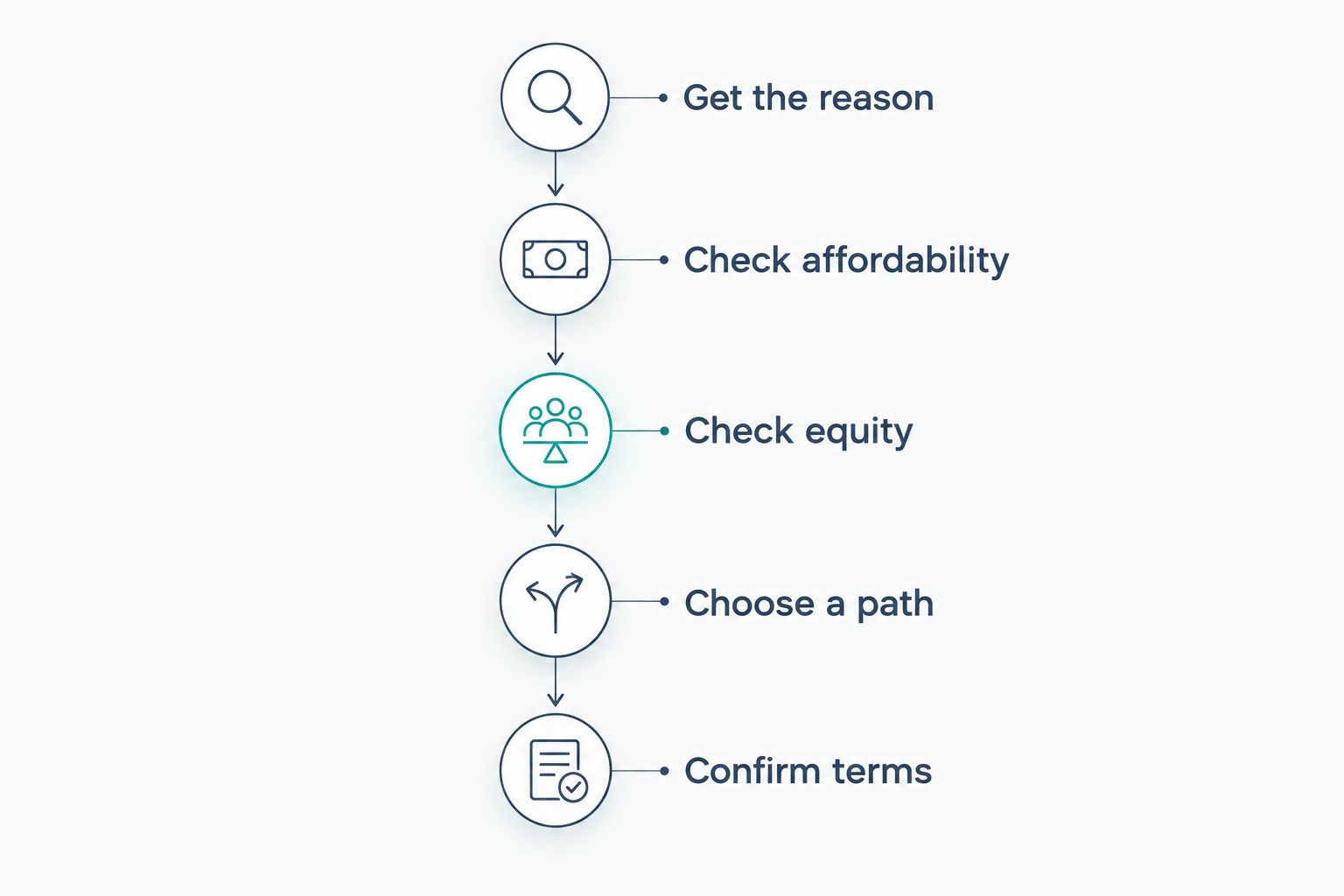
Use this sequence for your next conversation:
- Get the reason: Request the specific decision, outstanding requirements and any response deadline.
- Check affordability: Write down reliable income and essential expenses.
- Check equity: Compare expected net sale proceeds with current payoffs and other obligations.
- Choose a path: Ask for the option that matches your budget and keep-or-leave goal.
- Confirm terms: Review the written agreement before relying on payment relief, debt treatment or a transfer date.
For a 2026 decision, keep application records and foreclosure notices together. Submitting a request is not proof that a scheduled foreclosure has stopped. Ask the servicer for status confirmation and take time-sensitive notices to an attorney promptly.
How these options are ranked
The ranking starts with a sustainable way to keep your home, then separates temporary relief from catching up. It next covers exits and broader legal review. Your goal overrides the order: a homeowner who must relocate should examine sale options before payment relief.
Which short-sale alternative should you choose?
Start with a loan-modification review if you want to stay and your income supports a revised payment. If you need to leave, start with a full payoff and net-proceeds calculation instead.
Shortsalesdoneright provides short-sale processing and lender negotiation services and helps homeowners compare a short sale with other options. The service does not replace legal or tax advice and does not guarantee lender approval or forgiveness of an unpaid balance.
Request help comparing your options
Explain your mortgage situation and whether you want to stay or move through the homeowner intake form.
FAQ
What's the best alternative if I don't qualify for a short sale?
A loan modification is the first option to examine if you want to stay and can afford revised payments. If you need to leave, check whether a regular sale can cover all required obligations.
Does a rejected short-sale offer mean I don't qualify?
No. A rejected offer does not by itself establish that you are ineligible. Ask whether the decision concerns the offer, missing documents, property value or borrower eligibility.
Is forbearance better than a loan modification?
Forbearance fits temporary hardship; a loan modification addresses changes to the mortgage terms. Compare them based on whether your income will recover and how unpaid amounts will be resolved.
Can I sell an underwater house without a short sale?
Yes, if sale proceeds plus other funds cover all required payoffs and closing obligations. Without enough funds, you need another agreed solution rather than assuming the lender will release its lien.
Does a deed in lieu erase the remaining mortgage debt?
Not automatically. The agreement and applicable state law determine your remaining responsibility. Have an attorney review the release language before signing.
Should I stop paying my mortgage to qualify for help?
Do not stop paying solely to seek eligibility. Ask your servicer about options for your circumstances before changing payments; missed payments can have credit and foreclosure consequences.
Will applying for mortgage help stop a foreclosure auction?
Do not assume an application stops an auction. Federal protections, application timing, loan circumstances and state law affect the result. Get prompt legal advice when a sale date is scheduled.
One last thing
A mortgage statement balance is not the same as a payoff amount. Before ruling out a regular sale in 2026, request a current payoff and a realistic net-proceeds estimate. That comparison separates a true shortfall from an outdated assumption.


