

A short sale is a better fit when you need to leave a home worth less than you owe; a loan modification is a better fit when you want to stay and can afford the revised payments. Neither guarantees approval or a clean financial exit: in 2026, your lender’s written terms, any remaining debt, and state law determine the outcome.
- Is a short sale better than a loan modification? Choose by whether you need to leave or stay.
- A loan modification changes mortgage terms; it does not necessarily reduce principal or make the home affordable.
- A short sale requires lender approval and does not automatically forgive an unpaid balance.
- Shortsalesdoneright helps homeowners compare a short sale with other options before deciding how to proceed.
For help comparing your options, Shortsalesdoneright provides short-sale processing and lender negotiation services. Start with your housing goal, not an assumption that either option solves every mortgage problem.
Is a short sale better than a loan modification?
Choose based on whether you can realistically keep the home—not simply whether the lender offers a lower payment. A modification supports staying. A short sale supports selling when the proceeds will not fully cover the mortgage debt and the lender agrees to the transaction.
| Decision point | Loan modification | Short sale |
|---|---|---|
| Best for | Homeowners who want to stay and can sustain revised payments | Homeowners who need to sell with insufficient equity |
| What changes | The existing mortgage’s terms | Ownership of the home through an approved sale |
| Main benefit | A chance to retain the home under revised terms | A path to sell despite a mortgage shortfall |
| Main limitation | Revised payments still need to be affordable | The sale requires approval and a buyer |
| Unpaid debt | Review how arrears and principal are treated | Review whether the lender releases the remaining balance |
| What to verify | Final payment, term, and any deferred amounts | Sale conditions, closing requirements, and debt-release language |
Neither option is automatically better for your credit, taxes, or future borrowing. Those questions depend on your circumstances and the applicable rules.
Why this matters
A mortgage solution fails if it solves the wrong problem. Keeping a house is not a useful outcome when its ongoing expenses remain beyond your budget. Selling is not the right starting point when you want to stay and a workable modification is available.
For a 2026 decision, separate your housing goal from your mortgage balance. Being upside down means the home’s value is below the debt secured against it; that alone does not tell you whether keeping the property is affordable.
Your income, necessary expenses, reason for moving, and lender’s actual offer matter more than the name of the program. Ask what your life and budget would look like after the proposed solution takes effect.
Loan modification: Best for staying with affordable payments
A loan modification changes the terms of your existing mortgage. Depending on the offer, changes can involve the interest rate, repayment term, treatment of missed payments, or other loan provisions. Do not assume every offer includes the same changes.
A loan modification is the stronger fit when you want to remain in the home and the complete revised housing payment works within your budget. That means assessing more than principal and interest. Include property taxes, insurance, association obligations where applicable, utilities, and maintenance.
The main advantage is that you can pursue a way to keep the home rather than arranging a sale and move. The limitation is equally important: changing the mortgage does not remove your other housing expenses or repair an ongoing income shortfall.
Before accepting an offer, ask:
- What will the full payment be, including any required escrow amounts?
- Does the interest rate change later?
- How are missed payments handled?
- Does any amount become payable at the end of the loan?
- Are there trial payments or other conditions before the change becomes permanent?
Read the written offer instead of relying on a verbal payment estimate. A smaller monthly payment and a smaller total repayment obligation are different results. Ask the servicer to explain both.
Short sale: Best for leaving an upside-down mortgage
A short sale involves selling the property for less than the mortgage debt, subject to the necessary lender approvals. It fits a different goal from modification: leaving the property rather than keeping it under changed loan terms.
A short sale is the stronger fit when you need to sell, the expected proceeds will not cover the secured debt, and keeping the home is not workable. A move for employment, a household change, or continuing unaffordability can make an exit more relevant than another attempt to retain the property.
The advantage is a lender-reviewed route to a sale despite insufficient equity. The limitations include document requests, negotiations, buyer participation, and conditions that must be satisfied before closing. An accepted buyer offer is not the same as lender approval.
The unpaid balance deserves separate attention. Permission to sell and release of personal responsibility for the shortfall are not interchangeable. Have a qualified attorney review the approval documents and explain what happens to any remaining debt under the agreement and state law.
Shortsalesdoneright is best for homeowners seeking short-sale processing and lender negotiation support. That support does not replace legal or tax advice, and it does not guarantee lender approval.
If you are considering this route, review the short-sale timeline and milestones so you can distinguish application review, lender approval, and closing.
Why the better option varies
There is no single winner because homeowners face different housing goals and financial constraints. Use these factors to compare your actual choices:
- Your intention to stay. A modification serves a home-retention goal. A short sale serves an exit goal. Decide which outcome you need before comparing paperwork.
- Your sustainable budget. Use reliable income and necessary expenses. Do not base a long-term payment commitment on income you do not yet have.
- The property’s likely sale proceeds. Compare expected net proceeds with the debts secured against the home. An estimated market value alone does not settle whether a short sale is necessary.
- The lender’s written terms. A modification offer and a short-sale approval address different obligations. Read the conditions attached to each.
- Other claims against the property. Additional mortgages or liens can affect what must be resolved for a sale. Identify them early rather than discovering them near closing.
- Legal deadlines and state law. A pending request is not proof that an approaching foreclosure event has been postponed. Confirm the status directly and seek legal help when a deadline is near.
How to choose between a short sale and loan modification
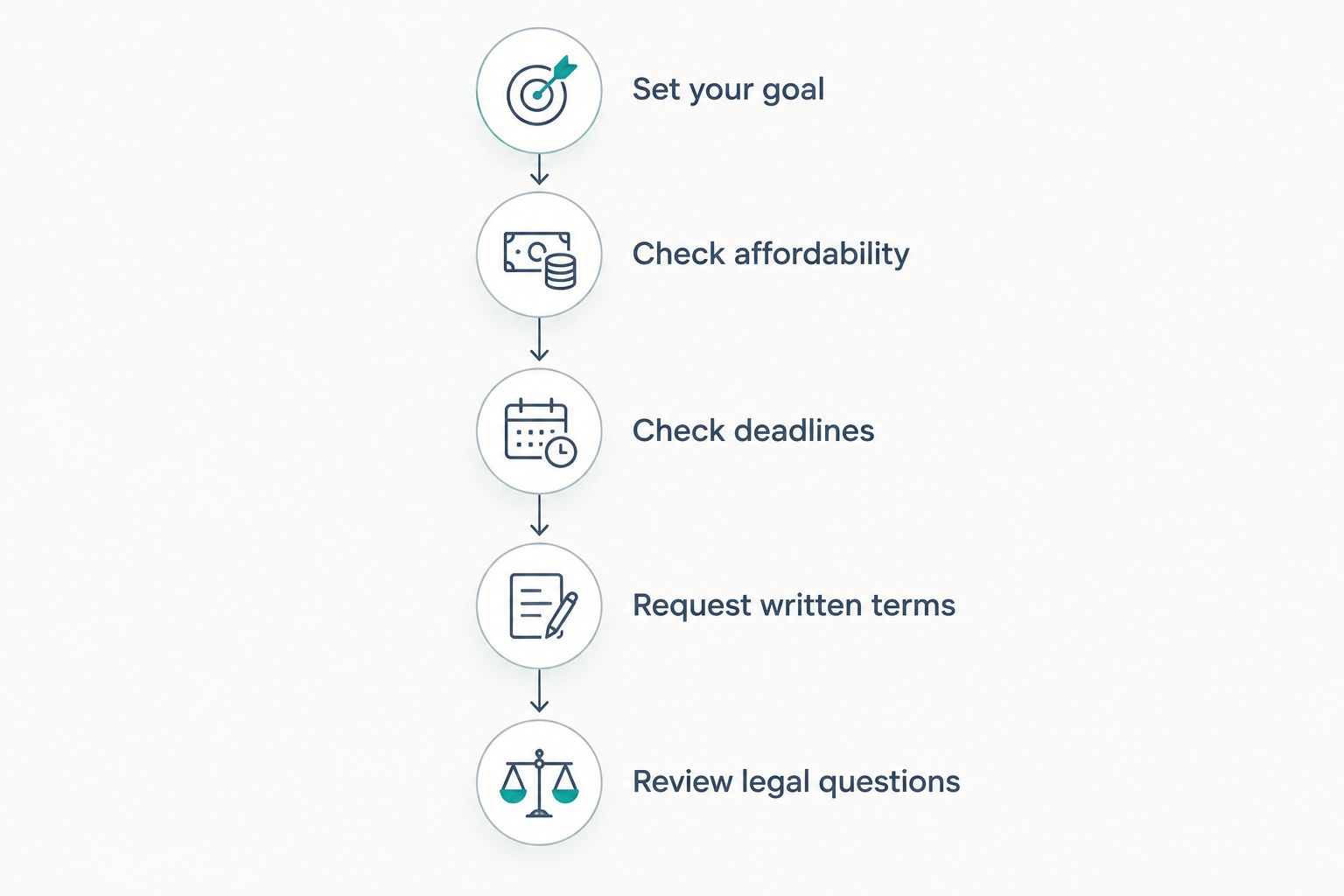
For your 2026 comparison, work through the decision in this order. You need a clear goal, an honest budget, and written information before you can make a useful choice.
- Set your goal. Decide whether you want to keep the property or need to leave. Include practical issues such as work, household needs, and whether the location still suits you. A mortgage change cannot solve a required relocation.
- Check affordability. Build a household budget using income you can document and expenses you actually pay. Compare that budget with the full proposed housing payment, not just a quoted reduction. Leave room for necessary home upkeep rather than assuming the mortgage is the only expense.
- Check deadlines. Gather notices and ask the servicer about the status of any foreclosure process. Record whom you spoke with and what was confirmed. If a sale date or legal response deadline is approaching, speak with a qualified attorney promptly.
- Request written terms. Ask what the modification changes, what remains owed, and what conditions apply. For a short sale, request written approval before treating the sale as authorized. Keep copies of submitted documents and correspondence.
- Review legal questions. Ask an attorney about responsibility for remaining debt and a qualified tax professional about potential tax consequences. Resolve those questions before signing documents you do not understand.
These steps separate a possible option from an acceptable outcome. An option becomes useful only when its payment, obligations, and conditions match your needs.
After reviewing the choices, contact Shortsalesdoneright through the homeowner intake form on its website if you need help comparing a short sale with other options. Have your mortgage statements, lender correspondence, and a summary of your circumstances ready so you can explain what needs to change.
Get help comparing your options
Request homeowner help with short-sale processing and lender negotiation.
What should you check before signing either agreement?
Approval is not the same as a complete explanation of your obligations. Before signing, identify what you must pay, what happens to unpaid amounts, and which conditions remain outstanding.
For a modification, look for the payment schedule, interest provisions, treatment of arrears, and any amount deferred until later. Ask the servicer to explain unclear language in writing. Keep the final agreement with your mortgage records.
For a short sale, examine the approval conditions and any language addressing the remaining balance. Do not treat the lender’s agreement to release its claim against the property as automatic confirmation that every personal obligation disappears.
Lender terms and state law vary. A qualified attorney should address legal obligations, foreclosure deadlines, and remaining-debt questions. A qualified tax professional should assess potential tax consequences and any applicable exclusions. Neither the name of the transaction nor someone else’s experience establishes your result.
Keep your 2026 decision tied to your own documents. General guidance helps you ask better questions; it does not change the agreement you sign.
Can I try a loan modification before choosing a short sale?
You can ask your servicer about modification before deciding whether to pursue a short sale. The important question is whether the review fits your housing goal and any approaching deadlines.
If you want to stay, evaluate the actual modification terms. If you need to move regardless of the payment, explain that clearly rather than treating modification as a required first step. Ask the servicer how separate requests affect the review process; do not assume they operate independently.
Does a short sale forgive the remaining mortgage balance?
A short sale does not automatically forgive the remaining mortgage balance. The written agreement and applicable law determine how the shortfall is handled.
Ask for an explanation of any language about debt release, required payments, or continued responsibility. Have an attorney review it before closing. A verbal assurance that the sale is approved does not answer every question about the debt.
Is a loan modification better if I am only temporarily behind?
A loan modification deserves consideration when you want to stay and can sustain the revised terms. Being temporarily behind does not by itself establish that modification is the right solution.
Describe the hardship accurately and ask the servicer which assistance options address it. Compare the resulting obligations with your expected income. Do not choose a short sale solely because you assume missed payments leave no way to keep the home.
FAQ
What's better if I want to keep my house: a short sale or loan modification?
A loan modification is the option aimed at keeping your house by changing mortgage terms. It is a workable choice only if the approved terms fit your budget and you can meet the conditions.
Is a short sale better than a loan modification if I have to move?
A short sale is more aligned with leaving when you must move and the sale proceeds will not cover the mortgage debt. Lender approval is required, and the treatment of any unpaid balance needs separate review.
Will a loan modification reduce what I owe?
A loan modification does not necessarily reduce what you owe. Review the written offer for changes to principal, interest, arrears, repayment length, and any deferred amounts.
Does applying for a short sale stop foreclosure?
A short-sale application is not proof that foreclosure has stopped. Confirm the status with the servicer and consult a qualified attorney about notices, deadlines, and state-law protections.
Which option is better for my credit score?
Neither option guarantees a specific credit-score result. Your payment history, account reporting, and broader credit profile matter, so do not choose based on a promised score change.
Who can help me understand unpaid debt and tax consequences?
A qualified attorney can explain unpaid-debt obligations, and a qualified tax professional can assess potential tax consequences. Lender terms and state law vary, so have them review your actual documents.
Can I compare both options before committing?
You can ask your servicer about both options before committing. Explain whether you want to stay or leave, request written information, and confirm how each review affects any deadlines.
One last thing
Ask what each option leaves you responsible for—not just what it changes today. A lower payment is only part of a modification. A completed sale is only part of a short-sale outcome.
Before you sign anything in 2026, write down the result you expect: whether you keep or leave the home, what you must pay afterward, and which obligations end. Then compare that list with the written agreement. If the documents do not clearly support your understanding, stop and get the relevant professional advice before committing.


