

Best overall for an underwater homeowner who must relocate: an agent-led short sale with processing support. Best for hands-on coordination: an owner-coordinated short sale. Best way to avoid a short sale: a standard sale when you can cover the closing shortfall. Shortsalesdoneright provides short sale processing and lender negotiation services for homeowners comparing these routes.
- Compare short sale options for homeowners facing a job transfer against your equity, relocation deadline, and ability to carry payments.
- Shortsalesdoneright is best for homeowners seeking short sale processing and lender negotiation support during relocation.
- A job transfer does not guarantee short sale approval or forgiveness of the remaining mortgage balance.
- Consider a standard sale, rental hold, or deed in lieu only after checking the obligations each leaves behind.
Why this matters
A job transfer creates a moving deadline. It does not create a matching deadline for your mortgage lender, buyer, or closing team. If your mortgage balance exceeds what a sale will cover, accepting an offer alone does not solve the problem.
For your 2026 move, separate two decisions: where you need to live and how to resolve the existing mortgage. Do not build your relocation plan around an unapproved short sale closing date. Lender terms and state law vary; take legal and tax questions to qualified professionals.
What makes the best short sale option?
The best route addresses your actual problem, not just the approaching move. Compare these criteria before committing:
- Equity position: Compare a realistic sale estimate with mortgage payoffs and selling expenses. An underwater mortgage and a manageable closing shortfall require different decisions.
- Payment capacity: Determine whether you can carry the existing home while paying for housing near the new job.
- Relocation deadline: Separate your work start date from your moving date and any proposed property closing date.
- Lender requirements: Ask what financial records, hardship explanation, buyer documents, and approvals your specific loan requires.
- Remaining obligations: Establish what happens to any unpaid mortgage balance, additional liens, taxes, and possession after closing.
Use 2 housing budgets: one for the move and one for keeping the existing property until its obligations end. This is a planning recommendation, not a prediction of how long a sale will take.
Job-transfer options at a glance
These are different routes, not interchangeable services. The order favors an underwater homeowner who needs a permanent move but cannot simply pay off the mortgage through a standard sale.
| Option | Best for | Standout feature | Key limitation |
|---|---|---|---|
| Agent-led short sale with processing support | Homeowners relocating who want lender coordination handled | Separates listing work from package preparation and lender follow-up | Requires lender review and acceptable written terms |
| Owner-coordinated short sale | Homeowners with time to manage lender communication | Keeps document tracking and follow-up directly with the homeowner | Adds administrative work during the move |
| Standard sale with a funded shortfall | Homeowners able to cover the gap at closing | Resolves the sale without asking the lender to accept less | Requires sufficient funds and an accurate closing estimate |
| Rental hold | Homeowners making a temporary move who can retain the property | Preserves ownership while relocating | Leaves mortgage and landlord obligations in place |
| Deed in lieu | Homeowners seeking a lender-approved transfer instead of a buyer sale | Transfers ownership through an agreement with the lender | Requires lender acceptance and review of remaining obligations |
1. Agent-led short sale: best for an overloaded relocation
An agent-led short sale pairs marketing and buyer negotiations with a request for the lender to accept less than the mortgage payoff. Processing support handles the supporting package and lender communication. You still provide financial records, respond to requests, and review the final terms.
Shortsalesdoneright is best for homeowners seeking short sale processing and lender negotiation support during relocation. The service also helps homeowners compare a short sale with other options; its agent support includes preparing the full short-sale package, a dedicated point of contact, and weekly lender updates.
Agent-led short sale pros
- Gives lender paperwork a defined owner while your agent handles the listing.
- Provides an organized route for responding to document requests.
- Helps keep your sale decision separate from the pressure of starting a new job.
Agent-led short sale cons
- Processing support does not guarantee lender approval or closing.
- You still need to supply current records and make decisions.
- Approval terms require careful review, especially treatment of an unpaid balance.
Best for: Homeowners who need a permanent move and want help managing the short sale process.
For a 2026 transfer, tell the team your work start date before setting expectations with a buyer. Ask who handles lender updates, who answers your questions, and who coordinates closing requirements. Verdict: Choose this route when the mortgage shortfall is real and relocation leaves little room for lender administration.
2. Owner-coordinated short sale: best for hands-on homeowners
An owner-coordinated short sale puts lender calls, document delivery, and status tracking with you. Your agent can still handle marketing and the sale contract. Confirm the division of responsibilities rather than assuming someone else is following up.
This route is about workload, not a different approval standard. The lender still evaluates the request and proposed transaction under its requirements.
Owner-coordinated short sale pros
- Gives you direct access to lender requests and status information.
- Lets you maintain the central document file yourself.
- Makes sense when you have time and are comfortable tracking detailed requests.
Owner-coordinated short sale cons
- Competes with moving arrangements and new-job responsibilities.
- Leaves you responsible for identifying unanswered requests.
- Does not replace legal advice about approval documents or remaining debt.
Best for: Homeowners with reliable availability and a clear understanding of the lender's submission process.
Before choosing this approach, identify who will answer calls during your workday and provide updated documents after you move. Keep 1 shared document folder for records your authorized team needs, using a secure method appropriate for financial information. Verdict: Choose only if you can consistently own the follow-up; skip it if the move already consumes your attention.
3. Standard sale: best when you can cover the shortfall
A standard sale deserves an early check, even when you believe the home is underwater. Ask your agent for a realistic sale estimate and your closing professional for an estimated settlement statement. Compare the expected proceeds with current payoffs and other closing obligations.
If you can cover the difference, a standard sale avoids asking the lender to accept a reduced payoff. That does not make using your savings the right decision. Your relocation needs and remaining financial cushion matter too.
Standard sale pros
- Avoids the reduced-payoff approval request required for a short sale.
- Provides a clear way to compare the sale gap with available funds.
- Keeps the decision focused on whether completing the sale is financially workable.
Standard sale cons
- Requires you to fund the difference when proceeds fall short.
- Reduces funds available for the move and unexpected expenses.
- Depends on accurate payoff information and closing estimates.
Best for: Homeowners whose available funds can cover the shortfall without undermining essential relocation needs.
For a 2026 move, use current documents rather than an old mortgage statement or an optimistic listing estimate. Verdict: Choose a standard sale when the verified gap is manageable; do not empty essential reserves just to avoid comparing alternatives.
4. Rental hold: best for a temporary transfer
Keeping the property as a rental is an alternative to selling, not a short sale strategy. It fits the comparison when your transfer is temporary or you want to retain the home and can carry its obligations.
Review mortgage, insurance, association, and local rental requirements before relying on rental income. Build the budget around ownership expenses, not just the difference between rent and the mortgage payment.
Rental hold pros
- Preserves ownership while you work in another location.
- Avoids requiring an immediate sale to complete your move.
- Gives a temporary relocation a different path from a permanent exit.
Rental hold cons
- Leaves you responsible for mortgage payments and property expenses.
- Adds tenant, maintenance, and vacancy responsibilities.
- Does not eliminate negative equity or guarantee a later sale outcome.
Best for: Homeowners with a credible reason to keep the property and enough financial capacity to manage it from elsewhere.
Ask who will respond to a repair request while you are at the new job. If the answer is unclear, the rental plan is incomplete. Verdict: Hold only when the full ownership budget works; skip renting as a substitute for solving an unaffordable mortgage.
5. Deed in lieu: best for exploring a non-sale exit
A deed in lieu is an agreement to transfer ownership to the lender instead of completing a buyer sale. It requires lender acceptance. Ask the servicer whether it will consider this route and what conditions apply.
Do not assume handing over ownership ends every obligation. Have a qualified attorney review the agreement's treatment of the mortgage balance and other legal consequences before signing.
Deed in lieu pros
- Offers a route to discuss when a buyer sale is not workable.
- Centers the decision on a written agreement with the lender.
- Does not depend on completing a conventional buyer transaction.
Deed in lieu cons
- Is not an option you can impose on the lender.
- Requires review of title issues and other liens.
- Does not justify assuming debt forgiveness or a particular credit outcome.
Best for: Homeowners seeking a permanent exit who need to compare a lender transfer with a short sale.
Verdict: Explore this route with the servicer and legal counsel when selling is not workable; do not treat it as an automatic fallback.
Build your relocation decision file
For your 2026 relocation, assemble the facts before choosing a route. Keep 3 dates visible: your job start date, intended moving date, and any stated mortgage or foreclosure deadline. These dates serve different purposes; none should be treated as automatic lender approval.
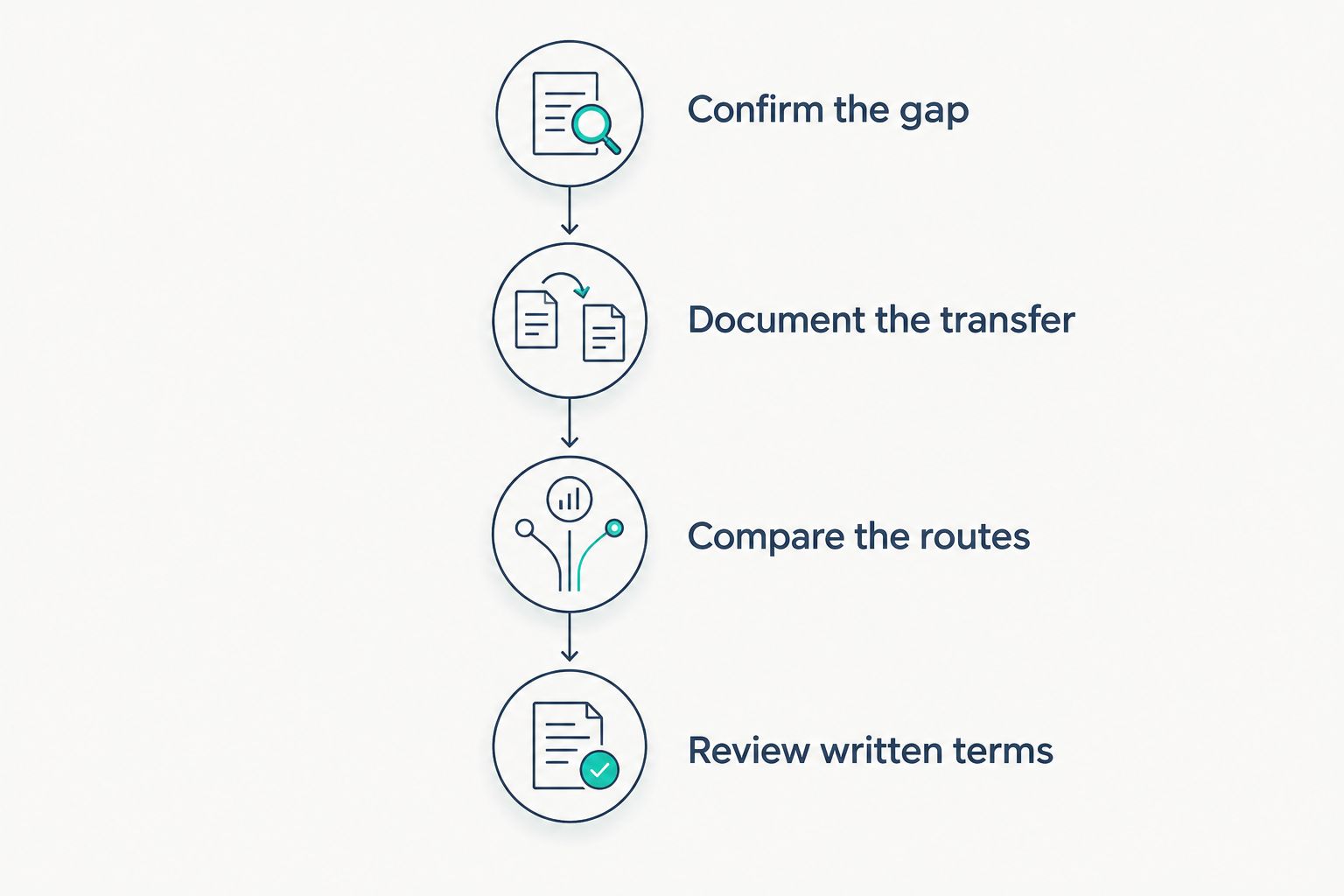
Use this sequence:
- Confirm the gap. Request current payoff information and a realistic estimate of sale proceeds.
- Document the transfer. Gather the employer's transfer notice and explain the resulting housing and financial changes accurately.
- Compare the routes. Review a short sale alongside any workable standard sale, rental, or lender-transfer alternative.
- Review written terms. Have the appropriate professionals address remaining debt, taxes, deadlines, and possession before you commit.
A transfer letter explains why you are moving. It does not, by itself, establish that the lender should accept a short sale. Connect the move to your actual finances without exaggerating hardship or omitting the new job's income.
If you are ready to compare options, request homeowner help through the appropriate intake form on the Shortsalesdoneright website. Explain the transfer, current mortgage status, and any deadlines already received.
Get help comparing your options
Explain your job transfer and mortgage situation through the homeowner intake form.
How these options rank
This ranking prioritizes a permanent relocation, an underwater mortgage, and limited capacity for administrative work. It compares payment capacity, lender requirements, timing, and remaining obligations—not approval rates or promised outcomes.
Change the order when your facts change. A manageable shortfall moves a standard sale up; a temporary transfer and sustainable ownership budget make a rental hold more relevant.
Which option should you choose?
Start with an agent-led short sale review if you must move permanently and cannot cover the mortgage shortfall. Compare that route with a current standard-sale estimate before committing. Use owner coordination only when you can handle the work yourself.
Your 2026 job start date is a planning constraint, not a promise that the property will close beforehand. Decide how you will handle housing, payments, access, and documents if the move happens first.
FAQ
What's the best short sale option if my employer transfers me?
An agent-led short sale with processing support is the strongest starting point when you must relocate, cannot cover the mortgage shortfall, and need help with lender coordination. Compare it with a current standard-sale estimate before committing.
Does a job transfer automatically qualify me for a short sale?
No. A job transfer does not automatically qualify you for a short sale. The lender evaluates your financial circumstances, the proposed transaction, and its applicable requirements.
Can I request a short sale while I am current on payments?
Ask your servicer to evaluate your circumstances; do not assume you must miss payments to ask about a short sale. Eligibility depends on the loan's requirements, and deliberately missing payments creates additional consequences.
Can I move before the short sale closes?
Moving and closing are separate events, so plan for the possibility that you relocate first. Confirm occupancy requirements, property access, insurance, maintenance, and document-signing arrangements with the relevant professionals.
Will a short sale erase the remaining mortgage balance?
Do not assume a short sale erases the remaining balance. Lender terms and state law vary; have a qualified attorney review the written agreement's treatment of any unpaid debt.
Is renting my home better than a short sale after a transfer?
Renting is the better fit only when keeping the property supports your plans and the full ownership budget works. It leaves mortgage, maintenance, vacancy, and landlord responsibilities with you.
Can I receive relocation assistance through a short sale?
Do not include relocation assistance in your moving budget unless the applicable program or lender confirms it in writing. Ask about eligibility, conditions, and payment timing rather than assuming assistance is included.
Who should answer legal and tax questions about my short sale?
A qualified attorney should address legal obligations, and a qualified tax professional should address tax consequences. Short sale processing and lender negotiation do not replace those services.
One last thing
Approval to sell and release from unpaid debt are not the same question. Before accepting the closing plan, ask where the written terms address each one. That distinction matters more than a reassuring phone update when you are preparing to leave town.