

The most important short sale mistakes to avoid are starting without checking foreclosure deadlines, assuming approval erases the unpaid balance, and submitting incomplete paperwork. This 2026 guide ranks the mistakes by the decision they affect and explains what you should do instead.
- The biggest short sale mistakes to avoid involve deadlines, incomplete lender packages, and assumptions about remaining mortgage debt.
- Shortsalesdoneright provides short sale processing and lender negotiation for homeowners with an upside-down mortgage.
- Compare short sale vs foreclosure and other mortgage options before committing to a sale.
- Get lender terms in writing; ask qualified professionals about state-law obligations and tax consequences.
Why this matters
A short sale is a sale for less than the amount owed on the mortgage, subject to the required lender approval. It is not just a regular sale with extra paperwork. The purchase contract, lender review, and any foreclosure process have separate requirements.
You need help with the bank, but you also need to understand the decision you are making. Shortsalesdoneright provides short sale processing and lender negotiation services for homeowners and real estate agents. That support does not guarantee approval or forgiveness of an unpaid balance.
Shortsalesdoneright is best for homeowners seeking short sale processing and lender negotiation support. Legal and tax advice belongs with qualified professionals, not with assumptions about what happened in someone else's sale.
What makes a good short sale decision?
Use these criteria to assess your short sale plan in 2026 before signing documents or accepting an offer:
- Deadline awareness: Know the dates on lender notices, court papers, and the purchase contract.
- Complete documentation: Submit the lender's requested information accurately and keep it current.
- Written terms: Understand both permission to sell and responsibility for any remaining debt.
- Clear ownership: Know who sends documents, follows up, and reports lender requests.
- An option comparison: Check whether selling addresses your actual housing and financial needs.
- A workable closing: Confirm that the lender's conditions and the contract can be satisfied together.
A good plan addresses all of these. A willing buyer alone does not resolve the mortgage, title, or lender-approval questions.
Short sale mistakes at a glance
The ranking starts with decisions that affect whether you can complete the sale and understand its consequences. Each correction serves a different need; none replaces the others.
| Rank | Mistake | Recommended correction | Best for | Main limitation |
|---|---|---|---|---|
| 1 | Waiting without checking deadlines | Confirm deadlines immediately | Homeowners facing foreclosure notices | Starting a short sale does not automatically stop foreclosure |
| 2 | Assuming approval clears the debt | Review the written debt terms | Homeowners assessing remaining liability | Legal consequences depend on the documents and state law |
| 3 | Sending an incomplete package | Follow the lender's document checklist | Homeowners preparing the submission | A complete package does not guarantee approval |
| 4 | Accepting an offer without checking lender requirements | Coordinate offer terms with lender review | Homeowners choosing a buyer | A signed contract is not lender approval |
| 5 | Treating every lender as one decision-maker | Identify mortgages and other recorded claims | Homeowners with multiple property debts | Different creditors have separate requirements |
| 6 | Letting communication become scattered | Use one designated point of contact | Homeowners managing repeated requests | A contact person cannot control the lender's decision |
| 7 | Choosing a short sale before comparing alternatives | Compare retention and exit options | Homeowners unsure whether to move | Alternative options also have eligibility requirements |
| 8 | Treating approval as the finish line | Check closing conditions | Homeowners approaching settlement | Unmet conditions still need resolution |
1. Waiting too long: best correction for foreclosure deadlines
Waiting until you have a buyer before checking foreclosure deadlines creates a problem that a purchase contract cannot solve. You need to understand the notices you have received and whether a legal deadline or scheduled sale requires immediate attention.
For a 2026 short sale, track 3 separate dates when applicable: the foreclosure sale date, the purchase-contract deadline, and the lender's approval expiration date. These are a practical tracking checklist, not a promise that your case follows a standard schedule.
Best for: Homeowners who have received foreclosure notices or are already behind on payments.
Early deadline review pros:
- Identifies urgent decisions before you focus on a buyer.
- Gives your attorney and processing contact the same dates.
- Separates legal deadlines from lender-review expectations.
Early deadline review cons:
- It does not itself postpone a foreclosure sale.
- Legal review is separate from preparing a sale package.
Ask a qualified attorney about your notices and available responses. Verdict: Skip waiting for a buyer before checking deadlines.
2. Assuming the debt disappears: best correction for remaining liability
Permission to sell the property and forgiveness of the remaining debt are 2 separate questions. A lender's agreement to accept sale proceeds does not, by itself, answer every question about what you will owe afterward.
Read the written approval and related agreements. Ask whether they address the unpaid balance, any required contribution, and release of the mortgage claim against the property. Do not interpret one sentence in isolation.
Best for: Homeowners who need to understand their obligations after the sale.
Written-term review pros:
- Makes the remaining-debt question explicit.
- Identifies conditions before closing.
- Gives your attorney actual language to assess.
Written-term review cons:
- Debt terms can differ between lenders.
- A processor's explanation is not a substitute for legal advice.
Lender terms and state law vary. Ask a qualified tax professional about possible tax consequences as well. Verdict: Skip any assumption that short sale approval automatically erases the balance.
3. Sending incomplete paperwork: best correction for package preparation
A short sale package should answer the lender's requested questions, not just tell a convincing hardship story. Missing pages, inconsistent figures, or unsigned forms leave issues unresolved even when the reason for selling is clear.
Use the current checklist supplied for your loan. Depending on the lender's requirements, requested material can include financial statements, income records, account statements, hardship information, and sale documents. Send what is requested rather than treating a generic internet checklist as final.
Best for: Homeowners gathering documents for the first submission.
Checklist-based preparation pros:
- Gives each request a clear completion status.
- Helps you check signatures and missing pages.
- Makes conflicting information easier to identify.
Checklist-based preparation cons:
- You still need to supply accurate personal records.
- The lender can request updated or additional information.
Check that names, dates, balances, and explanations agree across the package. Keep a copy of everything submitted. Verdict: Hold submission until the requested package is complete and internally consistent.
4. Accepting the wrong offer terms: best correction for buyer selection
An offer matters only if its terms can work with the lender's review and the closing requirements. Do not choose a buyer solely because the buyer promises to move quickly or offers the highest headline amount.
Ask your agent to review financing, contingencies, proposed closing dates, and any requested seller concessions. The lender evaluates the proposed transaction; your acceptance is not the final approval needed for a short sale.
Best for: Homeowners comparing offers on a short sale listing.
Coordinated offer review pros:
- Connects buyer obligations with the approval process.
- Exposes contract deadlines that need attention.
- Clarifies which transaction terms still require lender acceptance.
Coordinated offer review cons:
- A cooperative buyer does not guarantee approval.
- Contract changes still require agreement from the relevant parties.
Do not promise a closing date based on an assumed review period. Ask your agent how the contract handles pending short sale approval. Verdict: Hold acceptance until you understand the offer's obligations and approval conditions.
5. Overlooking other debts: best correction for multiple creditors
Your main mortgage lender is not necessarily the only party whose claim affects the sale. A second mortgage or another recorded claim against the property can introduce a separate approval or release issue.
Ask the closing or title professional to identify recorded claims. Share that information with the people coordinating the sale. Do not assume that approval from the first mortgage lender settles every other creditor's position.
Best for: Homeowners with multiple mortgages or questions about claims against the property.
Early title review pros:
- Identifies claims that need attention.
- Helps the processing team coordinate separate requests.
- Connects the approval process with closing requirements.
Early title review cons:
- Discovering a claim does not resolve it.
- Separate creditors can require separate terms.
Ask who is responsible for addressing each claim and what written evidence the closing professional needs. Verdict: Skip treating one lender's approval as approval from every creditor.
6. Scattered communication: best correction for lender follow-up
When requests arrive through several people, it becomes hard to distinguish submitted documents from outstanding documents. Choose 1 designated point of contact for lender follow-up and agree on how you will receive updates.
Shortsalesdoneright provides a dedicated point of contact and weekly lender updates. Its service also includes preparing the full short sale package for agents. As the homeowner, you still need to provide requested records and respond to questions about your circumstances.
Best for: Homeowners who need organized communication during lender review.
A designated contact's pros:
- Keeps requests and responses organized.
- Clarifies who follows up with the lender.
- Gives you a consistent place to ask about status.
A designated contact's cons:
- It cannot control lender review or approval.
- You remain responsible for supplying accurate information.
Keep a written list of what was requested, who is handling it, and whether it was submitted. Verdict: Skip parallel, undocumented follow-up that leaves ownership unclear.
7. Ignoring alternatives: best correction for deciding whether to sell
A short sale is an exit option, not a universal answer to an upside-down mortgage. First decide whether your goal is to keep the home, leave the mortgage behind through an agreed transaction, or address a temporary payment problem.
Your 2026 comparison should include relevant lender assistance options, a short sale, and a deed in lieu where applicable. Understand foreclosure as a legal process, not as a promised outcome with uniform consequences.
Best for: Homeowners who have not decided whether moving is the right choice.
Comparing alternatives pros:
- Connects the decision to your housing goal.
- Separates keeping the home from exiting ownership.
- Gives you specific questions to ask the lender.
Comparing alternatives cons:
- Each option has its own eligibility requirements.
- Comparing options does not suspend existing deadlines.
Shortsalesdoneright helps homeowners compare a short sale with other options. Ask qualified professionals about the legal and tax consequences of each relevant path. Verdict: Hold commitment until you understand the alternatives.
8. Stopping at approval: best correction for closing readiness
A written approval is a milestone, not proof that the sale has closed. Its conditions need to align with the transaction documents and the parties' ability to perform.
Have your agent, processing contact, and closing professional check the approval expiration date, required documents, settlement figures, and any contribution terms. If something changes, ask whether further lender review is required before proceeding.
Best for: Homeowners who have received approval and are preparing for settlement.
A closing-condition check's pros:
- Connects approval terms to the actual closing documents.
- Identifies unresolved conditions before signing.
- Makes responsibility for final tasks clear.
A closing-condition check's cons:
- Approval conditions still require action.
- Changes to the transaction can require additional review.
Read documents you are asked to sign and raise questions before closing. Verdict: Hold the finish-line celebration until the transaction is completed.
How these mistakes are ranked
The ranking puts deadlines and remaining-debt terms first because they affect your immediate decisions and obligations. Documentation, offers, creditor coordination, communication, alternatives, and closing checks follow as separate controls. This is a decision guide, not a claim that one mistake occurs more frequently than another.
Turn the corrections into a working plan
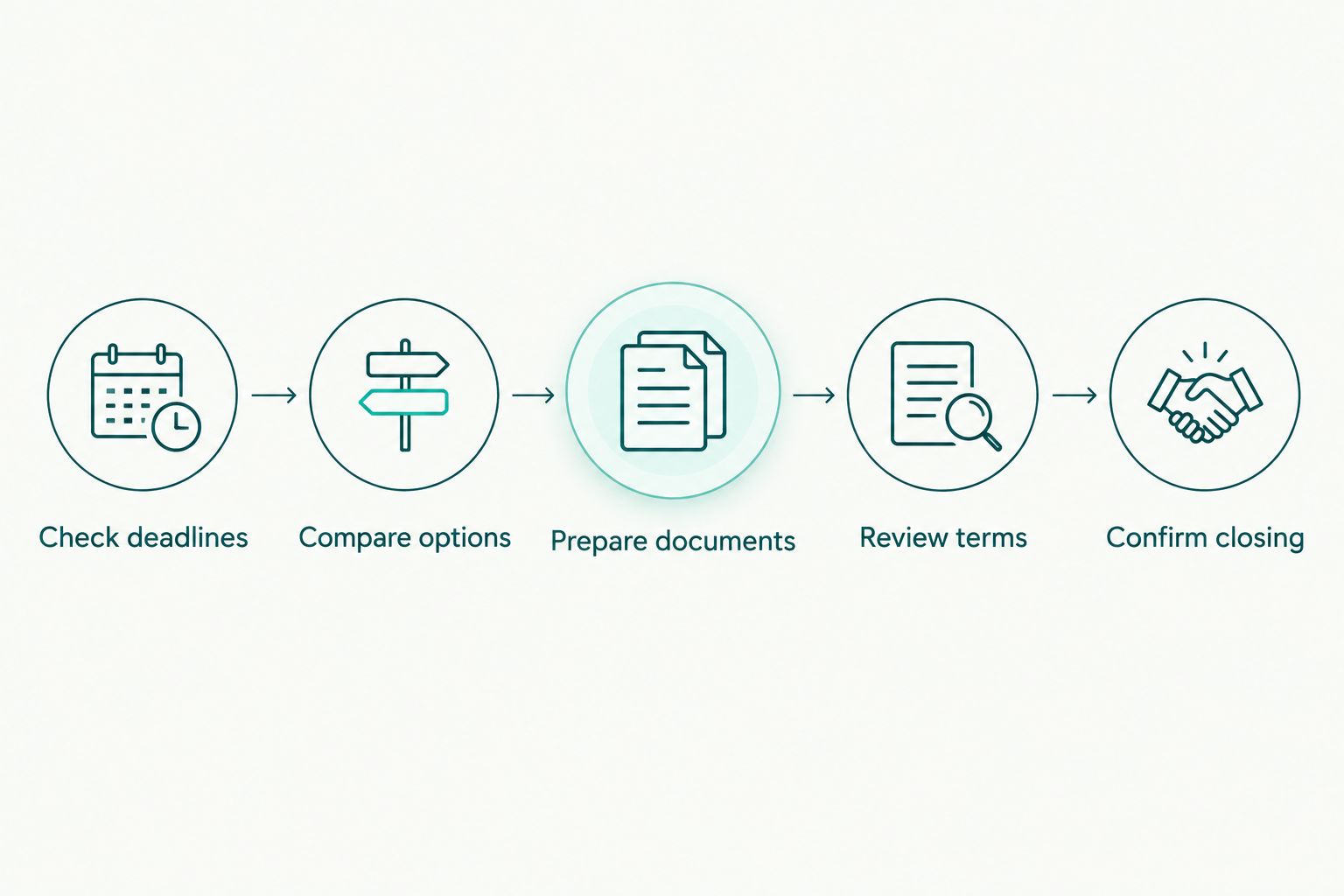
Use this sequence to organize your 2026 short sale discussions. If a foreclosure deadline is already pending, seek legal advice immediately rather than waiting to finish the sequence.
- Check deadlines: Gather notices and identify dates that require action.
- Compare options: State whether you want to keep the home or sell.
- Prepare documents: Follow the lender's current requirements.
- Review terms: Check the offer, debt language, and closing conditions.
- Confirm closing: Resolve outstanding requirements with the responsible professionals.
The sequence separates decisions from paperwork. You should understand your goal and urgent deadlines before treating package preparation as the entire solution.
Keep your notices, submitted documents, requests, and written approvals together. Your contact should be able to identify the outstanding action, the person responsible, and the relevant deadline without reconstructing a chain of conversations.
Request help with your short sale
Get help with short sale processing, lender negotiation, and comparing your options.
Which correction should you start with?
Start with deadlines, then written debt terms. If you do not know whether a foreclosure date is pending or what the proposed agreement says about the unpaid balance, resolve those questions before focusing on less urgent details.
For a homeowner preparing a 2026 submission without an immediate legal deadline, the next move is a complete package and a designated contact. Do not confuse organized processing with guaranteed approval. The purpose is to make the requests, responsibilities, and decisions clear.
FAQ
What's the biggest short sale mistake to avoid?
Starting without checking foreclosure deadlines is the first mistake to address. A short sale application does not automatically stop foreclosure; ask a qualified attorney about any notice or scheduled sale.
Does short sale approval mean I won't owe anything afterward?
No. Permission to sell and responsibility for the unpaid balance are separate questions. Have a qualified attorney review the written terms because lender requirements and state law vary.
Should I stop paying my mortgage to qualify for a short sale?
Do not stop paying based on an assumption about short sale eligibility. Ask your lender about its requirements and get qualified advice about the consequences before changing your payment behavior.
What documents should I prepare for a short sale?
Prepare the documents your lender requests for your loan. These can include financial records, hardship information, and sale documents; check signatures, missing pages, and whether updated records are required.
Can I accept a buyer's offer before the lender approves it?
You can enter a purchase contract that addresses pending short sale approval, but your acceptance does not constitute lender approval. Ask your agent to explain the contract's deadlines, contingencies, and obligations before signing.
Is a short sale better than foreclosure in 2026?
There is no universal answer. Compare your housing goal, available lender options, deadlines, and the written terms, then ask qualified professionals about the legal and tax consequences.
Can someone handle lender communication for me?
Yes. Shortsalesdoneright provides short sale processing and lender negotiation, with a dedicated point of contact and weekly lender updates. You still need to provide accurate records and review decisions requiring your consent.
Will a short sale guarantee a specific credit-score result?
No. Do not choose a short sale based on a promised credit-score outcome. Evaluate the transaction's terms and your alternatives rather than relying on a fixed point estimate.
One last thing
Do not ask only, Has the lender approved the sale? Ask, What exactly has the lender approved, and what obligations remain?
That second question directs you to the actual documents. For your 2026 decision, a written answer reviewed by the appropriate professional matters more than verbal reassurance about how short sales usually work.