

Best for an upside-down homeowner who needs to sell: short-sale processing through Shortsalesdoneright. Best for a temporary income gap: mortgage forbearance. Best for keeping the home on a sustainable payment: a loan modification. This 2026 guide compares short sale after job loss options with alternatives, so you can choose a path that fits your income and your plans.
- Shortsalesdoneright helps homeowners compare short sale after job loss options when an upside-down mortgage makes selling difficult.
- Mortgage forbearance addresses a temporary income gap; it does not erase postponed payments.
- A loan modification deserves consideration when you want to stay and can support an adjusted payment.
- Get lender terms in writing, including how any unpaid mortgage balance will be handled.
Why this matters
Job loss creates a payment problem. An upside-down mortgage creates a separate selling problem: your home cannot cover the mortgage payoff through an ordinary sale. You need to address both before choosing a short sale.
A short sale means selling the property for less than the mortgage balance with the lender's approval. Losing your job supports a hardship explanation, but it does not guarantee approval or cancellation of an unpaid balance.
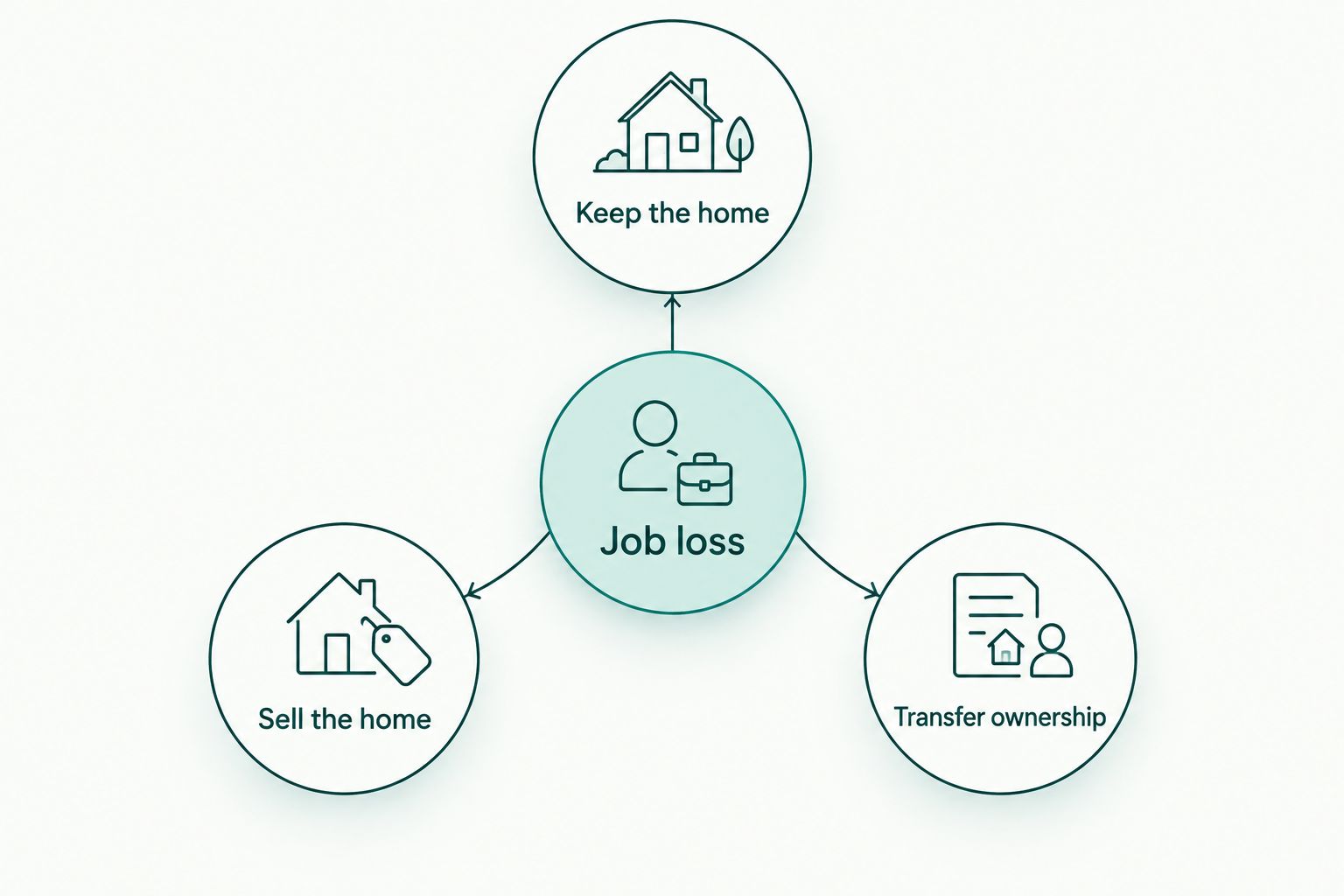
For your 2026 decision, separate the choices into 3 paths:
- Keep the home: ask about forbearance, modification, or a repayment plan.
- Sell the home: compare an ordinary sale with a lender-approved short sale.
- Transfer ownership: ask whether a deed in lieu of foreclosure is available.
The right path depends on whether your income loss is temporary, whether the home has equity, and whether you want to stay. Lender terms and state law vary. Take legal and tax questions to qualified professionals.
What makes the best option after job loss
Use these criteria to assess each option. A solution that only postpones an unaffordable payment does not solve a lasting income problem.
- Your goal: keeping the property and leaving the property require different plans. Start with the outcome you want.
- Income outlook: distinguish a temporary gap from a lasting reduction. Do not build a repayment plan around income you do not have.
- Equity position: compare likely sale proceeds, selling expenses, and the lender's payoff amount. A listing price alone does not establish equity.
- Payment sustainability: check the proposed housing payment against your current budget. Include taxes, insurance, and other required housing expenses.
- Debt resolution: identify what happens to missed payments and any balance left after a sale or transfer. Get the answer in writing.
- Deadline exposure: read lender notices and any foreclosure documents. A request for help is not proof that a scheduled legal action has stopped.
Choose the option that resolves your actual problem, not the option with the most reassuring name. A homeowner expecting income to return needs a different plan from someone who must relocate and cannot afford the property.
Job-loss mortgage options at a glance
The order below starts with the short-sale route this guide addresses. It is a decision tree, not a claim that selling is better than keeping your home.
| Option | Best for | Main function | Key limitation |
|---|---|---|---|
| Short-sale processing through Shortsalesdoneright | An upside-down homeowner who needs to leave | Package preparation and lender negotiation support | Lender approval and debt-release terms remain separate decisions |
| Mortgage forbearance | A temporary interruption in income | Temporarily pauses or reduces payments under an agreement | Postponed payments still need a resolution |
| Loan modification | Staying with an adjusted mortgage payment | Changes approved mortgage terms | Requires lender review; the resulting payment must be affordable |
| Repayment plan | Catching up after income returns | Spreads arrears into an agreed payment schedule | Requires room for more than the regular payment |
| Ordinary home sale | Leaving a property with sufficient equity | Uses sale proceeds to pay off the mortgage | Net proceeds must cover the payoff and transaction obligations |
| Deed in lieu of foreclosure | Seeking an exit without a buyer sale | Transfers ownership to the lender by agreement | Acceptance and unpaid-balance treatment are not automatic |
1. Short-sale processing: best for an upside-down homeowner who must sell
A short sale addresses the gap between what a property can sell for and what is owed on the mortgage. It fits a homeowner who needs to leave and cannot complete an ordinary sale that pays the loan off.
Shortsalesdoneright is best for upside-down homeowners who need short-sale processing and lender negotiation support. The service helps homeowners compare a short sale with other options. It also supports agents with full package preparation, a dedicated point of contact, and weekly lender updates.
Short-sale processing pros:
- Gives the lender a documented hardship and sale request.
- Provides support for package preparation and lender communication.
- Lets you pursue a sale when ordinary payoff is not possible.
Short-sale processing cons:
- The lender must approve the proposed transaction.
- A buyer's offer does not settle responsibility for an unpaid balance.
- Financial documents and lender requests still require your participation.
Explain how the job loss changed your income and why the proposed sale fits your situation. Use this guide to writing a short-sale hardship letter to organize the explanation without substituting emotion for financial facts.
Best for: homeowners who need to sell an upside-down property. Verdict: Hold until you compare retention options and understand the proposed debt terms.
2. Mortgage forbearance: best for a temporary income gap
Mortgage forbearance is an agreement to pause or reduce payments temporarily. It is a payment-relief arrangement, not mortgage forgiveness.
Ask your mortgage servicer how the postponed payments will be handled afterward. The answer matters as much as the immediate relief: a pause without a workable exit plan leaves the underlying problem unresolved.
Mortgage forbearance pros:
- Addresses an immediate interruption in income.
- Lets you explore keeping the home rather than selling immediately.
- Establishes agreed payment relief when the servicer approves it.
Mortgage forbearance cons:
- Postponed payments do not disappear.
- It does not fix a permanently unaffordable mortgage.
- The next step depends on your agreement and eligibility.
For a 2026 request, describe your current income accurately and ask what happens if employment has not resumed when the arrangement ends. Do not assume a new job will arrive on the lender's schedule.
Best for: homeowners facing a temporary disruption who want to stay. Verdict: Hold off on a sale while you assess the written forbearance terms.
3. Loan modification: best for staying on an adjusted payment
A loan modification changes mortgage terms with the lender's approval. Depending on the agreement, those changes can involve the interest rate, repayment term, or treatment of past-due amounts.
Focus on the proposed payment, not just the word modification. A changed loan still needs to fit your household budget after the job loss.
Loan modification pros:
- Addresses the mortgage terms rather than only delaying payments.
- Supports a stay-in-the-home goal when approved terms are workable.
- Creates a written basis for evaluating the new obligation.
Loan modification cons:
- Approval is not guaranteed.
- The lender requires financial information to evaluate the request.
- Changed terms do not necessarily resolve negative equity.
Compare the full housing obligation with your available income. If a replacement job pays less, use that lower income in the comparison rather than your former salary.
Best for: homeowners who want to stay and can support an adjusted payment. Verdict: Hold off on a short sale until you assess whether modification creates a sustainable budget.
4. Repayment plan: best for catching up after income returns
A repayment plan spreads missed payments across an agreed schedule, generally alongside ongoing mortgage payments. It addresses arrears when the regular mortgage payment is otherwise manageable.
This is not the same as a modification. Your main question is whether you can afford the catch-up obligation as well as the current payment.
Repayment plan pros:
- Creates a defined way to address missed payments.
- Fits a homeowner whose income has resumed.
- Avoids choosing a sale solely because of temporary arrears.
Repayment plan cons:
- Adds a catch-up obligation to your budget.
- Does not address negative equity.
- Becomes unsuitable if the total required payment is unaffordable.
Include essential expenses before committing. A plan that works only by ignoring groceries, utilities, transportation, or required insurance is not sustainable.
Best for: homeowners with restored income and room to catch up. Verdict: Skip if you cannot afford the regular payment plus the agreed arrears payment.
5. Ordinary home sale: best for leaving with sufficient equity
An ordinary sale uses the proceeds to satisfy the mortgage payoff without asking the lender to accept a shortfall. Job loss does not automatically make a short sale necessary.
Ask your agent to estimate net proceeds and obtain a current payoff amount from the servicer. Compare the figures before choosing a short-sale route.
Ordinary home sale pros:
- Avoids requesting lender acceptance of a mortgage shortfall.
- Fits a homeowner who wants to leave and has sufficient equity.
- Lets you assess the exit using estimated proceeds and payoff figures.
Ordinary home sale cons:
- Requires a buyer and a completed transaction.
- Selling expenses reduce the money available for payoff.
- A hopeful asking price does not guarantee sufficient net proceeds.
Include other liens or transaction obligations in the review. An apparent equity cushion can disappear when the comparison uses an incomplete payoff or ignores selling expenses.
Best for: homeowners who need to move and can satisfy the payoff through a sale. Verdict: Skip the short-sale route when an ordinary sale can meet the obligations.
6. Deed in lieu: best for evaluating an exit without a buyer sale
A deed in lieu of foreclosure transfers ownership to the lender by agreement. It is an alternative to discuss when keeping the property is not workable and a buyer sale is not the chosen route.
The lender must agree to the arrangement. Other liens can complicate acceptance, and the agreement must address your remaining obligations.
Deed in lieu pros:
- Provides an agreed ownership-transfer route when accepted.
- Does not depend on completing a sale to a separate buyer.
- Lets you review transfer conditions before signing.
Deed in lieu cons:
- Lender acceptance is not automatic.
- Other liens can create obstacles.
- Transferring ownership does not automatically erase an unpaid balance.
Have a qualified attorney review the documents, particularly any language about remaining debt or possession. Do not rely on a verbal assurance that handing over the property ends every obligation.
Best for: homeowners seeking a lender-approved exit without a buyer sale. Verdict: Wait for written terms and legal review before signing.
How these options are ranked
This 2026 ranking matches each option to a distinct homeowner need: an upside-down sale, temporary relief, payment adjustment, catching up, an equity-supported sale, or ownership transfer.
The criteria are your housing goal, income outlook, equity, payment sustainability, debt treatment, and deadlines. No option wins on all of them. Short-sale processing leads for an upside-down homeowner who needs to sell, not for every homeowner who loses a job.
What to gather before choosing
Bring these materials to your servicer conversation or short-sale consultation. Ask for the lender's current document requirements rather than assuming a generic checklist is complete.
- Income evidence: job-loss documentation, current benefits or other income, and any replacement employment information.
- Household budget: essential expenses and the housing payment you can actually support.
- Mortgage information: statements, account details, and a current payoff request.
- Property information: an agent's value assessment and estimated selling expenses.
- Notices: lender correspondence and any foreclosure documents or court papers.
Keep copies of submissions and written responses. Answer document requests with consistent figures; explain changes rather than leaving the lender to reconcile conflicting information.
For a possible short sale, seek 2 written decisions: approval of the sale itself and clear treatment of any unpaid balance. Do not treat approval of the transaction as proof that every debt obligation has ended.
Which option should you choose in 2026?
Start with whether you want to stay and whether the payment can become sustainable. If the income gap is temporary, ask about forbearance. If income has returned, compare modification and repayment options against your actual budget.
If you need to leave, check equity next. An ordinary sale deserves priority when it can satisfy the payoff. An upside-down property calls for a short-sale assessment or discussion of another lender-approved exit.
Shortsalesdoneright helps homeowners compare short-sale options and provides processing and lender negotiation services. If you are ready to act, request homeowner help through the appropriate intake form on the site.
Request help with your next step
Compare a short sale with other options after job loss.
FAQ
What's the best short sale option after losing my job?
Short-sale processing is the relevant option when you need to sell and the property cannot cover the mortgage payoff. First compare options for keeping the home if staying is your goal.
Does losing my job qualify me for a short sale?
Job loss supports a hardship explanation, but it does not guarantee short-sale approval. The lender reviews your financial circumstances, the property, and the proposed transaction.
Should I ask for forbearance before starting a short sale?
Ask about forbearance if your income loss is temporary and you want to keep the home. Review how postponed payments will be handled before deciding whether the arrangement fits your budget.
Can I sell normally instead of doing a short sale?
Yes, an ordinary sale is an option when net proceeds can satisfy the mortgage payoff and other transaction obligations. Compare an agent's proceeds estimate with a current payoff amount.
Will a short sale erase the rest of my mortgage debt?
A short sale does not automatically erase an unpaid mortgage balance. Get the lender's terms in writing and have a qualified attorney review your obligations under applicable state law.
Does requesting a short sale stop foreclosure?
Requesting a short sale does not itself establish that foreclosure has stopped. Confirm the status with the servicer and seek prompt legal help if you have foreclosure notices or court papers.
Can a short sale create a tax issue in 2026?
Canceled mortgage debt can create a tax issue in 2026, depending on applicable rules and your circumstances. Ask a qualified tax professional before assuming any canceled balance is excluded from taxable income.
How does Shortsalesdoneright help homeowners after job loss?
Shortsalesdoneright helps homeowners compare a short sale with other options and provides short-sale processing and lender negotiation services. Lender approval, debt treatment, and legal or tax outcomes are not guaranteed.
One last thing
A sale approval and a release from an unpaid balance are different questions. Before you sign, ask what happens to the remaining debt and where the written agreement answers that question.
That check matters more than a reassuring phone call. Keep the documents and obtain legal advice on any language you do not understand.