

Best for an unaffordable underwater home: a professionally supported short sale. Best for estate-related ownership questions: an estate-coordinated short sale; best for keeping an affordable home: a loan modification review. Your short sale options after spouse's death depend on who can sign, what you can afford, and what the lender accepts—not the loss alone.
- Short sale options after spouse's death start with ownership, mortgage responsibility, and your ability to keep the home.
- Shortsalesdoneright helps homeowners compare a short sale with other options for an upside-down mortgage.
- Choose a modification review if keeping the home is financially workable; consider forbearance for a temporary payment problem.
- A short sale requires lender approval and does not automatically erase an unpaid balance.
Why this matters
Losing your spouse does not automatically mean you must sell your home. It also does not automatically remove the mortgage or establish who has authority to sell. Separate the immediate payment problem from the ownership questions before choosing a path.
Shortsalesdoneright is best for homeowners seeking short sale processing and lender negotiation support for an upside-down mortgage. You can request help through the homeowner intake available through Shortsalesdoneright.
For a decision in 2026, use current income and actual household expenses. Do not build a payment plan around benefits, insurance proceeds, or estate distributions you have not confirmed.
What makes the best option after a spouse's death?
Judge each option against these criteria before comparing services or signing paperwork:
- Long-term affordability: Can your household sustain the payment after essential expenses?
- Sale proceeds: Would a sale cover the mortgage balances, other liens, and selling expenses?
- Authority to sign: Who owns the property, and who has legal authority to transfer it?
- Lender requirements: What documents, approvals, and written terms does the proposed solution require?
- Timing: Are payments overdue, or is a foreclosure deadline already approaching?
- Remaining obligations: What happens to an unpaid balance, other liens, and possible tax consequences?
The best choice solves your actual problem. A temporary payment pause does not fix a permanently unaffordable home. A short sale is not the first choice when you want to stay and can sustain an approved payment arrangement.
Your options at a glance
These are different routes, not interchangeable services. The order prioritizes the needs of a homeowner considering a short sale after bereavement.
| Option | Best for | Main benefit | Key limitation |
|---|---|---|---|
| Professionally supported short sale | Leaving an unaffordable underwater home | Processing and lender negotiation support | Approval and acceptable terms are not guaranteed |
| Estate-coordinated short sale | Resolving a sale involving estate authority | Addresses signing authority alongside the sale | Estate or title issues can prevent closing |
| Loan modification review | Keeping a home with a sustainable revised payment | Reviews changes to mortgage terms | Eligibility and an affordable outcome are not guaranteed |
| Forbearance review | Managing a temporary payment disruption | Requests temporary payment relief | Paused amounts still require a resolution |
| Deed-in-lieu review | Exploring an exit without a buyer-led sale | Considers a lender-accepted property transfer | Lender acceptance and lien issues remain obstacles |
1. Professionally supported short sale: best for leaving
A short sale asks the lender to accept sale proceeds that fall short of the mortgage payoff and permit the transaction under written terms. It fits a homeowner who needs to leave an underwater property and cannot sustain the mortgage after losing a spouse's income.
Shortsalesdoneright provides short sale processing and lender negotiation services. For agents, its stated support includes preparing the full short-sale package, a dedicated point of contact, and weekly lender updates. That administrative support does not replace legal advice or lender approval.
Supported short sale pros:
- Provides help organizing the lender submission.
- Gives lender negotiations a defined point of contact.
- Connects the proposed sale with the lender's review requirements.
Supported short sale cons:
- The lender can reject the proposal or request different terms.
- The approval does not automatically release every person from an unpaid balance.
Best for: You need to sell, sale proceeds will not cover the required payoff, and you want help handling the lender process.
Verdict: Buy processing support when you need it—not a promise of approval.
2. Estate-coordinated short sale: best for signing-authority issues
An estate-coordinated short sale combines the lender review with legal and title work needed to establish who can sell. It is not a separate lender program. The distinction is that ownership and estate administration shape the transaction.
Do not assume being a surviving spouse, living in the home, or making payments gives you authority to sign every sale document. Have a qualified attorney and title professional establish the requirements for your property. The guide to short selling an inherited house with a mortgage covers a related ownership situation.
Estate-coordinated short sale pros:
- Puts signing authority ahead of closing commitments.
- Brings estate, title, and lender requirements into the same plan.
- Helps distinguish ownership from responsibility for the mortgage debt.
Estate-coordinated short sale cons:
- Disagreements or unresolved authority can block the transaction.
- Lender consent does not resolve estate-law questions.
Best for: The property involves your spouse's estate, unclear title, or someone else's required signature.
Verdict: Hold sale commitments until a qualified professional confirms who can sign.
3. Loan modification review: best for keeping the home
A loan modification changes mortgage terms when the servicer and applicable loan requirements permit it. Ask for a review if you want to stay and your current household income can support a sustainable payment arrangement.
For your 2026 budget, count dependable income and essential expenses. Include property taxes, insurance, maintenance, and any association obligations—not just the principal-and-interest payment.
Loan modification review pros:
- Focuses on keeping the home rather than selling it.
- Allows a review based on your changed financial situation.
- Addresses ongoing affordability rather than only the next missed payment.
Loan modification review cons:
- The lender does not have to offer the terms you request.
- A revised payment still fails if your budget cannot support it.
Best for: You want to remain in the home and have enough continuing income to make a workable arrangement.
Verdict: Hold the sale decision while you assess a realistic retention option.
4. Forbearance review: best for a temporary disruption
Forbearance is an agreement for temporary payment relief, such as reduced or paused payments. It is not automatic debt cancellation. Ask how the unpaid amounts will be handled before accepting an arrangement.
This route fits a temporary gap better than a permanent loss of affordability. A pending survivor-benefit determination, for example, belongs in your discussion with the servicer—but do not treat an unapproved benefit as guaranteed income.
Forbearance review pros:
- Addresses an immediate payment interruption.
- Gives you a defined arrangement to discuss with the servicer.
- Lets you assess the next step without immediately committing to a sale.
Forbearance review cons:
- The agreement does not eliminate the underlying affordability problem.
- The end-of-plan repayment requirements need careful review.
Best for: Your financial disruption is temporary and you have a credible path to resumed payments.
Verdict: Skip forbearance as a stand-alone solution to a permanently unaffordable mortgage.
5. Deed-in-lieu review: best for exploring another exit
A deed in lieu of foreclosure involves transferring the property to the lender under an accepted agreement. It differs from a short sale because there is no buyer purchasing the property through the proposed transaction.
Ask the servicer whether it will consider this option and what conditions apply. Other liens, title problems, occupancy requirements, and the treatment of remaining debt all require review.
Deed-in-lieu review pros:
- Offers another exit to discuss when keeping the home is not workable.
- Does not depend on completing a buyer-led sale.
- Creates an opportunity to review written transfer terms before acceptance.
Deed-in-lieu review cons:
- Lender acceptance is not guaranteed.
- Transfer terms do not automatically eliminate all remaining obligations.
Best for: You need to leave and want to compare a lender-accepted transfer with a short sale.
Verdict: Hold until the lender's written terms receive legal review.
What to do before choosing a route
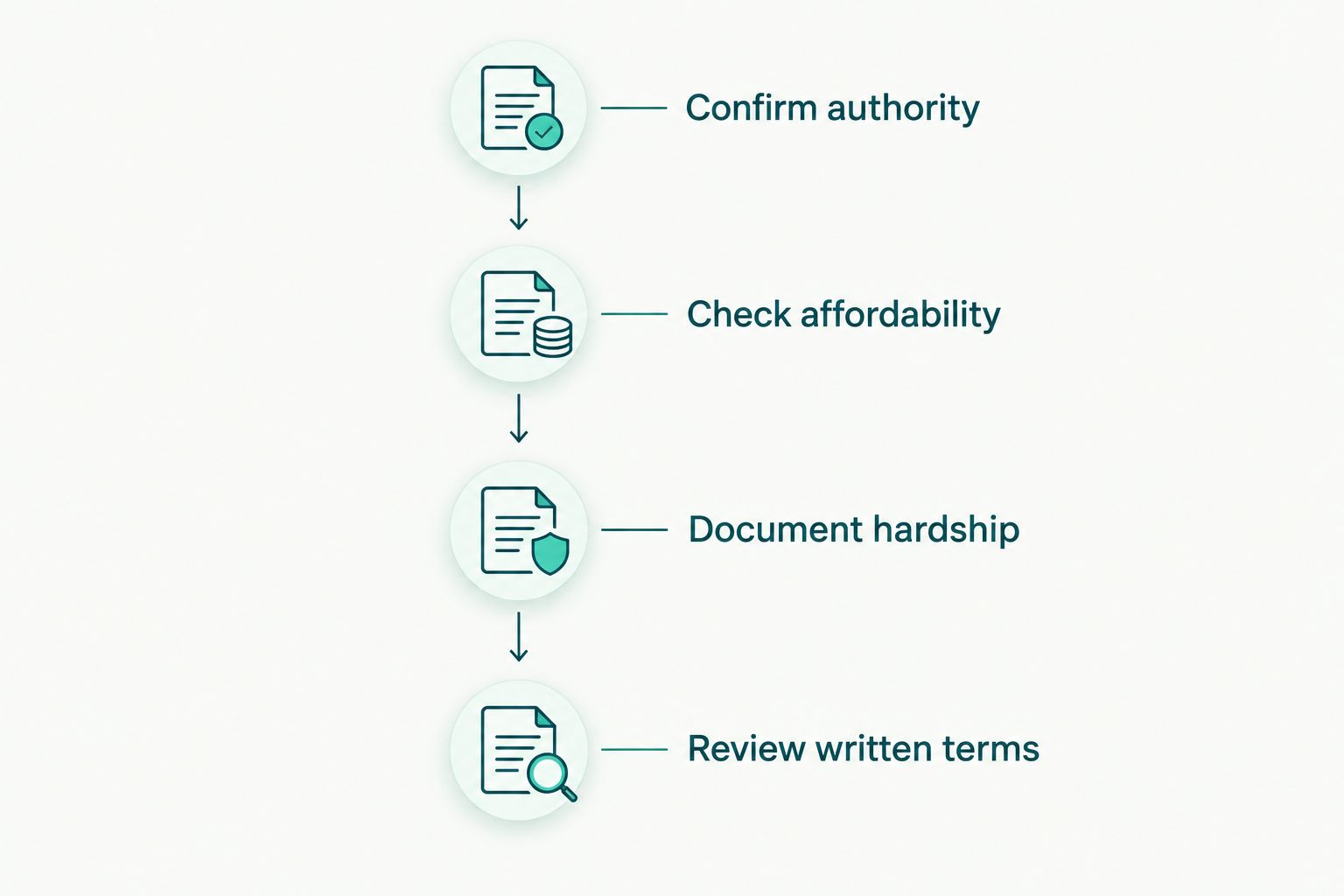
Use this sequence to turn an overwhelming decision into a manageable file. For a 2026 application, ask the servicer which documents must be current and how to submit them securely.
Confirm authority
Gather the death certificate and available ownership or estate documents. Ask the servicer what it needs to communicate with you and evaluate any successor-in-interest status. Separately, ask an attorney or title professional who can authorize a sale.
Check affordability
Write down dependable monthly income and essential household spending. Then ask a local real estate professional for a market-based assessment of sale proceeds after expenses and liens. Do not assume a short sale is necessary just because the payment is difficult.
Document hardship
Describe how your spouse's death changed the household finances. Keep the explanation factual and consistent with the supporting records. Ask the servicer which income, asset, expense, and property documents the applicable review requires.
Review written terms
Read the proposed approval or agreement before committing. Check deadlines, required payments, lien releases, and language about any remaining balance. Send legal questions to a qualified attorney and tax questions to a qualified tax professional.
If you already have a foreclosure notice, tell the servicer and your attorney immediately. Do not assume a short-sale request stops a scheduled foreclosure. Ask for written confirmation of any postponement rather than relying on a pending application.
Request help comparing your options
Use the homeowner intake to discuss an upside-down mortgage and short sale processing support.
How these options are ranked
This 2026 guide ranks routes by the problem each addresses: leaving an underwater home, establishing sale authority, keeping the home, bridging a temporary gap, or exploring another exit. The criteria are affordability, authority, lender requirements, timing, and remaining obligations—not a predicted approval rate.
The first option is the default only when you need to sell and the expected proceeds will not cover the required payoff. If a regular sale can cover the obligations, compare that route before pursuing a short sale.
Which option should you choose?
Choose a supported short-sale review when the home is underwater, keeping it is not sustainable, and you need to leave. If ownership is unsettled, resolve signing authority alongside that review rather than treating it as a closing-day detail.
Choose a modification review when staying is your goal and the numbers support it. Use forbearance for a temporary problem, not to postpone an unavoidable affordability decision. Consider a deed in lieu only after comparing its written terms with the available alternatives.
FAQ
What are the best short sale options after spouse's death?
A supported short sale fits an unaffordable underwater home; an estate-coordinated short sale fits a transaction with unresolved signing authority. Compare a modification if you want to stay, and forbearance if the payment problem is temporary.
Do I have to sell my house when my spouse dies?
No, your spouse's death does not automatically require a sale. Your ownership rights, mortgage arrangement, household finances, and applicable law determine which options need review.
Can I request a short sale if only my spouse signed the mortgage?
Ask the servicer what authority and documentation it requires before it can review a request with you. A qualified attorney should separately assess ownership, estate authority, and personal responsibility for the debt.
Does my spouse's death qualify me automatically for a short sale?
No, bereavement does not guarantee short-sale approval. The lender reviews the applicable requirements, financial circumstances, property information, and proposed transaction.
Will a short sale erase the unpaid mortgage balance?
A short sale does not automatically erase the unpaid balance. Have a qualified attorney review the written approval, any release language, and the effect of state law before you sign.
Should I stop paying the mortgage to get a short sale approved?
Do not stop payments simply to try to qualify for a short sale. Discuss your actual ability to pay with the servicer and ask how payment status affects the available review.
Will a short sale stop foreclosure in 2026?
Do not assume a short-sale application stops foreclosure in 2026. Ask the servicer for written confirmation of any postponement and consult a qualified attorney about deadlines.
One last thing
Permission to sell the property and release from an unpaid debt are different questions. Put both on your review checklist. Lender terms and state law vary, and neither a processing service nor a verbal assurance replaces qualified legal or tax advice.


