

Best overall for an unaffordable underwater home: a professionally coordinated short sale. Best for staying: a loan modification. Best for a temporary income gap: forbearance. These are the main short sale options for retirees with reduced income in 2026, alongside a regular sale when the proceeds cover what you owe.
- Short sale options for retirees with reduced income start with deciding whether keeping the home is affordable.
- Shortsalesdoneright provides short sale processing and lender negotiation for homeowners considering an underwater mortgage exit.
- Choose a loan modification review when you want to stay and need different mortgage terms.
- Compare written lender terms, remaining debt, and replacement housing before choosing a short sale.
Why this matters
Retirement changes the income supporting your mortgage. A payment that worked with wages can stop fitting when you rely on retirement benefits, pension payments, or withdrawals.
An underwater mortgage adds another problem: selling the home does not necessarily produce enough money to pay off the debt. A short sale addresses that sale shortfall; it does not automatically erase every remaining obligation.
Shortsalesdoneright provides short sale processing and lender negotiation services and helps homeowners compare a short sale with other options. Shortsalesdoneright is a fit for retirees who want help comparing an underwater-home exit and coordinating lender negotiations.
Lender terms and state law vary. Take legal questions to a qualified attorney and tax questions to a qualified tax professional before signing an agreement.
What makes the best retirement mortgage option?
Judge your 2026 choices against these criteria before comparing them:
- Monthly affordability: Include the mortgage, taxes, insurance, association obligations, utilities, and maintenance. A smaller loan payment alone does not settle the question.
- Income durability: Separate an ongoing retirement-income reduction from a temporary interruption. Temporary relief needs an affordable ending.
- Equity position: Compare a realistic sale estimate with mortgage payoff amounts and selling expenses. Do not assume you need a short sale.
- Remaining obligations: Find out what happens to unpaid mortgage debt and other property claims. Ask for written terms.
- Housing continuity: Identify where you will live next and what that housing requires from your retirement income.
Retirement mortgage options at a glance
The ranking below is a decision guide, not a claim that every retiree should sell. Each option answers a different problem.
| Rank and option | Best for | Main advantage | Key limitation |
|---|---|---|---|
| 1. Coordinated short sale | Leaving an unaffordable underwater home | Combines a property sale with lender negotiations | Requires lender agreement; remaining debt needs review |
| 2. Loan modification | Staying with a sustainable revised payment | Changes approved loan terms without selling | Approval and affordable terms are not guaranteed |
| 3. Forbearance | Managing a temporary income interruption | Provides agreed temporary payment relief | Does not by itself resolve permanently reduced income |
| 4. Regular sale | Leaving when proceeds cover the obligations | Avoids needing short-sale consent to accept a payoff shortfall | Requires enough proceeds or another way to cover the difference |
| 5. Deed in lieu | Exploring an exit without a completed buyer sale | Offers a lender-negotiated property transfer | Acceptance, title issues, and debt treatment require review |
1. Coordinated short sale: best for an underwater exit
A short sale is a sale in which the mortgage lender agrees to accept proceeds below the amount needed to pay off the mortgage. It is relevant when you need to leave and the property's sale proceeds cannot cover the debt and sale expenses.
Best for: Retirees with a lasting income reduction, an unaffordable home, and insufficient equity for a regular sale.
A coordinated short sale connects your listing agent, lender negotiations, documents, and closing work. Shortsalesdoneright offers processing and lender negotiation services, including a dedicated point of contact and weekly lender updates.
Coordinated short sale pros:
- Gives you a route to sell despite a mortgage shortfall.
- Keeps document requests and lender communications organized.
- Lets you evaluate a written sale agreement before committing to its terms.
Coordinated short sale cons:
- The lender can reject the proposed transaction or request changes.
- Sale approval does not automatically release you from all unpaid debt.
- Finding a buyer does not establish a guaranteed closing date.
For a 2026 retirement move, review the proposed debt treatment alongside your replacement-housing plan. Ask whether the approval releases the mortgage lien, addresses personal responsibility for the shortfall, or does both; an attorney can explain the distinction.
Verdict: Buy into this route when leaving is necessary and a regular sale cannot cover the obligations. Do not treat approval as guaranteed.
2. Loan modification: best for keeping an affordable home
A loan modification changes mortgage terms with the lender's approval. The useful question is whether the resulting payment fits your retirement budget—not simply whether it is lower than today's payment.
Best for: Retirees who want to stay and can support the full housing expense under revised terms.
Start with your mortgage servicer's assistance process. Compare a short sale with a loan modification before preparing for a move you do not want or cannot fund.
Loan modification pros:
- Offers a path to remain in your home.
- Addresses mortgage terms rather than requiring a buyer.
- Lets you assess a proposed payment against retirement income.
Loan modification cons:
- The servicer must review and approve the request.
- Revised terms do not eliminate maintenance, insurance, or tax obligations.
- A lower payment does not necessarily mean less total interest over the loan's life.
Ask for the complete proposed terms. Review the payment, term length, treatment of overdue amounts, and any balance due later—not just the first payment shown.
Verdict: Buy into modification review when staying is your goal and the full revised budget works. Skip an unaffordable agreement.
3. Forbearance: best for a temporary income interruption
Forbearance is an agreement that temporarily reduces or pauses mortgage payments. The missed or reduced payments still need treatment under the agreement or a later repayment arrangement.
Best for: Retirees with a temporary disruption and an identifiable way to resume affordable payments.
Forbearance fits a temporary problem better than a permanent gap between income and housing expenses. Before accepting, understand both the relief period and what follows it.
Forbearance pros:
- Provides agreed breathing room during a temporary hardship.
- Gives you time to assess longer-term housing choices.
- Does not require an immediate property sale.
Forbearance cons:
- Does not itself forgive missed payments.
- Leaves the underlying affordability problem unresolved if income stays lower.
- Requires careful review of the agreement's ending and repayment terms.
If your retirement income is permanently lower in 2026, ask what changes before relief ends. Do not build the plan around uncertain future earnings or an assumed loan modification.
Verdict: Hold this option for a temporary gap. Skip it as the sole answer to permanently unaffordable housing.
4. Regular sale: best when proceeds cover your obligations
A regular sale deserves a check before a short sale. Reduced income alone does not mean the home is underwater or that lender approval of a payoff shortfall is necessary.
Best for: Retirees who need to move and have enough proceeds, or another workable funding source, to complete the sale without a mortgage shortfall.
Ask your agent for an estimated seller net sheet. Have the closing professional check payoff amounts and property claims rather than relying on the balance displayed on a mortgage statement.
Regular sale pros:
- Avoids requesting permission for a mortgage payoff shortfall.
- Allows you to plan around an ordinary sale contract.
- Preserves any remaining proceeds after obligations and expenses are paid.
Regular sale cons:
- Depends on the actual sale proceeds and closing obligations.
- Still requires a replacement-housing plan.
- Does not solve a shortfall unless you can cover it another way.
Verdict: Buy into a regular sale when the verified numbers support it. Skip short-sale negotiations you do not need.
5. Deed in lieu: best for discussing an exit without a buyer
A deed in lieu of foreclosure is an agreement to transfer ownership to the lender instead of completing foreclosure. It is a separate option to discuss, not an automatic fallback after an unsuccessful listing.
Best for: Retirees who need to leave and want the servicer to evaluate an alternative property transfer.
Deed in lieu pros:
- Offers an exit to discuss without a completed buyer transaction.
- Creates an opportunity to review written transfer terms.
- Gives you another alternative to compare before accepting a short-sale agreement.
Deed in lieu cons:
- The lender does not have to accept it.
- Additional liens or title problems can complicate acceptance.
- Transferring ownership does not, by itself, establish that all debt is forgiven.
Have an attorney review the proposed transfer and remaining obligations. Confirm possession and move-out terms before arranging your relocation.
Verdict: Hold for lender and legal review when a buyer-based exit is not working. Do not transfer ownership on verbal assurances.
How these options are ranked
These recommendations prioritize a sustainable retirement budget, a realistic equity position, and clear written obligations. The short sale ranks first for the specific problem of leaving an unaffordable underwater home—not for retirees whose home remains affordable or has sufficient equity.
Foreclosure is not a recommended planning strategy here. If proceedings have started, obtain advice promptly; do not assume a request for mortgage assistance or a pending short sale stops an existing deadline.
Prepare your next conversation
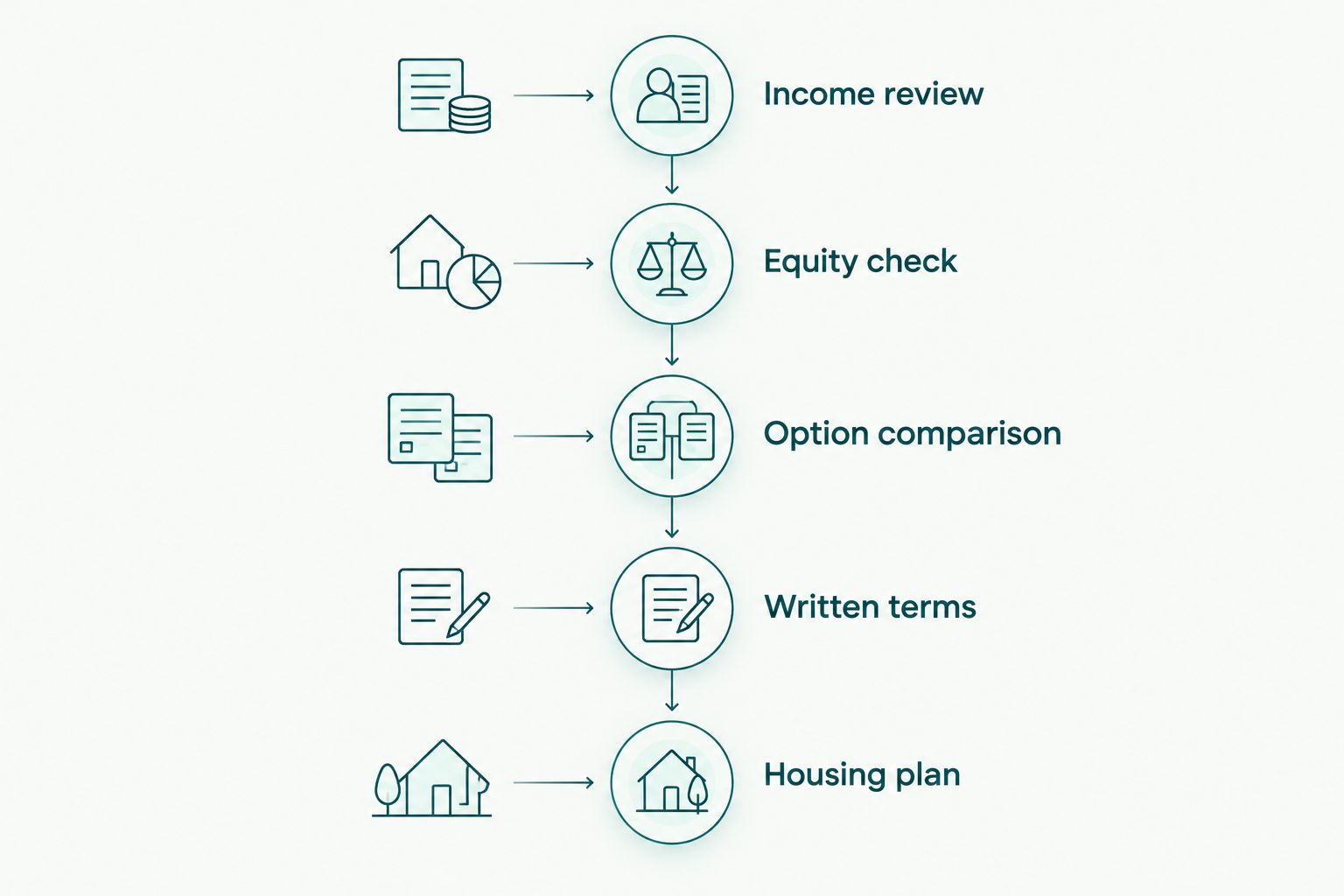
Use this sequence to turn a difficult decision into specific questions. For a 2026 review, work from current statements and current housing estimates.
- Income review: Write down reliable retirement income and essential spending. Separate recurring income from occasional withdrawals.
- Equity check: Obtain an estimated sale value, payoff information, and a seller net estimate.
- Option comparison: Ask the servicer which retention and exit options it will evaluate for your loan.
- Written terms: Review remaining debt, required actions, and deadlines with the appropriate professionals.
- Housing plan: Confirm your next housing arrangement before committing to a move-out date.
Keep a dated record of lender requests and submissions. A family member can help organize paperwork, but ask the servicer what authorization it requires before discussing your account with someone else.
If a short sale fits, request homeowner help through Shortsalesdoneright and use the homeowner intake form. Keep your agent involved in the listing and sale decisions.
Request help with your next step
Get help comparing a short sale with other options and coordinating lender negotiations.
Which option should you choose?
Choose a coordinated short-sale review when your retirement income cannot support the home and a regular sale leaves a shortfall. Choose modification review when staying is realistic; reserve forbearance for a temporary problem with a workable ending.
Do not choose based on a promised approval, a predicted credit score, or an assumption that every unpaid balance disappears. Choose based on written terms and a housing budget you can maintain.
FAQ
What's the best short sale option for a retiree with reduced income?
A coordinated short-sale review is the strongest starting point when you need to leave an unaffordable home and sale proceeds cannot cover the mortgage obligations. First check whether a regular sale works and whether keeping the home under revised terms is realistic.
Can I qualify for a short sale because I retired?
Retirement alone does not guarantee short-sale approval. Explain the income change and provide the financial documents your servicer requests so it can evaluate your circumstances.
Is a loan modification better than a short sale in retirement?
A loan modification is the better fit when you want to stay and the revised total housing expense is sustainable. A short sale addresses a different need: leaving when the proceeds cannot cover the mortgage payoff.
Should I stop making mortgage payments to get a short sale?
Do not stop paying solely to try to qualify for a short sale. Ask your servicer about its requirements and obtain advice about missed-payment consequences before changing your payment behavior.
Will a short sale erase the balance I still owe?
A short sale does not automatically erase the unpaid balance. Have a qualified attorney review the lender's written agreement and applicable state law before you accept the terms.
Will I owe taxes after a short sale in 2026?
Tax treatment depends on your circumstances and the rules that apply to the transaction. Ask a qualified tax professional to review any canceled debt and available exclusions rather than assuming the sale is tax-free.
Can a short sale guarantee less credit damage than foreclosure?
No specific credit-score result can be guaranteed. Review the debt obligations, housing outcome, and legal consequences rather than choosing based on a promised score change.
One last thing
Ask 2 separate questions: “Can I afford to keep this home?” and “Can I afford the move?” A short sale addresses the sale shortfall, but you still need a workable destination. Put the next home's recurring expenses beside your current housing budget before signing.


