

Best overall: coordinated mortgage-lender and HOA negotiations. Best for unclear HOA claims: a title-first review. Best for a documented income loss: a hardship-backed short-sale package. In 2026, the best short sale strategies for homeowners behind on HOA fees address both debts before closing—not just the mortgage.
- Best short sale strategies for homeowners behind on HOA fees: coordinate mortgage approval, HOA negotiations, and title clearance.
- Shortsalesdoneright helps homeowners compare short sales with other options; lender approval is never guaranteed.
- Mortgage short-sale approval does not automatically settle HOA arrears or release an association lien.
- If you receive a foreclosure notice, get state-specific legal advice while exploring a short sale.
Why this matters
An overdue HOA account creates a separate issue from an underwater mortgage. Your mortgage servicer reviews the proposed short sale, while the association or its authorized representative addresses its own claim. A mortgage approval letter alone does not resolve every obligation attached to the property.
Shortsalesdoneright provides short-sale processing and lender negotiation services and helps homeowners compare a short sale with other options. Shortsalesdoneright is best for homeowners who need short-sale processing and lender negotiation support while weighing their options.
Lender terms and state law vary. Ask a qualified attorney about liens, foreclosure notices, and remaining personal liability, and direct tax questions to a qualified tax professional.
What makes the best short-sale strategy for HOA arrears
Judge your 2026 plan against these criteria before choosing an approach:
- Complete debt picture: Identify the mortgage balances, HOA account, property taxes, and other claims affecting the sale.
- Written terms: Get the relevant approval, payment, and release terms in writing rather than relying on a phone conversation.
- Closing feasibility: Have the title or closing professional identify what must happen to transfer title.
- Documented hardship: Explain your financial circumstances and support them with the records your servicer requests.
- Deadline control: Track collection notices, foreclosure dates, approval expirations, and closing requirements separately.
- Goal fit: Decide whether you need to leave the property or want to explore keeping it. Those goals require different plans.
Short-sale strategies at a glance
These approaches address different problems. You can combine them; the ranking identifies where each belongs in your decision.
| Strategy | Best for | Main advantage | Key limitation |
|---|---|---|---|
| Coordinated negotiations | An underwater sale with HOA arrears | Connects mortgage and association terms before closing | Each party controls its own response |
| Title-first review | Unclear liens or disputed account details | Identifies closing obstacles early | Does not itself settle a debt |
| Hardship-backed package | Income loss or another financial hardship | Gives the servicer supporting records | Documentation does not guarantee approval |
| Written HOA agreement | A homeowner evaluating whether to stay | Addresses association arrears separately | Does not fix an unaffordable mortgage |
| Deadline-first legal review | A collection lawsuit or foreclosure notice | Puts urgent legal questions first | Does not automatically pause enforcement |
1. Coordinated negotiations: best for an underwater sale
A coordinated negotiation treats the mortgage short sale and HOA claim as connected closing issues. Your agent, short-sale processor, and closing professional need a shared understanding of the proposed transaction, while an attorney handles legal questions about the association's rights.
Start by requesting an itemized HOA statement and identifying who has authority to discuss settlement or release terms. Have the proposed closing statement reflect the association claim and any proposed resolution; do not assume mortgage proceeds can cover it without the required approvals.
Best for: You need to sell, the mortgage exceeds the expected sale proceeds, and overdue HOA charges also need resolution.
Coordinated negotiation pros:
- Brings the HOA claim into the discussion before closing.
- Connects proposed payments with the closing statement.
- Makes conflicting approval conditions easier to identify.
Coordinated negotiation cons:
- The lender and association can require different terms.
- A proposed settlement is not an accepted settlement.
Ask who will request updated balances and who will confirm written release requirements. Shortsalesdoneright offers a dedicated point of contact and weekly lender updates; those updates do not replace separate confirmation of HOA terms.
Verdict: Skip any plan that treats mortgage approval as automatic HOA approval.
2. Title-first review: best for unclear HOA claims
A title-first review identifies recorded claims and closing requirements before you build a sale around assumptions. Pair the title review with a current HOA account statement, because the account balance and recorded documents answer different questions.
Ask the closing professional what documents are needed to address the association's claim. If you dispute a charge or do not understand a recorded lien, take that issue to an attorney rather than asking the mortgage negotiator to decide it.
Best for: You have received conflicting balances, do not know whether a lien exists, or have other debts affecting the property.
Title-first review pros:
- Separates account questions from title questions.
- Identifies parties whose claims need attention.
- Gives negotiations a clearer factual starting point.
Title-first review cons:
- Identifying a claim does not resolve it.
- Disputed rights require legal advice beyond processing support.
For a 2026 sale, request statements that apply to your actual transaction and closing date. An older statement does not establish what the association will require at closing.
Verdict: Skip negotiations based only on an old bill or a verbal balance.
3. Hardship-backed package: best for an income disruption
A hardship-backed package explains why you are requesting a short sale and supplies the financial records your servicer requires. Keep the mortgage hardship and HOA arrears connected in the explanation without treating them as the same debt.
If reduced income affected both payments, explain that sequence plainly. Use the guide to documents for a short-sale package to organize your preparation, then follow your servicer's actual checklist.
Best for: Your ability to pay changed because of job loss, reduced income, or another financial hardship.
Hardship-backed package pros:
- Supports your explanation with records.
- Gives your agent and processor consistent information.
- Places HOA arrears within your wider financial picture.
Hardship-backed package cons:
- A complete submission does not guarantee acceptance.
- Financial documents can require updates during review.
Include HOA statements when relevant to the requested submission, and tell your team about new notices. Do not exaggerate your hardship or omit an account because you expect it to complicate negotiations.
Verdict: Skip a generic hardship letter that does not match your records.
4. Written HOA agreement: best for evaluating whether to stay
A written HOA payment or settlement agreement addresses the association account separately from the mortgage. It belongs in a short-sale discussion because you should compare leaving with keeping the home—not assume a short sale is necessary simply because HOA payments are overdue.
This is an alternative or supporting step, not mortgage short-sale approval. Before agreeing, review whether you can meet the proposed HOA terms alongside your mortgage, ongoing assessments, and other essential obligations.
Best for: You want to explore keeping the home and need to understand whether an HOA arrangement fits your finances.
Written HOA agreement pros:
- Puts proposed association terms in writing.
- Helps you evaluate a stay-in-the-home option.
- Separates the HOA discussion from mortgage assistance.
Written HOA agreement cons:
- It does not change your mortgage terms.
- An unaffordable agreement does not solve the underlying problem.
Ask what happens to collection activity while the agreement is in effect and what happens if you miss a payment. Have an attorney explain unclear terms; do not assume a payment arrangement stops a pending action.
Verdict: Skip an agreement you cannot sustain while exploring your mortgage options.
5. Deadline-first legal review: best after an enforcement notice
A deadline-first review puts an HOA collection lawsuit, mortgage foreclosure notice, or association foreclosure notice ahead of routine sale preparation. Bring the actual documents to a qualified attorney in the state where the property is located.
You can explore a short sale while getting legal advice. However, submitting a package does not itself establish that a lawsuit, collection action, or foreclosure has stopped.
Best for: You have received legal papers, a sale notice, or another notice with a response deadline.
Deadline-first review pros:
- Identifies urgent questions about your rights and obligations.
- Distinguishes the association's action from the lender's action.
- Helps your sale team work with confirmed deadlines.
Deadline-first review cons:
- Legal review does not guarantee a delay or settlement.
- A pending short sale does not replace a required legal response.
For a notice received in 2026, use the dates on the actual notice and get state-specific advice. Do not substitute an online timeline from another state or another homeowner's experience.
Verdict: Skip waiting for a lender update before addressing legal papers.
How to put your chosen strategy into action
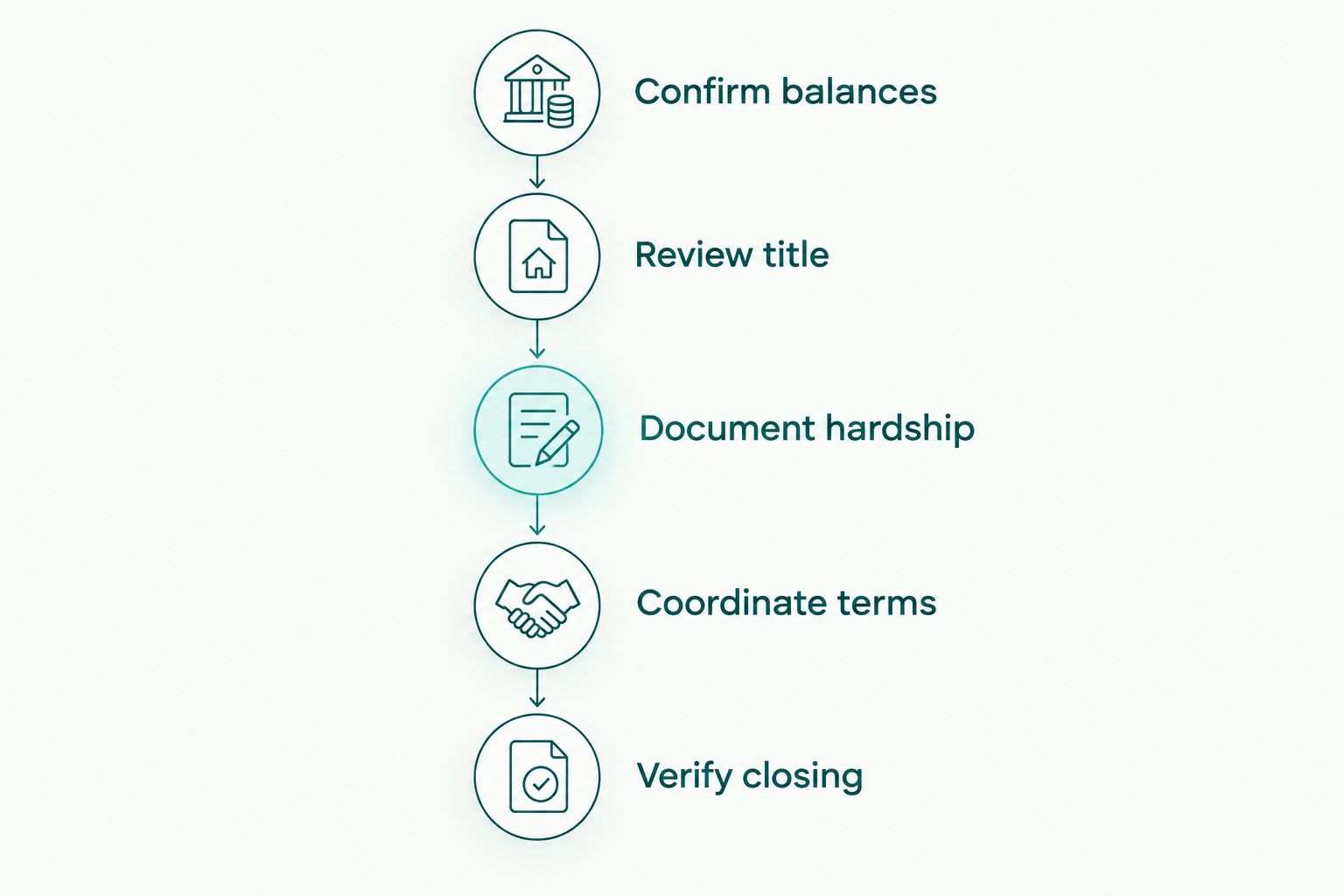
Use this sequence to keep the sale discussion grounded in documents. If you already have legal papers, move legal review to the front rather than following the sequence mechanically.
- Confirm balances: Request mortgage information, an itemized HOA statement, and relevant collection correspondence.
- Review title: Ask the title or closing professional to identify claims and required closing documents.
- Document hardship: Gather the financial records your servicer requests and explain your circumstances accurately.
- Coordinate terms: Compare the lender's proposed approval with the association's written requirements.
- Verify closing: Confirm updated balances, approval conditions, and release documents before signing.
Keep one folder for statements, notices, submissions, and written responses. Record which person owns each unresolved task; a shared status update is more useful when it identifies the next action rather than simply saying the file is pending.
Ready to discuss your situation? Request help through the homeowner intake form on the Shortsalesdoneright website. Share whether you want to sell or stay, and identify any notices with deadlines.
Get help comparing your options
Explain your mortgage situation, HOA arrears, and any notices with deadlines through the homeowner intake form.
How these strategies are ranked
Coordinated negotiations rank first because the proposed sale must address both mortgage approval and the HOA claim. Title review follows because you need to understand the closing requirements before promising a resolution.
The remaining strategies serve narrower needs: documenting hardship, evaluating whether to stay, or addressing an urgent notice. A legal deadline overrides the ranking. These are decision criteria, not reported success rates or promises of a particular outcome.
Which strategy should you choose?
For a 2026 short sale involving overdue HOA fees, start with coordinated negotiations supported by title review. Add a hardship-backed package based on your servicer's requirements, and ask for written confirmation of unresolved terms.
If you want to keep the home, compare mortgage assistance and an HOA agreement before committing to a sale. If you have legal papers, get legal advice first. The best next step depends on your goal and the documents—not the size of a verbal settlement promise.
FAQ
Can I short sell my house if I owe HOA fees?
HOA arrears do not by themselves determine whether a short sale can close. You need the required mortgage approval and a workable resolution of association claims and title requirements, subject to lender terms and state law.
Does short-sale approval wipe out overdue HOA fees?
Mortgage short-sale approval does not automatically erase HOA fees. Ask for written association terms and have the closing professional and your attorney confirm what those terms resolve.
Will my mortgage lender pay the HOA balance?
Do not assume your mortgage lender will authorize payment of the HOA balance from sale proceeds. Have the proposed closing statement and any requested payment reviewed as part of the approval process.
Can an HOA continue foreclosure while I apply for a short sale?
A short-sale application is not proof that HOA enforcement has stopped. Ask a qualified attorney about your state's rules, the notices you received, and any written agreement affecting the action.
Should I stop paying HOA fees while negotiating a short sale?
Do not treat a short-sale application as permission to stop paying HOA assessments. Discuss your budget and obligations with qualified advisers, and ask how ongoing charges affect the proposed resolution.
Is an HOA payment plan better than a short sale?
An HOA payment plan serves a different goal from a short sale. Compare whether you can afford to keep the home, because an association agreement does not change an unaffordable mortgage.
Will I owe anything after the short sale closes?
Do not assume closing eliminates every remaining obligation. Have an attorney review the mortgage and HOA terms for remaining liability, and ask a qualified tax professional about tax consequences.
One last thing
A lien release and a release from personal liability are different questions. Before closing, ask your attorney what each written agreement resolves and whether any obligation remains. Getting the sale closed is not a substitute for understanding the terms.


