

Instead of manually chasing access, valuation updates, and lender decisions, use a single BPO scheduling short sale approval workflow that tracks each handoff through written approval review. For agents handling these files in 2026, the key is separating a completed property visit from a lender-approved transaction.
- BPO scheduling short sale approval requires separate checks for access, valuation, lender review, and written terms.
- A broker price opinion supports valuation; it does not approve a short sale.
- Shortsalesdoneright short sale processing is best for agents seeking package preparation and lender negotiation support.
- Confirm approval conditions before scheduling a closing around an assumed lender decision.
Why this matters
A broker price opinion, or BPO, is a real estate broker's or agent's estimate of property value. A lender can use it during short sale review, but completing the visit does not establish an acceptable offer or release the homeowner from an unpaid balance.
Shortsalesdoneright short sale processing is best for agents who want package preparation and lender negotiation handled through a dedicated point of contact. The service includes preparing the full short sale package for agents and weekly lender updates. The listing agent still needs to coordinate property access, buyer communication, and transaction decisions.
If those administrative handoffs are consuming your day, Shortsalesdoneright provides processing and lender negotiation support. Keep the responsibility split clear before assigning the next task.
Before you start
For your 2026 file, gather these materials before arranging the valuation visit:
- Access and authority: Identify the lender's designated contact, confirm any required borrower authorization, and obtain permission to coordinate access with the owner or occupant.
- A current transaction file: Keep the lender's requested seller documents, signed offer, property details, and proposed closing information together. Confirm the lender's requirements rather than assuming a previous file's checklist applies.
- The non-obvious gotcha: Confirm whether the ordered BPO is exterior-only or requires interior access. An exterior assignment and an interior assignment require different preparations; do not assume the visitor will inspect inside.
Keep sensitive financial documents in an access-controlled file, separate from the property-access instructions. Give each recipient only the information needed for their role.
The steps below use a working checklist, not lender-portal button names. Follow the actual instructions supplied for the specific loan and valuation assignment.
Request readiness
Confirm the assignment before promising a date
- Verify the valuation request. Ask the lender or assigned negotiator whether a BPO has been ordered and who will coordinate scheduling. Do not treat a request to order a valuation as confirmation that an assignment exists.
- Confirm the scope. Establish whether the assignment requires interior access, exterior observation, or additional property information. Ask where scheduling questions should go.
- Identify the scheduling contact. Record the assigned person's name and contact details once provided. Verify unfamiliar requests through the established lender or processing contact before sharing access information.
- Separate your dates. Track at least 2 separate dates: the scheduled visit and the lender-confirmed receipt of the valuation. Add other deadlines only when the responsible party supplies them.
- Assign ownership. Choose 1 primary contact to coordinate access and status updates. Identify a backup without creating competing instruction chains.
Expected result: You know what was ordered, who owns scheduling, and what access the assignment requires. A calendar invitation alone does not establish any of those facts.
Keep the offer and seller-document work moving while scheduling proceeds. Ask the lender which items remain outstanding; a completed BPO does not cure an incomplete short sale package.
Property access
Prepare the visit without directing the opinion
- Confirm entry permission. Agree on access with the homeowner or occupant and follow applicable notice requirements. Do not assume a listing agreement resolves every access question.
- Send clear logistics. Provide the property address, appointment window, parking or entry instructions, and a reachable contact through the agreed channel. Share entry credentials only with an authorized recipient.
- Describe relevant conditions. Identify documented defects, inaccessible areas, unfinished work, or other property conditions relevant to the visit. Distinguish observed facts from estimates or opinions.
- Organize supporting material. Prepare dated condition photographs, available repair documentation, and relevant comparable sales for submission through the permitted channel. Do not pressure the assigned professional to reach a predetermined value.
- Confirm completion. After the appointment, establish whether the required access occurred and whether anything remains outstanding. Record a missed visit or incomplete access accurately.
Expected result: The assigned professional has the access required for the assignment, and the file records what happened. Mark the visit complete only after confirmation—not because the appointment time passed.
A homeowner's task here is practical: make the agreed areas accessible and identify known conditions honestly. The agent's task is different: coordinate access, preserve relevant evidence, and communicate the visit status to the transaction team.
Value review
Move from the visit to a lender decision
- Confirm lender receipt. Ask the designated contact whether the valuation has reached the lender's review process. A visit, a completed report, and lender receipt are separate milestones.
- Check package completeness. Ask which seller, buyer, or transaction documents are still needed. Update requested materials through the lender's stated submission process.
- Request a specific status. Ask whether the lender is reviewing value, reviewing the offer, requesting more information, or communicating proposed terms. Record the answer without upgrading it to approval.
- Handle a value disagreement with evidence. Ask whether the lender permits a valuation review or reconsideration. Submit relevant comparable sales and documented condition differences in the requested format.
- Record the next action. Identify who must respond, what they must provide, and any stated deadline. Leave an unknown deadline unresolved rather than replacing it with an estimate presented as fact.
Expected result: Your file distinguishes valuation status from offer status, with a named owner for the next action.
A higher valuation is a review issue, not permission to promise approval at the existing offer. For broader offer problems, review these reasons lenders reject short sale offers before deciding what evidence or transaction changes to submit.
Approval review
Check written terms before treating the file as approved
- Obtain the written decision. Review the lender's approval document rather than relying on a verbal status update. Confirm that the document applies to the correct borrower, property, and transaction.
- Compare the transaction details. Check the approved parties, required lender proceeds, closing deadline, permitted transaction expenses, and any stated contribution or other conditions against the proposed closing documents.
- Identify unresolved obligations. Have the homeowner obtain qualified legal advice about any remaining debt and the effect of the approval language. Direct tax questions to a qualified tax professional.
- Check other required parties. Identify any additional mortgage, lien, or other interest that needs resolution for closing. Do not assume one lender's approval resolves another party's requirements.
- Confirm the closing path. Have the appropriate closing professional verify that the transaction can meet the written conditions. Request clarification or an extension through the lender's process when needed.
Expected result: The transaction team understands the written conditions and unresolved issues before representing the file as ready to close.
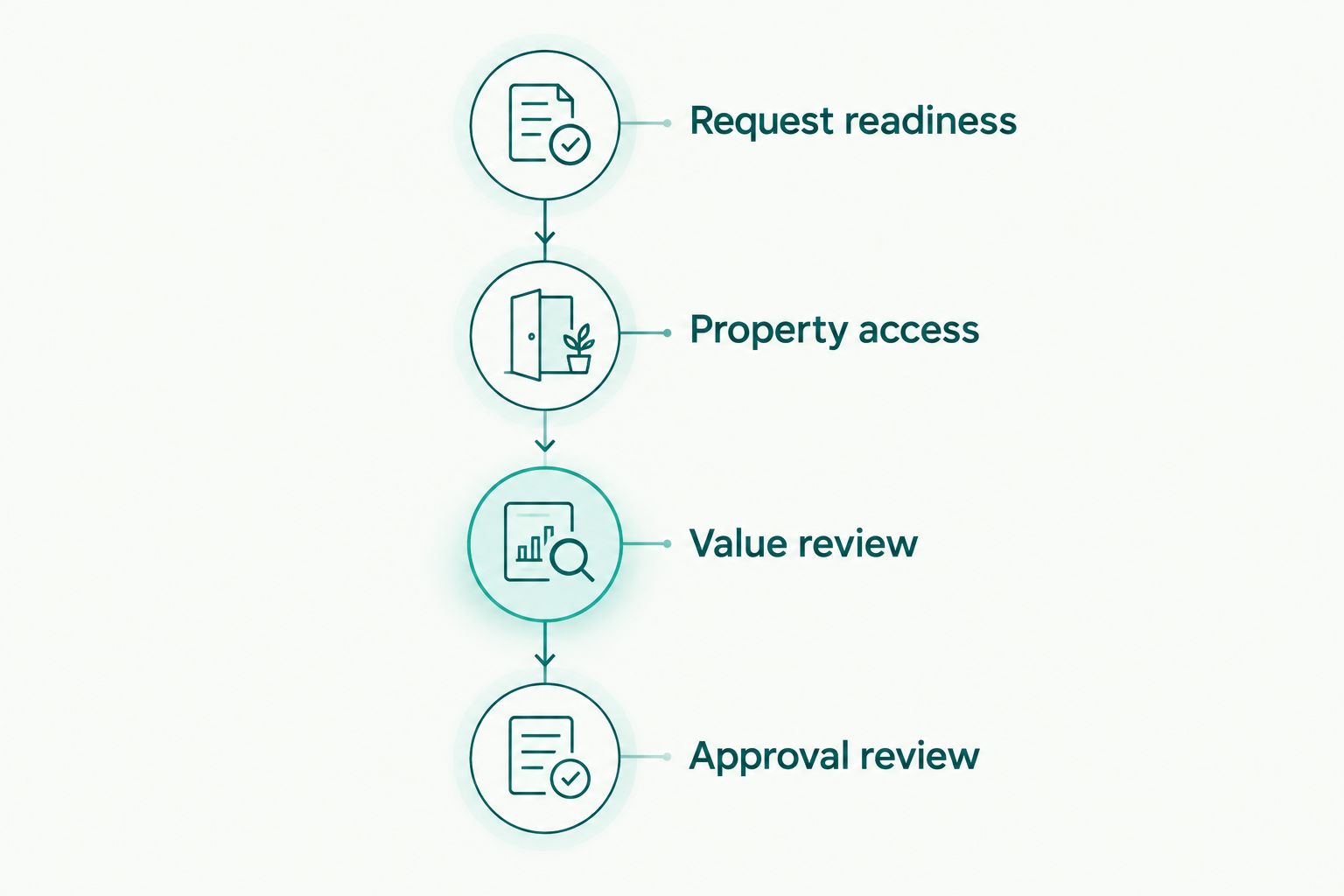
Use these 4 checkpoints in your 2026 tracker: Request readiness, Property access, Value review, and Approval review. Each checkpoint needs evidence, not just a checked box.
When the offer or property condition changes
The adjacent workflow starts when a material detail changes after scheduling or valuation. Examples include a replacement buyer, amended contract terms, newly documented damage, or an approval deadline the transaction cannot meet.
- Describe the change precisely. Identify what changed and which documents show it. Avoid sending an unexplained replacement package.
- Notify the designated contact. Ask what updated documents the lender requires and whether the change affects valuation or approval review.
- Confirm the affected milestone. Ask whether the existing valuation remains usable and whether written terms need revision. Do not order another BPO on the assumption that the lender will accept it.
- Reset expectations. Tell the buyer and homeowner which decision is now pending. Obtain the lender's response before treating the prior approval as applicable to changed terms.
For a 2026 file, retain the earlier decision and the updated instructions separately. Labeling a document as current should reflect confirmation, not merely its upload date.
Expected result: Everyone knows which terms are under review and which prior assumptions no longer support the closing plan.
Who should manage the workflow?
Both approaches require an agent to remain involved in the listing and transaction. The difference is who prepares the package and follows the lender-review work.
| Approach | Best for | Benefit | Limitation |
|---|---|---|---|
| Agent-managed processing | Agents who want direct responsibility for package preparation and lender follow-up | Keeps those tasks with the listing team | The team must also manage document requests and status tracking |
| Shortsalesdoneright processing | Agents who want short sale package preparation and lender negotiation support | Provides a dedicated point of contact and weekly lender updates | Agents still coordinate listing responsibilities; lender approval is not guaranteed |
Choose based on task ownership, not an expectation that outsourcing changes the lender's decision-making authority. Before handing off a file, agree on who communicates with the homeowner, buyer's agent, assigned valuation professional, and closing professional.
Troubleshooting
The visit happened, but there is no valuation status
Confirm completion with the scheduling contact, then ask the designated lender contact about receipt. Do not ask the homeowner to arrange a duplicate visit without confirming what is missing.
The assigned professional cannot enter
Resolve the specific access problem: missing permission, an unavailable occupant, incorrect entry instructions, or an inaccessible area. Confirm a revised arrangement through the authorized scheduling channel.
The lender's value does not support the offer
Request the permitted review process and submit property-specific evidence. A disagreement alone does not establish that the valuation is wrong, and submitting evidence does not guarantee a revised value.
The lender keeps requesting documents
Maintain a request log that records the document, requested period, submission date, and recipient. Ask whether the issue is a missing item, an unreadable file, an outdated document, or information that does not match.
A foreclosure date or approval deadline is approaching
Escalate the known date immediately to the lender contact and the homeowner's qualified legal adviser. A pending short sale or BPO appointment does not itself establish that foreclosure activity has stopped. Confirm any change through the appropriate source.
Customize your workflow
Keep your tracking system simple. Use columns for milestone, responsible person, evidence received, next action, and stated deadline. Keep separate notes for lender updates and buyer-facing communication so an internal status does not become an unsupported promise.
When you outsource, Shortsalesdoneright provides weekly lender updates; use those updates to maintain the transaction record. Flag a newly received deadline or material change promptly rather than waiting for the next routine update.
If you are ready to assign processing, request help through the agent intake form on the website. Homeowners should use the homeowner intake route to discuss their situation and compare a short sale with other options.
Request short sale processing help
Use the agent intake route to discuss package preparation and lender negotiation support.
FAQ
Does scheduling a BPO mean my short sale is approved?
No. BPO scheduling arranges a valuation step; short sale approval requires a lender decision and review of the written terms.
How long does short sale approval take after the BPO?
There is no single interval that applies to every file. Ask the lender which review stage is pending, which documents remain outstanding, and whether it has supplied a response date.
Should the homeowner be present for the BPO visit?
Follow the assignment's access instructions and the arrangements agreed with the homeowner or occupant. Confirm whether someone must provide entry rather than assuming attendance is required.
Can an agent challenge a BPO value?
An agent can ask whether the lender permits a valuation review. Follow the lender's process and submit relevant comparable sales and documented property conditions without assuming the value will change.
Does short sale approval forgive the remaining mortgage balance?
Do not assume approval forgives an unpaid balance. Lender terms and state law vary; a qualified attorney should review the homeowner's obligations, and a qualified tax professional should address tax questions.
Can the buyer change after written short sale approval?
Do not assume an existing approval applies to a replacement buyer. Notify the lender, submit the requested documents, and confirm whether revised written terms are required.
What should agents track in a 2026 short sale file?
Track valuation scheduling, access completion, lender receipt, package requests, and written approval conditions separately. Record the responsible contact and the next action for each unresolved item.
One last thing
Before you tell a buyer that the lender approved the sale, ask: Which written document supports that statement, and does it match this transaction? That question separates a promising status update from terms the closing team can actually review.
Lender terms and state law vary. Do not promise approval, forgiveness of an unpaid balance, or a specific credit-score result; direct legal and tax questions to qualified professionals.


