

Instead of chasing buyer financing and short-sale approval in separate email threads, use one closing checklist with named owners, written conditions, and shared deadlines. For your 2026 transaction, keep the buyer’s mortgage approval separate from the seller’s short-sale approval until both support the same closing date.
- Buyer loan approval short sale closing requires separate financing, seller-lender, and title checks before settlement.
- Shortsalesdoneright is best for agents seeking outsourced short-sale package preparation and lender negotiation.
- A buyer’s preapproval does not replace final underwriting or the seller’s written short-sale approval.
- Track approval deadlines, Closing Disclosure delivery, and funding requirements together without treating them as interchangeable.
Why this matters
Buyer financing approval does not authorize the seller’s lender to accept a short payoff. The buyer’s lender evaluates the borrower, property, and mortgage. The seller’s lender separately reviews the proposed short sale and sets its terms.
Shortsalesdoneright provides short-sale processing and lender negotiation for agents and homeowners. The service includes preparing the full short-sale package for agents, a dedicated point of contact, and weekly lender updates. It does not replace buyer underwriting, title work, or legal advice.
This workflow is for agents coordinating those responsibilities. Homeowners should receive a plain-language explanation of their approval terms, not responsibility for managing the buyer’s mortgage file.
Before you start
- Gather the controlling documents. Have the executed purchase agreement, amendments, written short-sale approval when issued, buyer financing status, and title or settlement contact information. Confirm authorization before sharing protected seller information.
- Confirm access and ownership. Identify the buyer’s loan officer, listing agent, buyer’s agent, short-sale processor, and settlement contact. Use an approved secure channel for financial documents, not a broadly shared email attachment.
- Check the deadline collision first. A short-sale approval can expire before buyer underwriting and settlement requirements are complete. A scheduled appointment does not extend that approval, stop foreclosure, or establish permission to fund.
For your 2026 checklist, record the source document beside every deadline. Do not copy dates from an old transaction template.
Approval status and responsibility
Use 2 approval tracks: buyer financing and seller-lender consent. Track title and settlement alongside them, because neither approval establishes that the property is ready to transfer.
The routes below serve different needs. Outsourced short-sale processing is best for agents who want package preparation and lender negotiation handled externally. Agent-managed processing is best for agents prepared to own those tasks themselves.
| Processing route | Best for | Advantage | Limitation |
|---|---|---|---|
| Shortsalesdoneright processing | Agents outsourcing short-sale package preparation and lender negotiation | Dedicated contact and weekly lender updates | Does not control buyer underwriting, title clearance, or lender approval |
| Agent-managed processing | Agents retaining direct responsibility for package preparation and lender follow-up | Agent keeps direct ownership of the processing work | Agent must also coordinate document requests and negotiation follow-up |
Create the closing record
- Create a transaction checklist in your existing system. Use the following as your own worksheet headings, not as assumed software buttons: Buyer financing, Short-sale approval, Title clearance, and Settlement.
- Assign 1 owner per task. Record the responsible person, next action, supporting document, and deadline. Give shared tasks a lead owner so responsibility stays clear.
- Ask the buyer’s loan officer for the current approval stage, outstanding conditions, and required next steps. Request status information appropriate for the transaction, not the buyer’s private financial records.
- Ask the short-sale processor for the current seller-lender status. If approval has arrived, save the complete letter and identify any required acceptance or acknowledgment.
Expected result: Your closing record distinguishes verified approvals from pending requests. Every open item has an owner and a source.
Reconcile the approval terms
- Compare the purchase agreement and amendments with the short-sale approval. Check the property, buyer, transaction terms, permitted expenses, required proceeds, and expiration date as applicable to the letter.
- Have the settlement professional identify mortgages, liens, judgments, taxes, or other title matters requiring resolution. Do not assume the first mortgage holder’s approval resolves every recorded claim.
- Give the buyer’s loan officer the transaction documents needed for underwriting through the approved channel. Ask whether the short-sale terms create any financing conditions.
- Refer unclear liability or release language to a qualified attorney. Refer questions about canceled debt and tax reporting to a qualified tax professional.
Expected result: The parties know which written terms govern settlement and which issues still require a decision. Lender terms and state law vary; approval does not automatically mean forgiveness of an unpaid balance.
Financing and settlement readiness
Keep the financing and settlement checks connected, but preserve their separate owners. A processor can report seller-lender progress; only the buyer’s lender can confirm its underwriting and funding requirements.
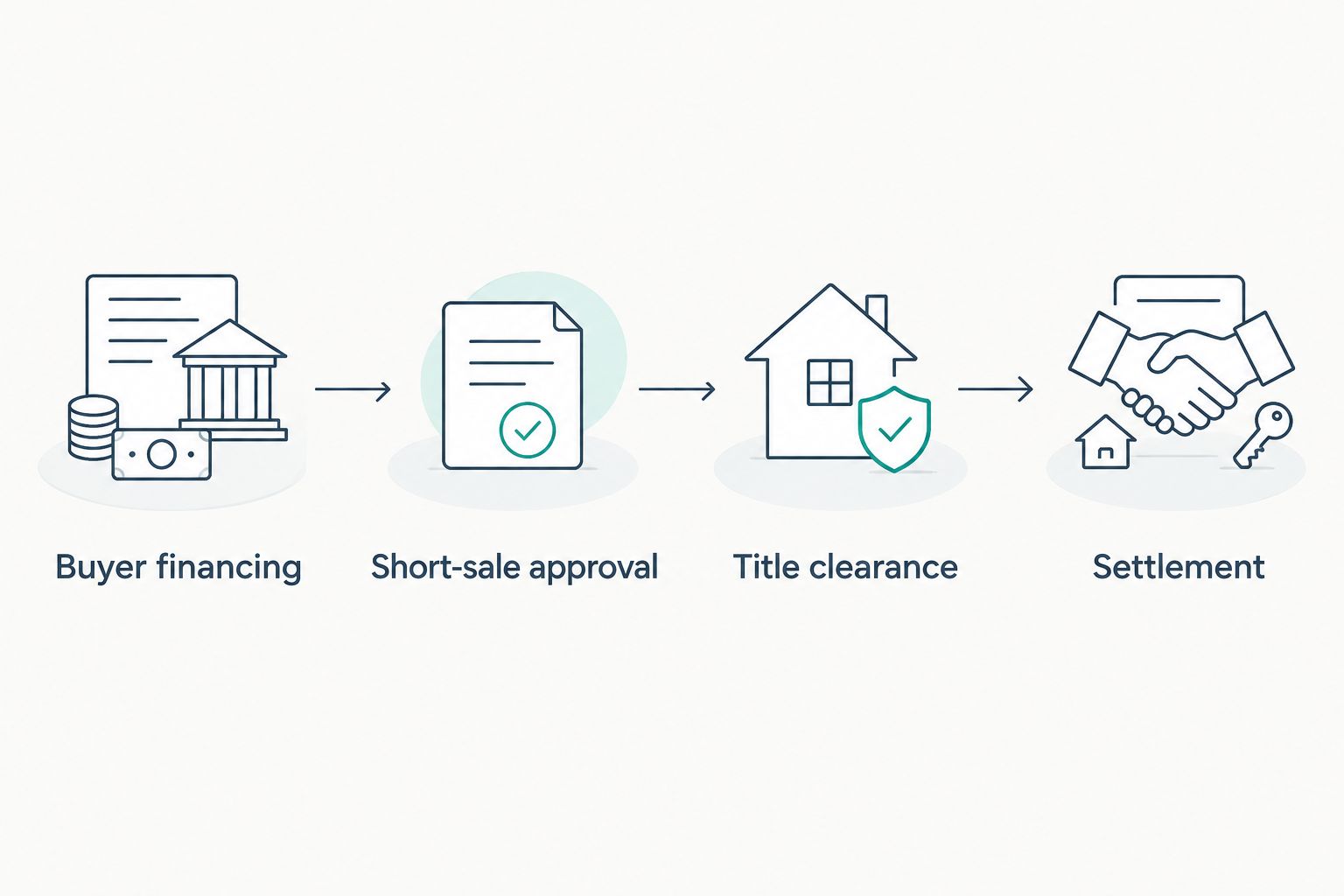
Confirm the buyer’s financing
- Ask the loan officer to distinguish preapproval, conditional approval, and readiness to close. Record the actual status and remaining conditions rather than shortening every response to approved.
- Confirm the status of the appraisal, property-condition requirements, insurance, and any borrower documents the lender still requires. Leave decisions about acceptable evidence to the lender.
- Ask about financing deadlines that affect the transaction, including document updates and any rate-lock expiration. Record who will address each deadline if closing moves.
- Confirm when the buyer must receive the Closing Disclosure and how the lender verifies receipt. Do not substitute the date an agent forwards a document for the lender’s compliance determination.
For mortgages covered by the applicable federal rule, the buyer generally must receive the initial Closing Disclosure at least 3 business days before consummation. The Consumer Financial Protection Bureau’s TRID guidance describes this requirement; use the lender’s transaction-specific calculation for your 2026 closing.
Expected result: The buyer’s lender has identified the remaining financing conditions and earliest permissible consummation date. An optimistic target date is no longer standing in for underwriting status.
Confirm settlement readiness
- Ask the settlement professional to compare the proposed settlement statement with the seller-lender approval. Route discrepancies to the processor before requesting signatures.
- Confirm how all required lien releases, payoff instructions, and lender permissions will be handled. Obtain clarification in writing when the approved terms do not match the proposed transaction.
- Reconcile the buyer-lender timeline with the short-sale expiration date. If the dates do not work, request an extension through the authorized channel before relying on a later closing.
- Confirm signing, funding, recording, and possession arrangements with the appropriate parties. Verify wire instructions through an independently confirmed contact method before anyone sends funds.
- After settlement, obtain confirmation of funding and recording as applicable. Save the final settlement documents and any required evidence of compliance with the short-sale terms.
Expected result: The parties have a supported closing schedule, not merely a calendar invitation. For more detail on settlement coordination, use the guide to connecting your title company to short-sale closing.
When buyer financing changes after short-sale approval
Recheck the affected approvals whenever the transaction changes. A new financing arrangement, revised contract term, or replacement buyer should trigger review rather than an assumption that the existing approval still applies.
For a 2026 file, keep the original documents and save revisions separately. A clear version history helps the processor and settlement professional identify what changed.
- Identify the change. Record whether the issue affects the buyer, loan program, contract terms, property requirements, or closing date. Identify the document that reflects it.
- Route the change. Ask the buyer’s lender about financing effects and the short-sale processor whether seller-lender consent or revised approval is required. Do not treat one party’s acceptance as everyone’s acceptance.
- Rebuild the schedule. Recheck underwriting, disclosures, title work, and approval expiration. Ask the settlement professional whether the revised transaction changes settlement documents.
- Confirm the revised path. Distribute the approved documents to authorized recipients and mark superseded versions clearly. Tell the homeowner what changed and what action, if any, they need to take.
Expected result: The file reflects the transaction that will actually close. If approval remains unresolved, report it as unresolved rather than preserving an unsupported closing date.
Troubleshooting
The buyer is preapproved but underwriting is unfinished
Ask the loan officer for the remaining conditions, responsible parties, and next review point. Keep financing marked pending until the lender confirms its current closing requirements are satisfied.
Do not describe preapproval to the seller as guaranteed funding. It is a different milestone.
The short-sale approval expires before closing
Send the processor the reason for the delay and a proposed revised schedule. Request written extension terms from the authorized seller-lender contact.
Do not close outside the approval terms on an expectation of later consent. Have the settlement professional confirm that the written approval supports the actual transaction.
The settlement statement differs from the approval
Identify the exact mismatch and send it to the processor and settlement professional. Ask whether the statement must change or whether the lender must approve a revision.
Do not resolve a discrepancy through an undocumented payment arrangement. Keep the transaction reflected in the required documents.
A corrected Closing Disclosure threatens the date
Ask the buyer’s lender whether the correction requires a new waiting period. Not every correction does; certain changes, including a loan-product change, can require another waiting period under the applicable rule.
The lender determines the disclosure timing for the actual loan. Update the short-sale extension request if that timing changes the closing schedule.
A foreclosure notice arrives during processing
Notify the homeowner, processor, and relevant transaction professionals promptly. Direct the homeowner to a qualified local attorney for advice about the notice and deadlines.
A pending short sale does not itself establish that foreclosure has stopped. Obtain confirmation through the appropriate lender or legal channel rather than relying on the existence of an active contract.
Customize your workflow
Use a weekly status update with separate lines for seller-lender review, buyer financing, title, and the next deadline. State the next action and owner under each line. Report pending requests as pending.
Shortsalesdoneright provides a dedicated point of contact and weekly lender updates for short-sale processing. Keep buyer financing updates with the loan officer so the seller receives a coordinated report without confusing the sources.
If you want help preparing the package and handling lender negotiation, request assistance through the appropriate agent intake form on the website. Homeowners should use the homeowner intake route to discuss their situation and compare a short sale with other options.
Request short-sale processing help
Get help with package preparation and lender negotiation while you coordinate the transaction.
FAQ
Does buyer loan approval mean a short sale can close?
No. Buyer loan approval addresses financing, while the seller’s lender must separately approve the short sale. Title, settlement, and all applicable approval conditions must also be addressed.
Can a buyer get mortgage approval before short-sale approval?
Yes, buyer financing review can proceed before the seller’s lender issues short-sale approval. The buyer’s lender determines what it can approve and which conditions remain outstanding.
What happens if the short-sale approval expires before closing?
Request a written extension through the authorized seller-lender channel. Do not assume a scheduled signing or completed buyer underwriting extends the existing approval.
How long before closing does the buyer need the Closing Disclosure?
For mortgages covered by the applicable federal rule, the buyer generally must receive the initial Closing Disclosure at least 3 business days before consummation. The buyer’s lender must calculate the timing and determine whether a later change requires a new waiting period.
Who coordinates buyer financing with short-sale processing?
The agent coordinates transaction milestones with the buyer’s loan officer, short-sale processor, and settlement professional. Each specialist remains responsible for confirming the requirements within their role.
Does short-sale approval forgive the seller’s remaining mortgage balance?
Short-sale approval does not automatically establish forgiveness of the remaining balance. Lender terms and state law vary, so a qualified attorney should review liability questions and a qualified tax professional should address tax consequences.
Can Shortsalesdoneright guarantee that the transaction will close?
No lender approval or closing outcome is guaranteed. Shortsalesdoneright provides short-sale processing and lender negotiation, while buyer financing, lender decisions, and settlement requirements remain separate responsibilities.
One last thing
Ask whether the approval deadline requires signing, funding, receipt of proceeds, or another specified event. Those milestones are not interchangeable. For your 2026 closing, have the processor and settlement professional confirm the letter’s exact requirement before fixing the final schedule.


