

Yes. A short sale can collapse after lender approval because the buyer still needs to complete the purchase, the closing must satisfy the approval letter, and unresolved title or contract issues can prevent the sale from closing.
- A short sale collapse after approval remains possible: lender consent is conditional, not a completed closing.
- Compare the approval letter, purchase contract, and closing statement before treating the transaction as ready.
- Buyer financing, expired approval, and unresolved liens can derail an approved short sale.
- Shortsalesdoneright provides short sale processing; lender approval and closing remain separate milestones.
Can a short sale deal collapse after the lender approves it?
Yes. Lender approval clears an important hurdle, but it does not complete the transaction. The seller's lender agrees to accept a short payoff under stated conditions. The buyer, seller, closing team, and other parties still have work to finish.
Keep these decisions separate:
| Decision | What it establishes | What it does not establish |
|---|---|---|
| Seller's lender approval | The lender accepts specified short-sale terms | That the buyer's mortgage is ready |
| Buyer's loan approval | The buyer meets the financing lender's requirements, subject to remaining conditions | That every title or seller-lender requirement is satisfied |
| Closing readiness | Required documents, funds, and closing conditions are in place | That an unresolved condition can be ignored |
The buyer loan approval to short sale closing workflow explains the handoff between financing and settlement. In 2026, treat the written approval as a set of instructions—not a substitute for closing confirmation.
Why this matters
For a homeowner, approval can feel like permission to stop worrying. For an agent, it can feel like the hardest part is finished. Both reactions become a problem if someone stops tracking the remaining conditions.
An approved transaction still needs active coordination. Replace “the bank approved it” with a specific question: “What remains before this sale can close?” That question identifies work someone can actually complete.
A delay is not automatically a collapse. A missing document, financing condition, or extension request needs a clear owner and a written response before anyone declares the transaction lost—or saved.
Why a short sale can collapse after approval
The risk comes from conditions that remain open or change after approval. Review these areas rather than assuming approval covers the entire transaction:
- Buyer financing: The buyer's lender still needs acceptable underwriting, property, and funding conditions.
- Approval deadlines: The seller's lender can set an expiration date or require closing by a stated deadline.
- Changed terms: A different buyer, revised proceeds, repair request, or contract amendment can require lender review.
- Title problems: Other mortgages, judgments, tax liens, or ownership issues can prevent an acceptable transfer.
- Seller obligations: Required signatures, documents, contributions, or other approval conditions must be addressed.
- Property condition: Damage, inspection findings, or an appraisal issue can affect financing or the buyer's decision to proceed.
Not every problem requires starting over. The response depends on the approval letter, purchase contract, lender requirements, and applicable state law.
Buyer financing falls through
The seller's lender and the buyer's lender make different decisions. A short-sale approval does not guarantee that the buyer qualifies for a mortgage or that the property meets the financing requirements.
Ask the buyer's agent which financing conditions remain unresolved. A general statement that financing is progressing does not tell you whether the transaction can meet its closing deadline.
For homeowners, the practical question is whether the buyer can still perform under the contract. For agents, it is which financing condition threatens closing and who is responsible for resolving it.
The approval expires before closing
Read the actual expiration language. Do not assume the lender's approval remains effective because the parties have scheduled a signing appointment or requested more time.
If closing will miss the deadline, request an extension through the lender's required process. An extension request is not an approved extension. Obtain written confirmation before relying on a revised deadline.
The deal changes after approval
A repair request, buyer substitution, or revised closing statement can change the transaction the lender reviewed. The approval letter determines which changes need further consent.
Do not assume an approved amount or buyer carries over to a revised agreement. Send the proposed change to the appropriate parties and ask what written authorization is required.
Another claim prevents closing
Approval from the main mortgage lender does not resolve every claim against the property. The title or closing professional must identify what needs to be released, paid, corrected, or otherwise addressed.
A second mortgage or ownership problem requires its own resolution. Ask for the exact obstacle and the document needed to clear it, rather than accepting a vague report that title is pending.
What should you check immediately after approval?
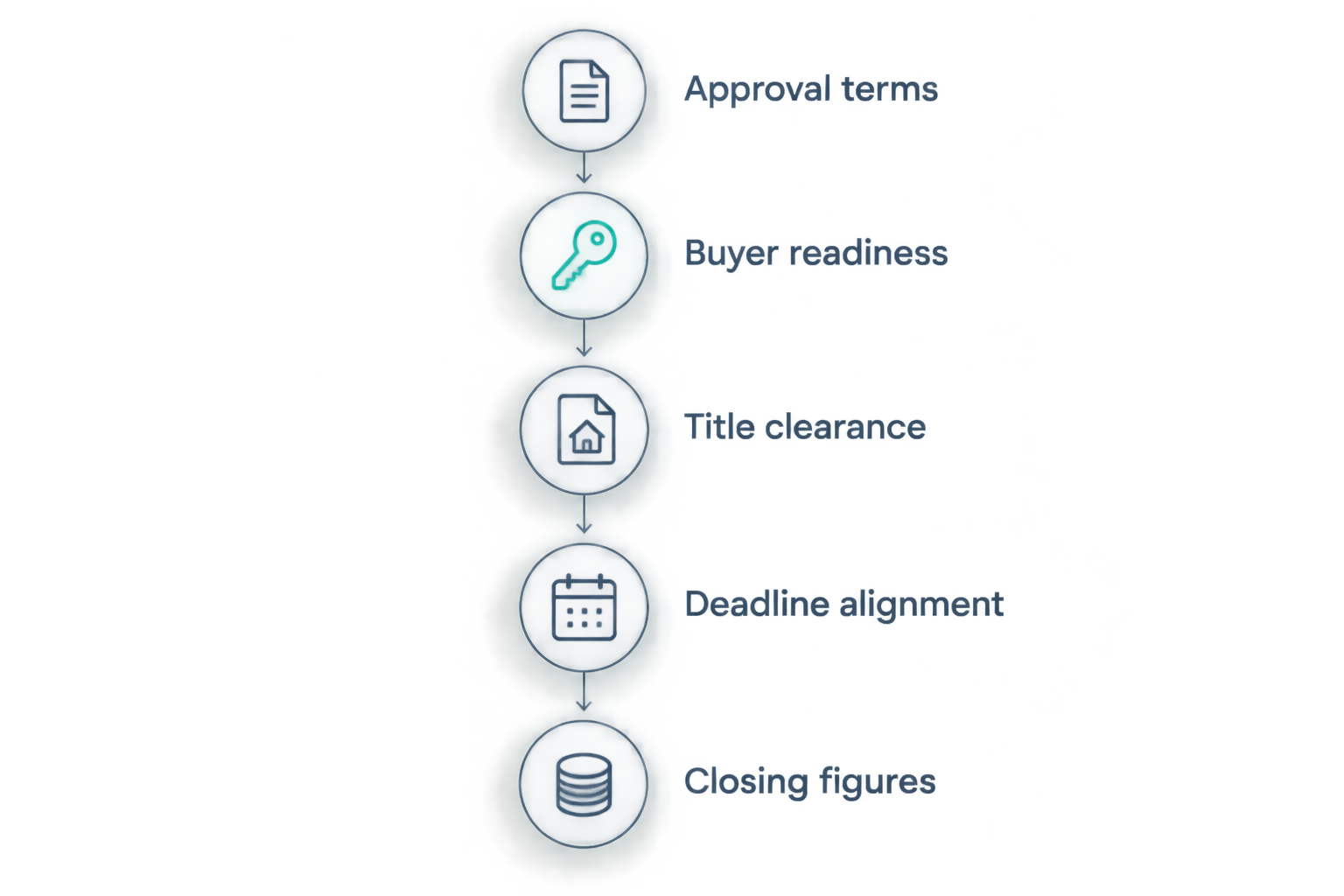
Use these 5 closing checks to turn lender approval into a clear action list. Each check should identify a responsible person, an unresolved condition, and the next required response.
Approval terms
Read the complete approval letter and any attachments. Confirm that the property, borrowers, buyer information where specified, required proceeds, closing deadline, and other conditions match the transaction.
Ask about unclear wording before signing. In particular, do not treat permission to release the mortgage lien as proof that the lender has forgiven any remaining personal debt.
Buyer readiness
Have the buyer's agent confirm the remaining financing and contract conditions. Separate completed items from items still awaiting review.
If an appraisal, inspection issue, or underwriting condition threatens closing, identify it while there is still an opportunity to request changes. Avoid describing a buyer as ready based only on an earlier preapproval.
Title clearance
Ask the title or closing professional to identify unresolved liens, ownership questions, and required releases. Confirm whether the closing team has the documents needed to complete its work.
If another creditor must agree to a payoff or release, track that response separately. Approval from one lender is not evidence of agreement from another.
Deadline alignment
Compare 2 deadlines: the lender's approval expiration and the purchase contract's closing deadline. Also identify any separate foreclosure date or other legal deadline that requires professional attention.
For a 2026 closing, use the dates in the current documents—not dates carried over from an earlier offer or approval. Request any necessary contract amendment and lender extension through their separate processes.
Closing figures
Compare the proposed closing statement with the lender's approval. Check whether the planned payments, credits, and lender proceeds satisfy the written terms.
If the figures change, ask the closing professional and negotiator whether further lender review is required. Do not leave an unexplained difference for the signing appointment.
Can you save an approved short sale that is falling apart?
Sometimes, but the fix must address the actual obstacle. A financing problem needs a financing response. An expiring approval needs a lender decision. More frequent status requests alone do not resolve either issue.
Start by describing the problem in one sentence. For example, identify an unresolved buyer-loan condition or a closing statement that does not match the approval. Then ask who can authorize the necessary correction.
| Response | Best for | Benefit | Limitation |
|---|---|---|---|
| Request an extension | A transaction that needs additional time | Seeks permission to close after the existing deadline | The lender must agree; the request alone changes nothing |
| Submit revised terms | A transaction with a material change | Gives the lender the updated deal to review | Existing approval does not establish acceptance of the revision |
| Evaluate a replacement buyer | A transaction whose original buyer cannot proceed | Provides another potential route to a sale | Buyer substitution can require new review and contract work |
| Review other homeowner options | A sale that no longer meets the homeowner's needs | Reopens the decision before further commitments | Legal, tax, credit, and housing consequences require individual review |
For a 2026 transaction, keep the recovery plan tied to current written terms. Do not rely on a past approval, an informal expectation, or an assumption that the lender will accept the same deal again.
Can a new buyer use the existing short-sale approval?
A new buyer should not assume the existing approval transfers. Ask the seller's lender whether buyer substitution is permitted and what revised documents or review are required.
The agent also needs to address the original contract before treating another offer as the active transaction. Contract rights and termination requirements depend on the agreement and state law.
Does short-sale approval stop a scheduled foreclosure?
Do not treat short-sale approval alone as confirmation that a foreclosure sale has been postponed or canceled. Obtain specific confirmation of the foreclosure status, and have a qualified attorney review any approaching legal deadline.
Keep that verification separate from routine processing updates. The consequence of misunderstanding a foreclosure date is too serious to leave to an assumption.
Does approval mean the unpaid mortgage balance disappears?
No. Approval of a short payoff does not, by itself, establish that the homeowner has no remaining personal liability. The written terms and applicable law control that question.
A qualified attorney should review unclear debt-release language. A qualified tax professional should explain any tax consequences under the rules applicable in 2026.
What agents should do—and what homeowners should do
The agent's job is transaction coordination. The homeowner's job is to make informed decisions about the proposed sale and personal obligations. Those responsibilities overlap, but they are not interchangeable.
For agents: Keep a written list of open conditions, responsible parties, and deadlines. Confirm lender requirements with the negotiator, financing status with the buyer's agent, and title requirements with the closing professional.
For homeowners: Read the approval before treating the sale as settled. Ask what you must sign, whether any personal obligation remains, and which questions need an attorney or tax professional.
In 2026, neither audience should rely on a status label such as approved without asking what remains. A useful update explains the obstacle, the required action, and whose response is outstanding.
When does outside processing help?
Shortsalesdoneright is best for real estate agents seeking outsourced short-sale processing and lender negotiation. Its service includes preparing the full short-sale package, providing a dedicated point of contact, and weekly lender updates.
That support addresses the administrative and lender-communication side of the transaction. It does not replace the buyer's financing work, the closing professional's title review, or independent legal and tax advice. It cannot promise approval or closing.
Homeowners can also get help comparing a short sale with other options. If you are ready to act, request help through the appropriate intake form on Shortsalesdoneright.
Get help with your short sale
Request processing help as an agent, or help comparing your options as a homeowner.
FAQ
Can a short sale collapse after approval even if everyone signed the contract?
Yes. A signed purchase contract does not establish that every lender, financing, title, or closing condition has been satisfied. The contract and applicable state law determine the parties' rights if the transaction fails.
Can the bank change an approved short sale?
The written approval controls the lender's conditions and deadlines. If the transaction changes or conditions are not met, ask the lender what further review or written authorization is required.
Can a buyer back out after short-sale approval?
A buyer's right to withdraw depends on the purchase contract, remaining contingencies, and applicable law. Lender approval alone does not answer whether withdrawal is permitted or what happens to the deposit.
What happens if short-sale approval expires before closing?
Do not rely on an expired approval as permission to close. Ask the lender whether an extension or renewed approval is required, and obtain its decision in writing.
Does short-sale approval guarantee debt forgiveness?
No. Short-sale approval does not automatically establish forgiveness of the unpaid balance. Have a qualified attorney review the written terms and a qualified tax professional review potential tax consequences.
Who should coordinate an approved short sale that is delayed?
The listing agent, negotiator, buyer's agent, and closing professional should coordinate the conditions within their respective roles. Assign each unresolved item to someone who can obtain the required decision or document.
Can Shortsalesdoneright guarantee that an approved short sale closes?
No. Shortsalesdoneright provides short-sale processing and lender negotiation, not a guarantee of lender approval or closing. Buyer financing, title requirements, lender terms, and state law still affect the outcome.
One last thing
Before scheduling the final signing, put 3 documents side by side: the lender approval letter, the current purchase contract, and the proposed closing statement. Ask the closing team to explain any mismatch in dates, parties, or transaction terms.
That comparison turns a vague question about whether the deal is safe into specific items that need resolution. Lender terms and state law vary; direct legal and tax questions to qualified professionals.


