

Yes, a short sale can be stopped before closing, but your right to cancel depends on the purchase contract, lender requirements, and state law. Withdrawing the short-sale request does not automatically cancel a signed sales contract, erase mortgage debt, or stop a separate foreclosure process.
- Can a short sale be stopped once it starts? Yes, but cancellation rights depend on contracts and state law.
- Lender approval and your purchase contract are separate issues; review both before withdrawing.
- Stopping a short sale does not automatically stop foreclosure or resolve unpaid mortgage debt.
- Shortsalesdoneright provides short-sale processing and lender negotiation, not a guarantee of approval or debt forgiveness.
Can a short sale be stopped once it starts?
Starting a short sale does not make completion inevitable. The practical question is what you have already signed and what must happen to end the transaction properly. In 2026, review the actual documents rather than assuming that lender review gives everyone an unrestricted exit.
If you need help coordinating the lender side, Shortsalesdoneright provides short-sale processing and lender negotiation. Contract cancellation and legal liability belong with a qualified real estate attorney.
| Where the transaction stands | What to check before stopping | Main limitation |
|---|---|---|
| Listed, with no accepted offer | Listing agreement and any processing agreement | Ending the listing and ending a service agreement are separate actions |
| Offer accepted, lender review pending | Purchase contract, lender-approval contingency, and cancellation notices | Pending approval does not automatically create a seller cancellation right |
| Lender approval issued | Approval letter, contract deadlines, and closing instructions | Approval conditions and contract obligations still need review |
| Closing is approaching | Signed documents, funds, title status, and local closing rules | A last-minute change requires immediate coordination |
| Closing is complete | Recorded documents and any legal dispute | Reversing a completed sale is not ordinary cancellation |
Your agent can organize the paperwork and communicate with the buyer's agent. An attorney should explain whether you have a cancellation right, need a negotiated release, or face a dispute.
Why this matters
A short sale involves several separate relationships: your mortgage, your listing agreement, your purchase contract, and any processing agreement. Ending one does not necessarily end the others. That distinction matters more than whether someone describes the file as open, approved, or ready to close.
For example, a lender can close its short-sale review while the buyer still expects you to perform under the purchase contract. You also remain responsible for addressing the mortgage unless a separate agreement or completed transaction changes that obligation.
Treat cancellation as a documented process, not a phone call. Your 2026 decision should include a plan for the home and mortgage after the sale stops, not just instructions to stop submitting documents.
Before an accepted offer: review your existing agreements
If you have not accepted a buyer's offer, you do not yet have that buyer's purchase contract to resolve. You still need to check the agreements already in place. A listing agreement or processing agreement can contain termination procedures and other obligations.
Tell your agent why you want to stop. A temporary delay, a decision to keep the home, and a decision to pursue another mortgage solution require different conversations. Be clear about which action you want.
Ask for written confirmation of what will happen to the listing and lender submission. Do not assume that taking the property off the market also withdraws a package already under review.
After an accepted offer: the contract controls your next move
Once you accept an offer, read the signed purchase contract and every addendum before requesting cancellation. A short-sale contingency can address lender approval, deadlines, or termination rights, but its exact wording matters. A buyer's right to cancel is not automatically the seller's right to cancel.
Ask a qualified attorney to identify the applicable notice requirements and explain the consequences of withdrawing. If the parties agree to end the sale, use the appropriate written cancellation or release documents. Address earnest money through the contract and the party holding it rather than making an informal promise.
Do not stop responding as a substitute for canceling. Silence leaves the buyer, agent, processor, and lender working from different assumptions. It also leaves you without a clear record of what has ended.
After lender approval: approval is not the same as closing
A lender's approval letter sets out the terms on which it will accept the proposed short sale. It does not replace your purchase contract. Read both documents together before deciding whether to continue.
Check the approval deadline, required signatures, treatment of the remaining balance, and any conditions that affect your decision. Do not assume that agreeing to release the mortgage lien also means releasing you from personal responsibility for an unpaid balance. Have a qualified attorney explain the actual wording and applicable state law.
If an approval expires, that does not by itself establish that every other agreement has ended. Ask your agent and attorney what remains active before treating the transaction as canceled.
Near or after closing: get immediate professional guidance
If closing is close, contact your agent, closing professional, and attorney immediately. Tell them exactly what has been signed and whether funds have moved. Local closing procedures determine which steps remain and what options exist.
Do not rely on the phrase “the sale hasn't recorded yet” as proof that you can freely withdraw. Signing, funding, delivery, and recording can have different legal significance depending on the transaction and state.
After a completed sale, you are no longer asking how to withdraw a short-sale application. You are asking whether there are legal grounds to challenge a completed transaction. That requires individualized legal advice, not a cancellation checklist.
Why your ability to stop a short sale varies
These factors determine the next step. Bring the underlying documents to your agent and attorney rather than relying on a verbal summary.
- Contract language: The purchase agreement and addenda establish the parties' obligations and any cancellation rights.
- Transaction stage: An unaccepted offer presents different issues from a sale with signed closing documents.
- Lender terms: The lender's review status and approval conditions affect what must be communicated or resolved.
- Other agreements: Listing and processing agreements have their own terms; review them separately.
- State law: Contract rights, foreclosure procedures, and responsibility for unpaid debt vary by state.
- Mortgage status: Missed payments, pending notices, and any foreclosure proceeding need attention independently of the sale.
A useful 2026 file review starts with signed documents and current notices. An old email saying the lender was reviewing the sale is not a substitute for confirming the present status.
How do I stop a short sale properly?
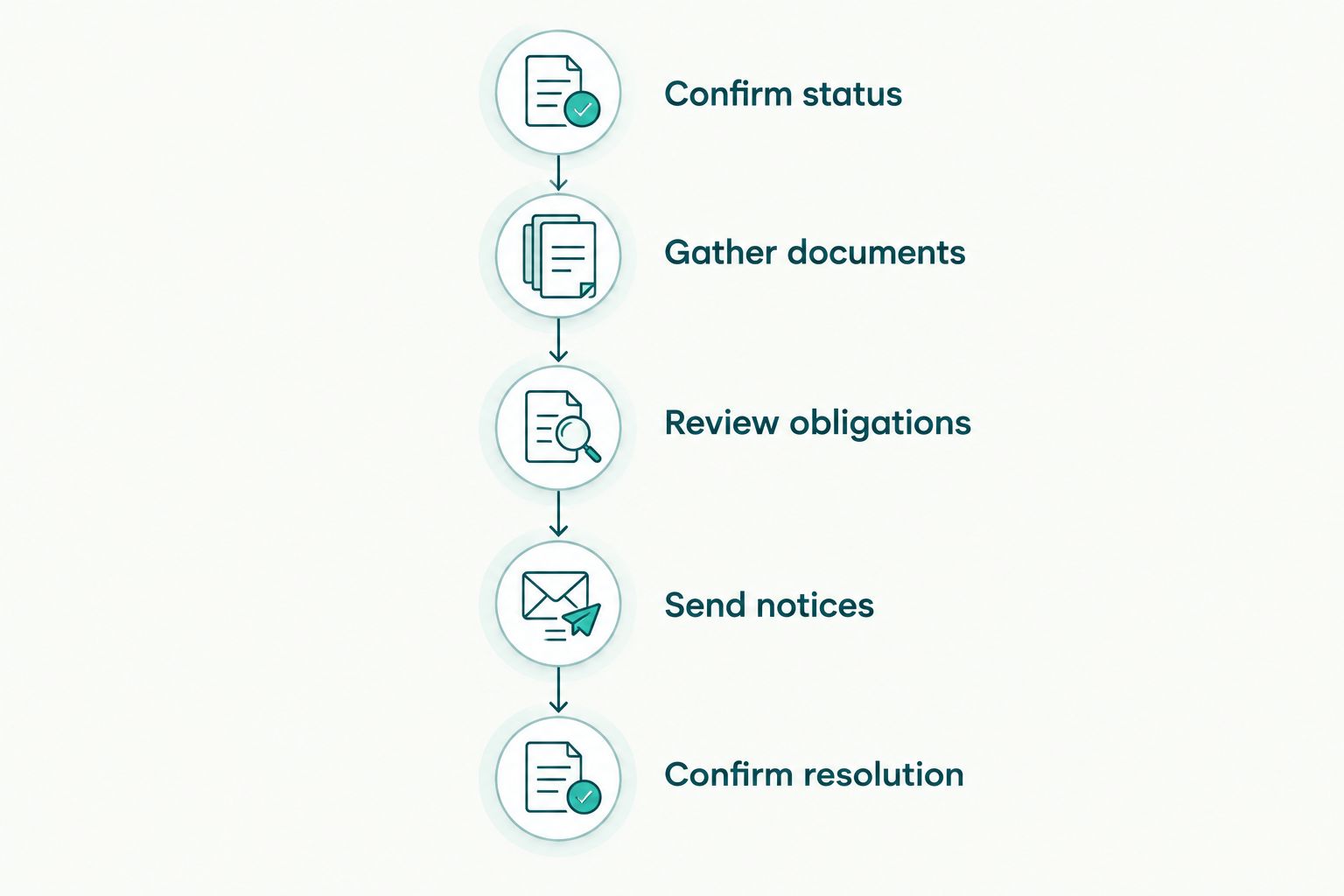
Use this sequence to organize the decision. It is a coordination checklist, not permission to cancel a contract.
- Confirm status. Ask your agent and processor whether the lender is reviewing the package, has issued approval, or is waiting for closing. Confirm any separate foreclosure status with the appropriate professional.
- Gather documents. Collect the purchase contract, addenda, listing agreement, processing agreement, lender correspondence, and any closing documents. Include recent mortgage and foreclosure notices.
- Review obligations. Ask a qualified attorney to explain your cancellation rights, required notices, and exposure if the buyer does not agree. Ask a tax professional about tax questions raised by your alternatives.
- Send notices. Follow the required process for the contract and each service agreement. Coordinate any withdrawal request with the agent, processor, and mortgage servicer.
- Confirm resolution. Obtain written confirmation of what ended and what remains open. Establish how you will address the mortgage and any pending deadlines afterward.
The sequence separates a personal decision from the steps needed to carry it out. You can decide that you no longer want the sale while still needing professional help to resolve the agreements.
Keep copies of notices and confirmations in the same file. A clear record helps everyone distinguish a request to withdraw from an agreement that has actually ended.
Should I stop the short sale to keep my home?
Keeping the home requires a workable mortgage plan, not just a canceled sale. Compare your current income, required payments, and the servicer's written terms before choosing. Do not treat an application for assistance as an approved solution.
| Option | Best for | Potential benefit | Main limitation |
|---|---|---|---|
| Continue the short sale | Homeowners who need to sell and cannot cover the mortgage payoff | A possible lender-approved sale despite insufficient proceeds | Approval and release from remaining debt are not guaranteed |
| Seek a loan modification | Homeowners who want to stay and need different mortgage terms | An approved modification changes specified loan terms | Applying does not guarantee approval or an affordable result |
| Bring the loan current | Homeowners with resources to resolve the delinquency | Addresses the missed-payment problem without selling | Requires a verified amount and a sustainable ongoing payment plan |
For a closer look at the stay-or-sell decision, compare a short sale with a loan modification. Ask the servicer what is required and obtain the proposed terms in writing.
For a 2026 decision, use current financial records. A job offer, expected payment, or family contribution should not be treated as money already received when you assess whether keeping the home is realistic.
What should my agent handle if I want to stop?
Your agent should help identify the transaction stage, assemble the signed agreements, and coordinate communication. Your agent should not promise that the buyer must release you or that withdrawing the request stops foreclosure. Those are separate questions.
For agents who need short-sale processing outsourced, Shortsalesdoneright is best for full-package preparation and lender communication. The service includes a dedicated point of contact and weekly lender updates. Processing support does not replace legal advice or guarantee lender approval.
If you need help comparing your next move, request assistance through the appropriate homeowner intake form on the website. Agents should use the agent intake route for processing support. Explain whether you want to continue, pause, or explore stopping the transaction.
Request help with your next step
Get short-sale processing support or help comparing your homeowner options.
Will stopping a short sale stop foreclosure?
Stopping a short sale does not automatically stop foreclosure. A short-sale review and a foreclosure proceeding are separate processes. Do not assume that either opening or withdrawing the sale changes a scheduled foreclosure event.
If you have a foreclosure notice or sale date, contact a qualified foreclosure attorney promptly. Ask the servicer for the current account status and written confirmation of any agreed postponement. Do not rely on a buyer, agent, or informal update to establish that a deadline changed.
Can the lender stop the short sale instead?
A lender can decline to approve a proposed short sale. Any approval also needs to be read for its conditions and expiration terms. The lender's decision does not automatically resolve the buyer's contract with you.
If the lender rejects the proposal, ask what the written decision says and have your agent review the contract's lender-approval provisions. Keep the reason for lender rejection separate from the steps needed to end or revise the sale agreement.
FAQ
Can I change my mind after starting a short sale?
Yes, but changing your mind does not automatically end a signed purchase contract. Review your cancellation rights, service agreements, and lender status before withdrawing.
Can I cancel a short sale after the bank approves it?
Cancellation after lender approval depends on your purchase contract, transaction stage, and state law. Ask a qualified attorney to review both the approval letter and the signed sales documents.
Does applying for a loan modification cancel my short sale?
Applying for a loan modification does not by itself cancel your purchase contract. Coordinate the application with your servicer and have your agent and attorney address any existing sale obligations.
Will I owe the remaining mortgage balance if I stop?
Stopping a short sale does not itself forgive mortgage debt. Your loan documents, any separate lender agreement, and state law determine your obligations.
Can the buyer force me to finish the short sale?
A buyer's rights depend on the purchase contract and state law. Have a qualified real estate attorney explain available remedies and whether a negotiated release is appropriate.
Who should I notify if I want to stop the short sale?
Start with your agent and attorney, then coordinate required notices to the processor, servicer, buyer's representative, and closing professional. Use the notice methods required by your agreements.
Will canceling a short sale protect my credit score?
Canceling a short sale does not guarantee a particular credit-score result. Missed payments and other account activity remain separate from your decision to withdraw the sale.
One last thing
Ask for confirmation of what remains open, not just what has closed. A withdrawn lender file can still leave a purchase contract, mortgage delinquency, or foreclosure deadline unresolved. Before ending a short sale in 2026, make sure your next mortgage step is as clear as your cancellation request.
Lender terms and state law vary. Take legal questions to a qualified attorney and tax questions to a qualified tax professional.