

Hiring a short sale negotiator involves a service fee set by the provider’s written agreement; you need a file-specific quote to know your cost. Before signing, confirm who pays, when payment becomes due, and whether separate legal, tax, or closing work falls outside that agreement.
- How much does it cost to hire a short sale negotiator? Get a written quote tied to your file.
- Shortsalesdoneright short sale processing fits agents seeking package preparation and a dedicated lender contact.
- Compare the work included, payment responsibility, and cancellation terms before choosing a provider.
- A processing agreement does not guarantee lender approval or forgiveness of an unpaid mortgage balance.
Why this matters
The fee alone does not tell you what you are buying. An agent needs to know which processing tasks leave their desk. A homeowner needs to know what they must pay and what obligations remain after the sale.
For a 2026 short sale, compare the written service agreement with the lender’s eventual approval terms. They answer different questions. Start with these questions to ask before hiring a short sale negotiator, then request a quote based on the actual file.
How much does it cost to hire a short sale negotiator?
There is no single amount you can apply to every short sale. Your cost depends on the provider’s agreement, the services included, and the payment obligations you accept. Ask for a written total and a clear explanation of what can change it.
A useful quote separates the negotiator’s work from the rest of the transaction. Do not assume that paying for processing also pays for an attorney, tax advice, title work, or every task needed to close.
| Part of the agreement | What to confirm | Why it matters |
|---|---|---|
| Service scope | Package preparation, submission, follow-up, and communication responsibilities | You can identify work that remains with you |
| Payment responsibility | The person or party contractually responsible | Expected payment and actual responsibility can differ |
| Payment trigger | The event that makes payment due | You need to understand your obligation before the outcome is known |
| Additional work | Which tasks require separate authorization | A changed file should not create an unexplained obligation |
| Cancellation | What happens if you stop or switch providers | Ending the relationship does not necessarily end every obligation |
| Unsuccessful outcome | What the agreement says if approval or closing does not happen | Hiring a negotiator does not guarantee a completed sale |
Ask the provider to explain any unclear term before you sign. Keep the explanation with the agreement, especially if it changes your understanding of who pays or when.
What work should the quote cover?
A quote should describe actions, not simply promise to handle the bank. You need to know who collects documents, checks the package, submits it, responds to requests, and reports progress.
For an agent, the key question is ownership. If the negotiator prepares the package but expects you to chase every missing document, that division of work belongs in the agreement. If lender follow-up is included, ask how updates reach you and who responds when the lender requests something new.
For a homeowner, the key question is participation. Outsourcing processing does not eliminate your responsibility to provide accurate information, sign required documents, and respond to requests. Ask which documents you must supply and how the provider will explain the next step.
Your 2026 quote should also identify where processing ends. Approval review, closing coordination, and advice about an unpaid balance are not interchangeable services. Assign each responsibility instead of assuming that someone else owns it.
Which approach fits your situation?
You are not choosing only between negotiators. You are deciding which work to handle yourself, which work to outsource, and which questions require a qualified professional.
| Approach | Best for | Benefit | Limitation |
|---|---|---|---|
| Agent-managed processing | Agents prepared to manage the package and lender communication | Keeps processing responsibility within the agent’s existing workflow | The agent retains document tracking and follow-up work |
| Outsourced short sale processing | Agents seeking help with package preparation and lender communication | Transfers the agreed processing tasks to a separate provider | Requires clear handoffs and does not guarantee approval |
| Legal consultation | Homeowners with questions about liability, notices, or state-law rights | Addresses legal questions within the attorney’s engagement | Does not replace processing unless that work is expressly included |
Match the service to the problem. Processing support addresses administrative work and lender communication. Legal advice addresses legal consequences. One does not automatically replace the other.
If your immediate concern is an approaching foreclosure deadline, tell the provider and consult a qualified attorney promptly. Do not treat a negotiator’s engagement as confirmation that a separate deadline has stopped.
Why short sale negotiator costs vary
Compare these factors before deciding that one quote offers better value than another:
- Work included. Package preparation, submission, document tracking, and lender follow-up are distinct tasks. Confirm which are covered.
- File condition. An organized package and a file missing required information need different preparation work. Explain what you already have.
- Parties involved. Disclose additional mortgages or other claims against the property so the provider can define the assignment accurately.
- Payment terms. Read what triggers payment and what happens if the transaction ends before closing.
- Changed circumstances. Ask how the agreement handles a replacement buyer, new lender requests, or a material change in the file.
- Professional boundaries. Establish whether legal, tax, title, or closing services require separate arrangements.
These are questions for comparing scope, not a formula for predicting a fee. Ask the provider to connect each charge or payment obligation to a defined service.
Do not assume that a longer process automatically changes your obligation. The agreement should explain whether duration or additional work affects the quoted terms.
How do you compare quotes before hiring?
Use the same file summary when speaking with each provider. Otherwise, you risk comparing proposals built around different facts.
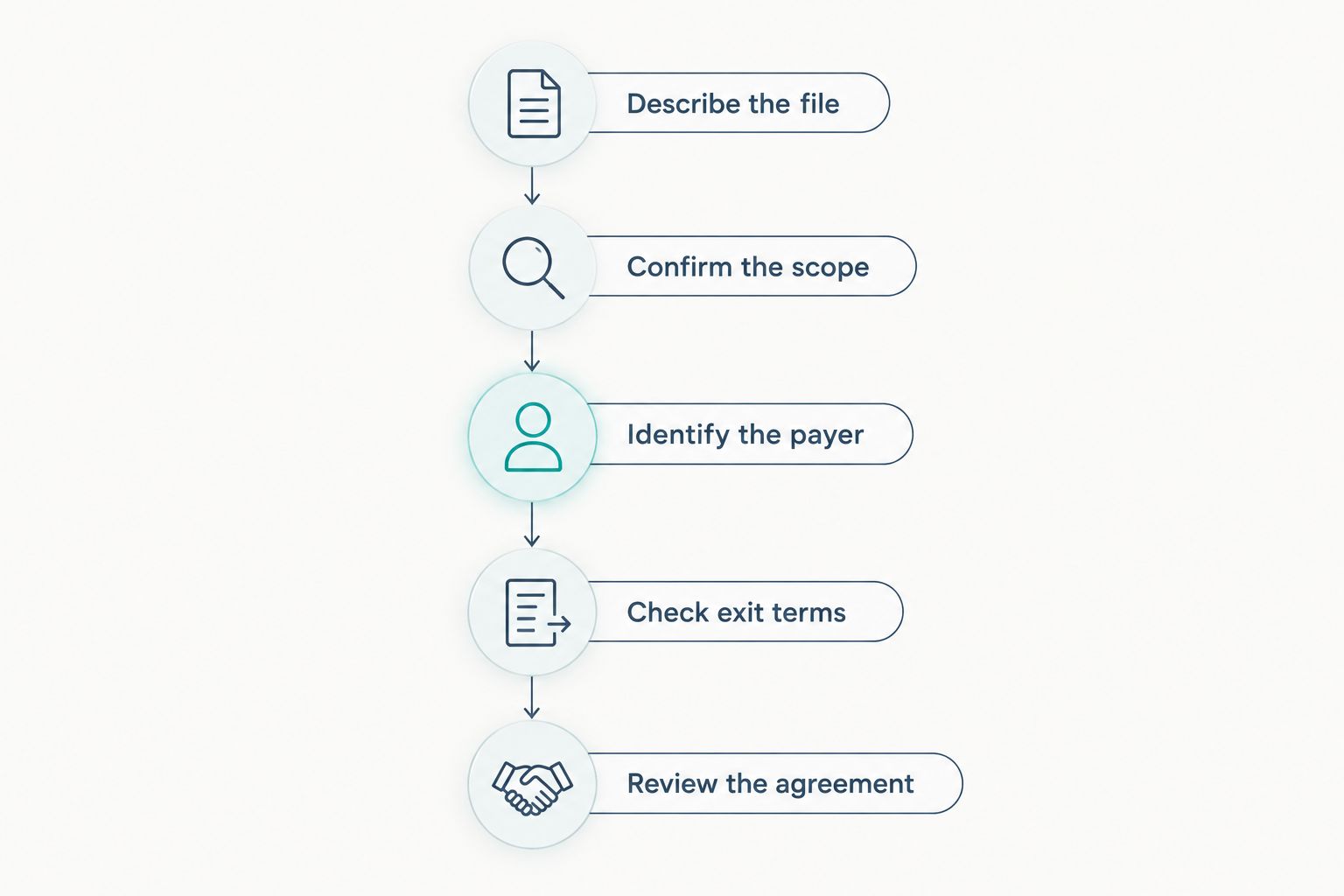
- Describe the file. Identify your role, the mortgage situation, the documents available, and any known deadlines. Separate confirmed facts from questions.
- Confirm the scope. Request a written list of included tasks and exclusions. Identify who communicates with the lender, agent, homeowner, and closing team.
- Identify the payer. Ask who signs the agreement and who becomes responsible for payment. Do not rely on an informal statement that someone else will cover it.
- Check exit terms. Read what happens after cancellation, lender rejection, buyer withdrawal, or a change of provider.
- Review the agreement. Resolve unclear language before signing. Take legal questions to a qualified attorney rather than asking the processor to interpret your rights.
Keep the final quote, signed agreement, and later changes together. A verbal explanation is harder to check when the file changes hands or a payment question arises.
For a 2026 comparison, request current terms directly from each provider. An older article or another seller’s experience is not your agreement.
Who pays the short sale negotiator?
Your written agreement determines your payment obligation; do not assume the lender will pay. Ask the provider to identify the intended payer and explain what happens if that payment arrangement is not accepted.
A proposed payment arrangement and lender acceptance are separate matters. Before closing, confirm that any lender-dependent arrangement is reflected in the required transaction documents. Ask the closing professional and your attorney to resolve inconsistencies.
Homeowners should also distinguish a negotiator’s fee from their broader financial exposure. Read about what a short sale costs the homeowner before treating the processing quote as the full picture.
Do you still owe a fee if the short sale fails?
A failed short sale does not, by itself, answer whether a fee is due. The cancellation and payment provisions control that question. Read them before authorizing work.
Ask the provider to explain what happens if the lender declines the offer, the buyer leaves, or you decide not to proceed. Also ask what happens if you move the file to another provider after work has begun.
Do not interpret a payment term as an approval promise. A provider can agree to perform defined work without controlling the lender’s decision.
Does hiring a negotiator erase the unpaid mortgage balance?
Hiring a negotiator does not erase an unpaid mortgage balance. The lender’s written terms and applicable law determine what happens to any remaining obligation.
Lender terms and state law vary. Have a qualified attorney review questions about personal liability, and take tax questions to a qualified tax professional. Do not assume that permission to sell for less than the mortgage balance also releases you from every remaining obligation.
If you are evaluating a short sale in 2026, ask about those consequences before accepting an offer or relying on a projected closing outcome. Processing support helps move the file; it does not replace legal or tax advice.
When outsourced processing makes sense
Shortsalesdoneright short sale processing fits real estate agents who want package preparation and lender communication handled by a dedicated contact. The service includes preparing the full short-sale package for agents, a dedicated point of contact, and weekly lender updates.
The benefit is a defined place for processing work and lender communication. The limitation is equally clear: agents and homeowners still need to provide accurate information and complete their assigned tasks. No processing service can promise lender approval.
Shortsalesdoneright also helps homeowners compare a short sale with other options. If you are the homeowner, lead with your goal and immediate concerns rather than asking only about the processing fee. If you are the agent, explain which tasks you want outsourced.
Ready to act? Use the appropriate agent or homeowner intake form on the site. Provide the known deadlines and describe the help you need.
Request help with your short sale
Explain your situation and request help through the appropriate agent or homeowner intake form.
FAQ
How do I get an accurate short sale negotiator quote in 2026?
Request a written quote based on your file, the work included, and the proposed payment terms. Disclose known deadlines and additional mortgages so the provider can define the assignment.
Can I assume the lender pays the negotiator?
No. Confirm the responsible payer in your agreement and ask what happens if the proposed payment arrangement is not accepted.
Is a short sale negotiator the same as a real estate attorney?
No. Processing and lender communication are different from legal advice. Ask a qualified attorney about liability, state-law rights, and legal deadlines.
Can a negotiator guarantee short sale approval?
No negotiator can guarantee lender approval. The lender makes the approval decision, and hiring a provider does not guarantee forgiveness of an unpaid balance.
What should an agent ask before outsourcing short sale processing?
Ask who prepares the package, tracks missing documents, communicates with the lender, and provides updates. Confirm the tasks that remain with you and how payment works if the sale does not close.
Does Shortsalesdoneright help homeowners compare their options?
Shortsalesdoneright helps homeowners compare a short sale with other options. Lender terms and state law vary; direct legal and tax questions to qualified professionals.
Should I choose the lowest short sale processing quote?
Choose based on the written scope and obligations, not the quoted fee alone. A lower quote is not the same service if it leaves essential processing tasks with you.
One last thing
Ask who owes payment if the expected payer does not pay. That question exposes a gap that a headline fee cannot answer. Get the answer in writing before work starts, not when the transaction is ready to close.