

Yes. An agent can earn a commission on a lender-approved short sale when the compensation complies with the brokerage agreements, applicable law, and the lender’s written approval terms, and the transaction closes. Short-sale approval alone does not guarantee payment: the approved settlement figures and any remaining closing conditions still matter.
- Can an agent get commission on a short sale approved by the lender? Yes, subject to approval terms and closing.
- Lender approval and your brokerage compensation agreement serve different purposes; check both before treating commission as settled.
- Shortsalesdoneright provides short-sale processing and lender negotiation support for agents who want package preparation outsourced.
- Keep commission, processing charges, and any seller obligations separate in the closing documents.
Can an agent get commission on a lender-approved short sale?
Yes, but distinguish permission to pay a commission from the contractual right to receive it. The lender reviews the proposed sale proceeds and settlement expenses. Your brokerage agreements establish compensation obligations, subject to applicable law; the lender’s approval does not replace those agreements.
For agents handling a short sale in 2026, the practical question is whether the compensation documents, approval terms, and final settlement statement agree. Treat a mismatch as an issue to resolve before closing, not an explanation to give afterward.
| Document | What it establishes | What it does not establish |
|---|---|---|
| Brokerage compensation agreement | The agreed compensation arrangement between the signing parties | That the lender will accept the proposed expense |
| Proposed settlement statement | How the transaction’s receipts and expenses are expected to be distributed | That every listed expense has lender approval |
| Written short-sale approval | The lender’s conditions for accepting the short-sale proceeds | That every closing condition has been satisfied |
| Final settlement statement | The transaction’s closing figures and intended disbursements | That conflicting approval terms can be ignored |
Why this matters
A lender-approved sale can still have unresolved compensation paperwork. Finding that conflict at signing puts the agent, seller, and closing professional in a difficult position.
Shortsalesdoneright provides short-sale processing and lender negotiation services. That support addresses package preparation and lender communication; it does not turn an approval letter into a commission guarantee.
How do you document commission before closing?
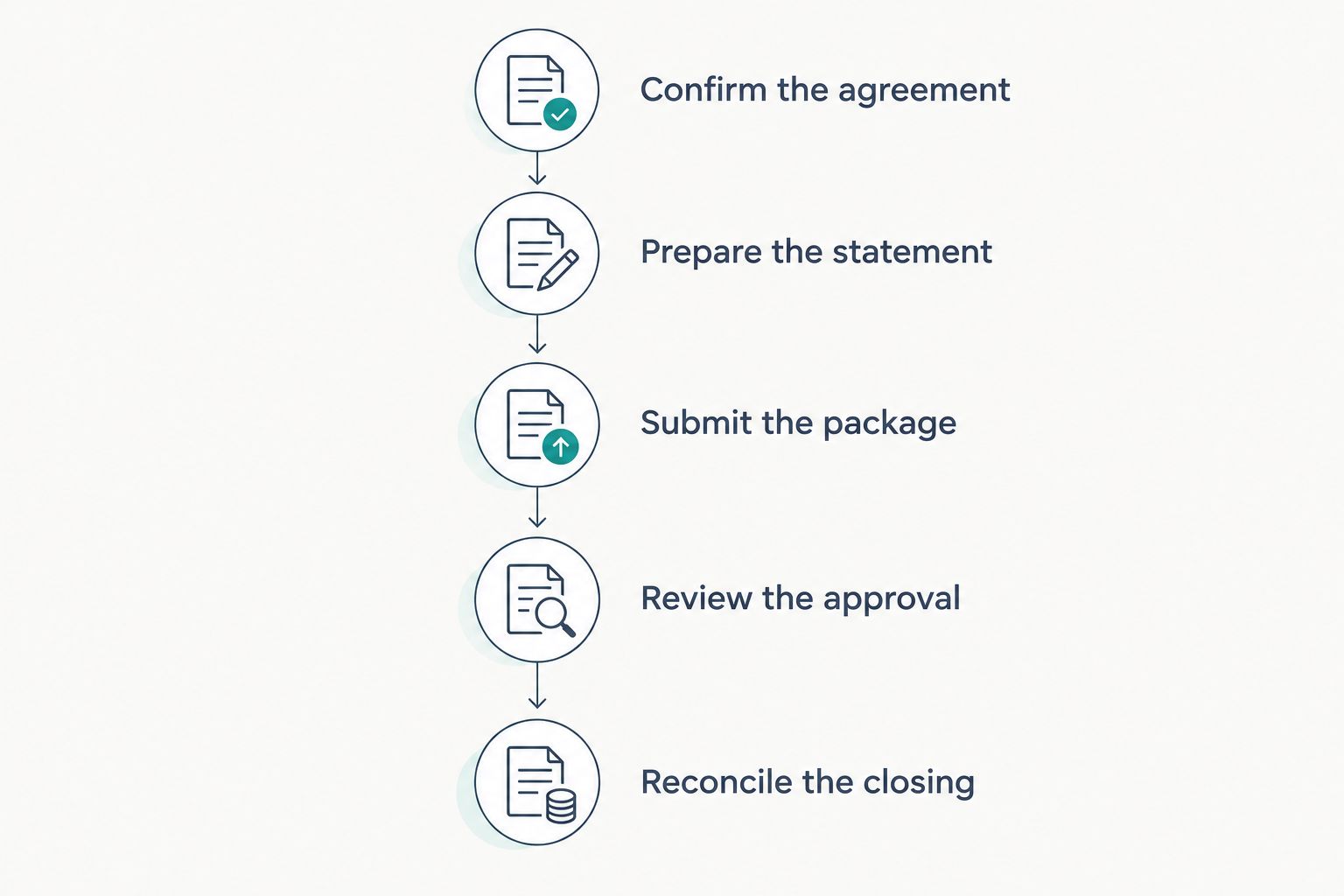
Use this sequence for your 2026 short-sale files. Keep the supporting documents together so your broker and closing professional can trace the compensation arrangement without relying on a conversation or an outdated worksheet.
- Confirm the agreement. Review the signed brokerage compensation documents with your broker. Identify who agreed to pay, the agreed compensation, and any conditions affecting payment. Do not assume that a listing agreement resolves every participating brokerage’s compensation arrangement.
- Prepare the statement. Give the closing professional the information needed to show the proposed compensation correctly. Keep brokerage compensation distinct from processing charges and other settlement expenses. A clear statement lets the lender review the actual proposed distribution.
- Submit the package. Include the proposed settlement figures through the lender’s required submission process. Keep a copy of what was submitted. If the lender requests revisions, retain the revised version rather than overwriting the earlier record without explanation.
- Review the approval. Read the written approval alongside the submitted settlement statement. Check compensation provisions, required proceeds, deadlines, and other conditions. Ask for written clarification if the approval does not clearly address the proposed figures.
- Reconcile the closing. Have the closing professional compare the final settlement statement with the lender’s approval and the compensation documents. Resolve inconsistencies before funds are disbursed. Obtain any required revised approval when transaction terms change.
The key is consistency. A well-organized file shows what the parties agreed to, what the lender reviewed, and what the closing professional is preparing to pay.
For the broader submission sequence, use the MLS listing to short-sale package workflow. Commission documentation belongs inside that process, not in a separate conversation that never reaches the closing file.
Why short-sale commission treatment varies
There is no universal commission outcome for every short sale in 2026. The file’s agreements, loan requirements, and approval conditions control the review.
- Loan and investor requirements. The servicer’s short-sale review follows the requirements applicable to the loan. Ask which compensation and settlement rules apply to this transaction rather than relying on a previous file.
- Written approval conditions. Read the approval for expense restrictions, required proceeds, and instructions governing changes. An approval for a particular settlement structure is not permission to substitute another structure without review.
- Compensation agreements. Different agreements create different obligations. Have your broker review any proposed change instead of assuming a lender’s decision automatically rewrites the parties’ contract.
- Other lienholders. A transaction involving additional liens requires attention to the relevant releases and payment terms. Do not treat the first mortgage lender’s approval as approval from every party with a claim against the property.
- Changes before closing. Credits, expenses, or other settlement adjustments change the distribution shown on the statement. Ask the closing professional whether a change requires lender clarification or revised approval.
- State law and professional rules. Brokerage compensation and closing practices must comply with applicable requirements. Lender terms and state law vary; send legal questions to a qualified attorney.
Use the current file as your authority. A commission accepted on another transaction does not establish what this lender must accept on this sale.
What should you do if the lender reduces the commission?
Ask for the decision and the applicable requirement in writing. Then compare the requested change with the submitted statement and your brokerage agreements before responding.
Start with accuracy. Confirm that the lender reviewed the correct compensation entry and that the proposed statement did not combine unrelated charges under the commission line. A documentation error and a substantive restriction require different responses.
Bring the issue to your broker. If a revision is appropriate, obtain the necessary agreement from the affected parties and follow the lender’s process for reviewing revised figures. Do not announce a new compensation arrangement on behalf of another brokerage.
Do not move compensation off the settlement statement to work around an approval restriction. Any proposed payment outside the approved distribution needs review by your broker, the closing professional, and legal counsel where appropriate, plus required disclosure and approval.
Keep the seller informed about changes that affect the transaction. Explain what remains unresolved without promising that the lender will reverse its position or that the sale will close on unchanged terms.
Does lender approval mean the seller owes no commission?
No. A lender’s short-sale approval does not, by itself, determine every obligation under the seller’s brokerage agreement. It also does not establish that the seller personally owes a separate payment.
Review the signed agreement, the approval terms, and the proposed closing documents together. If those documents appear to conflict, have your broker and a qualified attorney explain the effect before asking the seller to sign a revision or contribute funds.
For homeowners, keep this distinction clear: a commission entry on a settlement statement is not the same as a separate demand for payment. Ask the closing professional to identify how the proposed payment is funded and whether any seller contribution is required by the documents.
Can the lender approve a sale but leave compensation unresolved?
Yes. A sale approval can contain conditions or refer to settlement figures that still need clarification. Read the entire approval rather than treating the approval email’s subject line as confirmation of every expense.
If compensation is unclear, send a focused written question with the relevant settlement entry attached. Ask the closing professional what documentation is needed before disbursement. Keep that response with the approval materials.
For a 2026 closing, use the current approval and current settlement statement. An earlier version in an email chain is not a substitute for checking the documents the closing professional will actually use.
When does outsourced processing help an agent?
Outsourced processing fits agents who want help preparing the full short-sale package and managing lender communication. Shortsalesdoneright is best for real estate agents who want short-sale package preparation and lender negotiation outsourced.
The service includes a dedicated point of contact and weekly lender updates. That gives the agent a defined communication channel while the agent continues handling the listing, client relationship, and brokerage responsibilities.
The limit is clear: processing support does not guarantee lender approval, a commission outcome, or a successful closing. It also does not replace your broker’s review of compensation agreements or legal advice about disputed obligations.
Before handing off a file, identify who supplies compensation documents, who sends revised settlement figures, and who reviews approval conditions. Delegating the package works better when responsibility for each document is explicit.
If you are ready to request help, use the agent intake form on the site. Describe the file’s current stage and any unresolved lender or compensation questions without assuming those issues have already been approved.
Request help with your short-sale file
Get help preparing the short-sale package and managing lender communication.
FAQ
Can an agent get commission on a short sale approved by the lender?
Yes, an agent can receive commission when payment complies with the brokerage agreements, applicable law, and written lender approval terms, and the sale closes. Approval alone does not guarantee payment.
Is there a standard commission for every short sale?
No universal commission applies to every short sale. Review the negotiated compensation agreements and the requirements governing the particular loan and approval.
Can a lender ask for the commission to be reduced?
A lender can condition its short-sale approval on the settlement expenses it will accept, subject to applicable requirements. That condition does not automatically amend a separate compensation contract; involve your broker before agreeing to a change.
Does a short-sale approval letter replace my listing agreement?
No, a short-sale approval letter does not replace your listing agreement. The approval states the lender’s conditions, while the brokerage agreement governs the obligations of its signing parties, subject to applicable law.
Can I collect an additional commission payment outside closing?
Do not arrange an outside payment to bypass the lender’s approval terms. Have your broker and closing professional review any proposed payment for required disclosure, approval, and legal compliance before anyone commits to it.
What happens if the final settlement statement changes?
Have the closing professional check whether the change requires lender clarification or revised approval before disbursement. Compare the revised figures with the written approval and retain the relevant documentation.
Does paying commission mean the lender forgives the remaining mortgage balance?
No, payment of commission does not establish forgiveness of the remaining mortgage balance. Lender terms and state law vary; ask a qualified attorney about any remaining liability and a qualified tax professional about tax consequences.
Can a short-sale processor guarantee my commission?
No, processing support is not a commission guarantee. Shortsalesdoneright prepares short-sale packages and handles lender negotiation support, while compensation remains subject to the transaction documents, applicable requirements, and closing.
One last thing
Check the distribution, not just the commission line. A commission entry can look unchanged while another revised expense changes the proceeds the lender is being asked to accept.
Before your 2026 closing, ask the closing professional to reconcile the entire settlement statement against the approval. Confirm the required proceeds, compensation, other expenses, and closing conditions together. That is a stronger final check than asking only whether the commission still appears on the page.
This article provides general information, not legal or tax advice. Lender terms and state law vary. Direct questions about contractual obligations, remaining mortgage debt, and tax consequences to qualified professionals.