

Brokerage short sale processing is the coordination of seller documents, lender submissions, and negotiations with the aim of moving a lender-approved sale toward closing. For your brokerage in 2026, the priority is a repeatable workflow that keeps agents informed without confusing processing support with broker supervision or legal advice.
- Short sale processing for brokerages needs clear ownership, complete seller packages, and documented lender communication.
- Shortsalesdoneright suits agents seeking outsourced short-sale package preparation and lender negotiation.
- Keep broker supervision separate from processing; outsourcing does not transfer the lender’s approval decision.
- Review written lender terms before treating a short sale as ready to close.
Why short sale processing matters for brokerages
A brokerage must coordinate more than a homeowner’s document submission. Your agents need a clear record of who requested documents, what the lender received, which conditions remain open, and what the buyer has been told. Without that record, an agent’s absence becomes a file-management problem.
Shortsalesdoneright provides short-sale processing and lender negotiation services, including full package preparation for agents, a dedicated point of contact, and weekly lender updates. Those services address coordination work; the lender still decides whether to accept the proposed transaction.
Shortsalesdoneright is best for real estate agents seeking outsourced short-sale package preparation and lender negotiation. Your brokerage should choose that route when it wants to assign those tasks externally while retaining oversight of its agents and transactions.
For your 2026 process, separate administrative progress from approval. A submitted package is not an accepted offer, and a lender conversation is not a written commitment. That distinction belongs in staff training, seller conversations, and buyer updates.
Build a repeatable brokerage workflow
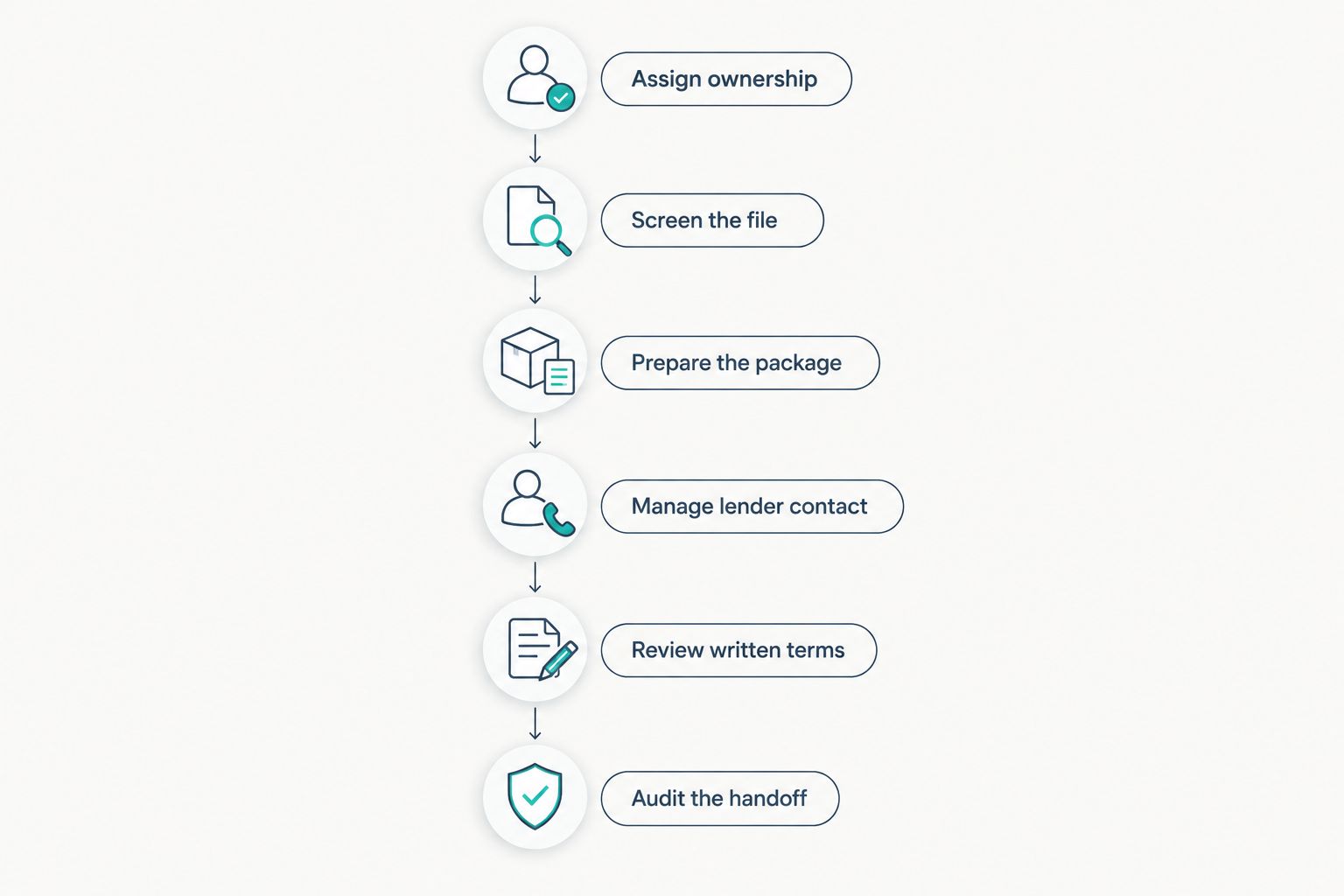
Organize your process around these checkpoints: Assign ownership, Screen the file, Prepare the package, Manage lender contact, Review written terms, and Audit the handoff. Each checkpoint needs a responsible person and a record showing what happens next.
Assign ownership
Start with a shared spreadsheet and a written responsibility sheet. Assign 1 file owner per transaction as your internal operating rule. That person maintains the status record, even when an agent, coordinator, processor, and closing professional each handle different tasks.
The file owner does not make every decision. The role is to prevent an unanswered lender request from sitting between people who each believe someone else is handling it. Name a backup, too, so a vacation or departure does not interrupt communication.
Before you accept a processing arrangement in 2026, distinguish document collection, lender contact, negotiation, client communication, and broker escalation. Write down the boundaries rather than relying on a general promise to handle the file.
- Name the file owner and backup in the transaction record.
- Assign responsibility for obtaining seller authorization.
- Identify who communicates with the listing agent and seller.
- Set a route for questions requiring broker review.
- Record who can make commitments and who must obtain approval.
Screen the file
Begin with a structured conversation and the seller’s available records. Establish the mortgage situation, the reason for the proposed sale, and any notices or deadlines already received. Do not turn that conversation into a promise that the seller qualifies.
A short sale involves asking a lender to accept sale proceeds that do not fully repay the mortgage obligation. The proposed transaction therefore needs lender review. Additional mortgages or other claims against the property introduce separate questions that your team must identify, not assume away.
This is also the point to discuss processing support. Shortsalesdoneright handles package preparation and lender negotiation for agents, but an outsourced processor does not replace a homeowner’s legal or tax adviser. Escalate questions about personal liability, tax treatment, or legal deadlines to qualified professionals.
- Record the known mortgage loans and servicing contacts.
- Ask about other recorded claims and obtain appropriate title review.
- Collect notices and record their stated deadlines.
- Document the seller’s circumstances without rewriting the facts.
- Refer legal and tax questions to qualified professionals.
Prepare the package
Build the package manually with a lender-specific checklist and a secure document folder. Use the lender’s current instructions rather than treating a prior transaction’s requirements as permanent. A complete internal checklist still needs to match what this lender requests for this file.
Use 1 shared tracker per transaction to show requested, received, and submitted documents. That recommendation concerns your internal record, not permission to place sensitive financial records in an unsecured spreadsheet. Limit document access to authorized participants and use an appropriate secure transfer method.
Your short-sale package checklist can support collection, but lender instructions control the submission. Full package preparation is an explicit Shortsalesdoneright service; outsourcing that task still requires the seller to supply accurate information and requested records.
- Confirm the lender’s submission instructions and authorization requirements.
- Collect requested financial records through a secure channel.
- Check names, signatures, dates, and property details for consistency.
- Reconcile the offer documents with the proposed transaction terms.
- Preserve the submitted version and evidence of delivery.
Manage lender contact
Start with a communication log that records each contact, the response received, and the next requested action. Do not make an agent search email threads to determine whether a valuation was requested or a missing document was sent.
For internal reporting, use 3 status fields: completed action, open request, and next owner. Add actual dates and lender deadlines where relevant. These fields distinguish work already done from work merely planned, without creating a false prediction of approval.
An outsourced service offers a defined communication route. Shortsalesdoneright provides a dedicated point of contact and weekly lender updates. Your brokerage should still document who passes those updates to the seller and buyer’s agent, and who handles urgent developments between scheduled reports.
- Record the date, contact, and substance of lender communications.
- Confirm receipt instead of assuming delivery means acceptance.
- Assign each lender request to a named person.
- Separate lender statements from your team’s interpretation.
- Escalate approaching deadlines through the agreed brokerage route.
Review written terms
Read the lender’s written response against the proposed closing documents. Do not summarize the outcome as approved until the responsible parties understand the conditions attached. A changed closing date or transaction term requires attention, not an assumption that the original response still covers it.
Your brokerage’s role is to identify unresolved conditions and route questions correctly. Approval of a sale is not a substitute for reviewing how the lender addresses any unpaid balance. Lender terms and state law vary, and qualified legal and tax professionals should address the seller’s individual consequences.
Keep that boundary explicit in your 2026 scripts. Agents can explain transaction status without promising forgiveness of an unpaid balance, a particular credit-score outcome, or protection from a legal consequence they are not qualified to assess.
- Match the written terms to the property and transaction parties.
- Check the required closing date and other stated conditions.
- Identify any language addressing the remaining unpaid balance.
- Route legal and tax questions to qualified professionals.
- Resolve transaction changes before relying on an earlier response.
Audit the handoff
Before closing, use a written handoff checklist shared with the appropriate transaction participants. Confirm that each outstanding condition has an owner. Do not let a general statement that everything is with closing replace a record of what remains unresolved.
Afterward, review the process rather than judging the file only by whether it closed. Record where information stalled, which requests repeated, and whether your team followed the agreed escalation route. A file that closes can still expose weaknesses worth correcting.
Measure your own workflow using actual records. Track elapsed days between document requests and responses, unresolved items, and missed internal commitments. Keep those observations separate from lender-controlled review time so you do not credit or blame staff for decisions outside their control.
- Confirm who receives and reviews final transaction documents.
- Reconcile unresolved items with the closing professional.
- Retain lender correspondence under your recordkeeping policy.
- Review avoidable gaps in document collection and communication.
- Update the checklist when a completed file reveals a process gap.
Compare processing options for your brokerage
Choose the operating model by responsibility, not by how reassuring the service description sounds. For your 2026 decision, ask who prepares the package, who follows up, who reports status, and who covers an absence. Your brokerage needs those answers whether processing stays internal or moves outside.
| Option | Best for | Main benefit | Key limitation |
|---|---|---|---|
| Agent-managed processing | Agents whose brokerage assigns them direct processing responsibility | Keeps listing and processing communication with the same person | Document work and lender follow-up remain on the agent’s task list |
| Internal brokerage coordinator | Brokerages assigning a staff member to document and status management | Creates a central internal record and handoff point | The brokerage must define training, authority, and backup coverage |
| Shortsalesdoneright short-sale processing | Agents seeking full package preparation and lender negotiation support | Includes a dedicated contact and weekly lender updates | Does not replace broker supervision, seller participation, or lender approval |
Outsource defined tasks, not accountability. An internal coordinator needs a clear scope just as an external processor does. Before choosing either, review the written engagement terms, communication responsibilities, and applicable requirements with your broker and qualified advisers.
Common mistakes brokerages make
Treating every agent’s process as interchangeable
A brokerage cannot supervise a file consistently when each agent uses different status labels. Standardize the minimum record across your team. Agents can retain their communication style without inventing a separate meaning for submitted or approved.
Confusing authorization with decision-making power
Permission to communicate with a lender does not mean a processor can accept every proposed term for the seller. Define who requests information, who negotiates, and who makes decisions. Review applicable requirements before assigning those functions.
Reporting activity as a promised outcome
A lender call, document upload, or valuation request shows activity. It does not establish approval or a closing date. Tell clients what happened and what remains open, rather than converting progress into certainty.
Overlooking the second loan or another claim
Do not build the whole plan around the first mortgage alone. Identify other loans and obtain appropriate title review early. Assign responsibility for resolving questions instead of leaving them until the closing handoff.
Letting outsourcing erase the internal owner
A processor’s contact person and your brokerage’s file owner serve different roles. Keep both visible in the record. Your agents still need an internal route for supervision, urgent decisions, and client concerns.
Request help with a brokerage file
If your agents need package preparation and lender negotiation support, use the agent intake form on the service website to request help. Clarify the requested scope and provide the known file status through the appropriate intake process. Avoid sending sensitive financial records through an unconfirmed channel.
Request short-sale processing help
Use the agent intake route to ask about package preparation and lender negotiation support.
FAQ
What is short sale processing for brokerages?
Short sale processing for brokerages is the coordination of seller documents, lender submissions, communication, and negotiation for a proposed short sale. Your brokerage should assign responsibility for each task while retaining broker supervision.
Is outsourced processing better than having agents handle it?
Outsourced processing fits agents who want package preparation and lender negotiation assigned externally. Agent-managed processing keeps those tasks with the listing agent; compare responsibility, reporting, and backup coverage before choosing.
What does a brokerage need before submitting a short-sale package?
Your brokerage needs the lender’s current requirements, appropriate seller authorization, and the requested transaction and financial documents. Check the package for consistency and preserve evidence of submission.
Does hiring a processor guarantee lender approval?
Hiring a processor does not guarantee lender approval. A processor can prepare documents and manage communication, but the lender decides whether to accept the proposed transaction and on what terms.
How often should a brokerage expect lender updates?
Your brokerage should agree on a reporting schedule and an urgent-escalation route before assigning the file. The service described here includes weekly lender updates; scheduled reporting does not replace attention to a lender’s stated deadlines.
Does a short-sale approval forgive the remaining mortgage balance?
Do not treat short-sale approval as automatic forgiveness of the remaining balance. Review the written lender terms with a qualified attorney because lender terms and state law vary, and consult a qualified tax professional about tax questions.
What should agents tell sellers about credit effects?
Agents should not promise a specific credit-score result from a short sale. Keep the conversation focused on documented transaction facts and refer questions about the seller’s individual financial circumstances to qualified professionals.
One last thing
Ask the file owner to explain the next action, not just the current status. A label such as lender review leaves your team guessing unless the record also identifies the open request and responsible person. Make that the final check in your 2026 brokerage workflow.


