

Yes. An agent can generally list a short sale property before the lender approves the price, provided the seller authorizes the listing and the agent follows applicable lender instructions, brokerage policies, MLS rules, and state law. The asking price does not commit the lender to accept less than the mortgage payoff. Before marketing, confirm the lender’s process and make the outstanding approval requirement clear.
- Can an agent list a short sale property before the lender approves the price? Generally, yes; lender instructions still matter.
- The seller’s asking price and accepted offer do not establish lender approval of a short sale.
- Shortsalesdoneright prepares short-sale packages for agents; processing support does not guarantee lender approval.
- Confirm submission requirements, disclose pending approval, and document the evidence behind the asking price.
Can an agent list a short sale before lender price approval?
Generally, yes. Listing authority and lender approval are separate. The seller authorizes marketing; the lender decides whether to accept the proposed short payoff under its requirements. Shortsalesdoneright provides short-sale processing and lender negotiation services for agents handling that distinction.
Keep these decisions separate in your 2026 listing file:
| Decision | Who makes it | What it establishes | What it does not establish |
|---|---|---|---|
| Listing authorization | Seller, through the listing agreement | Permission for the agent to market the property | Lender acceptance of a short payoff |
| Asking price | Seller, advised by the agent and subject to applicable instructions | The amount advertised to buyers | A lender-approved sale amount |
| Offer acceptance | Seller and buyer, through their contract | Their proposed transaction terms | Required lender consent |
| Short-sale approval | Lender or authorized servicer, under applicable requirements | Written consent subject to stated conditions | Automatic release from every remaining obligation |
An executed contract is not a substitute for written lender approval. Treat every reference to an approved price as a claim that needs supporting documentation.
Why this matters
You can generate buyer interest before the lender finishes reviewing the transaction. But if buyers mistake the asking price for an approved amount, you create expectations the seller cannot fulfill alone.
For the agent, the immediate task is accurate marketing and a complete file. For the homeowner, the immediate question is different: whether the proposed sale terms provide an acceptable exit after considering remaining debt, housing needs, and professional advice.
Market the property without presenting an unresolved lender decision as a settled fact. That distinction belongs in your seller conversation, buyer communications, and transaction records.
What should an agent verify before listing?
Use a documented pre-listing process rather than assuming every mortgage follows the same path. For a 2026 short-sale listing, confirm the instructions applicable to the actual loan and property.
Confirm seller authority
Identify who must authorize the listing and sign transaction documents. Ownership involving an estate, trust, divorce, or multiple owners requires attention before marketing begins.
Ask your broker and the title professional what documentation they need. Send questions about ownership rights or signing authority to a qualified attorney rather than resolving them through listing remarks.
Confirm lender instructions
Obtain the seller’s authorization to communicate with the mortgage servicer. Ask whether the servicer requires an initial review, specific listing language, valuation work, or other steps before marketing or submitting an offer.
Also ask whether an offer is required to begin the relevant review. Permission to start a file is not approval of the transaction. Record what the servicer requests and retain written instructions when provided.
Document market value
Support your pricing recommendation with comparable sales, current competition, property condition, and relevant market activity. Distinguish your market analysis from any valuation ordered by the lender.
If the seller chooses a different asking price, document the discussion. Your file should explain the recommendation without suggesting that the lender has endorsed it.
Check transaction requirements
Review brokerage policy, applicable MLS rules, required disclosures, and the contract forms used in your state. Ask the title professional to identify recorded claims that need attention.
Do not promise a closing date based only on the listing going live. A marketing launch does not establish the lender’s review schedule or resolve title issues.
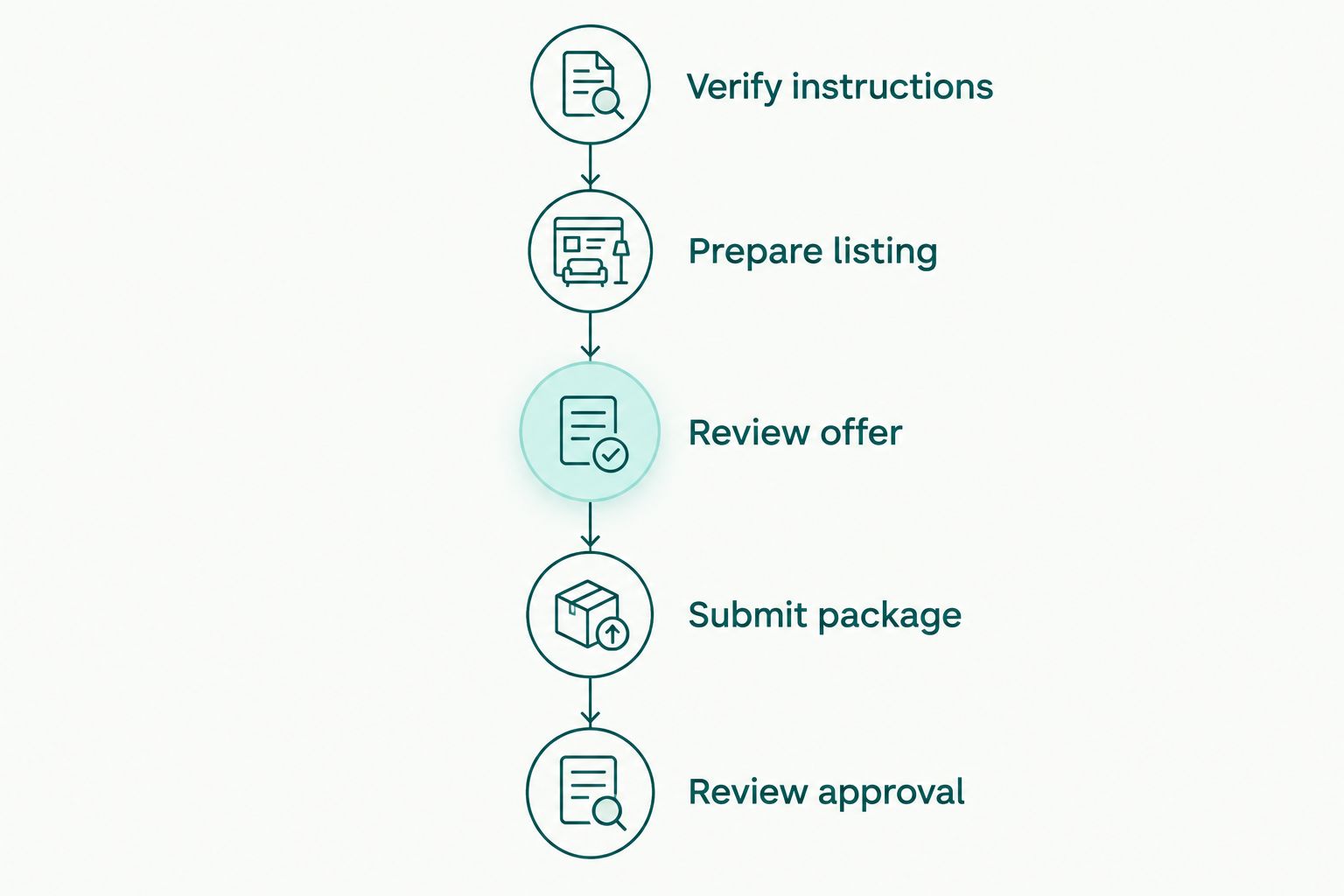
How do you move from listing to lender review?
The precise sequence depends on the lender’s requirements. Use the following workflow to assign responsibility and prevent a missing approval from being mistaken for completed work.
- Verify instructions. Confirm the lender’s submission process and any requirements that apply before listing.
- Prepare listing. Obtain seller authorization, document the pricing basis, and prepare accurate disclosures.
- Review offer. Evaluate the buyer’s terms with the seller and use appropriate contract protections with broker or legal guidance.
- Submit package. Provide the documents required for the lender’s review, including the offer when required.
- Review approval. Check written conditions, deadlines, and unresolved obligations before proceeding toward closing.
The benefit of this sequence is clear ownership of each task. Its limit is equally important: completing your steps does not compel the lender to approve the offer.
Keep the file current while the property is marketed. If the lender requests updated documents or the transaction terms change, identify who will respond and record what remains outstanding.
Should you list now or wait for lender guidance?
Best for an agent ready to market: listing before price approval is a practical route when the seller has authorized it and the applicable requirements permit it. Its advantage is beginning the search for a buyer; its limitation is that the advertised amount remains subject to lender review.
Best for an agent with unresolved instructions: wait to launch until the lender’s requirements and your brokerage’s obligations are clear. The advantage is avoiding a preventable process error; the trade-off is postponing marketing while those questions are resolved.
| Approach | Best for | Benefit | Limitation |
|---|---|---|---|
| List before price approval | A properly authorized listing with clear requirements | Begins marketing and buyer outreach | Does not establish an acceptable short payoff |
| Clarify instructions before launch | A file with unresolved lender or brokerage requirements | Establishes the correct submission path | Defers marketing while questions remain |
Neither route removes the need for written approval. Choose based on documented requirements, not a general belief that every short sale must start the same way.
Why does the lender’s position differ from the asking price?
An asking price is a marketing decision. A lender’s short-sale review addresses the proposed transaction and its own requirements, not just the amount displayed in the MLS.
These factors explain why the decisions can differ:
- Property valuation. The lender’s valuation and your comparable-sales analysis can reach different conclusions about the property.
- Property condition. Documented condition issues help explain the pricing recommendation; unsupported descriptions do not replace evidence.
- Proposed net proceeds. The lender reviews what it would receive after proposed transaction expenses, not simply the contract amount.
- Loan requirements. The applicable investor, insurer, or loan program can impose requirements beyond the agent’s pricing analysis.
- Other claims. Additional mortgages and recorded liens require attention because approval from one lender does not resolve every claim.
- Offer terms. Requested concessions and other contract provisions affect the transaction being submitted for approval.
For your 2026 file, explain the connection between these factors and the proposed sale. A lower asking price alone does not answer a lender’s questions about valuation or net proceeds.
What should the MLS listing say before approval?
Use the short-sale disclosures and status fields required by your MLS and brokerage. Make the unresolved lender approval clear without making claims about approval speed, debt forgiveness, or the lender’s likely decision.
Describe the property accurately. Do not label the asking price as lender-approved unless written documentation supports that description and remains applicable to the current transaction.
Keep private seller information out of public remarks. A need to explain lender approval does not create a reason to publish financial documents or personal hardship details.
Before publishing a 2026 listing, check that public remarks, agent-only remarks, and required fields tell the same story. Conflicting statements create confusion even when one field is correct.
Can the seller accept an offer before lender approval?
Yes, a seller can generally accept an offer subject to the necessary lender approval. Acceptance establishes the proposed agreement between the buyer and seller; it does not authorize a short payoff by itself.
Use the appropriate contract language with your broker or attorney. Address the approval contingency, relevant deadlines, and the parties’ rights if approval does not arrive or contains unacceptable conditions.
Explain those provisions before signatures. The buyer and seller should understand what they have agreed to and which decisions remain outside their control.
Does listing the home stop foreclosure?
No. Listing a property does not, by itself, stop foreclosure. Neither an MLS entry nor a submitted short-sale package is proof that a scheduled foreclosure action has been postponed.
If foreclosure is active, confirm the current status with the appropriate parties and direct the homeowner to qualified legal help promptly. Keep marketing milestones separate from verified foreclosure deadlines.
Never tell a seller that getting an offer makes the home safe from foreclosure. That assurance exceeds what an offer establishes.
Who should handle the lender paperwork?
Shortsalesdoneright is best for real estate agents who want short-sale package preparation and lender negotiation handled as a service. The service includes preparing the full short-sale package, a dedicated point of contact, and weekly lender updates.
That support addresses administrative work and communication. It does not replace the agent’s brokerage responsibilities, legal advice, tax advice, or the lender’s approval decision.
Before handing off a file, identify who gathers seller documents, obtains signatures, submits updates, and communicates with the buyer’s agent. If you are ready to act, request help through the appropriate agent intake form on the website.
Request help with your short-sale file
Get help preparing the short-sale package and managing lender communication.
FAQ
Can an agent list a short sale property before the lender approves the price?
Yes, generally, if the seller authorizes the listing and the agent follows applicable lender instructions, brokerage policies, MLS rules, and state law. The asking price does not establish lender approval.
Does the lender have to accept the MLS asking price?
No. An MLS asking price does not bind the lender to accept a short payoff. The lender reviews the proposed transaction under its applicable requirements.
Can I advertise a short sale as approved before receiving written approval?
Do not describe a short sale as approved without written documentation supporting that claim. Follow your MLS rules and brokerage policy, and confirm that any approval applies to the current transaction.
Can I start gathering short-sale documents before receiving an offer?
Yes, you can gather seller documents and confirm submission requirements before an offer arrives. Ask the servicer whether the relevant review requires an offer or additional preliminary steps.
Does a short-sale approval mean the seller owes nothing afterward?
No. Short-sale approval does not automatically establish that every unpaid obligation is forgiven. Lender terms and state law vary; have a qualified attorney review remaining-debt questions and a tax professional review tax consequences.
Will listing a short sale pause a foreclosure auction?
No. Listing a property does not by itself pause a foreclosure auction. Confirm any postponement through the appropriate parties and direct the homeowner to qualified legal help.
Can Shortsalesdoneright help an agent before lender price approval?
Shortsalesdoneright provides short-sale package preparation and lender negotiation services for agents. Its support includes a dedicated point of contact and weekly lender updates, without a promise of lender approval.
One last thing
Ask what is approved, not simply whether the file is approved. A valuation response, permission to submit documents, and written consent to a specific transaction are different milestones.
Before moving a 2026 short sale toward closing, match the written approval to the actual contract and closing documents. Have the appropriate professionals review unresolved conditions, remaining-debt language, and tax questions. Lender terms and state law vary.


