

Yes, an agent can arrange to switch short sale negotiators mid-transaction, subject to the seller’s authorization, the existing service agreement, and the mortgage servicer’s requirements. Changing negotiators does not, by itself, extend deadlines, preserve an approval, or stop foreclosure activity. Confirm the handoff with the seller, your broker, and the servicer before replacing the current contact.
- Can an agent switch short sale negotiators mid-transaction? Yes, subject to seller authorization, service agreements, and servicer requirements.
- Transfer the complete short sale package, submission history, and outstanding requests before ending the handoff.
- Shortsalesdoneright provides short sale processing for agents who want package preparation and lender communication outsourced.
- A negotiator change does not guarantee approval or extend a foreclosure deadline.
Can an agent switch short sale negotiators mid-transaction?
Yes, but treat the change as a documented transfer of responsibility—not simply a new email introduction. The seller’s permission to discuss the loan, the outgoing provider’s agreement, and the servicer’s process each need separate attention.
Use this sequence for a 2026 transaction. For the underlying document process, see the MLS listing to short sale package workflow.
- Review the agreement. Identify termination provisions, notice requirements, and responsibilities for transferring records.
- Confirm seller consent. Document whom the seller authorizes to communicate about the mortgage.
- Check servicer requirements. Ask how to replace an authorized third party and whether access must be established separately.
- Transfer the file. Include submitted documents, correspondence, outstanding requests, and relevant deadlines.
- Confirm receipt. Have the incoming negotiator identify missing records and verify the file’s status with the servicer.
- Assign the next action. Name the person responsible for each open request and communicate the transition to affected parties.
The handoff is not complete when records are sent. It is complete when the incoming negotiator can act and the next deadline has an owner.
Why this matters
Your seller still needs an accurate assessment of the transaction. Your buyer still needs reliable updates. Neither benefits from an uncoordinated switch that leaves everyone assuming someone else contacted the lender.
Separate dissatisfaction with the current provider from the condition of the file. A communication problem calls for better accountability; a missing authorization calls for corrected paperwork. Identify the actual problem before choosing the remedy.
For a 2026 handoff, work from current written records rather than a verbal summary. Ask what the servicer has received, what remains outstanding, and which deadlines have been confirmed.
Should you replace the negotiator or fix the current arrangement?
Switch when the replacement addresses a documented problem and has a workable transfer plan. Do not change providers solely because the lender has not delivered the answer your seller wants.
A new negotiator takes over communication and processing responsibilities. The new negotiator does not control the lender’s decision.
| Approach | Best for | Benefit | Limitation |
|---|---|---|---|
| Keep the current negotiator with a written action plan | A file with accessible records and a correctable communication problem | Avoids transferring responsibility during an active review | Does not resolve persistent failure to complete assigned work |
| Replace the negotiator through a documented handoff | An unresolved service problem with a replacement ready to accept responsibility | Establishes a new contact and clear next steps | Requires records, authorization, and access to be coordinated |
| Get legal advice before changing providers | A disputed agreement, threatened foreclosure, or disagreement over legal rights | Clarifies legal obligations before the agent acts | Does not itself transfer the file or secure lender approval |
Ask the current provider for a written status report before deciding. Compare the report with the lender correspondence and your own transaction records. If the accounts conflict, resolve the discrepancy instead of passing it to the replacement as an established fact.
What belongs in the negotiator handoff?
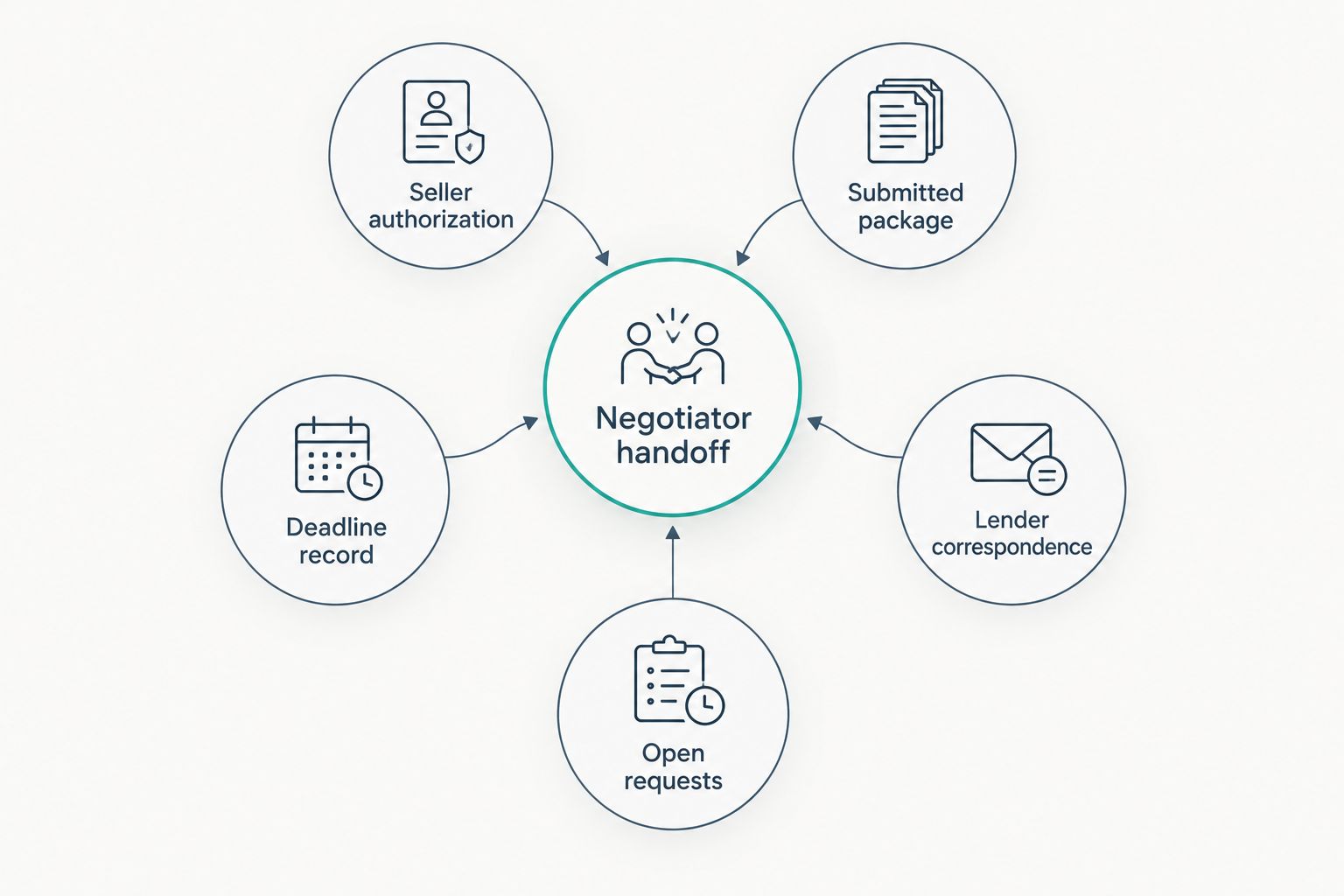
The incoming negotiator needs more than the seller’s name and loan reference. Transfer the working record through an approved secure channel, with the seller’s authorization and your brokerage’s privacy procedures in place.
Organize the handoff into these categories:
- Seller authorization: Existing permissions, contact information, and instructions for replacing the authorized third party.
- Submitted package: Copies of financial documents, hardship materials, the purchase agreement, and other documents actually submitted.
- Lender correspondence: Written requests, responses, submission confirmations, and relevant call notes.
- Open requests: Missing items, requested corrections, and the person currently responsible for each response.
- Deadline record: Contract dates, approval expiration dates, and any foreclosure-related notices provided to the transaction team.
Distinguish documents collected from documents submitted. A complete folder on an agent’s computer is not proof that the servicer received or accepted its contents.
Also identify sensitive records that should not travel through ordinary email. Do not share the outgoing negotiator’s login credentials. Ask the servicer how the incoming provider should establish authorized access.
Switching before the package is submitted
Before submission, focus on document ownership and readiness. Confirm which materials are complete, which need signatures, and which still need to be requested from the seller.
Ask the incoming negotiator to review the package before representing it as ready. An organized transfer is useful, but organization alone does not establish that the package meets the servicer’s requirements.
For a 2026 submission, have the replacement confirm which documents the servicer currently requires. Do not rely on an old checklist without checking it against the active file.
Keep the seller’s workload clear. Explain exactly which documents must be supplied again and why, rather than issuing a broad request to start over.
Switching while the lender reviews the file
During review, make the existing case status the first priority. Ask whether the servicer can update the authorized contact within the active case and what documentation it needs.
Do not assume that a provider change requires a new submission—or that the existing review will continue unchanged. Obtain file-specific instructions before taking either approach.
Have the incoming negotiator reconcile pending requests against the transferred records. If the outgoing provider says an item was delivered, locate the confirmation and ask the servicer whether the item remains outstanding.
Tell the buyer’s agent what is confirmed. A useful update states that the contact is changing, identifies the next action, and separates verified deadlines from unresolved questions. Avoid predicting an approval date.
Switching after short sale approval
An approval letter makes the written terms the priority. The incoming negotiator should receive the complete letter, related correspondence, and any amendments—not an agent’s summary of the conditions.
Confirm who will handle unresolved lender requests and coordinate with the closing professional. Ask the servicer whether the contact change affects anything required to close under the existing approval.
Do not interpret a negotiator change as permission to alter approved terms. Questions about the unpaid balance, releases, or the seller’s legal obligations belong with qualified legal counsel.
In a 2026 closing file, distinguish the approval expiration from the purchase contract’s closing date. Record each date under its own source, and ask the responsible party to address any conflict.
Why a negotiator handoff varies
There is no single transfer checklist that replaces the actual agreement or servicer instructions. These factors determine what the agent must verify:
- Service agreement: Notice provisions and record-transfer obligations shape how the outgoing engagement ends.
- Seller authorization: The incoming provider needs the permission required for its role and lender communications.
- Servicer process: Contact changes, document delivery, and portal access must follow the servicer’s instructions.
- File stage: An unsubmitted package presents different open tasks from a file with written approval.
- Document condition: Missing records and unexplained gaps must be resolved before the replacement can give a reliable status report.
- Legal deadlines: Foreclosure notices and other legal issues require advice specific to the property and applicable state law.
Lender terms and state law vary. Refer legal questions to a qualified attorney and tax questions to a qualified tax professional. Do not promise lender approval, forgiveness of an unpaid balance, or a particular credit-score result.
How do you choose the replacement negotiator?
Ask the replacement to explain how it will accept the file, verify its condition, and report progress. Seek a defined process rather than a promise that a new contact will get the lender to agree.
Useful questions include:
- Who will be the agent’s point of contact?
- Who prepares and checks the complete short sale package?
- How will the provider verify outstanding lender requests?
- How will the agent receive updates?
- What must happen before the provider accepts responsibility?
- Which issues must go to the broker, closing professional, or attorney?
Shortsalesdoneright is for real estate agents who want short sale package preparation and lender communication outsourced. Its short sale processing service includes preparing the full package, a dedicated point of contact, and weekly lender updates.
That support does not replace seller authorization or the servicer’s requirements. It also does not guarantee approval or remove the need for legal and tax advice. Request help through the agent intake form on Shortsalesdoneright and identify the transaction’s current stage.
Request help with your handoff
Use the agent intake form to explain the file’s status, outstanding requests, and known deadlines.
Will switching negotiators restart the short sale?
Switching negotiators does not establish whether a review must restart. Ask the servicer whether the existing case remains active, what authorization changes are required, and whether any documents need to be resubmitted.
Can an agent replace the negotiator without the seller’s permission?
An agent should not treat the listing relationship as a substitute for the seller authorization required for lender communication. Review the existing permissions and agreements with your broker, and obtain legal advice if authority is disputed.
Does switching negotiators stop a foreclosure sale?
A negotiator change is not confirmation that foreclosure activity has stopped. If a sale is scheduled or threatened, direct the seller to qualified legal counsel promptly and seek written confirmation of any claimed postponement from the appropriate source.
FAQ
Can my new short sale negotiator use the documents already collected?
The incoming negotiator can review the existing documents, subject to proper authorization and secure transfer. The provider must then confirm which records the servicer still accepts and which need updating.
Should I cancel the old negotiator before choosing a replacement?
Review the existing agreement and establish a handoff plan before leaving the file without a responsible contact. Coordinate the sequence with your broker, the seller, and the incoming provider.
Do I need a new lender authorization when I change negotiators?
Ask the servicer what authorization it requires to recognize the incoming negotiator. Do not assume the outgoing provider’s permission automatically transfers.
Will a different negotiator get my short sale approved?
A different negotiator cannot guarantee lender approval. Evaluate the replacement on package preparation, communication, and responsibility for outstanding requests—not a promised outcome.
What should I tell the buyer’s agent about the switch?
Tell the buyer’s agent the verified status, the next action, and any confirmed deadline that affects the transaction. Do not present the provider change as an approval or a guaranteed extension.
Can Shortsalesdoneright help agents with short sale processing?
Shortsalesdoneright provides short sale processing and lender negotiation services for real estate agents. Its service includes full package preparation, a dedicated point of contact, and weekly lender updates; request help through the agent intake form.
Who should answer questions about the seller’s remaining mortgage debt?
A qualified attorney should address the seller’s legal exposure under the approval terms and applicable state law. A qualified tax professional should address tax consequences; changing negotiators does not resolve either issue.
One last thing
Ask the incoming negotiator to explain the file back to you before calling the transfer complete. The explanation should identify the current stage, the last verified lender response, the next required action, and who owns it.
Use that check on every 2026 handoff. A replacement who has received the documents still needs to reconcile them with the servicer’s record. Until that happens, describe the status as unverified rather than telling the seller the transition is finished.


