

Yes, you can refinance instead of doing a short sale while underwater if your existing mortgage qualifies for a refinance program that permits it and you meet the lender’s requirements. An underwater balance blocks many standard refinances, and a lower payment does not automatically erase negative equity or make keeping the home affordable.
- To refinance instead of short sale underwater, confirm your existing mortgage qualifies before choosing to sell.
- FHA Streamline and VA IRRRL programs have different requirements from a standard refinance.
- A loan modification changes your existing mortgage; a short sale requires selling with lender approval.
- Shortsalesdoneright helps underwater homeowners compare a short sale with other options; lender approval is never guaranteed.
Can I refinance instead of doing a short sale if I’m underwater?
Yes, but being underwater does not create refinance eligibility. Your existing loan type, payment history, proposed loan terms, and lender requirements determine whether refinancing is possible in 2026.
Start with the outcome you need: keeping the property or leaving it. These are different decisions. If you need to move or cannot support an ongoing mortgage payment, refinancing does not solve that problem. The guide to alternatives to foreclosure for homeowners explains other paths to review.
| Option | Best for | Main benefit | Main limitation |
|---|---|---|---|
| Standard refinance | Owners who meet equity and underwriting requirements | Replaces the current mortgage with new terms | Negative equity generally prevents a standard refinance without addressing the balance |
| FHA Streamline refinance | Eligible homeowners with an existing FHA-insured mortgage | Permits qualifying refinances without an appraisal | Does not automatically reduce the principal owed |
| VA Interest Rate Reduction Refinance Loan | Eligible homeowners refinancing an existing VA-backed loan | VA does not require an appraisal for this program | Lender requirements still apply; the debt remains |
| Loan modification | Owners seeking an affordable way to keep the property | Changes terms of the existing mortgage | Requires servicer review and does not guarantee principal reduction |
| Short sale | Owners who need to sell when proceeds will not cover the mortgage payoff | Creates a lender-approved route to selling | Requires approval; treatment of unpaid debt needs separate review |
Why this matters
Negative equity and an unaffordable payment are separate problems. You can owe more than your home is worth and still afford the payment. You can also have equity and struggle to pay.
A refinance addresses the mortgage terms. It does not necessarily address lost income, a required move, or other debts. A short sale addresses selling the property, but it does not guarantee that every remaining obligation disappears.
For a 2026 decision, compare the full household budget with the actual proposed terms. Do not choose based only on a lower advertised interest rate.
Standard refinance: equity remains a barrier
A standard refinance generally requires the new mortgage to satisfy the lender’s loan-to-value requirements. Loan-to-value compares the mortgage balance with the property’s appraised value. At 100% loan-to-value, the mortgage balance equals that value; above 100%, the mortgage alone exceeds it.
Bringing funds to reduce the balance can change the calculation. That is not automatically the right use of your savings, especially if keeping the house would still strain your budget.
Best for: homeowners who can meet the equity requirements without undermining their financial stability. Ask the lender whether the property value, outstanding balance, and your finances support an actual application. A preliminary rate quote is not an approval.
Remember that selling involves a different calculation. Even when the property value exceeds the mortgage balance, selling expenses and other liens can affect whether the proceeds cover everything owed.
FHA Streamline refinance: check your existing loan
An FHA Streamline refinance applies to an existing FHA-insured mortgage. HUD’s FHA Streamline guidance permits transactions without an appraisal, which makes this a relevant question when your home has lost value.
That does not mean every underwater FHA borrower qualifies. Payment history, the required benefit to the borrower, and other program and lender requirements still matter. Some streamline transactions also require credit qualification.
Best for: eligible FHA borrowers who want to keep the home and can afford the resulting payment. Ask the lender to identify the specific refinance route and explain whether an appraisal or credit qualification is required for your case.
The limitation is simple: replacing the loan does not automatically forgive the difference between your debt and your property’s value. Review the new balance and repayment term, not just the monthly payment.
VA IRRRL: an appraisal is not a VA requirement
A VA Interest Rate Reduction Refinance Loan, commonly called an IRRRL, refinances an existing VA-backed home loan. VA’s IRRRL guidance states that VA does not require an appraisal or credit underwriting package, although lenders can impose their own requirements.
An underwater value therefore does not automatically end the discussion. Your lender still needs to confirm eligibility and explain the proposed transaction.
Best for: eligible VA borrowers whose goal is to keep the property with suitable mortgage terms. Ask whether any appraisal or underwriting requirement comes from VA or from that particular lender.
The trade-off remains the same: a refinance preserves the mortgage obligation. If you need to sell because of a move or an ongoing income shortfall, an IRRRL does not replace an exit plan.
Loan modification: ask when refinancing does not fit
A loan modification changes the existing mortgage rather than replacing it. Depending on the approved arrangement, changes can involve the interest rate, repayment term, or treatment of overdue amounts.
Best for: homeowners who want to stay but need the servicer to review payment relief. Ask your mortgage servicer—the company that collects your payments—for its mortgage-assistance application and required documents.
Do not assume a modification includes principal forgiveness. Ask whether any amount is deferred, whether a balance becomes due later, and what the permanent payment would be. A lower payment can come with a longer repayment period.
If both keeping and selling remain realistic, compare the written terms of a modification with the obligations attached to a short sale. Neither option should be chosen from a verbal summary alone.
Short sale: consider it when keeping the home no longer works
A short sale involves selling for proceeds that will not fully satisfy the mortgage payoff, subject to the necessary lender approvals. It is an exit strategy, not a refinance substitute that lets you keep the property.
Best for: homeowners who need to sell and cannot cover the shortfall through a regular sale. The benefit is a possible negotiated sale; the limitation is uncertainty until the required parties approve the transaction and its terms.
Shortsalesdoneright is best for underwater homeowners seeking short-sale processing and lender negotiation help. The service helps homeowners compare a short sale with other options; it does not provide refinance approval or guarantee a short-sale outcome.
Lender terms and state law vary. Before accepting an approval, have a qualified attorney review any remaining debt obligations and a qualified tax professional explain potential tax consequences.
Why your refinance options vary
The right 2026 question is not simply whether underwater owners can refinance. It is whether a specific program fits your loan and solves your household’s problem.
- Existing loan type. FHA Streamline and VA IRRRL eligibility depend on the mortgage you already have. These are not general programs for every underwater borrower.
- Payment history. Missed payments affect which refinance or assistance routes deserve review. Give the lender accurate dates and account information.
- Property value and liens. The first mortgage is only part of the picture when you also have a second mortgage, home-equity line, or other lien.
- Income and expenses. A payment must fit your actual budget. Approval alone does not establish that you can comfortably carry it.
- Your housing goal. Keeping the home, relocating, and ending an unsustainable payment obligation require different plans.
- Written terms and legal obligations. The new loan balance, repayment structure, lender conditions, and applicable state law affect the decision.
What should I ask before choosing either path?
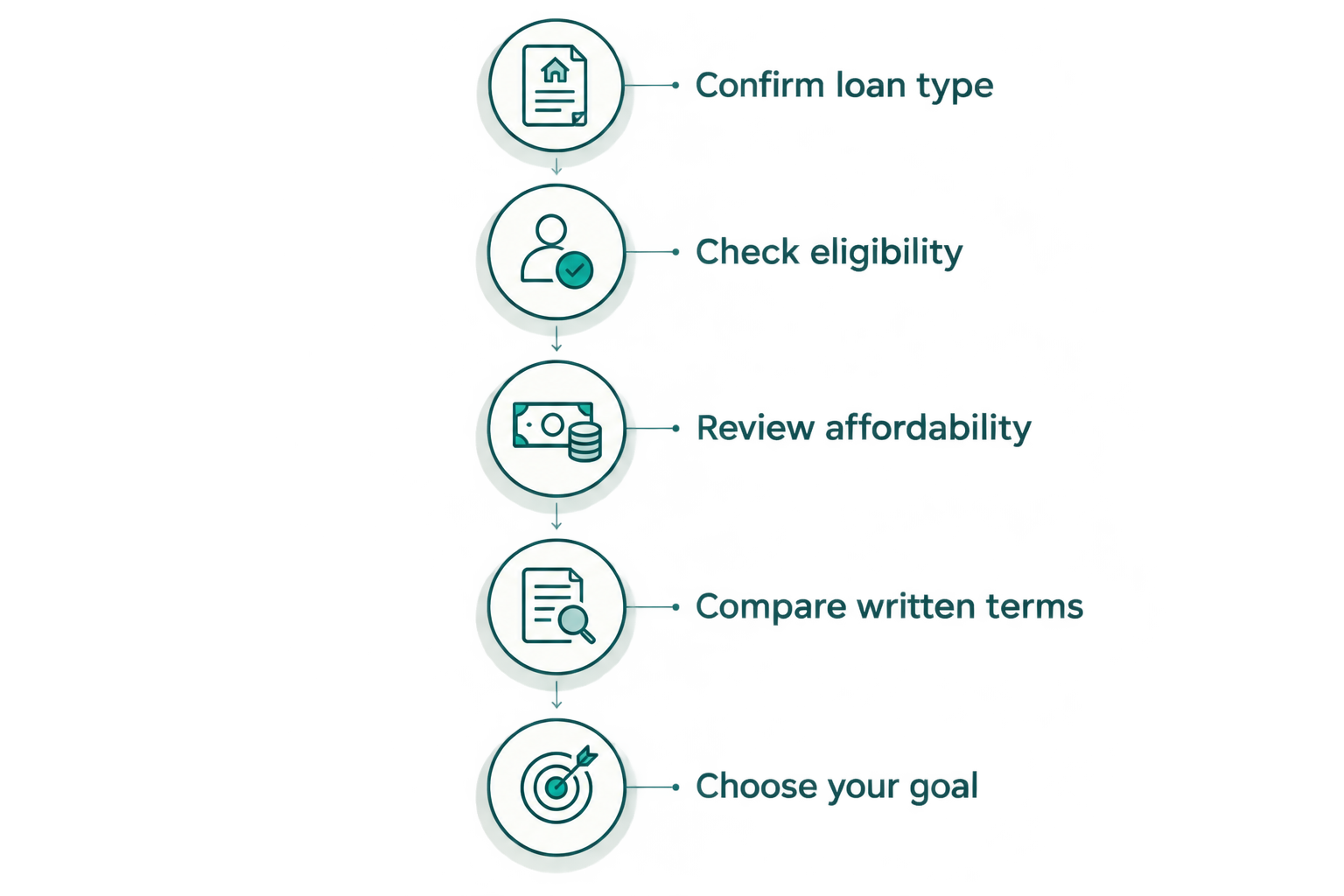
Use this sequence before you commit. It separates eligibility from affordability and keeps a possible sale from becoming your default answer too early.
- Confirm loan type. Ask the servicer whether your mortgage is conventional, FHA-insured, VA-backed, or another type. Do not infer this from the company name on your statement.
- Check eligibility. Ask which refinance or mortgage-assistance program the lender would evaluate. Request an explanation of any requirement that rules you out.
- Review affordability. Compare the proposed payment with reliable income and necessary expenses. Include property taxes, insurance, association dues, and maintenance in your housing budget.
- Compare written terms. Review the new balance, repayment term, amounts due later, and treatment of overdue payments. For a short sale, review the approval conditions and remaining obligations.
- Choose your goal. Decide whether a sustainable stay or an orderly sale fits your situation. Confirm the next action and any deadlines with the appropriate professional.
Keep a record of documents submitted, responses received, and deadlines. Ask the servicer what remains outstanding rather than assuming that submitting an application completes the review.
If a foreclosure notice or sale date is involved, raise it immediately. A refinance inquiry or short-sale request does not, by itself, stop foreclosure. Get case-specific advice from a qualified attorney and confirm any postponement directly.
Can I refinance if I’m current but my house is underwater?
Yes, being current leaves refinancing worth investigating, but it does not override equity or program requirements. Start with your existing loan type and ask whether a qualifying refinance route permits your property’s current value.
Do not deliberately miss payments to try to qualify for help. Ask the servicer which options apply to your present circumstances and what documentation it needs.
Does refinancing remove the underwater balance?
No, refinancing does not automatically remove the underwater balance. It replaces one mortgage with another; principal reduction requires a specific arrangement rather than an assumption.
For any 2026 refinance proposal, compare the current balance with the proposed balance. Ask whether amounts are being added to the new loan and whether the repayment term is being extended.
What if I need to move rather than lower my payment?
If you need to move, refinancing does not solve the sale shortfall. Ask a real estate professional to estimate the likely sale proceeds, then compare those proceeds with mortgage payoffs and other obligations.
If a shortfall remains, Shortsalesdoneright provides short-sale processing and lender negotiation services. Use the homeowner intake form to request help comparing a possible short sale with your other options.
Request help with your next step
Ask about short-sale processing and compare selling with other options for your underwater mortgage.
FAQ
Can I refinance instead of doing a short sale if I owe more than my house is worth?
Yes, if your existing mortgage qualifies for a refinance route that permits the transaction and you meet the lender’s requirements. Negative equity generally prevents a standard refinance unless you address the balance or qualify for a different program.
Does an FHA Streamline refinance require an appraisal?
An FHA Streamline refinance can proceed without an appraisal under FHA program rules. Your lender must confirm the applicable requirements and whether you qualify.
Can a VA IRRRL help if my home is underwater?
A VA IRRRL deserves review because VA does not require an appraisal for the program. You must have an eligible existing VA-backed loan, and lender requirements still apply.
Is a loan modification the same as refinancing?
No, a loan modification changes your existing mortgage, while refinancing replaces it. Neither automatically guarantees principal forgiveness.
Should I stop paying my mortgage to qualify for a short sale?
Do not stop paying solely to try to qualify for a short sale. Ask your servicer about options for your actual circumstances and obtain advice before changing payment behavior.
Will applying to refinance stop a foreclosure?
A refinance application does not, by itself, stop foreclosure. Confirm deadlines with your servicer and seek qualified legal help if a foreclosure action or sale date is involved.
Will a short sale erase everything I still owe?
A short sale does not automatically erase every unpaid obligation. Lender terms and state law vary, so have qualified legal and tax professionals review the consequences.
One last thing
A lower mortgage payment is not proof that keeping the house is the better choice. It must fit your income, other expenses, and plans for the property.
Before signing anything in 2026, ask what you will owe afterward and whether any amount comes due later. For a possible sale, Shortsalesdoneright can help you compare options; qualified legal and tax professionals should review those separate consequences.


