

You generally cannot remove an accurate short sale from your credit report early simply because the sale is complete or your finances have improved. You can dispute inaccurate, incomplete, unverifiable, or outdated reporting, but correcting an error does not necessarily remove the entire mortgage account or erase accurate late payments.
- To remove short sale from credit report early, identify a reporting error; accurate negative information generally stays.
- Experian, Equifax, and TransUnion can show different mortgage information. Check each report before disputing.
- Federal guidance generally allows 30 days for dispute investigations, with some investigations taking 45 days.
- Shortsalesdoneright handles short sale processing and lender negotiation, not a guaranteed credit-report deletion.
Can I remove a short sale from my credit report early?
An error gives you grounds for a dispute. An accurate short sale does not create a right to early deletion. Under the Fair Credit Reporting Act, consumer reporting companies must investigate qualifying disputes and correct or delete information that is inaccurate, incomplete, or cannot be verified.
A short sale does not necessarily appear as a separate item labeled short sale. The mortgage account can instead show that the lender accepted less than the full balance. Review the account status, balance, payment history, and dates together.
For background on the difference between reporting and scoring, read how a short sale affects your credit score.
| What your report shows | Best next step | What that step can accomplish | Limitation |
|---|---|---|---|
| Accurate settlement and payment history | Monitor the account | Helps you catch later changes | Does not require early deletion |
| Incorrect balance or account status | Dispute the specific field | Seeks correction supported by your records | Accurate negative history can remain |
| Negative information beyond its reporting period | Dispute outdated reporting | Seeks removal of information that is too old | The relevant dates must support removal |
| A mortgage that is not yours | Dispute ownership and address possible identity theft | Challenges an account linked to you incorrectly | Requires a different investigation from a settlement dispute |
Why this matters
A clean closing and a clean credit report are different outcomes. Your settlement documents explain what the lender accepted; your credit report describes the account's payment and settlement history.
In 2026, separate these questions before taking action: Is the reporting accurate? Are you still legally responsible for any unpaid balance? Are you eligible for another mortgage? Each requires its own review, and fixing one does not automatically resolve the others.
Keep your credit dispute focused on a provable reporting problem. Send questions about debt liability to a qualified attorney and questions about cancellation-of-debt income to a qualified tax professional. Lender terms and state law vary.
How do I check whether the short sale is reported incorrectly?
Start with your records, not a deletion request. A bureau needs to understand which information you challenge and why it is wrong.
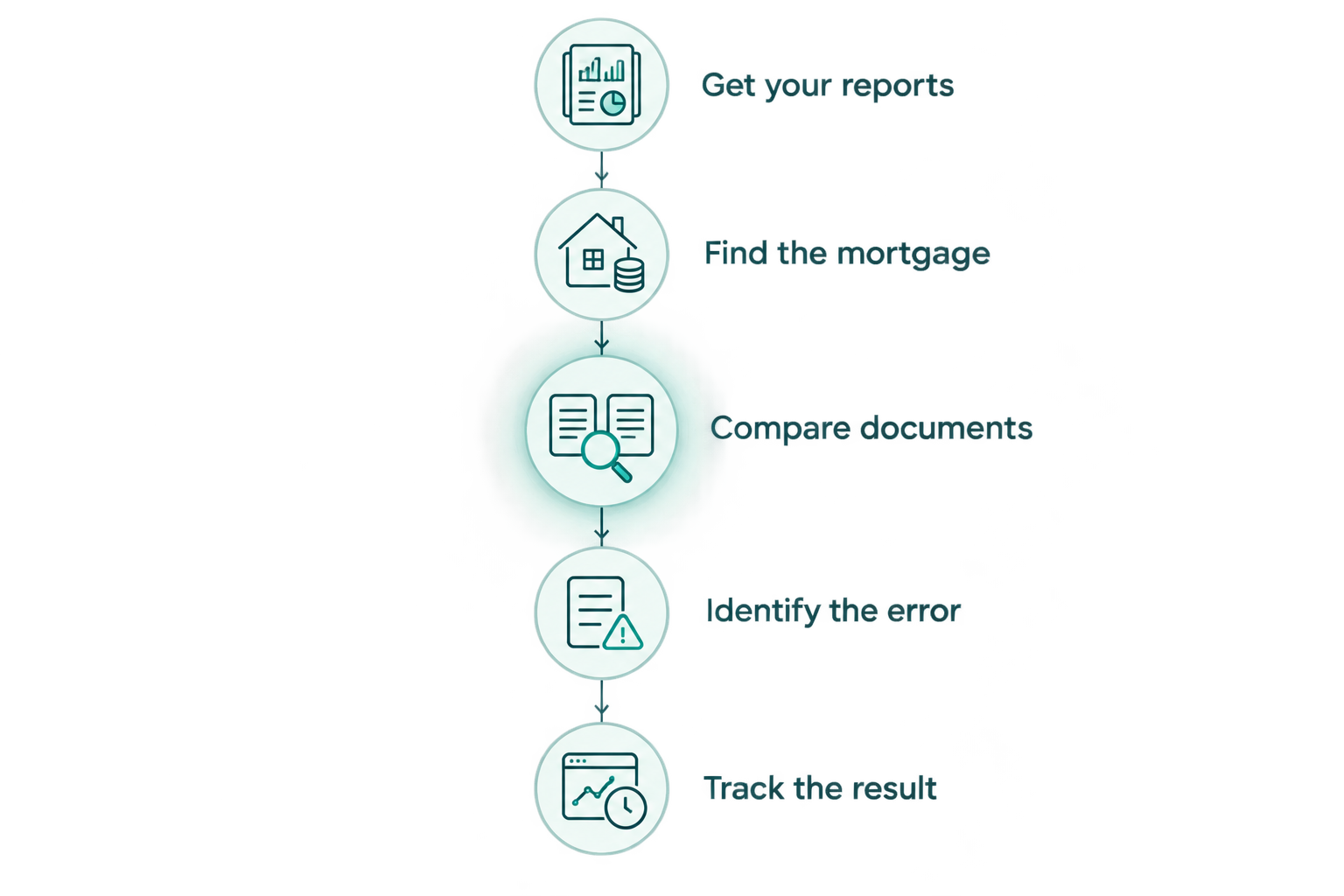
- Get your reports. Obtain your credit reports from Equifax, Experian, and TransUnion through the federally authorized AnnualCreditReport service. Review each report separately because the entries can differ.
- Find the mortgage account. Match the lender or servicer name, partial account number, and property-related records. A transferred mortgage can appear under a name you do not immediately recognize.
- Compare documents. Gather the short sale approval, closing statement, lender correspondence, and any written agreement about the remaining balance. Compare the actual terms with the reported account.
- Identify the error. Specify the disputed balance, status, payment, ownership information, or date. Explain the correction you are requesting rather than demanding that every reference disappear.
- Track the result. Keep the dispute confirmation, supporting documents, investigation result, and updated report. Check whether the correction addresses the original problem.
Send copies of relevant records, not your only originals. Use the bureau's instructions for submitting supporting material, and keep a complete copy of what you send.
For example, if an account still reports a balance that conflicts with the lender's written settlement terms, identify that conflict. Do not assume that accepting a short payoff also means the lender agreed to delete the account's payment history.
How long can short sale information stay on my credit report?
Most negative credit information can generally remain for 7 years, according to Consumer Financial Protection Bureau guidance. That is not a universal instruction to count from your short sale closing date: the applicable reporting period depends on the information reported and the account's delinquency history.
For accounts placed for collection or charged off, the Fair Credit Reporting Act ties the reporting-period calculation to the delinquency that immediately preceded that action, with a statutory 180-day provision. Do not substitute the date the lender last updated the account for the legally relevant delinquency date.
An account update after closing does not, by itself, establish improper reporting. The issue is whether the underlying dates and reporting period are accurate.
For a 2026 review, ask the bureau to explain the scheduled removal date if the report is unclear. A consumer-law attorney can assess a disputed reporting-period calculation when the records conflict.
Does closing the short sale restart the reporting period?
Closing a short sale does not automatically restart the reporting period for earlier negative information. A new update date and an older delinquency date serve different purposes.
Keep the payment history that shows when the relevant delinquency began. A settlement letter alone does not always establish that date.
How do I dispute a short sale reporting error?
Dispute the error with each bureau displaying it and with the lender or servicer furnishing the information. Consumer Financial Protection Bureau guidance recommends contacting both the reporting company and the business that supplied the disputed information.
Your dispute should make the requested correction easy to understand:
- Identify the account. Use the identifying details requested through the official dispute channel.
- Name the disputed field. State whether the problem concerns the balance, status, ownership, payment history, or date.
- Explain the mismatch. Describe how the reporting conflicts with your records.
- Attach relevant evidence. Include the document pages that establish the problem, with the relevant portions identified.
- Request a specific correction. Ask for an accurate balance, corrected status, corrected date, or deletion when the evidence supports it.
Avoid generic claims that the entire account must disappear because the short sale closed. A narrow, documented dispute addresses the information the bureau actually needs to investigate.
How long does a credit-report dispute take?
A credit-report dispute investigation generally takes 30 days, according to Consumer Financial Protection Bureau guidance. Some investigations can take 45 days under federal rules, including certain situations involving additional information.
These are investigation periods, not promised deletion timelines. Read the result carefully: a bureau can correct a field, delete information, or verify the information as reported.
If the result does not address your evidence, request an explanation of the investigation procedure. You can also submit a complaint to the Consumer Financial Protection Bureau or consult a consumer-law attorney about unresolved inaccuracies.
Why early removal outcomes vary
There is no single deletion request that fits every mortgage account. These factors determine what needs investigation:
- Accuracy. A correct settlement notation is different from an incorrect outstanding balance.
- Age. Outdated negative information raises a reporting-period issue, not a request for special treatment.
- Documentation. Written lender terms support a specific dispute; a recollection of a phone conversation is harder to substantiate.
- Reporting source. The bureau displays the information, while a lender or servicer often supplies it. Both can need notice of the error.
- Separate account history. Correcting the short sale status does not automatically remove accurate missed payments or resolve reporting on another mortgage.
- Ownership. An account belonging to someone else requires an ownership dispute, not an argument about how your sale was settled.
In 2026, judge the outcome against the error you documented. A corrected balance can be the right result even when the account remains visible.
Will a goodwill request or credit repair company remove it?
A goodwill request asks the lender for a voluntary change. It does not establish that the reporting is wrong, and the lender has no general obligation to delete accurate negative information because you ask.
Best for a documented error: a specific credit-report dispute. Its benefit is a formal investigation process; its limitation is that accurate information can remain after review.
Best for asking about voluntary accommodation: a goodwill request. Its limitation is straightforward: you cannot rely on acceptance, deletion, or a particular credit-score result.
The Federal Trade Commission warns that credit repair companies cannot legally remove accurate, current negative information. Treat a guaranteed short sale deletion as a warning sign. Do not describe a mortgage as identity theft unless it actually is.
You can submit your own disputes. Hiring help does not change the standard for whether the information is accurate or reportable.
What if I have not completed the short sale yet?
Before closing, focus on understanding the lender's written terms. Ask what the approval says about the unpaid balance, what conditions remain, and what documents you will receive after settlement. Do not treat a verbal reassurance as a promise about credit reporting.
Shortsalesdoneright is best suited to homeowners who need short sale processing and lender negotiation, not guaranteed credit-report deletion. Shortsalesdoneright helps homeowners compare a short sale with other options; its service does not establish a right to remove accurate credit history.
If you are still weighing an upside-down mortgage in 2026, request help through the homeowner intake form on the Shortsalesdoneright site. Ask a qualified attorney about legal obligations and a qualified tax professional about potential tax consequences before relying on settlement terms.
Get help comparing your options
Request short sale processing and lender negotiation help for your mortgage situation.
FAQ
Can I remove a short sale from my credit report before seven years?
You can dispute inaccurate, incomplete, unverifiable, or outdated short sale reporting before seven years. An accurate negative entry does not have to be deleted simply because you request early removal.
Does a short sale approval letter prove the credit report is wrong?
A short sale approval letter supports a dispute only when its terms establish a conflict with the reported information. Approval to accept a reduced payoff does not automatically require deletion of accurate payment history.
Will paying the remaining balance erase the short sale?
Paying a remaining balance does not automatically erase accurate short sale history. Whether a balance is owed depends on the lender's written terms and applicable law; consult a qualified attorney before assuming liability or forgiveness.
Can I dispute the short sale with all three credit bureaus?
Dispute the information with each credit bureau that reports the error. Equifax, Experian, and TransUnion can display different information, so identify the problem separately on each affected report.
Will correcting a short sale increase my credit score?
Correcting a short sale reporting error does not guarantee a credit-score increase. The result depends on the correction, the scoring model, and the other information in your credit file.
Can a lender remove accurate late payments after my short sale closes?
A lender is not generally required to remove accurate late payments because a short sale closes. You can ask about a voluntary adjustment, but you cannot rely on deletion or a specific credit outcome.
Does removing a short sale mean I qualify for another mortgage?
Removing or correcting a credit entry does not automatically qualify you for another mortgage. A lender evaluates loan-program requirements and your financial circumstances separately from the credit-report dispute.
One last thing
An accurate report matters more than a report with fewer visible accounts. Removing a settlement notation is not the same as removing every accurate late payment associated with the mortgage.
For your 2026 records, keep the approval letter, closing statement, final lender correspondence, and dispute results together. Those documents help you explain what happened without relying on a credit-report label alone.