

Yes, you can pursue a short sale of your house with an IRS tax lien in 2026, but the mortgage lender’s approval does not resolve the federal tax lien. You also need a title-clearing solution, often an IRS discharge of the property from the lien. Removing the lien from the house does not, by itself, erase your tax debt.
- Short sale house with IRS tax lien: possible, but lender approval alone does not clear the federal lien.
- An IRS property discharge removes the lien from that property, not necessarily your underlying tax debt.
- IRS Publication 783 recommends submitting a discharge application at least 45 days before the transaction.
- Shortsalesdoneright handles short sale processing; qualified legal and tax professionals should address your IRS obligations.
Can I short sale my house if I have a tax lien from the IRS?
Yes, if the mortgage lender accepts the short sale and the IRS lien is resolved sufficiently for closing. The buyer’s title requirements must also be satisfied. These are separate decisions, even when everyone reviews the same proposed sale.
Start with a title review, not a promise that the bank will handle everything. Shortsalesdoneright provides short sale processing and lender negotiation services, while your title professional and qualified tax adviser address the federal lien requirements.
The key distinctions are below. None of these documents should be treated as a substitute for another.
| Decision or document | Best for | What it addresses | What it does not establish |
|---|---|---|---|
| Mortgage short sale approval | Selling for less than the mortgage payoff | The mortgage lender’s conditions for accepting the sale | IRS consent or automatic forgiveness of the mortgage balance |
| IRS property discharge | Transferring a particular property without the federal lien attaching to it | Removal of the federal tax lien from the specified property | Cancellation of your remaining tax debt |
| Federal tax lien release | Clearing a lien after the applicable release requirements are met | Release of the federal tax lien | Permission from the mortgage lender to accept a short payoff |
Bank approval is not IRS approval. Your closing team needs documents that address both claims.
Why this matters
An accepted offer can still leave you unable to close if the IRS lien remains unresolved. A lender’s approval letter addresses that lender’s position, not every claim against the property.
There are 3 separate decisions to confirm: mortgage approval, IRS lien treatment, and title clearance. Track each one by the document needed, the person responsible, and the outstanding condition.
A discharge also creates a distinction that matters after closing. You can transfer the house without settling your entire tax account. Ask a qualified tax professional what collection obligations remain before you agree to the sale.
IRS property discharge: removing the lien from this house
A property discharge removes specified property from the effect of a federal tax lien. It is often the relevant request when you need to sell a house but cannot fully resolve the tax debt through the sale.
The IRS evaluates the applicable legal basis and its interest in the property. An underwater mortgage does not automatically establish that the IRS must discharge the house. Lien priority, property value, and the proposed distribution of proceeds matter.
For a 2026 application, use the IRS’s current Form 14135, Application for Certificate of Discharge of Property from Federal Tax Lien, and Publication 783, which explains the application process. Confirm the current submission instructions before sending sensitive records.
The benefit is specific: a discharge can address the federal lien that obstructs the transfer. The limitation is equally specific: a property discharge does not necessarily reduce the amount you owe the IRS.
Federal tax lien release: a different result
A lien release is not another name for a property discharge. A release addresses the federal tax lien itself when the applicable release requirements are met, rather than removing only the house being sold.
If you cannot pay the tax balance through the transaction, do not assume a full release is the required or available route. Ask your tax adviser and title professional which document fits your circumstances.
Also separate a lien release from withdrawal of a filed lien notice. Withdrawal concerns the public notice and does not, by itself, cancel the underlying tax debt. Request the document that actually solves the closing problem.
How do I prepare a short sale with an IRS tax lien?
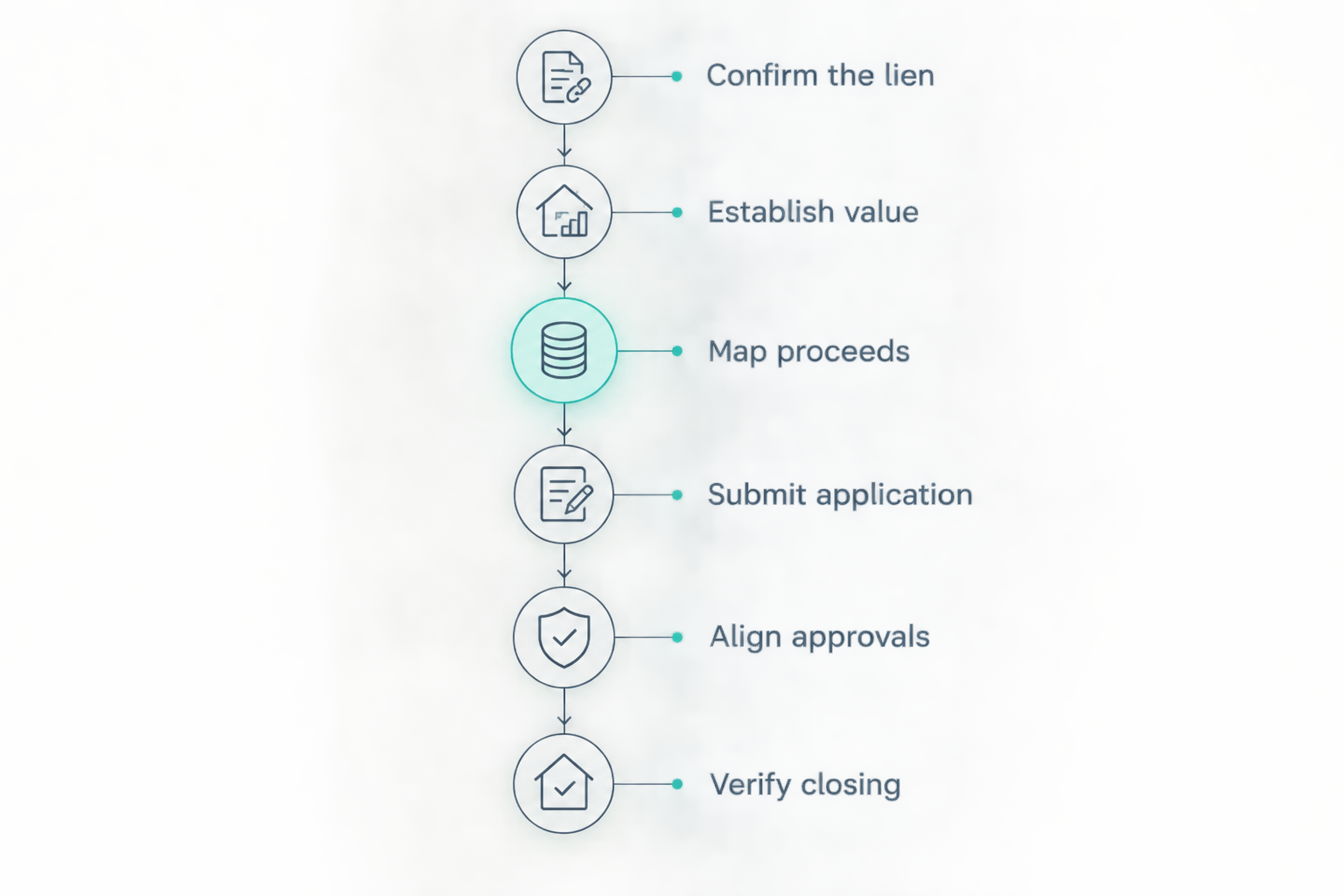
Use these 6 steps to coordinate the mortgage review and the federal lien issue. Begin the title work early, so the IRS request does not become a last-minute discovery.
1. Confirm the lien
Give your title company or closing attorney every IRS lien notice you have. Ask for a title search that identifies the recorded federal tax lien, mortgages, judgments, and other claims affecting the house.
Confirm whose tax debt appears on the notice and how the property is owned. Joint ownership, a trust, or a lien involving only one owner needs case-specific review. Do not assume the lien is irrelevant because your spouse or another owner owes the tax.
2. Establish value
Gather the purchase contract and the valuation records required for the application. Your tax adviser should check the current IRS instructions for acceptable supporting evidence.
A low offer alone does not prove the property has no value for the IRS. The proposed price needs support, especially when the sale would leave the federal tax claim unpaid.
3. Map proceeds
Have the closing professional prepare a proposed settlement statement showing where the sale proceeds would go. It should match the transaction being presented to the mortgage lender and the IRS.
Do not assume every proposed payment will be accepted. Ask the title professional and tax adviser to explain lien priority and the proposed allocation. If the IRS requires a payment, the closing figures and other approvals must accommodate it.
4. Submit application
Prepare Form 14135 with the supporting documents required for your situation. These generally include information about the property, the federal lien, the proposed transaction, valuation, and claims against the property.
IRS Publication 783 recommends submitting the application at least 45 days before the transaction date. That is planning guidance, not a guaranteed decision deadline. Confirm the current requirements and allow time to answer requests for additional information.
5. Align approvals
Compare the mortgage approval conditions with the IRS’s written requirements and the proposed settlement statement. Check the approved proceeds, required payments, expiration dates, and any conditions that must be satisfied before documents are issued.
Tell the lender negotiator when the IRS request affects the closing schedule or distribution. If the lender changes the terms, ask whether the IRS submission also needs updating. Separate approvals built on different figures do not create a closing-ready transaction.
6. Verify closing
Before signing, have the title professional confirm exactly what IRS documentation is required and how its conditions will be met. A pending application is not a discharge certificate.
Keep copies of the mortgage approval, IRS documents, final settlement statement, and relevant correspondence. Ask your tax adviser what remains due after closing and what records you will need for your tax return.
Why IRS lien outcomes vary
The house’s mortgage balance is only part of the review. These factors explain why another seller’s result does not establish what the IRS will require in your case:
- Property value. The IRS needs support for the value used in the discharge request, not just the seller’s estimate.
- Lien priority. The order and legal standing of claims affect the IRS’s interest in the sale proceeds. Recording dates alone do not resolve every priority question.
- Proposed distribution. The settlement statement shows what each claimant would receive and which expenses the transaction would pay.
- Ownership. The identity of the taxpayer and the form of ownership can affect the analysis.
- Application completeness. Missing documents or inconsistent figures create additional questions before a decision can be made.
- Transaction changes. A replacement buyer, revised price, or changed distribution needs review rather than an assumption that earlier terms still apply.
For your 2026 sale, build the plan around the current title report and written requirements. Do not rely on an old approval from a different transaction.
What should I ask before accepting an offer?
Ask your agent and closing professional whether the proposed contract gives the transaction room for both lender review and IRS lien resolution. A qualified attorney should advise you on contract language and deadlines.
Bring these questions to the discussion:
- Who will prepare and submit the IRS discharge application?
- Who will answer IRS requests for additional documents?
- Does the proposed settlement statement account for every identified lien?
- What happens if the IRS requires a payment the lender has not approved?
- Who will check approval expiration dates before scheduling closing?
If you have received a foreclosure notice or sale date, tell your attorney immediately. Submitting a short sale request or an IRS discharge application does not itself stop foreclosure. Lender terms and state law vary.
For closing coordination, review how to connect your title company to short sale closing. The title professional should be involved before the final approval arrives.
Where does short sale processing help?
Shortsalesdoneright short sale processing is best for homeowners who need lender coordination while qualified advisers address the IRS lien. The service provides a dedicated point of contact and weekly lender updates. For agents, it includes preparing the full short sale package.
Keep the responsibilities distinct. Short sale processing addresses the lender submission and negotiation; it does not replace legal advice, tax advice, or the IRS’s decision on a discharge request.
If you are ready to act, request help through the homeowner intake form on the site. Explain that an IRS lien affects the property and identify any foreclosure deadline at the start.
Request help with your short sale
Explain your mortgage situation and IRS lien through the homeowner intake form.
Does an IRS discharge forgive my unpaid taxes?
No. An IRS property discharge removes the specified property from the lien; it does not necessarily forgive your unpaid taxes. The IRS can retain collection rights against you and other property, subject to applicable law.
The mortgage balance is a separate issue. Read the lender’s approval for any terms about the unpaid mortgage debt, and have an attorney explain language you do not understand.
Can the IRS discharge the house without receiving proceeds?
Yes, a discharge without payment is possible when the IRS determines its interest in the property has no value under the applicable discharge rules. That result is not automatic merely because the mortgage exceeds the sale price.
Support the request with the required valuation, claim information, and proposed distribution. Your qualified adviser should identify the appropriate basis for the application.
Does a short sale create another tax issue?
Yes, cancellation of mortgage debt can create a separate federal tax question. Any applicable exclusion or exception depends on your circumstances and the law governing the relevant tax year.
Ask a qualified tax professional to review both the existing IRS debt and the proposed mortgage cancellation. Clearing title does not answer either tax question by itself.
FAQ
Can I short sale my house with an IRS tax lien in 2026?
Yes, if the lender approves the short sale and the federal lien is resolved sufficiently for closing. An IRS property discharge is one route, but the IRS must approve the applicable request.
Which IRS form do I need to sell a house with a federal tax lien?
Form 14135 is the application for a certificate of discharge of property from a federal tax lien. Check the current instructions and IRS Publication 783 for the supporting documents required in your situation.
How early should I apply for an IRS property discharge?
IRS Publication 783 recommends applying at least 45 days before the transaction date. That recommendation is not a promise that the IRS will decide your application within that period.
Will the IRS remove its lien if my mortgage is underwater?
An underwater mortgage does not automatically qualify the house for discharge. The IRS evaluates its interest using the applicable rules, property value, competing claims, and supporting records.
Does my bank’s short sale approval cover the IRS lien?
No, mortgage short sale approval does not resolve an IRS tax lien. Your title professional must confirm the separate federal lien requirements for closing.
Will an IRS payment plan clear the lien so I can sell?
An IRS payment plan does not automatically remove the federal tax lien from your house. Ask your tax adviser which discharge or other title-clearing action your transaction requires.
Can Shortsalesdoneright help with my short sale?
Shortsalesdoneright provides short sale processing and lender negotiation services for homeowners and real estate agents. Qualified legal and tax professionals should advise you on IRS lien rights, remaining tax debt, and state-law obligations.
One last thing
Ask what document clears the property, not whether someone has approved the sale. Those are different questions. Before your 2026 closing, have the title professional identify the required IRS document and explain any conditions still outstanding.
Lender terms and state law vary. Get legal advice about remaining mortgage liability and tax advice about existing tax debt or canceled debt before you sign.