

A short sale can damage a cosigner’s credit if the mortgage appears on the cosigner’s credit reports and the lender reports missed payments or a settlement for less than the full balance. Living elsewhere or leaving payment management to the homeowner does not remove the obligation you signed. Selling the property also does not automatically release you from an unpaid balance; that depends on the lender’s written terms and applicable state law.
- How does a short sale affect a cosigner's credit? Reported late payments and a less-than-full settlement can hurt it.
- A short-sale approval is not automatically a release of the cosigner’s remaining debt.
- Get written terms covering each obligated borrower before agreeing to close.
- Shortsalesdoneright helps homeowners compare short-sale options; it cannot promise lender approval or a credit-score outcome.
How does a short sale affect a cosigner’s credit?
A cosigner’s credit exposure follows the loan obligation and reported account history—not who lives in the house. If you signed for repayment, the homeowner’s missed payments can become part of your credit history too. The broader guide to short-sale credit effects explains why payment history and the final account status both matter.
Separate these situations before assessing your risk:
| Your situation | Credit concern | What to check |
|---|---|---|
| You signed the loan and payments are current | A settlement for less than the full balance can still be negative | Current account status and proposed reporting |
| You signed the loan and payments are late | Reported delinquencies can hurt your credit before closing | Payment history on your own reports |
| The lender approves a short sale | Approval alone does not establish your release from remaining debt | The approval letter and any separate release |
| Your name is on the deed but not the loan | Ownership alone does not establish personal repayment liability | The note, guarantees, and other signed documents |
There is no fixed point loss that applies to every cosigner in 2026. Your existing credit history, the reported mortgage history, and the scoring model affect the result. A prediction based only on the words short sale leaves out those differences.
Why this matters
A homeowner can focus on selling the property while a cosigner focuses on protecting a separate household’s finances. Both concerns belong in the same transaction, but they are not interchangeable.
Treat credit reporting and remaining debt as separate questions. A lender can agree to release its claim against the property without necessarily releasing every person who promised repayment. Likewise, a written debt release does not automatically erase accurate late-payment reporting.
For a 2026 short sale, your immediate task is to identify what you signed, what has already been reported, and what the lender proposes to release. Do not wait until closing to raise those questions.
If payments are current: settlement reporting still matters
Keeping the mortgage current avoids adding missed-payment history while payments remain on time. It does not guarantee that a settlement for less than the full amount will leave your credit unchanged.
Ask the servicer how it expects to report the completed transaction for each obligated borrower. Request the explanation in writing, while recognizing that a short-sale processor cannot guarantee a particular credit-report entry or score.
Do not stop making payments simply because someone says missed payments are required for a short sale. Ask the servicer about its eligibility rules and discuss your circumstances before changing payment arrangements. A homeowner’s payment decision can affect a cosigner who receives no direct benefit from the sale.
If payments are late: the damage can begin before closing
Late-payment reporting can affect the cosigner before the lender approves an offer. Closing the sale does not make earlier, accurately reported delinquencies disappear.
Credit reports distinguish delinquency stages such as:
- 30 days late: Check whether the account shows an initial reported delinquency.
- 60 days late: Check whether the missed-payment history has progressed.
- 90 days late: Check whether the account reflects a more serious delinquency.
These are reporting categories, not predictions about how many points you will lose. Verify the actual entries rather than assuming the homeowner’s report and yours contain identical information.
Under the Fair Credit Reporting Act, most negative credit information can generally remain on a credit report for up to 7 years. That federal reporting framework applies in 2026; the starting point and treatment depend on the type of entry. Do not assume the short-sale closing date restarts the reporting period for every earlier late payment.
Why a cosigner’s credit outcome varies
The same property sale can affect two borrowers differently because their credit files are different. These factors explain why a single score-loss estimate is unreliable:
- Signed obligations. A borrower, guarantor, and owner who did not sign for repayment can have different obligations. Have a lawyer interpret unclear documents.
- Payment history. A current mortgage and a mortgage with reported delinquencies do not present the same credit history.
- Final account reporting. Review whether the account shows an accurate balance, payment history, and settlement status after closing.
- Existing credit history. The mortgage entry becomes part of your own credit file, not the homeowner’s file alone.
- Scoring model. Different scoring models can produce different results from the same underlying information.
- Other secured loans. A second mortgage or home-equity loan requires its own review; resolving one account does not establish how another will be treated.
Remaining debt is a separate legal issue, even when it later affects your finances. Lender terms and state law vary. Ask a qualified attorney whether the proposed agreement releases you personally, not just whether the sale can close.
What should a cosigner do before approving a short sale?
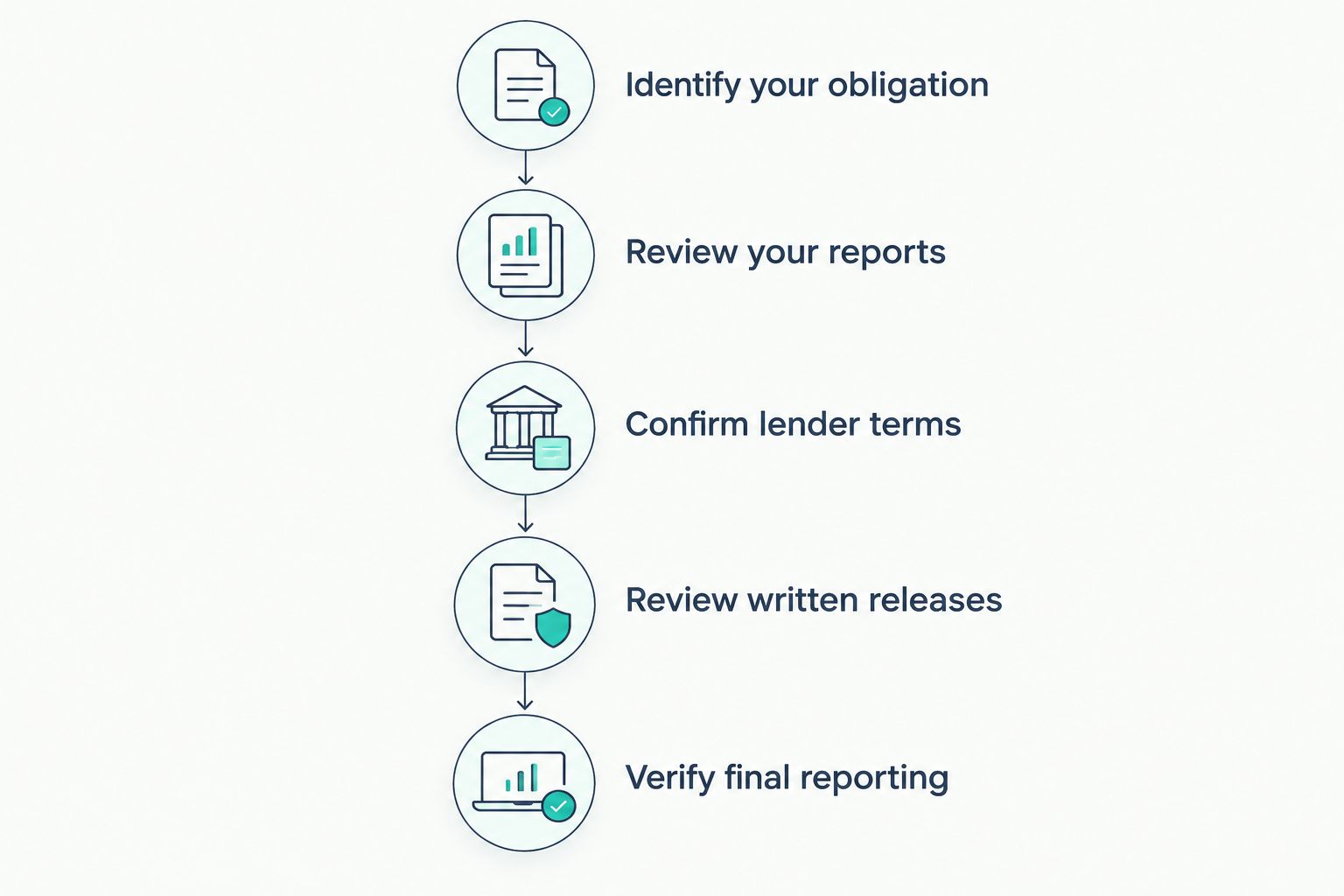
Use this sequence before signing sale-related agreements or relying on the homeowner’s understanding of the lender’s terms. If a foreclosure deadline is approaching, get legal advice promptly; a short-sale application does not automatically stop that process.
Identify your obligation
Collect the signed promissory note, any guarantee, and relevant loan agreements. A deed identifies ownership, but it does not answer every question about repayment liability.
Ask a real estate attorney to explain your role if the documents are unclear. Do not assume that the informal label cosigner describes every provision you signed.
Review your reports
Obtain your credit reports from Equifax, Experian, and TransUnion. Check whether the mortgage appears, whether your responsibility is described accurately, and whether the payment history matches your records.
Save copies for comparison after closing. If the account does not appear on one report, do not treat that absence as proof that you have no legal obligation or that the account cannot appear later.
Confirm lender terms
Ask the servicer what information it needs from you and how you can receive updates. Its authorization and privacy requirements determine what it can share with the homeowner, agent, processor, and cosigner.
Keep payment questions separate from sale negotiations. Find out whether payments are current, what amounts remain unpaid, and whether any existing payment arrangement continues during review.
Review written releases
Have an attorney review the approval letter and any proposed agreement before closing. The review should address each obligated person and each relevant loan.
Ask whether the documents release only the lender’s claim against the property or also address personal responsibility for an unpaid balance. Watch for requests to sign a new repayment agreement. Do not assume a release covering the homeowner also covers you.
Verify final reporting
Keep the approval letter, releases, closing documents, and account correspondence. After the servicer updates the account, compare the credit-report entries with those records.
Dispute specific inaccuracies with the credit reporting company and the business that supplied the information. Accurate negative information is different from an error; do not describe every unfavorable entry as incorrect.
What should you ask the lender in writing?
A useful request names the cosigner and the loan instead of asking whether everything is handled. Keep the written response with your transaction records.
Ask these questions:
- Does the proposed approval address every person obligated on this loan?
- Will any unpaid balance remain collectible from me after closing?
- Does the agreement require a separate payment or repayment promise?
- How does the servicer expect to report the completed account?
- Which documents will confirm that the agreed terms were completed?
A phone conversation helps clarify the process, but it is not a substitute for reviewing the actual agreement. If a verbal explanation conflicts with the paperwork, resolve the conflict before signing.
For a 2026 transaction, use the documents issued for your own loan. Another seller’s approval letter, even from the same lender, does not establish your terms.
Is a short sale better than keeping the mortgage?
The right comparison starts with whether the homeowner can afford to keep the property and whether the lender offers a workable alternative. A short sale addresses a sale below the mortgage balance; it is not a promise of less credit damage than every other option.
| Option | Best for | Main benefit | Main limitation |
|---|---|---|---|
| Short sale | Homeowners who need to sell an underwater property | Provides a lender-reviewed path to a sale | Requires approval; credit and remaining-debt issues need review |
| Loan modification | Homeowners seeking to keep the property with changed loan terms | Can change the existing payment arrangement if approved | Does not sell the property or automatically release a cosigner |
| Repayment arrangement | Homeowners able to resume payments and address arrears | Can provide a structured way to catch up | Requires an affordable arrangement and does not erase accurate past reporting |
Compare the actual proposed agreements, not the labels. An option that helps the homeowner keep the house can still leave you responsible for the mortgage. An option that transfers the property can still require careful review of your remaining liability.
Can I remove myself as cosigner before the short sale?
You cannot remove yourself from a signed repayment obligation merely by asking the homeowner to take over. A lender-approved release or another legally effective resolution is needed.
Changing the deed is not the same as changing the loan. Before transferring an ownership interest, ask an attorney what the transfer would—and would not—change about your obligations.
Will the lender pursue me after the house sells?
The answer depends on your signed obligations, the lender’s written agreement, and applicable state law. Do not treat approval of the sale as confirmation that the lender has waived every claim against you.
Have an attorney review any language about an unpaid balance or future collection. A tax professional should separately review potential tax consequences; a credit-report update does not resolve those questions.
Where can a homeowner get short-sale help?
Shortsalesdoneright is best for homeowners who need short-sale processing and lender negotiation support while comparing their options. The service helps with the transaction process; legal advice, tax advice, lender approval, and specific credit outcomes remain outside that promise.
If you are ready to act, visit Shortsalesdoneright and request help through the homeowner intake form. Tell the team that a cosigner is involved so the file identifies the additional person whose obligations need review.
Request help with your short sale
Explain your mortgage situation and identify any cosigner when requesting homeowner help.
FAQ
Will a short sale hurt my credit if I only cosigned?
A short sale can hurt your credit if the mortgage is reported on your credit file and includes delinquencies or a settlement for less than the full balance. Not living in the home does not remove a repayment obligation you signed.
How many points will my credit score drop after a short sale?
There is no fixed point loss for a cosigner after a short sale. Your credit history, the account’s reported history, and the scoring model determine the effect.
Can a short sale affect me if the homeowner never missed a payment?
Yes, a settlement for less than the full balance can affect your credit even without missed payments. Keeping payments current does not guarantee a neutral credit result.
Does a short-sale approval release the cosigner?
A short-sale approval does not automatically release the cosigner from an unpaid balance. Have an attorney review whether the written agreement specifically addresses your personal obligation.
Does being on the deed make me responsible for the mortgage?
Being on the deed alone does not establish that you personally promised to repay the mortgage. Your signed loan documents and applicable law determine your obligations.
Can I dispute a short sale on my credit report?
You can dispute inaccurate or incomplete account information with the credit reporting company and the business that supplied it. Accurate negative information is not an error simply because it lowers your score.
Can Shortsalesdoneright guarantee that my credit will be protected?
Shortsalesdoneright cannot guarantee a credit-score result, lender approval, or forgiveness of an unpaid balance. Its short-sale processing and lender negotiation services do not replace legal or tax advice.
One last thing
Check your name, not just the property address. A document authorizing a sale answers a different question from a document releasing your personal repayment obligation.
Before a 2026 closing, ask your attorney to identify the language that applies to you. If the document does not clearly resolve your obligation, get clarification before treating the sale as the end of your responsibility.