

A lender generally needs a complete short-sale package—not just the buyer’s offer—before it can evaluate the proposed sale and the homeowner’s financial situation. There is no universal page count: follow the mortgage servicer’s current checklist for financial records, hardship information, signed sale documents, and estimated closing proceeds. A complete submission starts the review; it does not guarantee approval or prevent requests for updated records.
- How much documentation does a lender require before reviewing a short sale offer? Follow the servicer’s checklist, not a page target.
- A signed offer alone generally does not establish the homeowner’s hardship, finances, or proposed lender proceeds.
- Ask which documents remain outstanding and whether the file is complete for evaluation.
- Shortsalesdoneright provides short-sale processing for agents who want package preparation and lender follow-up handled.
Why this matters
An uploaded offer and a complete review file are different things. Your servicer needs enough information to assess the seller’s circumstances and the proposed transaction. Missing signatures, incomplete statements, or conflicting figures create questions that an offer alone cannot answer.
For agents managing a short-sale listing in 2026, the useful target is a documented, complete submission—not a thick submission. Shortsalesdoneright prepares the full short-sale package for agents and provides a dedicated point of contact and weekly lender updates. Those services support the process; the lender still makes the decision.
How much documentation does a lender need to review a short sale offer?
Expect to document the borrower, the hardship, the property sale, and the proposed distribution of proceeds. The exact requirements depend on the servicer, the mortgage’s applicable program, and the borrower’s circumstances. Ask for the current short-sale checklist before collecting records.
Use this table to organize the request. It is a preparation guide, not a substitute for your servicer’s instructions.
| Document group | Records to prepare when requested | What the records establish |
|---|---|---|
| Borrower authorization | Signed third-party authorization and required application forms | Who the servicer can communicate with and whose application it is reviewing |
| Hardship information | Hardship statement and supporting records | Why the borrower is requesting a short sale |
| Income and assets | Pay records, benefit statements, bank statements, or business financial records | The borrower’s financial position |
| Tax information | Tax returns, transcripts, or other requested tax forms | Financial information required for the evaluation |
| Sale documents | Executed purchase agreement, addenda, and requested listing records | The proposed transaction and its terms |
| Closing and title information | Estimated settlement statement and information about other liens | Proposed proceeds and claims affecting the sale |
Ask the servicer to identify missing items specifically. “Documents received” does not answer whether the file is ready for evaluation. Keep the response with your submission record so you know what remains outstanding.
For a document-focused companion checklist, see documents to include in a short-sale package.
Borrower records: Show the financial picture clearly
A hardship explanation gives the financial records context. It should describe what changed, how that change affects the mortgage, and whether the situation is continuing. Keep it factual and consistent with the application.
Supporting records should match the hardship described. A job-loss explanation and a self-employment income decline involve different evidence. Supply what the servicer requests rather than adding unrelated personal records.
For income and asset documentation, check these details before submission:
- Coverage: The records cover the dates the servicer requested.
- Completeness: Statements include every requested page, including pages without transactions.
- Consistency: Names, account information, and income figures agree across the application.
- Readability: Scans show the entire page without cropped totals or signatures.
- Explanation: Any requested explanation for a discrepancy accompanies the relevant record.
If a requested document does not exist, ask which substitute the servicer accepts. Do not leave the item unexplained or create a record to fill the gap. For example, a homeowner without wage income should ask how to document the income or support actually received.
Use the servicer’s secure submission method for sensitive financial information. Confirm the recipient before sending tax records, account statements, or identifying information.
Offer documents: Show the complete transaction
The purchase agreement needs to tell a consistent story. Check the property address, buyer and seller names, signatures, dates, and referenced addenda. Include the documents the servicer requests to support the buyer’s proposed financing or funds.
The estimated settlement statement serves a different purpose from the contract. It shows how the proposed transaction translates into estimated proceeds after the listed charges and payments. Coordinate its preparation with the appropriate closing professional rather than treating the purchase price as the lender’s expected proceeds.
Pay particular attention to changes after the initial offer. A revised purchase price, concession, buyer, or closing arrangement can make an earlier submission inaccurate. Send the relevant signed amendment and updated supporting documents when required.
Keep one clearly identified current contract set. Preserve earlier versions in your records, but make the active agreement unmistakable. A reviewer should not have to guess which offer terms apply.
For a 2026 submission, check the servicer’s current forms and instructions instead of reusing a prior transaction’s package unchanged. An organized old checklist is still the wrong checklist if the current file requires something different.
How to confirm the package is ready for review
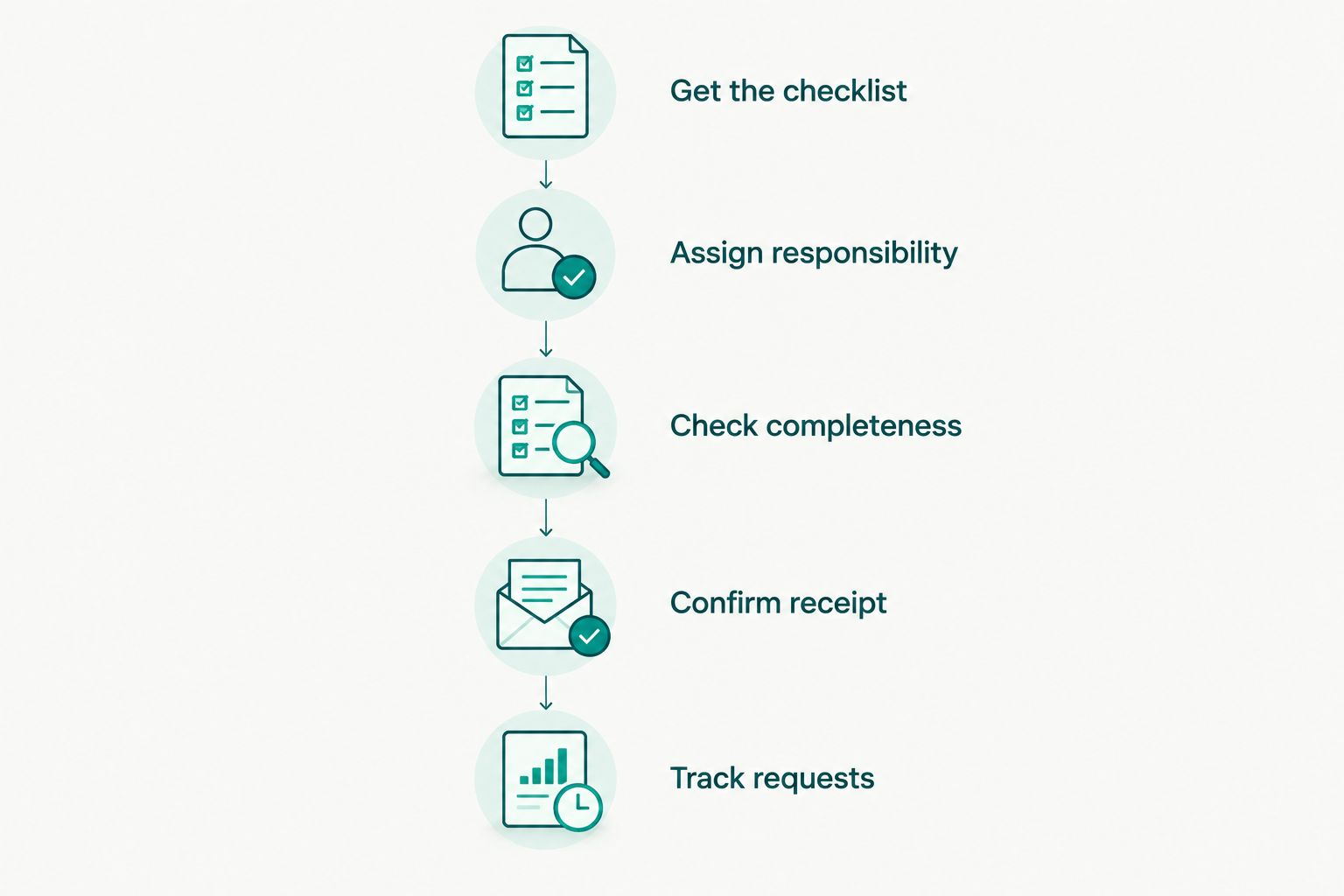
Treat submission as a sequence with a recorded outcome at each stage. The goal is to establish what the servicer received, what it still needs, and what happens next.
- Get the checklist. Request the current short-sale application instructions, required forms, submission method, and applicable deadlines. Confirm whether the servicer accepts preliminary documents before an offer arrives.
- Assign responsibility. Identify who collects homeowner records, checks the contract, coordinates the estimated settlement statement, and communicates with the servicer. Give each outstanding item an owner.
- Check completeness. Compare the assembled file against the checklist. Resolve missing pages, unsigned forms, inconsistent figures, and unclear document versions before uploading.
- Confirm receipt. Save the submission confirmation and an index of what was sent. Ask whether the servicer can open and read the documents.
- Track requests. Ask whether the package is complete for evaluation. Record each additional request, its deadline, the responsible person, and the date it was answered.
A submission confirmation proves transmission, not approval or completeness. Keep those milestones separate when updating the homeowner or buyer’s agent.
After an additional request arrives, update the same tracking record rather than starting a separate email-only list. This keeps the homeowner’s tasks and the agent’s follow-up aligned. Ask for clarification immediately when a request is ambiguous.
Why short-sale documentation requirements vary
There is no reliable universal document total for a 2026 short sale. These file-specific factors explain why one borrower’s package differs from another’s:
- Mortgage program and investor requirements. The rules governing the loan affect the forms and evidence the servicer requests.
- Income source. Employment, self-employment, benefits, and rental income require different supporting records.
- Hardship circumstances. The documents should support the actual reason for seeking relief.
- Borrower and ownership structure. Additional borrowers, a trust, an estate, or disputed authority can require clarification of who must participate or sign.
- Other liens. A second mortgage, tax lien, or other claim affects the information needed to assess the proposed closing.
- Changes during review. Updated finances or revised sale terms can require replacement documents.
These differences are a reason to ask targeted questions, not to send every record you possess. Match the documentation to the request and the facts. Ask a qualified attorney about ownership, signing authority, or legal rights when those issues arise.
What should the homeowner handle, and what should the agent handle?
The homeowner supplies accurate personal information and financial records. The homeowner also reviews and signs required forms, explains the hardship truthfully, and responds when the servicer needs clarification. An agent should not guess at those answers.
The agent coordinates the listing and transaction documents within the agent’s role. That includes keeping the purchase agreement and addenda consistent, communicating transaction changes, and coordinating with the closing professional on requested sale information.
Shortsalesdoneright is best for real estate agents who want short-sale package preparation and lender follow-up handled. Its processing services include preparing the full package, a dedicated point of contact, and weekly lender updates. The boundary is clear: outside processing does not replace the homeowner’s records, the lender’s decision, or legal and tax advice.
Before requesting processing help, identify the outstanding documents and any known sale or foreclosure deadlines. This gives the processor a clear starting point. In 2026, as with any active transaction, communicate the actual file status rather than promising an approval date.
Request short-sale processing help
Get help preparing the package and coordinating lender follow-up for your short-sale listing.
Can a lender review my offer before every document is submitted?
A servicer can receive an offer before the borrower’s full file is complete, but receipt is not the same as a full evaluation. Ask which preliminary steps it will take and which documents it requires before evaluating the proposed short sale.
Do not describe the file as “under approval” simply because the offer was uploaded. Tell the buyer’s agent whether receipt, completeness, or a substantive review has actually been confirmed.
Will the lender ask for updated documents after submission?
A lender can request updated financial information or revised sale documents during review. Changes in income, an amended contract, or records that no longer meet its date requirements can trigger another request.
Ask which documents need refreshing and what dates they must cover. Do not assume that resending the entire original package answers a specific request.
Does a complete package mean the short sale will be approved?
A complete package does not guarantee approval. The lender still evaluates the request and proposed terms under the requirements that apply to the loan.
Approval also does not automatically mean an unpaid balance is forgiven. Lender terms and state law vary. Have a qualified attorney explain liability and a qualified tax professional explain potential tax consequences before you rely on an expected outcome.
FAQ
How many pages should a short-sale package contain?
There is no universal page count for a short-sale package. Use the servicer’s current checklist and submit complete, readable records for each requested item.
Is a signed purchase offer enough to start the lender’s full review?
A signed purchase offer alone generally is not enough for a full short-sale evaluation. The servicer also needs the borrower and transaction information required by its checklist.
Do I have to submit bank statements and tax returns?
Submit bank statements and tax records when the servicer requests them. Ask for the exact date coverage and acceptable documents rather than assuming a standard requirement applies to every loan.
What if I cannot provide a document the lender requests?
Ask the servicer which alternative documentation it accepts and how to explain the missing record. Do not omit the item without explanation or submit inaccurate information.
Can my real estate agent speak to the lender for me?
Your agent generally needs the servicer’s required authorization before discussing protected loan information. Confirm the authorization requirements and whether the servicer has accepted the completed form.
Does sending a complete package stop foreclosure?
Do not assume that sending a short-sale package stops foreclosure. Ask the servicer about the loan’s current status and consult a qualified attorney about deadlines and protections that apply to your situation.
Can a short-sale processor guarantee lender approval?
A short-sale processor cannot guarantee lender approval. Processing helps organize documents and lender communication, while the lender controls its decision and terms.
One last thing
Ask this question after submission: Is the file complete for evaluation, and if not, exactly what is missing? It is more useful than asking whether someone received your email. Record the answer and the next action.
For your 2026 file, keep the completeness confirmation alongside the current contract, document index, and open requests. If you are ready to delegate package preparation and lender follow-up, request help from Shortsalesdoneright through the agent intake form. Homeowners considering a short sale should use the homeowner intake form to discuss their situation and other options.


