

A short sale has no fixed homeowner cost: your out-of-pocket obligation depends on the closing charges, any contribution the lender requires, and the written terms for the unpaid mortgage balance. In 2026, the practical answer is to review your estimated closing statement alongside the lender’s approval letter. Closing the sale does not automatically mean every remaining debt or tax issue disappears.
- How much does a short sale cost the homeowner? There is no fixed total; written lender terms determine your obligations.
- Separate closing charges, required contributions, remaining mortgage debt, and possible tax consequences before accepting terms.
- Shortsalesdoneright provides short-sale processing and lender negotiation support, not a guarantee of approval or debt forgiveness.
- Ask qualified legal and tax professionals to review obligations that extend beyond closing.
Why this matters
A closing statement and a mortgage balance answer different questions. The closing statement shows how the transaction’s money is allocated; the lender’s written terms help establish what happens to the mortgage debt.
For your 2026 decision, focus on what you must pay, what comes from sale proceeds, and what remains unresolved afterward. Shortsalesdoneright helps homeowners compare a short sale with other options and provides processing and lender negotiation services. Keep that support separate from the legal and tax advice your situation requires.
How much does a short sale cost the homeowner?
Your homeowner cost is the amount you must personally fund—not every charge shown in the transaction. Some charges can be paid from sale proceeds if the lender approves them. Other obligations require separate review, including any requested contribution and the treatment of an unpaid balance.
Use this breakdown to ask for an itemized answer rather than a verbal promise that the sale will cost you nothing.
| Cost or obligation | What determines your responsibility | What to verify |
|---|---|---|
| Agent compensation | Your agreement and the lender-approved settlement terms | Whether it is covered by proceeds or creates a separate obligation |
| Title, settlement, and recording charges | Local requirements, transaction documents, and lender approval | Each charge, its payer, and whether it is approved |
| Property taxes and association balances | Account balances, applicable law, and settlement terms | What must be resolved to transfer title |
| Homeowner contribution | The lender’s written approval conditions | Whether you must provide funds or sign a repayment agreement |
| Additional mortgage or lien balances | Each creditor’s requirements and applicable law | Whether the property lien and personal debt are both addressed |
| Legal, tax, and moving expenses | Services you engage and your relocation needs | Which obligations sit outside the closing statement |
Treat this as a review checklist, not a prediction that every category applies. Ask the settlement professional to identify the payer for each charge and explain any amount that is still an estimate.
Build a homeowner cost worksheet
For a 2026 offer, keep the latest documents together and reconcile them before signing. A worksheet without matching written terms is not a reliable statement of your obligations.
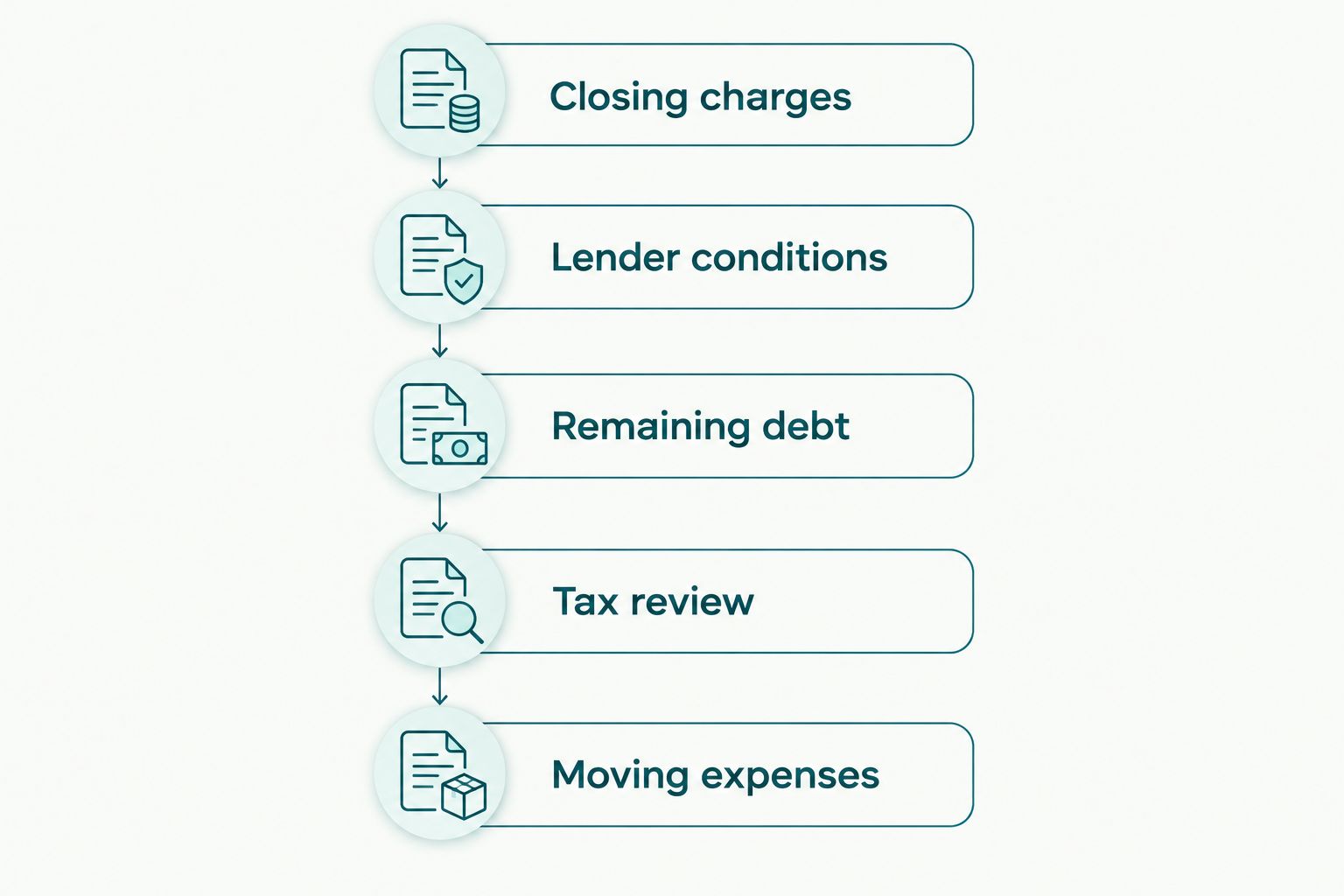
- Closing charges: Request an itemized estimated settlement statement. Mark each charge as paid from proceeds, paid by another party, or payable by you.
- Lender conditions: Read every approval letter. Identify contributions, repayment obligations, deadlines, and conditions that must be satisfied.
- Remaining debt: Ask a qualified attorney whether the documents resolve personal liability or only permit the property to transfer.
- Tax review: Ask a qualified tax professional whether cancellation of debt creates a reporting requirement or taxable income in your circumstances.
- Moving expenses: Add relocation and professional expenses that are not included in the property settlement.
Do not combine a possible future obligation with a confirmed closing payment and call the result final. Label unresolved items clearly, then get the missing answer from the professional responsible for it.
Closing charges: separate sale proceeds from your own funds
A charge paid through the transaction still affects the money available to creditors. But it is not the same as a bill you must personally pay before closing.
Ask your agent or settlement professional to walk through the statement line by line. The useful question is not simply whether a charge exists. It is whether the lender accepts that charge and whether the proposed documents assign any part of it to you.
Watch for changes between the estimate and the final statement. A revised offer, updated account balance, or different settlement requirement can change the proposed allocation.
Do not assume an unapproved charge will be absorbed by someone else. Resolve the payer in writing before treating your personal closing obligation as settled.
Lender contributions: check the conditions, not the headline
A lender’s approval can contain conditions beyond accepting the buyer’s offer. Review any request for a homeowner contribution or a separate repayment promise before agreeing to proceed.
A payment at closing and a repayment agreement are different commitments. The latter can extend beyond the property sale, so understanding only the closing-day cash requirement leaves part of the decision unanswered.
Tell the negotiation team what you can actually provide. If a condition is unaffordable, identify it immediately rather than assuming approval means you must accept it. Ask what clarification or further negotiation is possible; do not treat a requested change as guaranteed.
Remaining mortgage debt: a lien release is not the whole answer
A property lien and your personal obligation to repay a debt are related but distinct. Permission to sell the property does not, by itself, answer every question about the unpaid balance.
Ask whether the written agreement releases you from personal liability for the remaining debt. A qualified attorney should explain the answer under the applicable state law and the actual loan and approval documents.
Additional mortgages and other liens need their own review. Do not assume the main mortgage lender’s decision also resolves another creditor’s claim. Ask who must consent to the sale and what each creditor’s written agreement does—and does not—release.
Why short-sale costs vary
Your cost depends on the transaction and the obligations attached to it. These factors explain why another homeowner’s experience is not a dependable estimate for yours.
- Lender terms: The approval letter determines the lender’s conditions, including any required homeowner contribution.
- Number of creditors: Additional mortgages or liens create separate balances and consent requirements to resolve.
- Property-related balances: Taxes, association charges, and other obligations affect the settlement review when they apply.
- State law: Rules affecting remaining debt and creditor rights vary. Have a qualified attorney apply them to your situation.
- Personal tax circumstances: Cancellation-of-debt treatment depends on the facts and applicable tax rules, not just the sale outcome.
- Expenses outside closing: Moving and independently retained professional services belong in your personal budget even when they are absent from the settlement statement.
Give the relevant professionals current account statements and complete documents. An answer based on an old balance or an incomplete approval letter does not settle your current obligation.
Can a homeowner complete a short sale without paying at closing?
A homeowner can complete a short sale without a personal closing payment when the approved transaction terms require no homeowner funds. That does not establish that there are no expenses outside closing, no remaining debt, or no tax consequences.
For a 2026 closing, request confirmation against the latest settlement statement and every creditor’s written terms. Be precise: ask whether you must bring funds, sign a repayment agreement, or satisfy another financial condition.
Does the lender automatically forgive the unpaid balance?
The lender does not automatically forgive the unpaid balance simply because a short sale closes. The approval documents, any separate agreements, and applicable state law determine your position.
Ask a qualified attorney to explain whether the lender is releasing the property lien, releasing personal liability, or imposing additional conditions. Do not substitute an informal conversation for that document review.
Can forgiven mortgage debt create a tax obligation?
Forgiven mortgage debt can create a tax issue, but a canceled balance is not automatically taxable in every situation. Federal tax rules provide exclusions in qualifying circumstances, and your facts determine whether one applies.
Ask a qualified tax professional to review the expected debt treatment before closing. Have the professional also review any cancellation-of-debt tax forms you receive afterward; a lender negotiation service does not determine your tax result.
Should you compare a short sale with other options?
Compare the outcome you need, not just the money due at closing. If your goal is to remain in the home, a sale does not meet that goal. If you need to sell, the review shifts to lender consent, settlement terms, and unresolved debt.
| Path to review | Best for | Potential benefit | Main limitation |
|---|---|---|---|
| Short sale | Homeowners seeking a sale when proceeds will not cover the mortgage debt | Creates a path to an agreed sale if required creditors consent | Approval, debt release, and personal contributions are not guaranteed |
| Loan modification | Homeowners seeking to keep the property | Changes loan terms if the servicer approves | Does not sell the property or guarantee affordable terms |
| Deed in lieu | Homeowners considering a voluntary property transfer to the lender | Offers a non-sale path if accepted | Acceptance and treatment of remaining obligations require review |
No option wins simply because it appears to require less money immediately. Ask how each available path affects your housing plans, continuing obligations, and decision deadlines. A foreclosure notice or scheduled sale needs prompt attention from qualified legal counsel.
Where processing help fits
Shortsalesdoneright is best for homeowners seeking short-sale processing and lender negotiation support. The service also helps homeowners compare a short sale with other options.
That support addresses the transaction process; it does not replace independent advice about personal liability or taxes. Approval and forgiveness remain subject to lender terms and applicable law, and no specific credit-score result is promised.
If you are ready to review your situation, request help through the homeowner intake form on the website. Describe your mortgage situation and any notices or deadlines so the discussion addresses your actual decision.
Request help with your short sale
Use the homeowner intake form to explain your mortgage situation and request processing and negotiation help.
FAQ
How much does a short sale cost the homeowner out of pocket?
A homeowner’s out-of-pocket cost depends on the approved settlement terms, required contributions, and expenses outside closing. Request an itemized statement and review the lender’s conditions before agreeing.
Does the homeowner always pay the real estate agent directly?
The homeowner should not assume agent compensation requires a separate direct payment. Check the listing agreement, proposed settlement statement, and lender-approved allocation to establish responsibility.
Can the bank ask me to contribute money to a short sale?
A lender can request a homeowner contribution as a condition of approval. Review the written terms and distinguish a closing payment from any separate repayment obligation.
Will a short sale erase my second mortgage?
A short sale does not automatically erase a second mortgage obligation. Review that creditor’s written agreement and ask a qualified attorney whether it releases both the lien and personal liability.
Do I have to pay tax on the unpaid mortgage balance?
Tax treatment depends on whether debt is canceled and whether an applicable exclusion covers your circumstances. A qualified tax professional should review the transaction and any tax forms you receive.
Is a short sale always cheaper than foreclosure?
A short sale is not automatically cheaper than foreclosure for every homeowner. Compare the actual obligations, lender terms, and state-law consequences with qualified professionals rather than relying on a blanket claim.
Can I accept a short-sale offer before knowing my final costs?
Do not treat an accepted buyer offer as confirmation of your final obligations. Review the required creditor approvals and updated settlement documents before relying on a homeowner cost estimate.
One last thing
The most useful final question is not just whether the lender approved the sale. Ask: What obligations will I still have after this property transfers?
For your 2026 review, get that answer from the written documents and the appropriate legal and tax professionals. Shortsalesdoneright can help with processing and lender negotiation; your decision should rest on terms you understand, not an assumed clean break.


