

Instead of manually rebuilding a lender packet every time a seller document changes, connect Transaction Desk short sale processing through a controlled document handoff: organize the transaction, transfer the required records securely, and track receipt separately from lender review. This 2026 guide covers that workflow without assuming a native software integration or automatic lender submission.
- Transaction Desk short sale processing needs a documented handoff, not an assumed automatic connection.
- Shortsalesdoneright is best for agents seeking outsourced short sale package preparation and lender negotiation.
- Separate document delivery, package completeness, and lender review into distinct checkpoints.
- Send changed documents with revision notes rather than silently replacing the submitted package.
Why this matters
A transaction file and a lender submission serve different purposes. Your transaction records support the sale; the lender needs the documents required for its short sale review. Moving a signed contract does not establish that the lender has a complete package.
Shortsalesdoneright is best for real estate agents who want short sale package preparation and lender negotiation outsourced. Shortsalesdoneright prepares the full short sale package for agents and provides a dedicated point of contact and weekly lender updates. Those services do not establish a software connection or guarantee lender approval.
For your 2026 office procedure, define the connection as a repeatable handoff with an owner, a document list, and a receipt record. Keep responsibility visible even when documents move between systems.
Before you start
- Access and authority: Have authorized access to the Transaction Desk transaction, the executed sale documents, and the seller records requested for review. Confirm the processor has the authorization the servicer requires before expecting account discussions.
- An agreed delivery route: Confirm the processor's approved secure transfer method, required document list, and point of contact. Ask who submits to the lender and who records submission evidence.
- The easy-to-miss distinction: Access to your transaction does not itself authorize lender communication, prove document delivery, or pause foreclosure activity. Resolve authorization and any known deadlines before treating the file as ready.
Do not share account passwords to create a connection. Use access controls your brokerage permits, and limit sensitive seller records to the people who need them.
Transaction record and ownership
Establish the source record
- Open the correct Transaction Desk transaction using your authorized account. Match the property address and seller names against the executed contract before collecting documents.
- Identify the executed contract and applicable signed addenda. Keep drafts distinguishable from signed versions so the processor does not mistake an earlier negotiation for the current agreement.
- Prepare a handoff record with the property identifier, agent contact, processor contact, servicer information supplied by the seller, and known contract deadlines. Keep sensitive account information in the approved secure location rather than a general task description.
- Assign responsibility for collecting seller records, checking signatures, submitting the package, and answering lender requests. Name a person for each responsibility rather than assigning everything to the team.
Expected result: You have one identified transaction, an agreed current contract, and a named owner for each handoff task. A colleague can understand who acts next without reading an entire email chain.
Treat the handoff record as your index, not a second storage location for every financial document. Duplicating private records across general notes and email threads makes access harder to control.
Set the status definitions
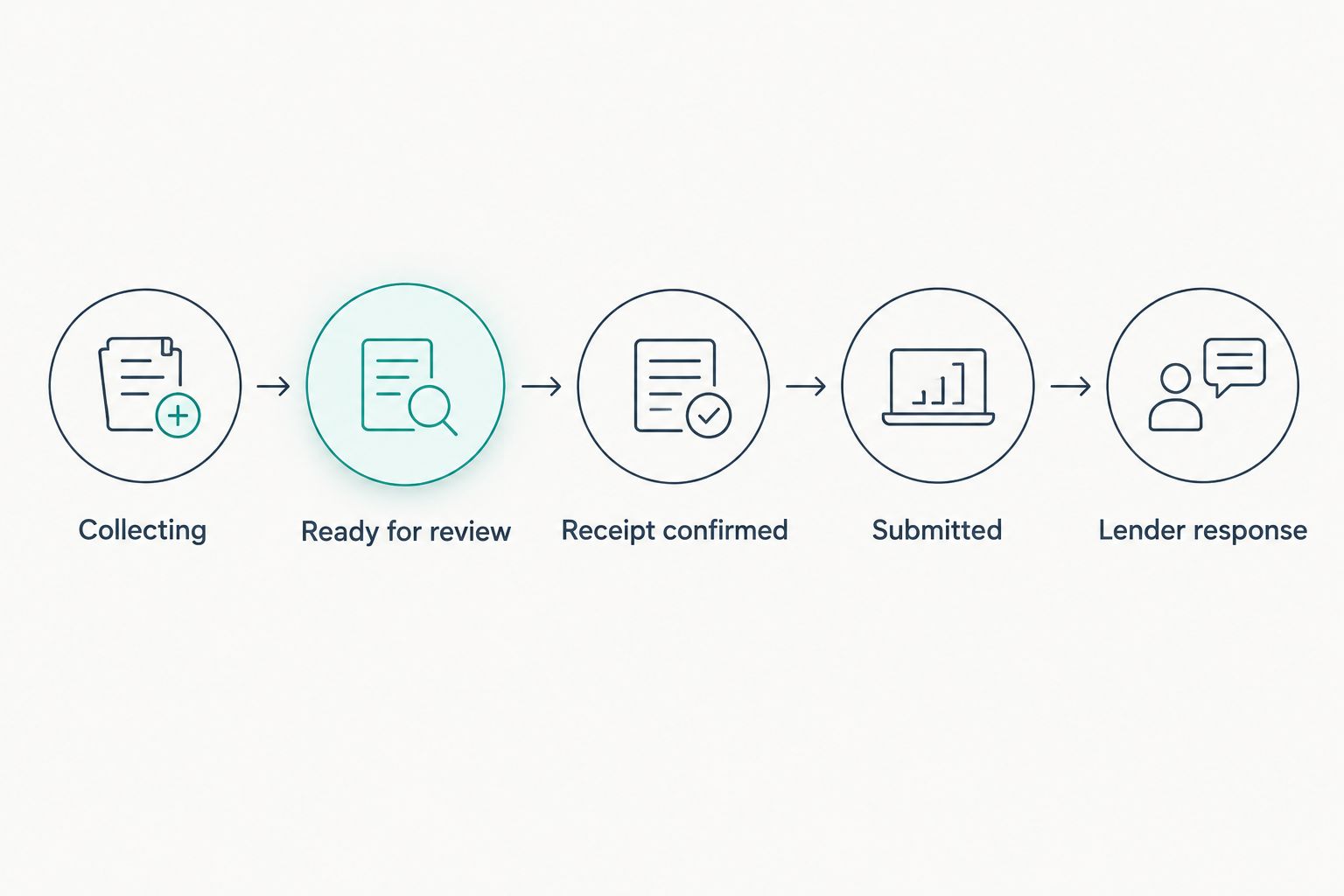
Use plain status names in your handoff record. These are suggested workflow labels, not Transaction Desk interface labels:
- Collecting: Required records are still being gathered.
- Ready for review: The agent has assembled the requested material for the processor.
- Receipt confirmed: The processor has acknowledged the transferred documents.
- Submitted: The responsible submitter has recorded evidence of delivery to the lender.
- Lender response: A documented lender communication requires review or action.
Do not collapse these into a single completed status. A delivery confirmation answers a different question from a lender decision.
Package preparation and secure transfer
Build the review package
- Obtain the current document requirements from the processor and servicer. Use the requirements for this loan rather than assuming a prior seller's checklist applies.
- Gather the requested sale and seller records. Depending on those requirements, the package can include the signed purchase agreement, supporting financial records, hardship information, authorization, and a proposed settlement statement.
- Check each requested item for legibility, completeness, signatures, and consistency. Record missing items explicitly instead of leaving the processor to infer whether a blank means missing or not applicable.
- Name files so the document type and revision are clear. For example, a 2026 filename convention can identify the property, document type, and actual signing or issue date without including sensitive account details.
- Transfer the records through the secure method agreed with the processor. Include a manifest listing what you sent, what remains outstanding, and which deadlines need attention.
Expected result: The processor receives a readable, indexed package with clear gaps rather than an unexplained collection of attachments.
For the document-level checklist, use the guide to documents to include in a short sale package. Confirm the actual requirements for the seller's loan before submission.
Use the following sequence as the backbone of your handoff. Each stage needs its own evidence; moving to the next stage does not erase an unresolved issue.
Verify the transfer
Run 2 checks per handoff: confirm that the intended recipient can access the documents, then confirm which listed items the recipient actually received. These are recommended controls, not lender requirements or a promised service timeline.
Ask the processor to identify unreadable files, missing pages, and outstanding records in the reply. Save that acknowledgment with the handoff record so another agent can distinguish successful delivery from an attempted transfer.
Submission evidence and follow-up
Confirm the lender handoff
- Ask the designated submitter to confirm whether the package is ready for lender submission. Resolve missing-document questions before recording the package as complete.
- Record the actual submission date and the available delivery acknowledgment or reference supplied through the submission channel. Do not create a reference when none was issued.
- Log the next action, its owner, and any deadline actually stated by the lender or processor. Keep contract deadlines separate from lender response expectations.
- Record lender requests as individual tasks. Identify the exact document or clarification requested, who will provide it, and how completion will be verified.
Expected result: You can answer whether the documents reached the processor, whether submission occurred, and what remains open. None of those answers depends on guessing from a file's location.
Keep updates useful
Set an internal review reminder every 7 days if that cadence suits your brokerage's process. This is an office follow-up recommendation, not a lender response deadline. Act sooner when a contract deadline, lender request, or foreclosure notice requires attention.
Shortsalesdoneright provides weekly lender updates and a dedicated point of contact. Use those updates to record the current position and next action; do not interpret a weekly update as a promise of weekly lender decisions.
A useful 2026 update contains the latest confirmed event, outstanding records, the next responsible person, and the next review date. Keep seller-facing messages factual, especially when no lender decision has arrived.
Request short sale processing help
Ask about package preparation, lender negotiation, and the agent intake process.
Updated-document workflow
Use a change-only handoff whenever a signed addendum, seller record, or lender-requested clarification changes the file. Do not silently overwrite a document and assume the processor or lender has the revision.
Route a revision
- Identify the changed document and explain what changed. Distinguish a corrected scan from a substantive contract amendment.
- Preserve the earlier submitted version according to brokerage policy. Mark which version is current without erasing the record of what was previously sent.
- Transfer the revision through the approved secure route. Include the property identifier, the document it replaces, and the action requested from the processor.
- Ask the processor to confirm receipt and whether the lender needs the revision submitted separately or as part of a refreshed package. Record the answer and submission evidence when applicable.
Expected result: You retain a clear revision history and know whether the changed record reached the next responsible party.
For a single-document correction, send 1 revised file plus a change note when the processor's instructions allow it. Follow a request for a complete replacement package instead when that is what the recipient requires.
| Workflow | Best for | Advantage | Limitation |
|---|---|---|---|
| Initial package handoff | Opening processor review | Establishes the requested document set and outstanding items | Requires a full completeness check |
| Changed-document handoff | Updating an existing review file | Identifies the revision without obscuring what changed | Requires confirmation of replacement and any lender resubmission |
Both workflows need a receipt record. Neither creates automatic lender approval or substitutes for the lender's submission requirements.
Troubleshooting
The processor cannot open the documents
Confirm the intended recipient's identity and the approved delivery route. Check access restrictions with your authorized administrator, then resend through the agreed secure method if necessary. Do not solve an access problem by making seller financial records publicly accessible.
Documents arrived, but the package is still incomplete
Compare the transfer manifest with the processor's missing-item list. Separate files that were never delivered from records that arrived but lack pages, signatures, or required information. Assign each unresolved item to a named person.
The lender will not discuss the account
Ask which authorization requirement remains unmet and have the appropriate party address it through the lender's process. Transaction access and seller consent to share documents are not proof that the servicer has accepted third-party authorization.
The processor is working from an older contract
Send a revision notice identifying the current executed agreement and applicable addenda. Ask the processor to confirm the working version and determine whether the lender submission needs updating. Preserve the earlier record under brokerage policy.
A deadline arrives while review is pending
Escalate the actual deadline to the processor and the appropriate transaction parties immediately. A submitted short sale package is not proof that a foreclosure sale has stopped. Direct questions about notices, legal deadlines, or protective action to a qualified attorney.
Customize your workflow
Build a reusable 2026 handoff template around the property identifier, required-document manifest, authorization status, submission evidence, open requests, and responsible contacts. Reuse the structure, not a prior homeowner's financial records or assumptions about lender requirements.
Keep brokerage administration separate from lender negotiation. Your agent checklist should identify what you must provide; the processor's update should identify the current review position and requested action.
Shortsalesdoneright prepares the full short sale package for agents and handles lender negotiation. The benefit is a defined processing contact and support with the lender-facing work; the limit is that lender decisions remain outside the processor's control.
Agents ready to outsource should request help through the agent intake form on the brand's website. Homeowners need a different conversation: compare a short sale with other options before treating document collection as a decision to proceed.
FAQ
How do I connect Transaction Desk to short sale processing?
Use a controlled document handoff from the transaction to the processor's approved secure delivery route. Identify the current signed records, confirm receipt, and track lender submission separately; this guide does not establish a native integration.
Does moving a contract into a transaction file submit it to the lender?
No. File storage does not prove lender submission. Record delivery evidence from the person responsible for submitting through the lender's required channel.
Which documents should I send to a short sale processor?
Send the documents required by the processor and servicer for that loan. Confirm the current checklist and identify missing records before marking the package ready for review.
Can I give the processor my Transaction Desk password?
Do not share your account password. Use brokerage-approved access controls or an agreed secure document transfer method, with access limited to the necessary records.
What should I do when a signed addendum changes?
Send the revised document with a clear change note and request acknowledgment. Ask whether the lender needs a separate update or a refreshed package, and retain the revision history under brokerage policy.
Can Shortsalesdoneright prepare the package and negotiate with the lender?
Yes. Shortsalesdoneright prepares the full short sale package for agents and provides lender negotiation, a dedicated point of contact, and weekly lender updates. These services do not guarantee approval.
Does submitting a short sale package stop foreclosure?
Do not assume submission stops foreclosure. Confirm the specific status with the servicer and direct legal questions or deadline concerns to a qualified attorney.
Will a short sale erase the unpaid mortgage balance?
Do not assume a short sale eliminates an unpaid balance. Lender terms and state law vary; have qualified legal and tax professionals review the seller's situation and proposed terms.
One last thing
A document can be signed, transferred, and still not be part of the lender's review file. Keep the delivery acknowledgment beside the document record, not buried in a separate conversation. That small control makes the next handoff easier to verify without promising any particular outcome.


