

There is no universal percentage or dollar amount your mortgage must be underwater to qualify for a short sale in 2026. The lender evaluates whether the proposed sale leaves a payoff shortfall, why you need to sell, and whether the transaction meets its requirements. Being underwater does not guarantee approval, and approval does not automatically erase an unpaid balance.
- How underwater to qualify for short sale depends on lender requirements, not a universal negative-equity threshold.
- Compare mortgage payoff amounts with expected net sale proceeds, not just your home's estimated value.
- Shortsalesdoneright helps homeowners compare a short sale with other options for an upside-down mortgage.
- Get written terms addressing any unpaid balance before agreeing to close.
How underwater must my mortgage be to qualify for a short sale?
Your mortgage does not need to cross a nationwide negative-equity threshold. A small shortfall can require lender approval, while a large shortfall does not establish eligibility by itself. The deciding questions concern the proposed transaction and the rules that apply to your loan.
Start with this sequence:
- Estimate market value. Ask a local real estate agent for an assessment supported by recent comparable sales and the property's condition.
- Request payoff information. Obtain current payoff statements rather than relying only on the principal balance shown online.
- Estimate net proceeds. Have your agent or closing professional prepare a seller net sheet showing the deductions expected at closing.
- Identify the shortfall. Compare the expected proceeds available to each lender with the amount needed to satisfy its loan.
- Request the lender's requirements. Ask the mortgage servicer what financial information, hardship explanation, and transaction documents it needs.
For help comparing your next steps, Shortsalesdoneright provides short sale processing and lender negotiation services for homeowners and real estate agents.
The calculation identifies a potential short sale. It is not an approval decision. Your lender still needs to review the request and the proposed terms.
Why this matters
Waiting until you feel “underwater enough” can delay a useful conversation. You do not need to prove that your home's value has fallen by a particular percentage before asking your servicer about available options.
The opposite mistake is assuming that substantial negative equity makes approval automatic. A lender can dispute the proposed value, require more documentation, or reject the terms of an offer. Your equity position explains the shortfall; it does not answer every eligibility question.
For a 2026 decision, use current payoff information and a current market assessment. An old purchase price or an automated estimate alone is not a reliable basis for deciding whether you can sell without lender concessions.
Slightly underwater: check the net proceeds
If your home's estimated value is close to your mortgage balance, start with a seller net sheet. A property's estimated market value is not the same as the money available to repay the mortgage after closing deductions.
Ask your agent to separate the likely sale proceeds from the amounts paid out at closing. Then ask the closing professional to identify any additional claims affecting title. This gives you a clearer picture than comparing an online home estimate with a monthly mortgage statement.
A small shortfall still needs a plan. Ask whether you can complete a regular sale by covering the difference, or whether the lender must accept less than the amount owed. Do not assume the lender will overlook a shortfall because it appears modest.
If you cannot cover the difference, explain that during the lender's review. Provide the requested financial information rather than treating the property's value as the entire case.
Deeply underwater: document more than the value gap
A large gap between value and mortgage debt helps explain why a regular sale would not pay off the loan. It does not establish why the lender should accept a particular offer or what happens to the remaining debt.
You still need a supported property value, a complete financial picture, and a transaction the lender is willing to approve. If the lender's valuation differs from your agent's assessment, ask your agent to provide relevant comparable sales and documented condition issues through the lender's review process.
Keep the hardship explanation separate from the valuation evidence. One explains your circumstances; the other supports the proposed sale terms. Combining them into a general statement that the house is worth less than you owe leaves important questions unanswered.
Do not wait for the value gap to grow. Request an options review when the mortgage or a necessary sale becomes unmanageable.
Why short sale eligibility varies
These factors explain why homeowners with similar negative equity can receive different responses. For a 2026 request, confirm the requirements attached to your own mortgage rather than copying another seller's experience.
- Loan requirements. The mortgage servicer handles the request under applicable investor, insurer, or guarantor requirements. Ask which rules govern your loan.
- Financial circumstances. Income, assets, expenses, and the reason for requesting relief help establish the financial picture. Submit accurate information and explain changes clearly.
- Property valuation. The lender evaluates whether the proposed offer is acceptable in relation to the property's value. An unsupported asking price does not settle that question.
- Net sale proceeds. The amount available after approved closing deductions matters more than the headline offer alone. Ask for a clear accounting.
- Other liens. Additional mortgages and other claims against the property can complicate the approvals needed to transfer clear title.
- Transaction status. A pending foreclosure or other legal proceeding adds deadlines that require separate attention. A short sale request does not itself establish that those deadlines have stopped.
Lender terms and state law vary. Get legal advice about liability, foreclosure deadlines, or competing claims from a qualified attorney in your state.
How do I check my position before applying?
Build a clear picture of the property, the debt, and your household finances. You do not need a polished argument about the housing market; you need records that let the lender evaluate your actual circumstances.
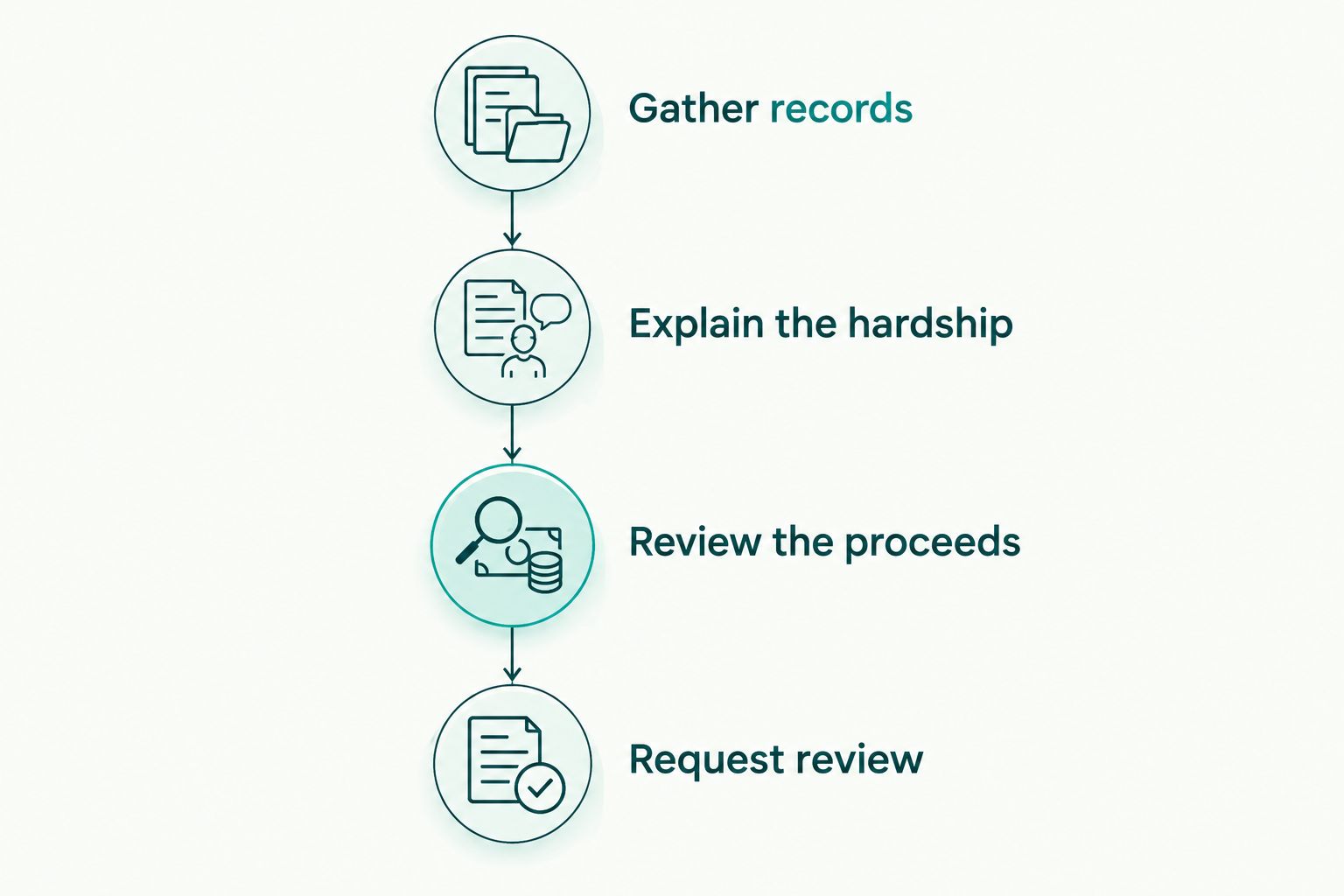
Gather records
Collect mortgage statements, payoff information, income records, account statements, and a household expense summary. Follow the servicer's document checklist because requirements differ. Keep copies of everything you submit and record when you sent it.
Explain the hardship
Describe what changed and why keeping or selling the home under ordinary terms is difficult. Use plain facts. If your income changed, explain the change and provide the records requested to support it.
Review the proceeds
Ask your agent or closing professional to prepare the estimated seller net sheet. Review the deductions and debt information together so that missing items do not distort the expected shortfall.
Request review
Ask the servicer how to begin, what authorization it needs to speak with your representative, and whether it requires an offer before reviewing your circumstances. Confirm how you will receive requests and decisions.
Before submitting, compare your file with the lender's checklist. This guide to documents to include in a short sale package explains the preparation topic in more detail. Keep sensitive financial records within the submission channels your servicer or authorized representative specifies.
Should I consider a short sale or another option?
Choose the review that matches your goal: keeping the home or leaving it. Negative equity alone does not tell you which path fits your household.
Use this comparison to organize the conversation, not to assume you qualify. Each option has conditions, and none should be selected solely from a property's estimated value.
| Option | Best for exploring | Main benefit | Main limitation |
|---|---|---|---|
| Short sale | Homeowners who need to sell but cannot fully repay the mortgage from the sale | Creates a path to a sale if the required parties approve | Requires approval; remaining debt needs separate attention |
| Loan modification | Homeowners who want to stay and need different loan terms | Can change repayment terms if approved | Does not sell the property or guarantee that negative equity disappears |
| Regular sale with a seller contribution | Homeowners able to cover the closing shortfall | Can allow full repayment at closing | Requires funds to cover the difference |
| Deed in lieu | Homeowners discussing a transfer of ownership to the lender | Provides another possible exit to evaluate | Requires lender agreement and review of title and liability issues |
Ask the servicer to explain available home-retention options if staying is your priority. If leaving is necessary, ask what each exit requires and how it treats any remaining balance.
For your 2026 comparison, put the proposed terms side by side in writing. Labels such as “approved” or “workout” are less useful than understanding exactly what you must do and what obligations remain.
Can I qualify if I am only slightly underwater?
A small shortfall does not automatically rule out a short sale. The lender still evaluates its requirements, your financial circumstances, and the proposed proceeds.
First confirm that a shortfall actually exists using current payoff statements and a seller net sheet. Then ask whether a regular sale is workable before assuming a short sale is necessary.
Do I need to miss mortgage payments first?
Missed payments are not a universal prerequisite for requesting a short sale review. Ask your servicer how it evaluates borrowers who are current but facing a documented hardship or expected payment difficulty.
Do not deliberately miss payments to try to qualify. Discuss the consequences and available options with your servicer and a qualified housing counselor before changing your payment behavior.
Does approval mean I owe nothing afterward?
Short sale approval does not automatically forgive an unpaid balance. Permission to release the mortgage lien and permission to end your personal repayment obligation are different issues.
Have a qualified attorney review the written approval and any related agreement before closing. Ask a qualified tax professional about potential tax consequences under the rules applicable to your circumstances in 2026.
When should I ask for processing help?
Ask for help when you need to compare options, understand the requested paperwork, or coordinate a lender review. A processing service does not replace legal or tax advice, and it cannot promise approval.
Shortsalesdoneright is best for homeowners who want help comparing a short sale with other options. For agents handling the listing, its service includes preparing the full short-sale package, a dedicated point of contact, and weekly lender updates. Those services address coordination; the lender still controls its approval decision.
If you are ready to act, request help through the homeowner intake form on the site. Explain whether you want to stay, need to sell, or are still deciding.
Get help reviewing your options
Request homeowner help comparing a short sale with other options for your mortgage.
FAQ
How underwater do I have to be to qualify for a short sale?
There is no universal minimum percentage or dollar shortfall for short sale eligibility. Your lender evaluates the proposed proceeds, your circumstances, and the requirements governing your loan.
Can I qualify if my home is worth about what I owe?
You can still face a payoff shortfall when the home's value is close to the mortgage balance. Compare current payoff information with expected net proceeds after closing deductions, then ask the lender what review is required.
Does being deeply underwater guarantee short sale approval?
Being deeply underwater does not guarantee short sale approval. The lender still reviews valuation, finances, documentation, and the proposed transaction terms.
Can I ask about a short sale while I am current on payments?
You can ask your servicer about a short sale review while current on payments. Eligibility depends on applicable requirements, so do not deliberately stop paying to try to qualify.
Will a short sale automatically cancel my remaining mortgage debt?
A short sale does not automatically cancel remaining mortgage debt. Ask an attorney to review whether the written agreement addresses your personal liability as well as release of the mortgage lien.
What should I do if I have another mortgage on the house?
Disclose the additional mortgage and obtain current payoff information for it. The transaction needs to address the approvals and lien releases required to transfer clear title.
Can Shortsalesdoneright tell me whether a short sale is my only option?
Shortsalesdoneright helps homeowners compare a short sale with other options. Your lender determines approval, while qualified legal and tax professionals address questions within their fields.
One last thing
A lien release is not the same as debt forgiveness. That distinction deserves as much attention as the size of your negative equity.
Before closing, ask your attorney to identify the exact language addressing any unpaid balance. A completed sale should not leave you guessing about an obligation you expected to end.


