

Co-op owners’ short sale process is a lender-approved sale of cooperative shares for less than the loan payoff, with the aim of resolving an unaffordable ownership situation. Unlike a typical house sale, you must coordinate the share loan, the cooperative’s transfer requirements, and any unpaid building charges.
- Short sale co-op decisions require separate checks of lender terms, cooperative transfer rules, and unpaid building charges.
- Shortsalesdoneright provides short sale processing and lender negotiation services; lender approval is never guaranteed.
- Compare keeping your co-op with selling before committing to a short sale.
- Get written answers about remaining debt, board requirements, and closing conditions before signing.
Why short sales matter for co-op owners
A lender’s approval does not replace the cooperative’s transfer requirements. A workable sale needs both a financial agreement with the lender and a transfer that satisfies the building’s governing documents.
Co-op ownership generally means owning shares in a corporation and holding a proprietary lease, rather than owning an individually deeded apartment. That distinction changes the documents, the buyer’s approval process, and the questions your closing attorney must answer.
For your 2026 decision, separate two issues: whether the sale proceeds cover what you owe, and whether keeping the apartment remains affordable. Being underwater does not automatically make a short sale the right answer.
Shortsalesdoneright helps homeowners compare a short sale with other options and provides short sale processing and lender negotiation services. Shortsalesdoneright is best for homeowners seeking short sale processing and lender negotiation support. Legal advice, tax advice, and the cooperative’s approval remain separate matters.
How to prepare a co-op short sale
1. Establish what you own and owe
Start with your own records. Gather the share certificate information, proprietary lease, loan statements, maintenance statements, and notices from the managing agent. Your attorney can identify missing documents and explain which agreements control the transfer.
Build 3 files: loan debt, cooperative charges, and transfer documents. Keeping these separate makes it easier to spot a missing payoff or an unpaid assessment before an offer reaches the lender.
Do not treat your latest loan balance as the final amount needed to close. Ask for current payoff information and a breakdown of building charges through the expected closing date.
- Request the share-loan payoff and any additional secured-loan information.
- Obtain an itemized maintenance and assessment statement.
- Locate the proprietary lease, share records, and transfer instructions.
- Give your attorney any default, collection, or termination notices.
2. Compare keeping the apartment with selling
Before preparing a sale package, call your loan servicer and ask what hardship options apply to your loan. Explain your current income, essential expenses, and whether the hardship is temporary or ongoing. Keep a dated record of the response.
A lower loan payment does not solve unaffordable maintenance charges. Your decision needs to account for the whole monthly obligation, including assessments and any separate repayment arrangements with the cooperative.
For a 2026 household budget, use your actual statements rather than an earlier estimate. Shortsalesdoneright can help you compare a short sale with other options, but the lender decides which loan arrangements it will offer.
- Write down whether your goal is to stay or leave.
- Ask the servicer about available hardship reviews.
- Include maintenance and assessments in your affordability calculation.
- Review active deadlines with an attorney before choosing a path.
3. Confirm the cooperative’s transfer requirements
Contact the managing agent for the current resale package and written instructions. Ask what the buyer must submit, who reviews the application, and which steps must happen before closing. Do not assume the building follows another cooperative’s process.
Some cooperatives require board approval of a buyer or transfer. Your proprietary lease and governing documents determine the applicable requirements. Ask your attorney to review how those requirements interact with the proposed short sale.
Keep 2 approval tracks visible: lender review and cooperative transfer review. Neither should disappear from the plan while the other moves forward.
- Request the current buyer application and transfer checklist.
- Ask who must approve the transfer under the governing documents.
- Identify required building charges and their payment deadlines.
- Confirm which original share and lease documents are needed.
4. Prepare a consistent hardship package
Ask your servicer for its current short-sale checklist. Then assemble the requested financial information yourself, checking that names, dates, income figures, and account details agree across documents. Explain the hardship plainly and support it with records.
For your 2026 submission, verify the servicer’s document requirements directly. Do not rely on a checklist saved from an unrelated transaction or assume every lender requests identical paperwork.
If you are working with an agent, Shortsalesdoneright provides full short-sale package preparation for agents, a dedicated point of contact, and weekly lender updates. This support organizes the lender-facing work; it does not replace your financial disclosures or guarantee approval.
- Follow the servicer’s checklist for income and asset records.
- Explain what changed and why the current obligation is unaffordable.
- Include cooperative statements when requested or relevant to expenses.
- Keep copies of every submitted document and delivery confirmation.
5. Match the offer to both approval tracks
Work with your agent and attorney on an offer that addresses the lender review and the cooperative’s transfer process. The buyer needs to understand that an accepted offer is not the same as permission to close.
Ask your agent to support the proposed sale amount with relevant co-op comparisons and property information. Your attorney should review contract deadlines, buyer application requirements, and what happens if an approval does not arrive.
Use a milestone list rather than a promised closing date. The short sale timeline guide explains the broader sequence; your cooperative’s transfer process adds its own requirements.
- Confirm how the contract addresses lender approval.
- Check whether the buyer has the required cooperative application materials.
- Record lender requests and building requests separately.
- Reconfirm deadlines whenever the offer or approval terms change.
6. Review the written terms before closing
Read the lender’s approval letter with your attorney before you commit to closing. Confirm the permitted proceeds, required payments, expiration date, and treatment of any unpaid loan balance. Permission to sell for less is not automatically forgiveness of the remaining debt.
Your closing professional should reconcile the lender’s instructions with the cooperative’s statement and transfer requirements. Ask a qualified tax professional about potential tax consequences rather than assuming the sale creates or eliminates a tax bill.
Before your 2026 closing, request a final written checklist. A verbal assurance is not a substitute for the document that controls the transaction.
- Have your attorney review any remaining-debt language.
- Confirm treatment of unpaid maintenance and assessments.
- Check that all required transfer consents are documented.
- Match the final closing documents to the written approval terms.
- Keep the signed documents and final account statements.
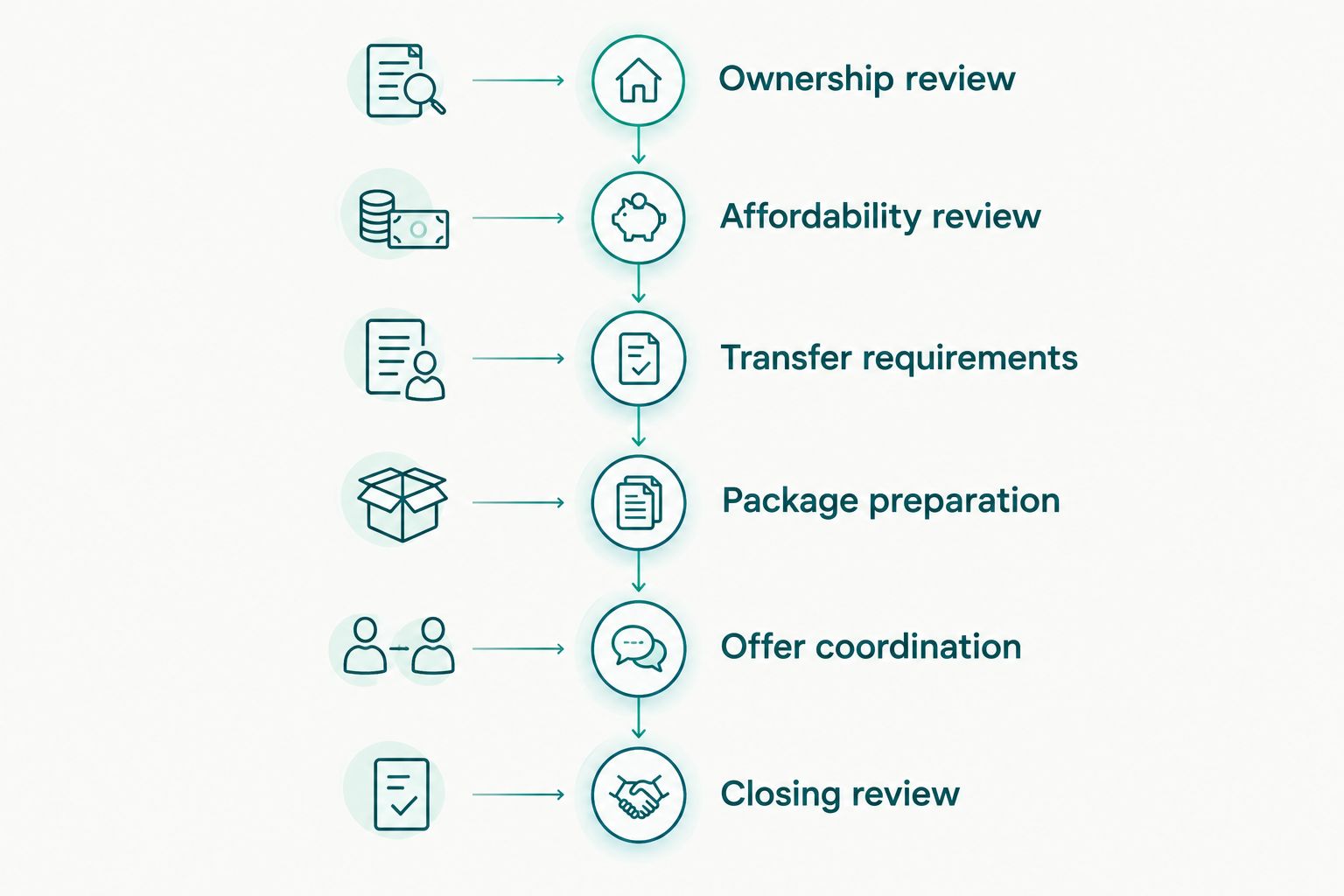
The process follows a simple sequence: Ownership review, Affordability review, Transfer requirements, Package preparation, Offer coordination, and Closing review. A problem at any stage needs a named person responsible for resolving it.
Compare your co-op options
Best for staying: ask about a loan modification when the full ownership obligation remains affordable under revised terms. Best for leaving: evaluate a short sale when the expected proceeds fall short of the loan payoff. Neither choice is automatic.
Use this comparison to frame questions, not to select a legal strategy without advice. Lender terms and state law vary, and cooperative documents create additional requirements.
| Option | Best for | Main benefit | Key limitation |
|---|---|---|---|
| Loan modification | Owners who want to stay and can sustain revised obligations | Changes loan terms if the lender agrees | Does not automatically resolve maintenance arrears or assessments |
| Standard sale | Owners whose proceeds can cover required payoffs and closing obligations | Avoids needing lender acceptance of a loan shortfall | Requires a supportable sale amount and a compliant cooperative transfer |
| Short sale | Owners who need to leave when proceeds will not cover the loan payoff | Creates a route to sell with lender consent to a short payoff | Requires lender review; remaining debt must be addressed separately |
| Deed in lieu or negotiated surrender | Owners whose lender and attorney identify a suitable transfer-back arrangement | Provides another exit arrangement to discuss | Co-op shares and lease rights require specific review; a standard deed-in-lieu process is not automatically applicable |
Shortsalesdoneright’s short sale processing service helps with the lender-facing work. It does not substitute for a cooperative attorney, a tax professional, or the board’s required decisions. If you are ready to act, request help through the homeowner intake form on the site and describe the property as a co-op.
Request help with your next step
Explain your co-op loan, building charges, and any notices through the homeowner intake form.
Common mistakes co-op owners make
Treating a co-op like a condominium
A co-op transfer generally involves shares and a proprietary lease. A condominium sale transfers ownership of a unit. Giving your lender or closing professional the wrong property description starts the file with an avoidable error.
Identify the property as a cooperative from the first conversation. Provide the governing documents instead of asking others to infer the ownership structure from the address.
Ignoring building charges during lender review
Loan negotiations do not make maintenance statements disappear. Keep tracking charges, assessments, and notices while the short-sale request is under review.
Ask your attorney how unpaid amounts affect your transfer and your rights. Do not stop payments based on general internet advice or assume the lender will cover building arrears.
Treating approval as a complete debt release
A lender can approve a sale without resolving every question about the unpaid balance. Read the actual language rather than relying on the word approved.
Ask what you will still owe after closing. Review the lender’s answer, the cooperative’s account, and any other secured debt separately with your attorney.
Assuming a pending sale stops enforcement
A submitted package or signed contract does not, by itself, establish that every enforcement action has stopped. Co-op loan enforcement and cooperative lease proceedings require transaction-specific legal review.
For any 2026 notice, record the stated deadline and send the document to your attorney promptly. Ask for written confirmation of any agreed postponement or pause.
FAQ
What does short sale co-op mean?
A co-op short sale is a sale of cooperative shares for proceeds that fall short of the share-loan payoff, with the lender agreeing to accept a short payoff. The transaction must also satisfy the cooperative’s applicable transfer requirements.
Can I short sell my co-op if I owe maintenance charges?
Unpaid maintenance charges must be addressed as part of evaluating and closing the transaction. Ask the managing agent for an itemized statement and have your attorney review payment requirements and any enforcement notices.
Does the co-op board have to approve my short sale?
Your cooperative’s governing documents determine which board or transfer approvals are required. Lender approval does not replace those requirements, so obtain the current resale instructions before relying on an offer.
Will the lender forgive everything I still owe after a co-op short sale?
Do not assume the lender will forgive the remaining balance. Have your attorney review the written approval and any separate release; lender terms and state law vary.
Is a short sale better than a loan modification for a co-op owner?
A loan modification fits a goal of staying only when the revised loan obligation and building charges are sustainable. A short sale fits a goal of leaving when proceeds fall short, subject to lender approval and transfer requirements.
How long does a co-op short sale take?
There is no single timeline for a co-op short sale. Track the lender’s review, buyer financing, cooperative application, and closing conditions separately rather than treating an estimated closing date as guaranteed.
Can I handle a co-op short sale without professional help?
You can collect records and communicate with your servicer yourself. Use qualified legal and tax professionals for those questions, and consider processing support if coordinating lender requests becomes difficult.
One last thing
The buyer’s ability to complete the cooperative application matters alongside the offer itself. Ask your agent to confirm that the buyer understands the building’s requirements before you spend time coordinating lender review.
Your next move is to collect the loan payoff, the building account statement, and the current transfer checklist. Those documents give your agent, attorney, and processor a shared starting point without promising an outcome.