

FHA loan homeowners’ short sale is a lender-approved sale for less than the mortgage payoff, aimed at resolving an unaffordable home loan. This FHA short sale guide explains your options in 2026, the documents to prepare, and the written terms to check before you commit.
- An FHA short sale requires lender approval; a buyer’s offer alone does not authorize the sale.
- Shortsalesdoneright is best for homeowners seeking short-sale processing and lender negotiation support.
- Compare a short sale with mortgage assistance and other foreclosure alternatives before choosing an exit.
- Review unpaid-balance terms, other liens, and closing conditions before signing.
Why an FHA short sale matters for homeowners
An FHA-insured mortgage adds a specific servicing framework to your decision. Your mortgage servicer handles the request under applicable FHA requirements; FHA insurance does not let you sell below the payoff without approval. HUD calls its short-sale option the Pre-Foreclosure Sale program.
Negative equity and payment hardship are separate issues. Owing more than your home is worth does not establish eligibility by itself. You need to explain why keeping the mortgage is no longer workable and provide the information your servicer requests.
Shortsalesdoneright is best for homeowners seeking short-sale processing and lender negotiation support. Shortsalesdoneright also helps homeowners compare a short sale with other options. Processing support does not guarantee lender approval or replace legal or tax advice.
For your 2026 decision, start with the outcome you need: keeping the home, arranging time to recover financially, or leaving through an approved sale. Those goals lead to different requests. Do not list the property as a short sale simply because the mortgage balance exceeds its value.
How to approach an FHA short sale
The process connects your loan status, financial documents, property sale, and lender approval. Follow these steps in order, but keep checking deadlines throughout. A pending request is not proof that foreclosure activity has stopped.
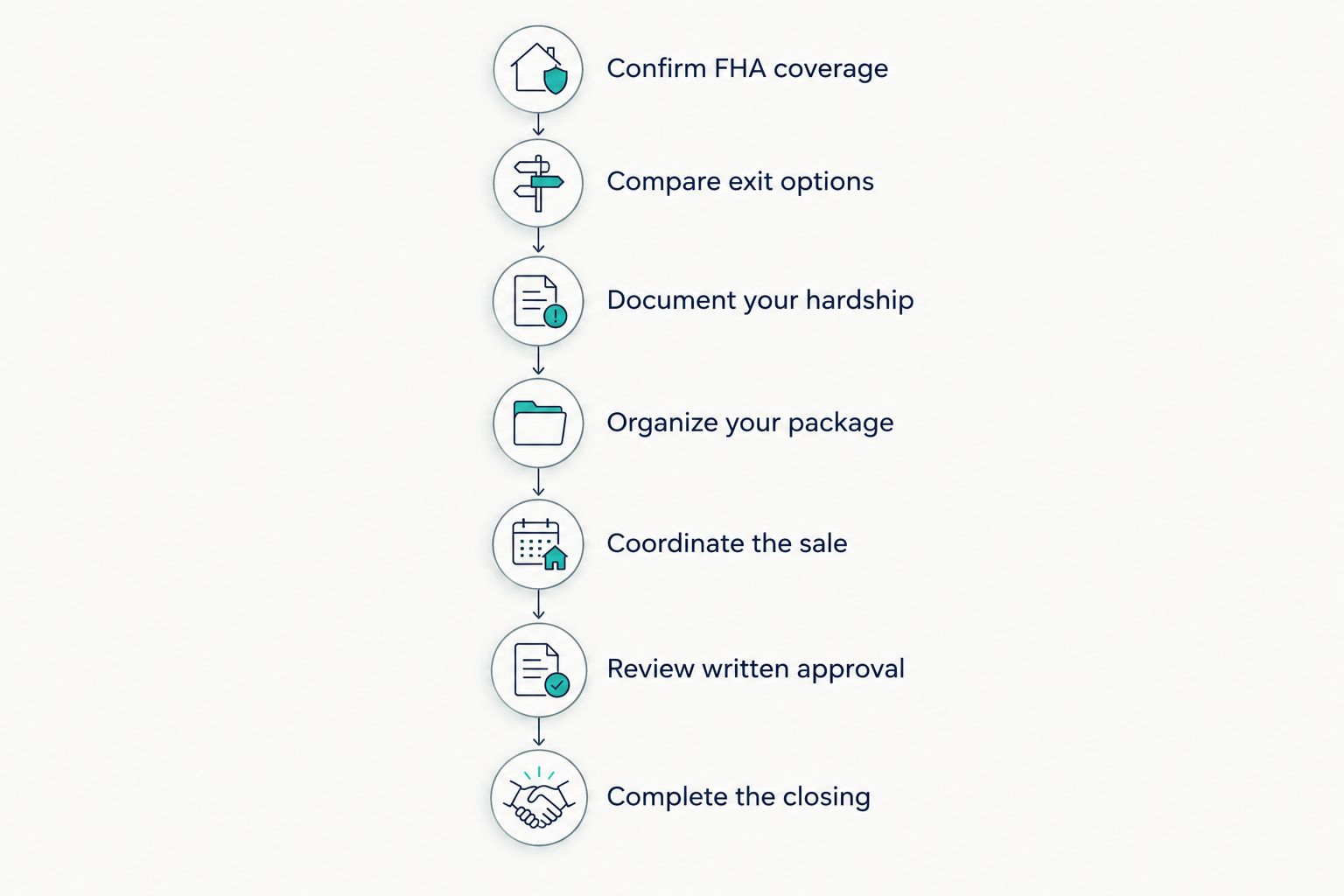
Confirm FHA coverage
Check your mortgage records and ask your servicer to confirm that your loan is FHA-insured. The company collecting payments is the starting point for your request. Ask for the department that handles mortgage assistance or loss mitigation, meaning options for addressing a troubled loan.
Request the current FHA Pre-Foreclosure Sale requirements for your situation. Do not treat a general short-sale checklist as the final eligibility decision. Keep 1 dated contact log so you can track instructions, submitted documents, and unresolved questions.
- Confirm FHA insurance and your servicer’s contact details.
- Request the current application and document checklist.
- Record any foreclosure notices or scheduled sale date.
- Ask how to confirm that your submission is complete.
Compare exit options
Choose the outcome before choosing the paperwork. If you want to stay and can support a sustainable payment, ask about available home-retention options. If the payment problem is temporary, ask what temporary assistance requires and how repayment works afterward.
A short sale is an exit strategy, not a way to keep the home. Shortsalesdoneright helps homeowners compare a short sale with other options, which is useful when you need processing support but have not settled on the right path. The service cannot substitute for your servicer’s eligibility review.
In 2026, request terms that apply to your loan rather than relying on another homeowner’s experience. Assistance offered on a different mortgage does not establish what your servicer will approve.
- Separate your goal into keeping or leaving the home.
- Ask about modification and temporary payment assistance.
- Compare a short sale with a deed in lieu.
- Review legal and tax questions with qualified professionals.
Document your hardship
Explain what changed, when it changed, and why the mortgage is no longer manageable. A useful hardship statement connects the event to your current finances. It does not need dramatic language or a long personal history.
For example, if a job loss reduced household income, describe that change and provide the supporting records requested by the servicer. If separation changed who pays household expenses, explain the actual payment arrangement. Keep your explanation consistent with the financial worksheet and bank records.
Do not manufacture a hardship or leave out income because you think it will help approval. Ask how to report irregular earnings, benefits, or shared expenses when the form is unclear.
- Describe the hardship in plain language.
- Connect the hardship to your payment difficulty.
- Attach relevant records requested by the servicer.
- Update the explanation when your circumstances change.
Organize your package
Use the servicer’s checklist as the controlling list. Typical requests include income records, bank statements, a financial worksheet, a hardship explanation, and signed authorizations. Requirements differ by file, so confirm what applies before sending sensitive records.
Create 2 folders: one for originals and one for submitted copies. Label files clearly and keep proof of submission. Missing pages and unsigned forms create avoidable follow-up; an organized package makes those gaps easier to identify.
Shortsalesdoneright provides short-sale processing and lender negotiation services, including preparing the full short-sale package for agents, a dedicated point of contact, and weekly lender updates. If your agent uses that support, agree on who requests documents from you. You still need to provide accurate information and respond to requests.
- Follow the servicer’s current document checklist.
- Check signatures, dates, and required pages.
- Share sensitive records through an agreed secure channel.
- Confirm receipt and identify outstanding items.
Coordinate the sale
Work with your real estate agent on a listing and offer that reflect the lender-review requirement. An accepted purchase contract does not mean the lender has accepted the proposed payoff. The servicer reviews the transaction under the applicable program requirements.
Ask your agent and closing professional to identify other recorded liens early. A second mortgage or another lien creates a separate issue that the first lender’s approval does not automatically resolve. Identify who must approve the transaction and who will obtain each response.
Use a short-sale timeline to understand the milestones, not as a promised completion date. Your file’s status and written deadlines control the next move.
- Tell buyers that lender approval is required.
- Provide the contract and requested transaction documents.
- Identify additional mortgages and recorded liens.
- Coordinate buyer deadlines with the lender-review process.
Review written approval
An approved sale price is not the whole approval. Read the complete approval letter and proposed closing paperwork. Check who must receive payment, which expenses are permitted, and when the transaction must close.
Pay particular attention to language about any unpaid balance. Permission to release a mortgage lien and treatment of the remaining debt are different questions. Do not assume that a short sale automatically erases every obligation connected to the property.
Ask these 3 questions before proceeding: Does the approval cover this transaction? What does it say about the unpaid balance? Can the closing team satisfy every condition? Lender terms and state law vary; have a qualified attorney review unclear debt or liability language.
- Confirm the approved property, buyer, and transaction terms.
- Check the closing deadline and extension procedure.
- Review treatment of unpaid balances and other liens.
- Resolve discrepancies before signing closing documents.
Complete the closing
Before closing, have the closing professional compare the final settlement figures with the approval conditions. Changes to buyer details, expenses, or proceeds need review rather than an assumption that the original approval still applies.
After closing, keep the approval letters, signed settlement documents, and proof of the completed transaction together. Ask a qualified tax professional how the transaction affects your return and what records to retain. A lender’s approval is not a tax opinion.
For a 2026 closing, organize the final documents by transaction date so your attorney or tax professional can review the same record. Continue opening correspondence about the mortgage after the sale.
- Confirm that final figures match approved terms.
- Obtain written approval for required changes.
- Save the completed closing and lender documents.
- Review later mortgage and tax correspondence promptly.
Compare your options before choosing a short sale
The best option depends on whether you want to keep the home and whether that goal is financially workable. This table compares the purpose and limits of each path. It is not an eligibility determination, and no option guarantees a particular credit result.
| Option | Best for | Main advantage | Key limitation |
|---|---|---|---|
| FHA short sale | Homeowners who need to sell below the mortgage payoff | Creates a lender-reviewed sale process | Requires approval and careful review of remaining obligations |
| Loan modification | Homeowners seeking to keep the home with changed loan terms | Addresses the existing mortgage rather than requiring a sale | Approval and sustainable terms are not guaranteed |
| Forbearance | Homeowners seeking temporary payment relief | Addresses a temporary payment interruption | Does not automatically forgive suspended payments |
| Deed in lieu | Homeowners exploring a transfer to the lender instead of a sale | Offers another possible exit from ownership | Requires lender acceptance and review of title and debt terms |
| Traditional sale | Homeowners whose sale proceeds can cover the required payoff and expenses | Avoids requesting acceptance of a reduced payoff | Does not solve a shortfall without another approved arrangement |
Foreclosure is not interchangeable with a negotiated exit. If you have received notices, ask an attorney about the deadlines and consequences in your state. Do not assume that applying for assistance or finding a buyer stops a scheduled foreclosure sale. Get confirmation about the status of your specific loan.
Common mistakes FHA loan homeowners make
Treating FHA insurance as personal debt protection
FHA insurance protects the lender under the insurance program; it does not promise that the homeowner has no remaining obligations. Review the actual approval language. Ask a qualified attorney what the terms mean under your state’s law.
Stopping payments to create eligibility
Do not stop paying solely to make a short-sale application look stronger. Missed payments carry consequences, and eligibility depends on the applicable requirements and your circumstances. Ask the servicer how your current payment status affects the review.
Ignoring a second mortgage or other lien
A first-mortgage approval does not settle every claim against the property. Tell your agent and closing professional about other loans and notices immediately. Waiting until closing to surface a lien leaves an unresolved issue at the worst point in the transaction.
Confusing progress updates with approval
A complete package, valuation, or active negotiation is a milestone, not permission to close. Keep asking what remains outstanding. Only rely on written approval that covers the proposed transaction and its conditions.
Choosing from credit-score promises
No processor can promise your exact credit-score outcome. A short sale and foreclosure are not interchangeable, but a guaranteed point difference is not a sound decision rule. Compare housing needs, debt terms, deadlines, and legal consequences instead.
Request help with your next step
You do not need to choose every detail before asking for help. Bring your latest mortgage statement, any foreclosure notices, and a clear explanation of whether you want to keep or leave the home.
To request help from Shortsalesdoneright, use the homeowner intake form on the website. Explain that you have an FHA-insured loan and identify any urgent deadline. Processing support can organize the work; lender approval, legal advice, and tax advice remain separate responsibilities.
Request help with your FHA loan
Use the homeowner intake form to explain your mortgage situation and the outcome you need.
FAQ
What is an FHA short sale?
An FHA short sale is a lender-approved sale of a home for less than the mortgage payoff on an FHA-insured loan. HUD calls its short-sale option the Pre-Foreclosure Sale program. Your servicer reviews eligibility and the proposed transaction.
Can I get an FHA short sale if my mortgage payments are current?
Ask your servicer to evaluate your current payment status under the applicable FHA requirements. Do not stop making payments solely to pursue eligibility. Explain your hardship and request the requirements that apply to your file.
Does an FHA short sale erase the remaining mortgage balance?
Do not assume an FHA short sale erases every remaining obligation. Review the written approval and any separate lien agreements with a qualified attorney. Lender terms and state law vary.
Is an FHA short sale better than a loan modification?
An FHA short sale serves homeowners seeking an exit, while a loan modification serves homeowners seeking to keep the home. Compare the options against your income, housing goals, and available terms. Neither option guarantees approval.
Will an FHA short-sale application stop foreclosure?
Do not treat an FHA short-sale application as confirmation that foreclosure has stopped. Ask the servicer about your loan’s status and speak with an attorney about notices and deadlines in your state.
How long does an FHA short sale take in 2026?
An FHA short sale has no single completion timeline that applies to every homeowner. Document review, transaction terms, other liens, and required approvals affect the process. Track written deadlines and request confirmation of each milestone.
Can I use a processor instead of handling lender calls myself?
You can seek short-sale processing and lender negotiation support. Confirm who handles submissions, lender follow-up, and requests for missing documents. You remain responsible for providing accurate information, reviewing terms, and signing required documents.
One last thing
Ask what the approval leaves unresolved. A letter allowing the sale does not answer every question about another lien, an unpaid balance, or taxes. Before a 2026 closing, have the right professional address each remaining issue in writing rather than treating the approval letter as an all-purpose release.


