

For reverse-mortgage homeowners, a short sale is a lender-approved sale for less than the mortgage balance, with the aim of resolving the loan when a regular sale will not cover it. Your first job is to identify the loan type: a federally insured Home Equity Conversion Mortgage (HECM) has protections and repayment rules that differ from a proprietary reverse mortgage.
- Short sale reverse mortgage decisions start with identifying whether your loan is a HECM or a proprietary reverse mortgage.
- HECM loans are non-recourse, but selling the home still requires following the servicer’s instructions.
- Shortsalesdoneright is best for homeowners seeking short-sale processing and lender-negotiation help, not legal or tax advice.
- Compare keeping the home, selling, and transferring ownership before committing to a short sale.
Why reverse-mortgage short sales matter for homeowners
An underwater reverse mortgage does not work like an underwater purchase mortgage. HECM borrowers generally do not make monthly principal-and-interest payments, but they still have obligations involving occupancy, property taxes, insurance, and maintenance. A growing balance alone does not mean you must sell.
Separate the reason the loan is due from the question of what the home is worth. A permanent move, a borrower’s death, or an unmet loan obligation creates a different decision from simply wanting to relocate.
Shortsalesdoneright helps homeowners compare a short sale with other options and provides short-sale processing and lender negotiation. The servicer determines the applicable requirements; a processing service cannot promise approval.
For a 2026 decision, use your actual mortgage documents and current servicer notices. HUD’s HECM program guidance and the Consumer Financial Protection Bureau’s reverse-mortgage guidance distinguish federally insured loans from proprietary products; do not apply HECM protections to a different loan automatically.
How to evaluate and prepare a reverse-mortgage short sale
Identify your loan and everyone’s status
Start with your closing documents and latest statement. Look for HECM or FHA insurance references, then ask the servicer to confirm the loan type in writing. HECM borrowers generally must be at least 62 years old when obtaining the loan; a younger spouse’s status requires separate attention.
Next, identify who signed as a borrower, who owns the property, and whether a spouse has protections as an eligible non-borrowing spouse. Those are different questions. Do not assume a person on the deed has the same rights as a borrower under the loan.
- Find the note, mortgage or deed of trust, and latest statement.
- Confirm whether the loan is a HECM or proprietary product.
- List borrowers, owners, and any non-borrowing spouse.
- Obtain authorization before someone else discusses the account.
Confirm why the loan is due
Call the servicer yourself and request the reason for any repayment demand. Ask for the notice, response deadline, and available options in writing. Keep the envelope and record when each notice arrived.
For HECMs, an absence lasting more than 12 consecutive months because of physical or mental illness can trigger repayment when no other borrower occupies the home, subject to applicable spouse protections. Other occupancy changes have different rules. Do not turn that medical-absence rule into a general permission to leave the property vacant.
A short-sale request does not itself stop foreclosure. If your 2026 file includes a foreclosure notice or sale date, ask a qualified local attorney about immediate deadlines while the servicer reviews your options.
- Ask whether the loan is currently due and payable.
- Request the exact reason and supporting notice.
- Confirm occupancy and spouse-protection requirements.
- Record foreclosure deadlines separately from review deadlines.
- Ask what action, if any, pauses enforcement in writing.
Compare keeping the home with selling
Before collecting a short-sale package, decide what outcome you actually need. Staying in the home, moving permanently, and settling an inherited property are separate goals. A sale is not the right starting point when an available remedy addresses the underlying problem and you want to remain.
Ask the servicer about options relevant to the specific issue, including property-charge repayment arrangements where available. A HUD-approved housing counselor can help you understand the choices without making the sale decision for you.
Shortsalesdoneright can help homeowners compare a short sale with other options. Its processing and lender-negotiation services do not replace housing counseling or an attorney’s assessment of ownership, estate, or foreclosure questions.
- State whether you want to stay, move, or settle an estate.
- Ask about remedies for the stated loan problem.
- Speak with a HUD-approved housing counselor.
- Compare a regular sale with a lender-approved short sale.
- Review legal and tax questions with qualified professionals.
Establish the value and payoff requirements
Request a current payoff statement and ask how the servicer determines acceptable sale proceeds. Your agent’s market analysis helps set expectations, but it does not replace an appraisal or another valuation the servicer requires. An online estimate is not lender approval.
The HECM 95% rule needs context. CFPB guidance explains that heirs selling a home worth less than the HECM balance can sell for at least 95% of the appraised value to satisfy the loan. Do not assume that figure is a universal discount, an automatic approval, or the rule for every living-borrower sale.
For your 2026 transaction, obtain written instructions covering the applicable valuation, acceptable proceeds, and transaction expenses. The buyer’s price and the amount the lender receives are not identical once closing expenses enter the calculation.
- Request a payoff statement with its expiration date.
- Obtain the servicer’s written valuation instructions.
- Ask which sale-proceeds rule applies to your situation.
- Have the agent prepare an estimated closing statement.
- Identify other liens before accepting an offer.
Assemble the package and submission record
Ask the servicer for its current checklist before sending sensitive documents. Reverse-mortgage files should not be treated as standard hardship short sales by default. The required information depends on the loan, the reason for repayment, and who has authority to act.
Prepare the file yourself with your agent, or ask about processing support. Shortsalesdoneright’s services include preparing the full short-sale package for agents, a dedicated point of contact, and weekly lender updates. Those services organize the work; they do not control the lender’s decision.
If you inherited the property, review selling an inherited house with a mortgage still owed alongside your estate attorney’s advice. Authority to sign needs to be established before closing, not assumed from a family relationship.
- Collect the servicer’s forms and requested supporting records.
- Include proof of authority for an estate or representative.
- Add the listing agreement and offer when required.
- Include the estimated closing statement and lien information.
- Keep a dated record of submissions and missing-item requests.
Review approval terms before scheduling the move
Get the approval in writing. Read the approved buyer, proceeds, closing deadline, permitted expenses, and treatment of the remaining balance. A verbal statement that the file looks acceptable is not a closing instruction.
HECM non-recourse protection generally limits repayment to the home’s value rather than other assets, but the sale still needs to follow the applicable requirements. Other liens, proprietary loan terms, and tax questions need their own review. Do not assume one approval letter resolves every obligation tied to the property.
For a 2026 closing, confirm that the approval, payoff, and settlement statement agree. Ask for corrected documents before signing when amounts, parties, or deadlines conflict.
- Match the approval to the actual purchase contract.
- Confirm how the remaining mortgage balance is treated.
- Obtain required releases from other lienholders.
- Have your attorney review unresolved legal terms.
- Confirm possession and moving arrangements in writing.
- Keep the final settlement statement and recorded documents.
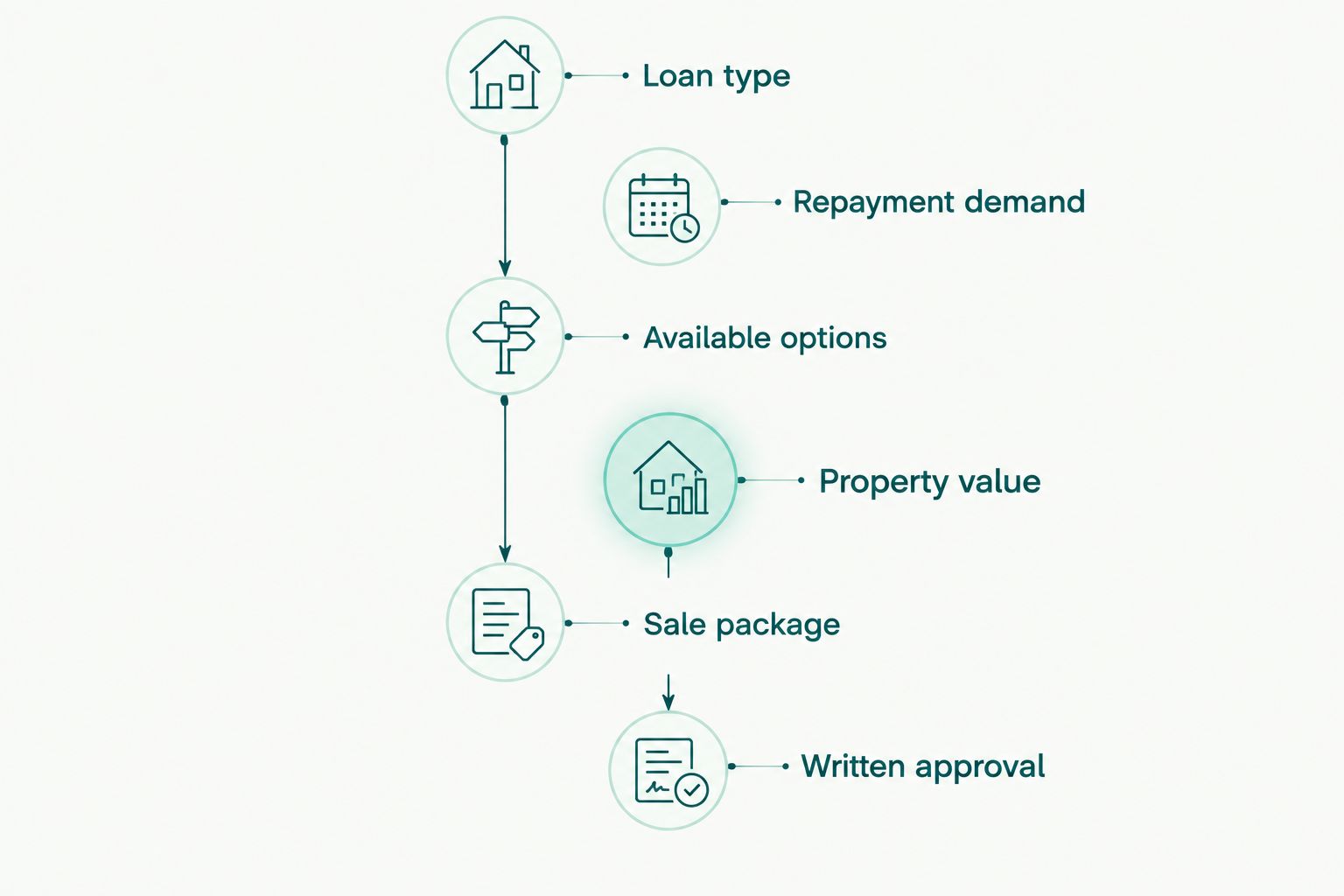
The process has distinct checkpoints. Establish the loan rules first, then build the sale file; submitting documents before understanding the repayment demand creates avoidable backtracking.
Compare your options before choosing a short sale
Best means the option that fits your goal and the loan’s rules, not the option with the most reassuring name. Use this comparison to structure the servicer conversation. Availability depends on your circumstances; lender terms and state law vary.
| Option | Best for | Main benefit | Key limitation |
|---|---|---|---|
| Keep the home and address the loan issue | Borrowers who want to stay and have an available remedy | Preserves occupancy without selling | Not every repayment trigger has a remedy that allows continued occupancy |
| Regular sale | Owners whose proceeds cover the payoff and required closing obligations | Avoids negotiating acceptance of a mortgage shortfall | The payoff and other obligations must be covered |
| Lender-approved short sale | Owners who need to sell when proceeds will not cover the balance | Creates an agreed sale process for resolving the mortgage | Requires applicable lender approval and coordinated closing terms |
| Deed in lieu | Owners considering transferring the property instead of marketing it | Offers an alternative to a buyer-based sale | Requires acceptance; title problems or other liens complicate the option |
| Foreclosure | Owners whose property proceeds through enforcement without another resolution | Does not require finding a buyer yourself | Timing, possession, and legal consequences depend on the case and state law |
HECM non-recourse protection does not make foreclosure consequence-free. Nor does a short sale guarantee a particular credit result. Ask how each option affects your move, remaining obligations, and estate before choosing.
Request help comparing your options
Ask about short-sale processing and lender negotiation for your reverse-mortgage situation.
Common mistakes reverse-mortgage homeowners make
Treating an underwater balance as a demand to sell
A HECM balance exceeding the property’s value does not, by itself, require an immediate sale. Check whether a repayment trigger exists. Selling simply because the balance grew skips the question that determines your next move.
Applying the heirs’ rule to every sale
The 95% appraisal provision is not a blanket instruction to accept any discounted offer. Ask the servicer which rule governs your specific sale and what valuation it will use. Obtain the answer before setting expectations with a buyer.
Moving out without checking occupancy rules
A permanent move changes the analysis, even when a relative remains in the home. Borrower status and eligible non-borrowing spouse protections matter. Confirm the effect of your planned move before treating continued family occupancy as sufficient.
Assuming the short-sale file stops foreclosure
Submission, review, and approval are different milestones. Keep responding to notices while the file is pending, and seek local legal help when enforcement deadlines exist. Only rely on a postponement that has actually been confirmed.
Assuming non-recourse means no other questions remain
A HECM’s protection does not answer every question about separate liens, estate administration, or taxes. Have qualified professionals review those issues independently. Do not treat a lender’s sale approval as a tax opinion.
FAQ
Can I do a short sale if I have a reverse mortgage?
A reverse-mortgage short sale is possible when the applicable lender requirements are met. Identify whether the loan is a HECM or proprietary reverse mortgage, then request written sale instructions from the servicer.
Do I have to sell if my reverse mortgage exceeds my home’s value?
A HECM balance exceeding the home’s value does not by itself require a sale. Borrowers must still meet occupancy, property-charge, and other loan obligations.
Can heirs sell a reverse-mortgage home for less than the balance?
Heirs handling an underwater HECM can sell the home for at least 95% of its appraised value to satisfy the loan, under the applicable HECM rules. Obtain the servicer’s valuation and sale instructions before accepting an offer.
Can my spouse stay after I die or move into care?
A spouse’s ability to remain depends on borrower status and applicable non-borrowing spouse protections. Ask the servicer to review the specific loan and occupancy circumstances before making a move or sale decision.
Does asking for a short sale stop a reverse-mortgage foreclosure?
A short-sale request does not itself stop foreclosure. Confirm any postponement in writing and ask a qualified local attorney about deadlines and available protections.
Will I owe the unpaid reverse-mortgage balance after selling?
HECM loans are non-recourse, but the sale must follow the applicable repayment and approval requirements. Proprietary reverse mortgages and separate liens require their own review; do not assume all obligations receive identical treatment.
Who should help me review a reverse-mortgage short sale?
Start with the servicer and a HUD-approved housing counselor, then involve a real estate agent for a sale. Use a qualified attorney for legal questions and a tax professional for tax consequences.
One last thing
The most useful document is the notice explaining why repayment is required—not the statement showing the largest balance. Put that notice beside the loan documents before making your 2026 plan. It tells your advisers which problem needs solving; the balance alone does not.


