

Jumbo loan homeowners’ short sale is a lender-approved sale for less than the mortgage payoff, with the aim of resolving an unaffordable, underwater home loan. This 2026 short sale jumbo loan guide explains how to compare your options, document your finances, and review the lender’s terms without assuming that a large mortgage follows a standard approval program.
- A short sale jumbo loan decision starts with your payoff, property value, and ability to keep the home.
- Shortsalesdoneright is best for homeowners seeking short-sale processing and lender negotiation support.
- A short sale does not automatically erase the unpaid mortgage balance or stop foreclosure.
- Compare loan modification, sale alternatives, and written lender terms before committing to an exit.
Why short sales matter for jumbo loan homeowners
A jumbo mortgage exceeds the applicable conforming loan limit when originated. That label describes the loan category, not your lender’s short-sale requirements. Your mortgage servicer must explain the review process that applies to your loan.
Your immediate question is whether you need to leave or need a sustainable payment. If keeping the home remains your goal, compare a short sale with a loan modification before listing it as a short sale.
For a 2026 decision, use a current payoff and current market evidence. Your original purchase price does not establish today’s value, and the mortgage balance on a monthly statement does not necessarily equal the amount needed to pay off the loan.
Being underwater identifies a shortfall. It does not establish short-sale eligibility. Your lender reviews the proposed transaction and your circumstances under its requirements.
How to approach a jumbo mortgage short sale
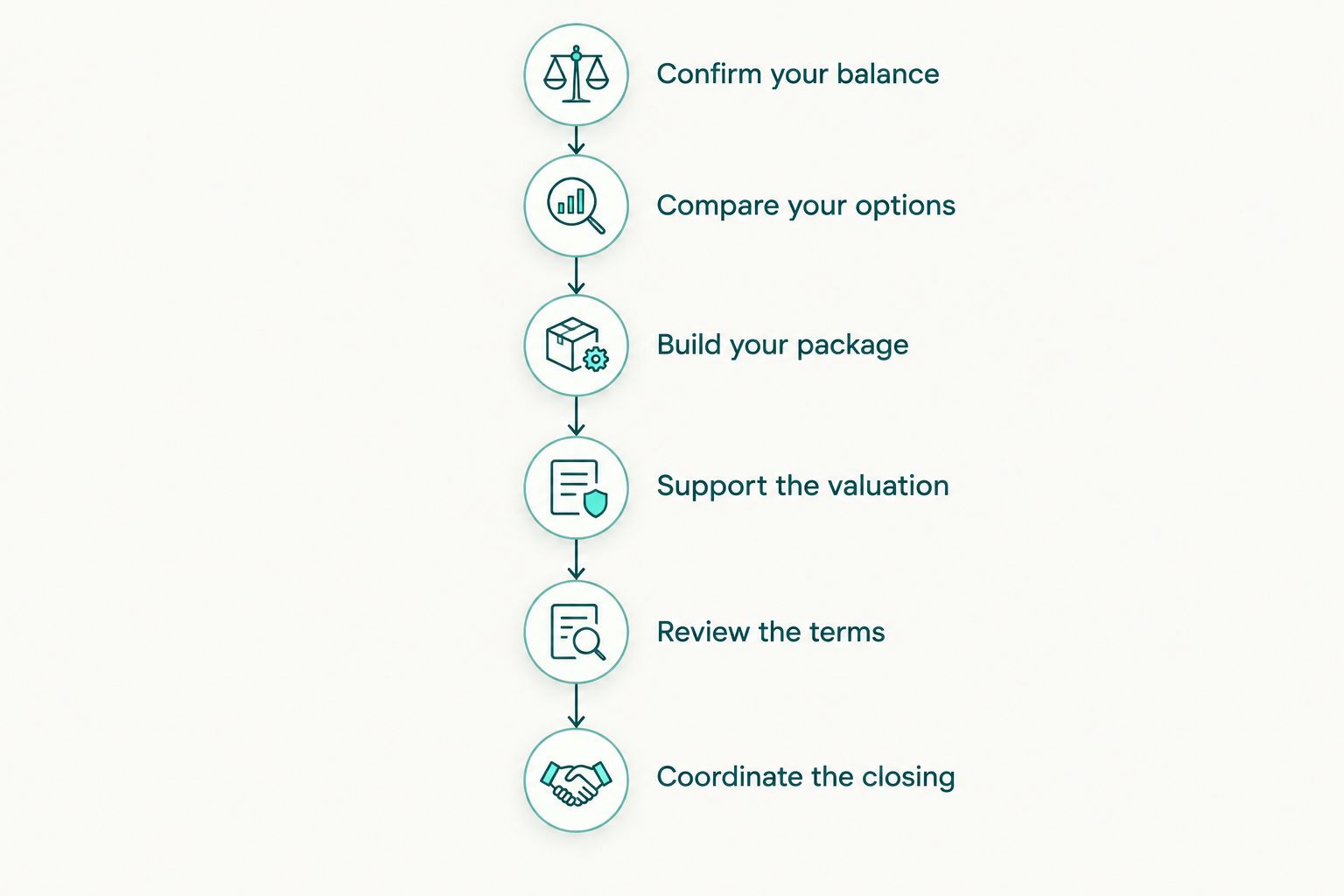
Confirm your balance
Start manually. Gather your mortgage statements, request a written payoff, and ask a local real estate agent for an evidence-based estimate of the property’s sale value. Keep the payoff’s expiration date visible.
Compare estimated net sale proceeds with the debts that must be addressed at closing. A second mortgage, home equity line of credit, unpaid property taxes, or other recorded claim needs attention even when the first mortgage is the largest obligation.
Do not treat online home estimates as a substitute for a property-specific review. Condition, comparable sales, and selling expenses belong in the discussion.
- Request a dated payoff from each mortgage servicer.
- Ask your agent for comparable sales and a proposed listing strategy.
- Have the title or closing professional identify recorded claims.
- Separate estimated selling expenses from mortgage debt.
- Record any foreclosure notice or scheduled sale date.
Compare your options
Call your servicer and ask which home-retention and sale options apply before choosing a short sale. Explain whether you want to keep the property, whether your income has changed, and whether the payment problem is temporary or ongoing.
A loan modification changes mortgage terms if approved. A short sale transfers the property to a buyer for proceeds that do not fully cover the payoff. A deed in lieu transfers ownership to the lender if accepted. These are different decisions, not interchangeable application forms.
Do not stop making payments simply to pursue a short sale. Ask the servicer about review requirements and get advice on the consequences of any payment decision.
- Ask about loan modification and other available retention options.
- Confirm whether a conventional sale can cover the required payoff.
- Ask whether the lender considers a short sale while payments are current.
- Discuss a deed in lieu if selling is not workable.
- Take foreclosure deadlines to a qualified attorney promptly.
Build your package
You can start by requesting the servicer’s checklist and collecting documents yourself. Create 3 folders: financial records, property records, and lender correspondence. Follow the actual checklist rather than assuming every jumbo lender wants the same documents.
A financial explanation should connect the hardship to your ability to maintain the mortgage. Describe what changed, when it changed, and how it affects your finances. Disclose requested income, assets, and obligations accurately.
For homeowners who want help coordinating that work, Shortsalesdoneright provides short-sale processing and lender negotiation services. A dedicated point of contact and weekly lender updates support communication; the lender still controls approval. Your agent can also receive help preparing the full short-sale package.
- Obtain the lender’s current application and document checklist.
- Collect requested income records, statements, and tax documents.
- Write a factual hardship explanation with relevant dates.
- Complete any required authorization for your representative.
- Keep copies of submitted documents and delivery confirmations.
Support the valuation
Your asking price and the lender’s acceptable sale proceeds are not automatically the same. Work with your agent to support the proposed price with comparable sales, property condition, and documented buyer feedback.
If the lender requests an appraisal or broker price opinion, coordinate access promptly. Disclose known issues accurately. Do not exaggerate defects or manufacture repair estimates to justify a lower offer.
For a 2026 listing, ask your agent to refresh market evidence when negotiations continue and conditions change. A stale pricing argument does not explain a current offer.
- Gather relevant closed sales and competing listings with your agent.
- Document condition issues with photographs and available reports.
- Provide genuine repair estimates when relevant and requested.
- Make the property accessible for required valuation appointments.
- Track offers, buyer feedback, and lender requests together.
Review the terms
Approval to sell is not automatically forgiveness of the remaining debt. A release of the mortgage lien and a release of personal responsibility for an unpaid balance are separate issues. Have a qualified attorney explain the proposed agreement.
Separate 2 questions in your notes: can the property transfer, and what obligations remain afterward? Ask about any requested contribution, repayment agreement, or conditions attached to approval before accepting them.
Lender terms and state law vary. A qualified tax professional should review potential tax consequences using the rules applicable to your 2026 transaction and your circumstances. Do not assume debt cancellation is tax-free.
- Obtain the lender’s approval and conditions in writing.
- Ask your attorney to explain any remaining debt obligation.
- Identify required contributions or separate repayment terms.
- Confirm how other lienholders will be addressed.
- Ask a tax professional about reporting and potential exclusions.
- Check the approval expiration date and closing conditions.
Coordinate the closing
Keep 1 dated communication log covering lender requests, submissions, decisions, and deadlines. Ask who owns each open task so your agent, processor, attorney, and closing professional do not rely on different versions of the file.
A pending short sale does not automatically pause foreclosure. Confirm the status of any foreclosure action separately, and obtain any postponement confirmation in writing. If an approval or closing deadline becomes unrealistic, raise the issue before it expires.
Use the following sequence as your 2026 working checklist. It organizes the file; it does not guarantee that the lender will approve the sale.
- Confirm that the buyer’s contract matches approved terms.
- Check that required lienholder approvals remain valid.
- Resolve closing-document questions before signing.
- Confirm any necessary deadline extension in writing.
- Agree on possession and moving arrangements in the contract.
- Retain the final settlement statement and lender correspondence.
Compare your options before committing
Choose the path that matches your housing goal and financial position, not just the mortgage size. Start by asking whether you can keep the home sustainably and whether a sale can cover the required payoff.
The table separates the main choices and the ways to coordinate a short sale. None guarantees approval, debt forgiveness, or a particular credit outcome.
| Option | Best for | Main benefit | Key limitation |
|---|---|---|---|
| Conventional sale | Homeowners whose sale proceeds can cover required payoffs and closing expenses | Avoids requesting approval for a mortgage shortfall | Does not solve a gap between proceeds and required payoffs |
| Loan modification | Homeowners who want to stay and need changed mortgage terms | Addresses the existing loan without selling | Requires lender review and a workable payment arrangement |
| Self-coordinated short sale | Homeowners working with an agent who can manage lender communication and documents | Keeps coordination directly with the homeowner and agent | Requires ongoing tracking, follow-up, and document updates |
| Shortsalesdoneright short-sale processing | Homeowners and agents seeking processing and lender negotiation support | Provides a dedicated contact and weekly lender updates | Does not replace legal or tax advice or guarantee lender approval |
| Deed in lieu | Homeowners seeking an ownership transfer to the lender rather than a buyer | Offers a different exit for lender consideration | Requires lender acceptance and review of title and remaining obligations |
If you are undecided, request the applicable requirements for more than one option. Comparing written requirements is more useful than choosing based on a promised outcome.
Request help with your short sale
Use the homeowner intake form to explain your mortgage situation and request help comparing your options.
Common mistakes jumbo loan homeowners make
Treating the jumbo label as an approval rule
A large mortgage balance does not establish a separate right to a short sale. Ask your servicer which requirements apply to your specific loan, including financial disclosures and offer submission.
Assuming an underwater home proves hardship
Property value and payment affordability answer different questions. Explain both your estimated shortfall and the circumstances affecting your ability to keep paying. Do not substitute a market-loss explanation for requested financial records.
Leaving the home equity line out of the plan
A first-mortgage approval does not resolve a separate home equity lien. Include every known mortgage and recorded claim in the opening discussion, then have the closing professional confirm what must be addressed.
Signing without understanding the unpaid balance
Do not interpret permission to close as a promise that nothing remains owed. Have an attorney review the exact release language and any separate repayment document before you sign.
Treating lender review as foreclosure protection
A submitted package is not a written postponement. Track foreclosure notices independently and ask a qualified attorney about deadlines. Processing support is not a substitute for legal advice about a scheduled sale.
FAQ
Can I do a short sale on a jumbo loan?
Yes, a jumbo loan can be considered for a short sale if the lender agrees to the transaction. Ask your servicer for the requirements that apply to your mortgage; being underwater alone does not establish eligibility.
Do I have to miss payments before requesting a jumbo loan short sale?
Do not assume you must miss payments to request a short-sale review. Ask your servicer whether it considers borrowers who are current, and get advice before changing your payment behavior.
Does a jumbo mortgage short sale erase the unpaid balance?
A jumbo mortgage short sale does not automatically erase the unpaid balance. The written agreement and applicable state law determine remaining obligations, so have a qualified attorney review the terms.
Is a loan modification better than a short sale for a jumbo mortgage?
A loan modification fits a goal of keeping the home; a short sale fits a goal of selling when proceeds will not cover the payoff. Compare eligibility, payment sustainability, and written terms before choosing.
Can I short sell a jumbo mortgage if I also have a HELOC?
A short sale with a HELOC requires attention to both mortgage obligations and the liens affecting the property. Have your agent and closing professional identify the approvals and releases needed for the proposed sale.
Will applying for a short sale stop my foreclosure?
Applying for a short sale does not automatically stop foreclosure. Confirm the foreclosure status separately and obtain written confirmation of any postponement; consult an attorney promptly about deadlines.
How can Shortsalesdoneright help a jumbo loan homeowner?
Shortsalesdoneright provides short-sale processing and lender negotiation services and helps homeowners compare a short sale with other options. Support includes a dedicated point of contact and weekly lender updates, without a promise of approval, debt forgiveness, or a specific credit result.
One last thing
The most important document is not always the approval letter alone. Any attached conditions or separate repayment agreement can change what the transaction means for you. Before signing, ask your attorney to explain what lets the property transfer and what, if anything, remains your responsibility afterward.