

Self-employed homeowners’ short sales are lender-approved home sales for less than the mortgage payoff, aimed at resolving an unaffordable, underwater mortgage through a sale. This 2026 guide explains how to document uneven business income, compare alternatives, and prepare for lender review without confusing business revenue with money available for your mortgage.
- Short sale self employed checklist: explain your hardship, reconcile business income, and obtain written lender terms.
- Shortsalesdoneright provides short-sale processing and lender negotiation for homeowners who need help managing the lender review.
- Business revenue is not take-home income; document expenses, transfers, and owner withdrawals separately.
- A short sale does not automatically cancel an unpaid balance; lender terms and state law vary.
Why short sales matter for self-employed homeowners
A self-employed homeowner’s financial picture rarely fits neatly into a paycheck. Your business can receive customer payments while expenses leave little available for housing. A prior tax return can also describe a stronger business than the one you operate now.
Your package needs to explain both the mortgage shortfall and your current ability to pay. Being self-employed is not, by itself, a hardship or a reason for approval. Connect the change in your finances to the payment you can no longer sustain.
Shortsalesdoneright is a fit for homeowners seeking short-sale processing and lender negotiation rather than handling lender follow-up alone. You can request homeowner help through the appropriate intake form on Shortsalesdoneright.
For your 2026 decision, separate the housing problem from the business problem. Selling the home does not resolve business debts, and keeping the business open does not establish that the mortgage is affordable. Evaluate each obligation on its own terms.
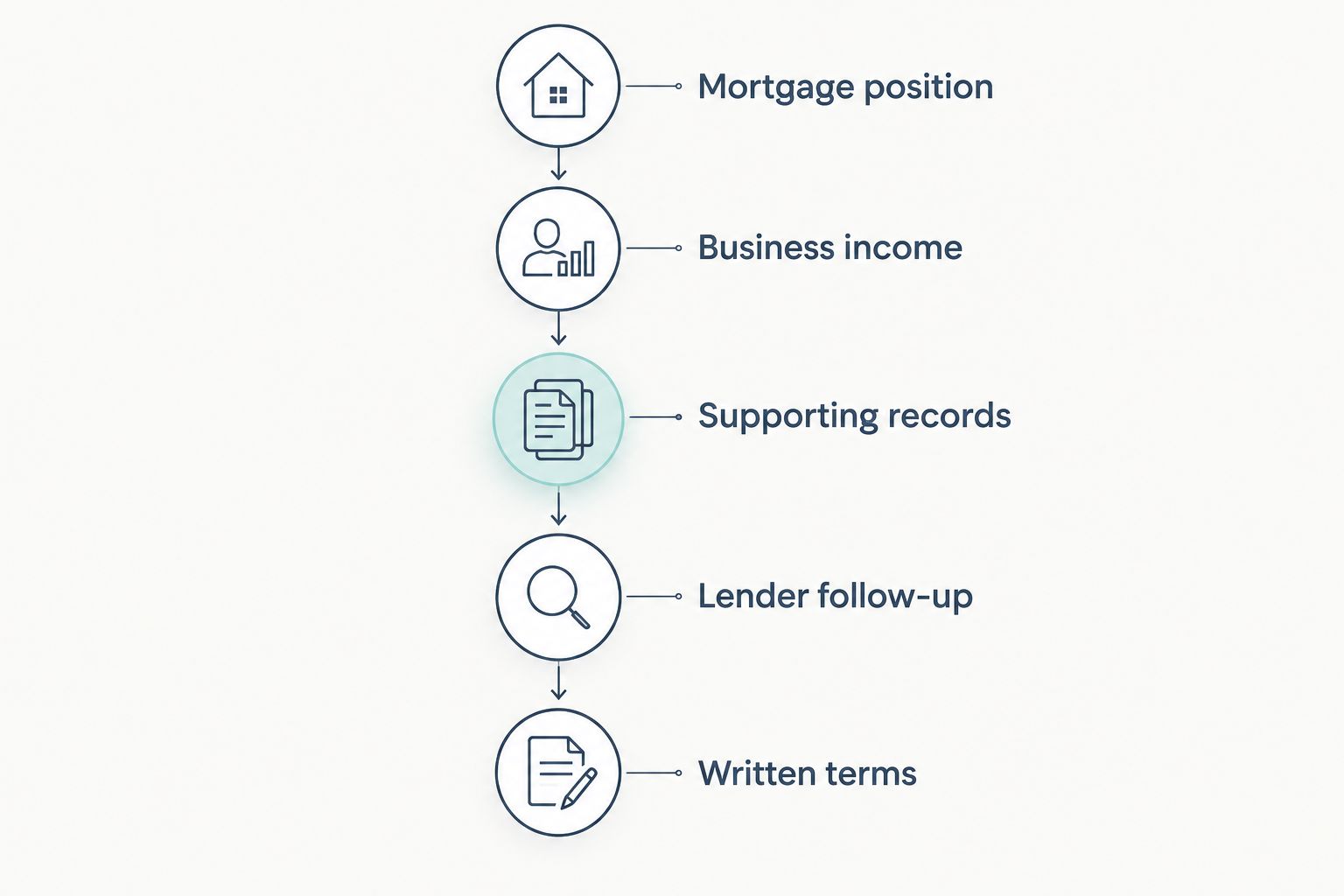
Prepare your short-sale decision and lender package
Establish your mortgage position
Start with your own records. Gather your mortgage statements, identify other loans secured by the property, and ask your servicer what its short-sale review requires. Have a real estate agent assess the property’s likely selling range using current comparable sales.
An online estimate is not a lender decision. The relevant question is whether the expected sale proceeds, after transaction expenses, will cover the obligations that must be addressed to close.
Keep foreclosure notices separate from ordinary account mail. Submitting a short-sale request is not confirmation that a foreclosure action has stopped. Ask about deadlines directly, and take legal notices to a qualified attorney.
- Record the servicer and account reference for each mortgage.
- Identify second mortgages and other known property liens.
- Ask your agent for a supported estimate of sale proceeds.
- Keep 1 dated checklist of requests, submissions, and deadlines.
Separate business income from household cash
Build a clear financial summary before sending a pile of statements. Use a spreadsheet or your existing bookkeeping records to show business receipts, operating expenses, and money transferred to your household. Then prepare a separate household budget.
Create 2 separate summaries: business operations and household finances. This prevents the same money from appearing twice. A transfer between accounts is not another customer payment, and an owner withdrawal does not explain how much profit the business earned.
For a 2026 submission, explain the period each document covers. If your tax return and current profit-and-loss statement show different conditions, describe the business change rather than leaving the lender to reconcile it unaided. Ask your accountant to resolve bookkeeping errors before submission.
- Distinguish customer receipts from transfers and borrowed funds.
- Separate business expenses from personal spending.
- Identify owner withdrawals and household contributions.
- Explain seasonal swings, unpaid invoices, and unusual deposits.
Assemble the requested supporting records
Ask your servicer for its current document list and submission instructions. Build folders around that list, not around a generic checklist found online. Requirements depend on the lender, loan, and circumstances.
Self-employed borrowers should be ready to explain current income as well as historical tax reporting. Records such as tax returns, business statements, bank statements, and hardship evidence can help tell that story when requested. Do not assume every document is mandatory or that sending more pages makes a stronger package.
Shortsalesdoneright’s short-sale processing and lender negotiation services provide a supported path for handling the submission and lender communication. That support does not replace your responsibility to supply accurate records or the lender’s authority to decide.
- Confirm which business and personal records the servicer requests.
- Match statement periods to the financial summaries you submit.
- Keep copies of every completed form and attachment.
- Ask how to submit sensitive information securely.
Write a hardship explanation tied to evidence
Describe what changed, when it changed, and how it affected your mortgage payment. A lost contract, reduced workload, or business closure needs an explanation grounded in your actual circumstances. Do not add a hardship simply because it sounds persuasive.
Use plain language. Explain why current revenue does not translate into enough household income, and identify whether the problem is temporary or continuing. Make sure the explanation agrees with your bank statements and financial summaries.
A strong letter is specific without becoming a business autobiography. The guide to writing a short-sale hardship letter provides a useful next step once your records are organized.
- State the business or household change that caused the hardship.
- Connect the change to your available mortgage-payment funds.
- Explain unusual figures that otherwise look inconsistent.
- Describe the resolution you are asking the lender to consider.
Coordinate the offer and lender follow-up
Your agent handles the sale-side work, including pricing and offers. The lender separately reviews whether to accept the proposed short-sale terms. A buyer’s signed contract is not the same as lender approval.
Agree on who submits documents and who answers lender requests. Without that assignment, your agent, processor, and household can send conflicting versions or assume someone else responded. Maintain a single record of the latest package and outstanding questions.
If you seek processing help, ask about the homeowner communication process and how it connects with your agent’s work. Shortsalesdoneright’s agent service includes full package preparation, a dedicated point of contact, and weekly lender updates; clarify how those arrangements apply to your transaction.
- Assign responsibility for submission, follow-up, and seller responses.
- Record the date and substance of lender communications.
- Replace outdated records when the lender requests updates.
- Keep buyer-contract deadlines distinct from lender-review milestones.
Review the written terms before accepting
Read the approval terms before treating the transaction as resolved. Check the approved sale conditions, closing deadline, any requested contribution, and the treatment of the remaining loan balance. Ask for clarification in writing when the language is unclear.
Use 3 questions to guide the review: What must happen to close? What obligation remains afterward? Who must explain the legal and tax consequences? A sale approval and a release of the mortgage lien do not, by themselves, answer every debt question.
Lender terms and state law vary. Have a qualified attorney review questions about remaining debt and legal rights. Ask a qualified tax professional about cancellation-of-debt reporting and any rules applicable to your situation in 2026.
- Read the approval letter and proposed closing documents together.
- Identify conditions, deadlines, and required signatures.
- Obtain professional advice about any remaining balance.
- Confirm how later business-income changes must be reported.
The process has distinct decision points. Financial preparation supports review; it does not guarantee the lender will approve the sale or accept the terms you request.
Compare your options before choosing a short sale
Choose based on whether you want to keep the home and whether the payment is sustainable. A temporary gap in customer payments calls for a different discussion from a lasting decline in business income. Ask the servicer which options it will review for your loan.
The table separates the purpose of each route from its limitation. These are decision categories, not promises of eligibility or approval.
| Option | Best for | Main benefit | Key limitation |
|---|---|---|---|
| Repayment plan or forbearance | Homeowners addressing a temporary payment disruption | Provides a route to discuss short-term payment relief | Does not automatically resolve a lasting affordability problem; repayment terms require review |
| Loan modification | Homeowners seeking to keep the property | Changes loan terms if approved | Approval and an affordable resulting payment are not guaranteed |
| Short sale | Homeowners seeking to sell when proceeds will not cover the mortgage payoff | Allows a sale subject to lender agreement | Requires review of sale terms and any remaining debt |
| Deed in lieu | Homeowners exploring a transfer of ownership to the lender | Offers a route to discuss surrendering the property without a buyer sale | Lender acceptance, other liens, and remaining-debt terms require review |
| Foreclosure process | Homeowners needing to understand an existing legal process, not a preferred recommendation | Understanding the process helps identify deadlines and response options | State procedures and legal consequences require qualified advice |
Prepare your own records first; that keeps you informed whichever route you choose. Processing support adds help with lender communication, but it does not replace an attorney, tax adviser, or the lender’s decision.
Request help with your short sale
Ask about homeowner short-sale processing and lender negotiation support.
Common mistakes self-employed homeowners make
Treating gross revenue as mortgage-payment money
Customer receipts do not show what remains after business expenses. Submit a reconciled explanation of business income and household funds rather than asking the lender to infer your position from deposits alone.
Assuming a tax return explains current hardship
Historical tax records and current business performance answer different questions. Explain the gap when a major customer loss or business change makes the earlier return a poor description of current income.
Moving money without documenting the purpose
Transfers, owner contributions, and borrowed funds can make an account look stronger than operating income supports. Keep a clear record of where funds came from and what they represent. Do not rearrange transactions to create a misleading picture.
Assuming sale approval settles every obligation
Permission to complete a short sale is not an automatic promise to forgive an unpaid balance. Review the actual written terms, and keep following legal deadlines unless the appropriate party confirms a change.
FAQ
Can I get a short sale if I am self-employed?
Self-employment does not automatically prevent a short-sale review. Your lender evaluates the request under its requirements, including the financial information and proposed sale terms you submit.
What income documents should a self-employed homeowner prepare?
Prepare the business and personal records your servicer requests. These can include tax returns, current profit-and-loss information, bank statements, and explanations of transfers or unusual deposits; confirm the required periods before submitting.
Can I request a short sale while my business is still operating?
You can ask your servicer to review a short sale while your business continues operating. Explain why the income available to your household does not support the mortgage; an operating business alone does not establish either eligibility or ineligibility.
Should I stop paying my mortgage to qualify for a short sale?
Do not stop making payments simply to try to qualify for a short sale. Ask your servicer about its review criteria and discuss the consequences of missed payments with a qualified adviser before making that decision.
Does a short sale erase the remaining mortgage balance?
A short sale does not automatically erase the remaining mortgage balance. The written lender agreement and applicable state law determine the relevant obligations; ask a qualified attorney to review the terms.
Does submitting a short-sale package stop foreclosure?
Do not assume that submitting a short-sale package stops foreclosure. Confirm the status with the servicer and obtain legal advice about notices, deadlines, and available responses.
Who can help me organize a self-employed short-sale request?
Shortsalesdoneright provides short-sale processing and lender negotiation services for homeowners and real estate agents. An accountant can help reconcile business records, while qualified legal and tax professionals should answer questions in their respective fields.
What tax questions should I ask before a short sale in 2026?
Ask a qualified tax professional how a proposed short sale and any cancellation of debt would affect your specific 2026 tax position. Provide the loan information, proposed lender terms, and relevant business and personal records rather than assuming a general exclusion applies.
One last thing
A profitable business and a household short of cash can exist at the same time. Unpaid customer invoices and money tied up in operations help explain that difference, but the lender needs records rather than a general assurance.
Before submitting, trace the path from business receipts to household funds. Then check that your hardship explanation tells the same story. Consistency makes the package easier to understand; it is not a guarantee of approval.


