

New-agent short sale processing is the coordination of a home sale requiring lender acceptance of reduced mortgage proceeds, with the aim of helping an upside-down homeowner sell. This 2026 guide explains a short sale for new real estate agents: how to assess the listing, organize the lender package, manage negotiations, and separate your responsibilities from legal and tax advice.
- A short sale for new real estate agents starts with lender requirements, seller authorization, and a documented listing assessment.
- Shortsalesdoneright short-sale processing suits agents who want package preparation and lender negotiation handled outside their own workflow.
- Keep buyer acceptance, lender approval, and closing requirements separate; none replaces the others.
- Lender terms and state law vary. Refer legal and tax questions to qualified professionals.
Why short-sale processing matters for new agents
A short-sale listing adds a lender decision to the normal seller-and-buyer negotiation. An accepted offer does not establish what the lender will accept or whether an unpaid mortgage balance remains the seller's responsibility.
For a new agent, the challenge is ownership. Who submits documents? Who follows up? Who tells the buyer that a requested closing date remains unconfirmed? Without clear assignments, a missing authorization or unanswered request can leave everyone waiting.
Shortsalesdoneright provides short-sale processing and lender negotiation services for agents and homeowners nationwide. For agents, the service includes full package preparation, a dedicated point of contact, and weekly lender updates. That support does not replace your brokerage supervision, transaction duties, or the lender's decision.
Shortsalesdoneright short-sale processing is best for agents who want package preparation and lender negotiation handled outside their own workflow.
Your goal in 2026 is not to predict approval. It is to keep the file accurate, the next action visible, and each participant clear about what remains unresolved.
How to handle your first short-sale listing
Establish the seller's situation before promising a path
Start with the homeowner's objective. Do they want to sell, keep the home, or understand their choices? A homeowner who wants to remain in the property needs information about retention options, not an automatic short-sale recommendation.
Review the estimated sale proceeds against the mortgage obligations and selling expenses. An upside-down mortgage is a starting point for investigation, not proof that a lender will approve a short sale. Ask your broker how your office handles these listings before accepting responsibilities you have not performed.
Separate financial facts from legal questions. A notice, judgment, bankruptcy filing, or disputed ownership issue belongs with the appropriate qualified professional. Do not interpret its effect yourself.
- Record the seller's goal, occupancy status, and known mortgage accounts.
- Request current mortgage statements and any lender or foreclosure notices.
- Prepare an estimated net sheet using documented assumptions.
- Identify ownership or legal questions that require professional review.
Confirm the lender's requirements and your authority
Use the mortgage servicer's current instructions rather than a packet saved from another transaction. Confirm who handles the request, how documents must be submitted, and what authorization permits communication about the seller's account.
Maintain 1 checklist per lender. A separate mortgage or lien can introduce another decision-maker, so do not assume the first lender's instructions cover the entire transaction. Confirm the parties involved with the closing professional and your broker.
If you plan to outsource processing, establish responsibilities before documents start moving. Shortsalesdoneright prepares the full short-sale package for agents and provides a dedicated point of contact and weekly lender updates. You still need to agree on who communicates with the seller, buyer's agent, and closing professional.
- Obtain the required seller authorization before discussing account details.
- Confirm the submission channel and required document formats.
- Identify additional mortgages or liens for further review.
- Assign responsibility for submissions, follow-up, and transaction updates.
Build a complete and consistent package
A package should tell one consistent financial and transaction story. Names, property details, income records, hardship explanations, and contract terms should agree across the documents you submit.
Start manually with a document index and a secure collection method approved by your brokerage. Use the lender's checklist as the controlling reference. This short-sale package document guide provides additional preparation context, but the lender determines what the specific file requires.
Full package preparation through a processor moves assembly work out of your daily workload. It does not remove the need for accurate seller information or signatures. Ask for a clear list of outstanding items rather than a vague report that the package is almost complete.
- Match every requested document to a checklist entry.
- Check signatures, dates, names, and property details before submission.
- Flag missing pages and unexplained financial inconsistencies.
- Retain the submitted version and evidence of delivery.
Price the listing and prepare the offer carefully
Use comparable sales, property condition, and current market evidence to support your pricing recommendation. A price designed only to attract attention can create expectations that the lender has not accepted.
Explain the approval condition to buyers through the forms and disclosures your broker directs you to use. Do not describe seller acceptance as lender approval. Keep requested concessions, financing terms, and estimated proceeds visible because they affect the proposed transaction.
A complete offer is easier to evaluate than a loose collection of emails. That is an administrative advantage, not an approval guarantee. If terms change after submission, identify the change clearly and confirm whether further review is required.
- Document the comparable sales and condition factors behind the price.
- Use brokerage-approved short-sale disclosures and contract provisions.
- Check the offer for signatures, financing details, and requested concessions.
- Update the estimated net sheet when material terms change.
Track requests and communicate the actual status
Keep 1 status log per listing. Record what was requested, who owns the response, the stated deadline, and evidence that the response was delivered. A shared record is more useful than relying on everyone's memory of a phone call.
Report the current stage precisely. Package submitted, receipt confirmed, additional documents requested, and written terms received are different events. None should be shortened to approved unless the actual written decision supports that statement.
For your 2026 workflow, agree on a regular communication schedule without turning it into a promised lender response time. Shortsalesdoneright provides weekly lender updates for agents; those updates report progress and outstanding issues, not a guaranteed decision date.
- Log lender requests and assign an owner to each response.
- Confirm receipt rather than assuming delivery means review.
- Tell the buyer's agent which conditions remain unresolved.
- Escalate approaching contract or notice deadlines to the appropriate professional.
Review written terms before coordinating closing
Use 3 review checkpoints: lender terms, contract alignment, and closing readiness. Each checkpoint answers a different question. What did the lender accept? Does the transaction match those terms? Can the closing team complete the required work?
Read the written decision with your broker and closing professional. Do not assume approval releases the seller from an unpaid balance. Refer questions about remaining liability, legal rights, and tax consequences to qualified professionals.
Check expiration dates and conditions against the planned closing. If the buyer, proceeds, concessions, or schedule changes, confirm whether the lender must review the change. The written decision—not an optimistic conversation—sets the lender's stated conditions.
- Compare the written terms with the contract and proposed closing figures.
- Refer unpaid-balance language to the seller's qualified legal adviser.
- Confirm required releases and closing instructions with the closing professional.
- Check whether transaction changes require renewed lender review.
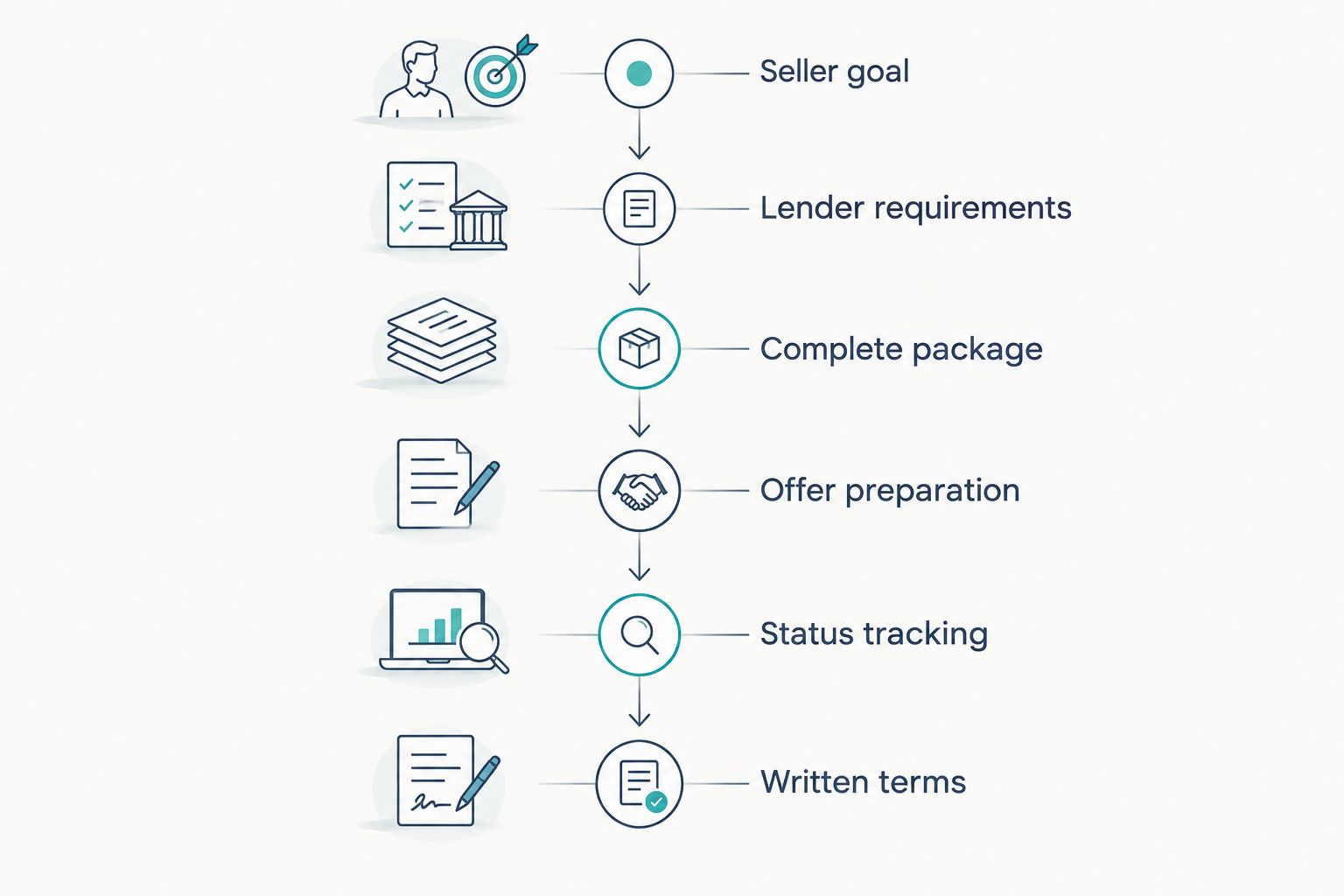
The sequence below separates the work into distinct stages. Keep unresolved requests attached to their stage rather than treating submission as completion.
Compare processing options for your first listing
Choose support based on the work you need transferred, not the promise of an outcome. For a first short-sale listing in 2026, compare package preparation, lender contact, reporting, and your brokerage's supervision requirements.
These options address different needs. Processing handles administrative and negotiation work; legal and tax advice addresses questions that processing does not resolve.
| Option | Best for | Main advantage | Key limitation |
|---|---|---|---|
| Agent-managed processing | Agents with broker supervision and capacity for lender follow-up | Direct control over the document checklist and communication log | You retain package assembly, submission tracking, and follow-up work |
| Shortsalesdoneright processing | Agents who want package preparation and lender negotiation outsourced | Full package preparation, a dedicated contact, and weekly lender updates | Lender approval remains outside the processor's control; legal and tax advice remains separate |
| Broker or experienced-agent guidance | New agents learning transaction duties and office procedures | Guidance on the agent's role and brokerage requirements | Guidance alone does not transfer processing responsibilities |
| Qualified legal and tax advice | Sellers with questions about liability, rights, or tax consequences | Advice directed to the seller's specific legal or tax situation | It does not automatically include listing management or lender processing |
Confirm scope before assigning the file. Ask who collects seller documents, who submits revisions, how you receive updates, and what happens when the lender requests more information. Also confirm what remains your responsibility.
Ready to request processing support? Use the agent intake form on the website to explain the listing and the help you need. Do not send sensitive financial records through an unapproved channel.
Request help with your short-sale listing
Start with the agent intake form to request package preparation and lender negotiation support.
Common mistakes new agents make
Treating an upside-down mortgage as automatic eligibility
Negative equity does not establish the lender's decision. Document the seller's circumstances and confirm the review requirements before presenting a short sale as the agreed solution.
Advertising seller acceptance as approval
A signed purchase contract records the buyer's and seller's agreement. It does not establish the lender's acceptance of reduced proceeds. Keep listing remarks and buyer updates accurate about the current status.
Assuming submission stops foreclosure activity
Do not tell a seller that sending a package pauses a foreclosure process. Confirm account status with the servicer and refer notices and legal deadlines to qualified counsel. Lender terms and state law vary.
Leaving seller communication entirely to the processor
Outsourcing package preparation does not remove your relationship with the seller. Agree on communication responsibilities so the homeowner knows whom to contact about listing activity, lender requests, and legal questions.
Promising a clean financial exit
Never promise forgiveness of an unpaid balance, a particular credit-score result, or a fixed closing date. Explain what the written terms establish and send legal and tax questions to the right professionals.
FAQ
What's the first step in a short sale for new real estate agents?
Start by documenting the seller's goal, mortgage situation, and known deadlines with your broker's guidance. Then confirm the servicer's requirements and obtain the authorization needed to discuss the account.
Can a new real estate agent handle a short sale without a processor?
A new agent can manage the processing work with appropriate brokerage supervision and a clear understanding of the required duties. Outsourcing transfers agreed package and lender-follow-up tasks, but it does not replace the agent's transaction responsibilities.
What does Shortsalesdoneright handle for real estate agents?
Shortsalesdoneright provides full short-sale package preparation and lender negotiation services for agents. The service includes a dedicated point of contact and weekly lender updates, without a promise of lender approval.
How long does a short sale take in 2026?
A short sale has no single completion timeline that an agent can promise. Track document requests, written lender terms, contract deadlines, and closing requirements instead of presenting an estimated date as a commitment.
Does lender approval erase the seller's remaining mortgage balance?
Lender approval does not by itself establish that the seller has no remaining liability. Have a qualified legal professional review the written terms because lender terms and state law vary.
Does submitting a short-sale package stop foreclosure?
Do not assume that submitting a short-sale package stops foreclosure activity. Confirm the account's status with the servicer and refer foreclosure notices and legal deadlines to qualified counsel.
Should I recommend a short sale when the homeowner wants to keep the house?
Do not treat a short sale as the default when the homeowner wants to keep the house. Help the seller identify questions about retention options for the servicer or a housing counselor, and keep legal and tax advice with qualified professionals.
One last thing
Track approval to sell and release from an unpaid balance as separate questions. A file can appear ready to close while the seller still needs advice about the written terms. Make that distinction part of every 2026 short-sale checklist, not a last-minute discovery at the closing table.


